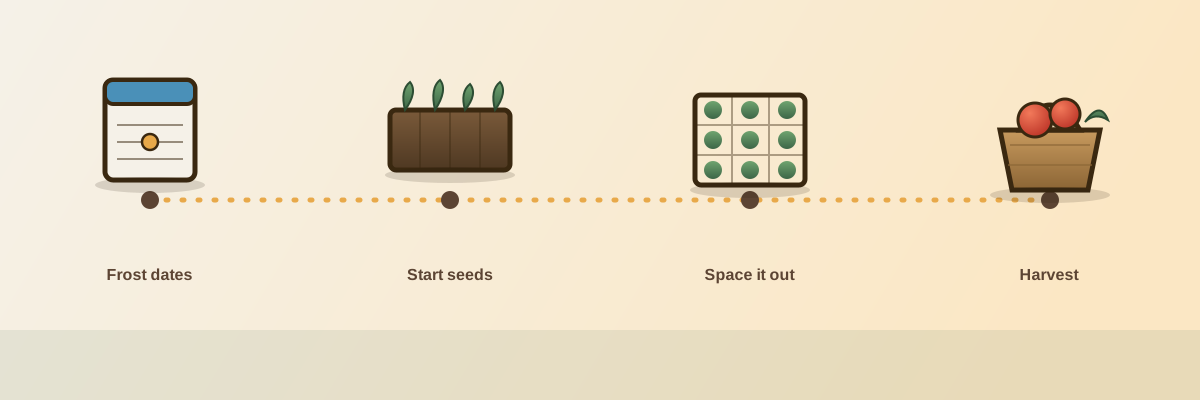
Planning a vegetable garden really means answering one question in four stages: when do I start, when do I plant, how far apart, and what will I get? These four calculators aren’t independent tools you pick from — they’re sequential stages, each one feeding the next. Your frost date sets your seed-starting calendar. Your seed-starting calendar tells you when to transplant. Your spacing decision at transplant time determines how many plants fit in your bed. And that plant count, combined with per-plant yield data, tells you what the whole bed will actually produce.
Skip a stage or work them out of order and the numbers stop lining up — spacing math is meaningless without knowing how many transplants you’ll have ready, and a yield estimate is only as good as the plant count that feeds it. Worked in sequence, though, these four calculators take a garden from “I want to grow vegetables this year” to an actual bed plan with real dates and real numbers attached.
One more tool rounds out this cluster without being part of that sequence: the Growing Degree Days Calculator. Where the four-stage pipeline above plans a season around calendar dates, growing degree days track accumulated heat instead — useful once the season’s underway, for timing pest scouting or a crabgrass pre-emergent application against a real published threshold rather than a guess from the date on the wall.
Frost Date, Spacing & Yield Calculators
Start With the Beginner's Guide
Stage 1: When Do You Start?
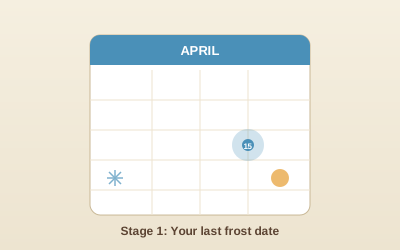
Everything in this cluster traces back to one date: your local average last spring frost. Cold-tender crops (tomatoes, peppers, cucumbers) can’t go outside until after it; cold-hardy crops (broccoli, cabbage, lettuce) can go out a few weeks before it. That single date is the anchor the next three stages all build from — get it wrong and every downstream date shifts with it.
Stage 2: When Do You Plant?
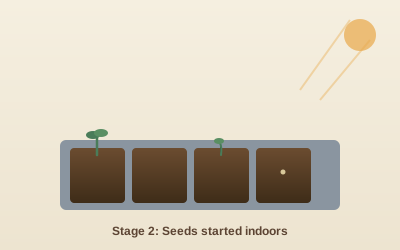
This stage builds directly on Stage 1’s output. Most warm-season crops start indoors 6–8 weeks before that last frost date (peppers and eggplant want 8–10 weeks, since they’re slower to size up), then transplant out 1–2 weeks after the frost date once the soil has warmed. Cold-hardy crops like broccoli and cabbage flip that timing — started indoors 6–8 weeks before frost, but transplanted 2–4 weeks before it while they can still handle a cold snap. Root crops and beans skip the indoor stage entirely and get direct-sown, since they don’t transplant well.
Stage 3: How Far Apart?
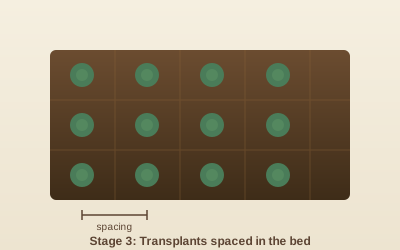
Once your transplants (or direct-sown seedlings) are ready, spacing determines how many actually fit in your bed — and the method you use changes that number a lot. Row spacing leaves room to walk between rows: broccoli at 18 in in-row × 24 in between rows works out to 3 sq ft per plant. Square-foot gardening skips the walking rows and packs plants at their minimum spacing in a grid instead — the same broccoli fits at 1 sq ft per plant, three times denser than the row method for an identical plant.
Neither method is universally “better” — row spacing suits larger plots where you need equipment or hand-tool access between rows, while square-foot gardening suits raised beds where every square foot is reachable from a path. What matters is picking one and applying it consistently, since mixing the two within a bed makes the plant count math unreliable.
Spacing math alone doesn’t guarantee a productive bed — tight spacing in nutrient-poor soil underperforms no matter how correct the plant count is. Not sure you’ve got enough depth and volume of good soil for the bed you’re planning? Our Raised Bed Soil Calculator (from the Soil & Amendments cluster) figures out exactly how much topsoil-compost blend to fill it with, so the plants your spacing plan packs in actually have the soil to back them up. For exact spacing on one specific crop — tomato, pepper, carrot, and a dozen others — see our plant spacing guides by crop.
Stage 4: What Will You Get?
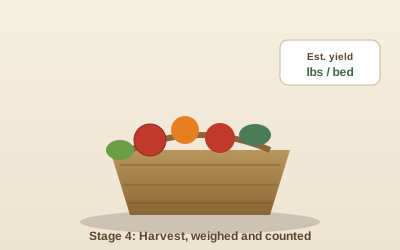
This is where Stage 3’s spacing decision closes the loop into an actual harvest estimate. Broccoli yields about 0.8 lb per plant regardless of spacing method — but at 1 sq ft per plant (square-foot method) that’s roughly 0.8 lb per sq ft of bed space, while at 3 sq ft per plant (row method) the same plant only delivers about 0.27 lb per sq ft. Same crop, same per-plant yield, nearly 3× the yield per square foot just from the spacing method chosen back in Stage 3.
That’s the full loop: your frost date set your seed-starting calendar, your seed-starting calendar told you when to transplant, your spacing decision at transplant time determined your plant count, and that plant count just told you what the bed will actually produce. Change any one stage — a later frost date, tighter spacing — and the numbers cascade through the rest. Work through all four calculators in order and you’ll go from “I want to grow vegetables” to a dated, numbered bed plan before you buy a single seed packet.