To grow cilantro, sow seed 1/4 to 1/2 inch deep in cool weather, in spring and again in fall, then thin the seedlings to 6 to 8 inches apart. Leaves are ready 45 to 70 days after planting. Cilantro starts to flower once temperatures pass about 85°F, so use succession planting and sow a fresh batch every 2 to 3 weeks, and in hot climates grow it from fall through early spring.
Cilantro Quick Facts
| What | Answer | Source |
|---|---|---|
| Best season | Cool weather: early spring and late summer to fall | Oregon State |
| Seed depth | 1/4 to 1/2 inch | Texas A&M, UF/IFAS, Utah State |
| Soil temperature to sprout | 55 to 68°F | Oregon State |
| Spacing after thinning | 6 to 8 inches (rows 12 to 15 inches apart) | Clemson, UF/IFAS, Texas A&M |
| Days to harvest | 45 to 70 days from planting | Texas A&M, UF/IFAS |
| Bolts when | Temperatures pass about 85°F, or days turn long and warm | Texas A&M, UF/IFAS |
| Light | Full sun to part shade | UF/IFAS |
| Cold | Mature plants tolerate light freezing | Oregon State |
Cilantro vs Coriander: The Same Plant, and How Big It Gets
Cilantro and coriander are the same plant, Coriandrum sativum. Illinois Extension puts it simply: if the leaves are harvested it is called cilantro, and if the seeds are harvested it is called coriander. Clemson HGIC adds that cilantro is a Spanish word for the leaves and stems, while coriander is the common term used by the British, though it has become more common internationally. So a recipe or seed packet that says coriander leaves means the same herb you buy as cilantro.
That also means everything on this page applies if you searched for how to plant or care for coriander. Sow the seed, thin, water and harvest leaves exactly as below, then let a plant bolt if you want coriander seed (see the bolting section). UF/IFAS Gardening Solutions notes that the same plant that gives you cilantro in cooler seasons will produce seeds in warmer weather.
How big do cilantro plants get? Extension sources give a range, and the plant is small before it flowers. UF/IFAS Gardening Solutions calls it a small plant reaching about one foot in height, Illinois Extension says it grows one to two feet tall, University of Maryland Extension says about 2 feet, and Utah State says 1 to 3 feet. Utah State suggests leaves are ready to cut at about 4 to 6 inches tall, long before the plant reaches full height.
When to Plant Cilantro, by Region
Cilantro is a cool-season herb, so the question of when to plant it is really a question of when your weather is cool. Oregon State University Extension says to plant in early spring and again in late summer, and to avoid the peak of summer heat, when plants flower too soon. Utah State University Extension gives the same pattern: plant in early spring for a summer to fall harvest, and in warmer areas plant in fall and harvest in spring. Illinois Extension says to sow directly in the garden after the danger of frost is past, but Oregon State notes that mature plants tolerate light freezing, so a cold snap after sprouting is not a disaster.
If you are asking how to plant cilantro in your own area, work out your dates from the frost calendar. Spring sowings go in as the soil thaws and warms toward the 55 to 68°F range cilantro seed likes, and fall sowings go in once the summer heat has broken, early enough that the plants can grow before hard cold arrives.
| Region | When to plant | Notes |
|---|---|---|
| Cooler regions (northern states, Pacific Northwest) | Early spring, and again in late summer | Oregon State and Utah State. Avoid sowing so that plants mature in midsummer heat. |
| Warmer areas in general | Fall, harvesting in spring | Utah State Extension. |
| Central Texas | February (harvest in April) and September (harvest in November) | Texas A&M AgriLife Extension. |
| Florida | Fall, winter and early spring | UF/IFAS Extension. Best in the cool months. |
Sources: Oregon State University Extension, Utah State University Extension, Illinois Extension, Texas A&M AgriLife Extension and UF/IFAS Extension (Hardee County and Gardening Solutions). Dates vary within a state, so use your own frost dates as the final check.
How Far Apart to Plant Cilantro, and How Much Seed
Extension guides disagree a little, because the right spacing depends on whether you want small leaves fast or big bushy plants. Texas A&M AgriLife Extension and Utah State both give 2 inches apart for leaf harvest, Clemson and UF/IFAS say to thin to 6 to 8 inches, Maryland says 7 to 10 inches, and Oregon State thins to 8 inches. Utah State asks for 8 to 10 inches when you are growing cilantro for coriander seed. For seed rate, Oregon State sows 10 to 15 seeds per foot of row.
| Measurement | Range in extension guides | Good default |
|---|---|---|
| Seed depth | 1/4 to 1/2 inch | 1/4 to 1/2 inch |
| Between plants after thinning | 2 to 10 inches | 6 to 8 inches |
| Between rows | 12 to 24 inches | 12 to 15 inches |
| Seeds per foot of row | 10 to 15 (Oregon State) | 10 to 15, then thin |
Spacing is where the math comes in for a bed. A 4 by 4 foot bed is 48 inches on a side. On a 6-inch grid with plants 3 inches in from the frame, you get 8 stations per side, so 8 × 8 = 64 plants. On an 8-inch grid with plants 4 inches in from the frame, you get 6 per side, so 6 × 6 = 36 plants. Tighter spacing gives more leaves sooner, and wider spacing gives bigger plants that last a little longer.
How to Plant Cilantro From Seed, Step by Step
Sow cilantro where it will grow. Illinois Extension notes it is difficult to transplant because of its taproot, which is why seed is the better route.
- Pick the spot. Full sun to part shade, in rich, well-drained soil, according to UF/IFAS. In warm areas, Maryland Extension suggests a spot that gets afternoon shade.
- Wait for cool soil. Oregon State gives 55 to 68°F as the soil range where cilantro seed germinates.
- Sow the seed. Scatter 10 to 15 seeds per foot of row and cover with 1/4 to 1/2 inch of soil, as Oregon State and Texas A&M advise. Leave rows 12 to 15 inches apart.
- Keep it moist. Texas A&M AgriLife Extension says the plant’s most critical water need is during germination and establishment.
- Thin the seedlings. Thin to 6 to 8 inches apart for full-size plants. Eat the thinnings.
- Sow again. Maryland Extension says to sow every 2 to 3 weeks, and Illinois Extension every 3 to 4 weeks, so you always have a fresh batch coming along.
Succession sowing is the single best habit for cilantro, because each plant only has a short window before it bolts.
How Long Does It Take Cilantro to Grow?
Plan on 45 to 70 days from planting to a first harvest in cool weather. That is the range given by Texas A&M AgriLife Extension and by UF/IFAS Extension in Hardee County, Florida. UF/IFAS adds that in summer the crop matures in 40 to 45 days, because heat speeds everything up and cilantro bolts quickly. Leaves are ready to cut once they are about 4 to 6 inches long, a figure that Utah State, Maryland and Texas A&M all give.
If you let the plant go to seed, the timeline stretches: UF/IFAS Extension says to look for seeds about three months after planting.
How to Grow Cilantro in a Pot
Cilantro does well in containers. Maryland Extension says it can be grown successfully in containers, and Illinois Extension’s container guide lists herbs at a minimum container size of 10 inches, which it equates to about 3 gallons of mix. Because the taproot dislikes being moved, sow the seed straight into the pot it will stay in.
- Pot size: at least 10 inches, about 3 gallons (Illinois Extension).
- Drainage: make sure there are enough drainage holes to let excess water out.
- Potting mix: Illinois Extension calls soil-less mixes, made from peat, vermiculite, bark, coconut fiber and perlite, the best and most common medium for containers.
- Watering: stick a finger in the mix. If the top inch feels dry, water.
- Feeding: soil-less mixes are low in nutrients, so Illinois Extension suggests a slow-release or liquid fertilizer at some point.
How to Grow Cilantro Indoors and at Home
You can grow cilantro at home on a windowsill all year, which sidesteps the heat problem entirely. Iowa State University Extension lists cilantro among the herbs that grow best indoors. Start it from seed indoors the same way you would outside: sow into the final pot at 1/4 to 1/2 inch deep, keep the mix moist until it sprouts, then thin.
Light is what most indoor cilantro lacks. Iowa State says most herbs need around eight hours of direct light a day indoors, with a south-facing window best and a bright east or west window also workable. If your window is dim, use a grow light: Iowa State suggests placing lights 6 to 12 inches from the leaves on a timer for 12 to 16 hours a day, and University of Vermont Extension gives 6 to 12 inches from fluorescent tubes for 14 to 16 hours. Let the soil dry a little between waterings, as Iowa State advises, and keep the pot away from heaters, since Utah State says to keep the soil below 75°F, especially near a heat source.
Can You Grow Cilantro From Cuttings or in Water?
Short answer: we do not recommend it, and we could not find extension support for it. We looked for land-grant extension guidance on rooting cilantro stem cuttings in a glass of water and found none. What extension sources do say points the other way: Illinois Extension notes that cilantro has a taproot and is difficult to transplant, and every guide above grows it from seed.
Cilantro is also a fast annual with a short garden life, so it is quicker and more reliable to sow seed than to try to clone it. You will have a harvestable plant in 45 to 70 days from seed. If you want to experiment with a grocery-store bunch in water, treat it as an experiment, not a method, and sow seed as your real supply. For growing cilantro in water, a hydroponic setup with a proper nutrient solution is a different system from a jar on the windowsill.
How to Grow Cilantro in Florida, Texas and Other Hot Climates
In hot-summer states the rule flips: summer is the off-season, and cilantro grows from fall through early spring.
Cilantro in Florida. UF/IFAS Extension in Hardee County says cilantro can be planted during the fall, winter and early spring months, with 50 to 85°F giving the best growing conditions. UF/IFAS Gardening Solutions says it grows best in fall and winter because it quickly flowers and goes to seed when days get long and warm. Seed goes in 1/4 to 1/2 inch deep, thinned to 6 to 8 inches apart.
Cilantro in Texas. Texas A&M AgriLife Extension lists February for an April harvest and September for a November harvest in central Texas, and says cilantro starts to flower when temperatures exceed 85°F. That fits Utah State’s general advice that in warmer areas, you plant in fall and harvest in spring.
Anywhere with hot summers. Give plants afternoon shade, as Maryland Extension suggests for hot, humid weather, and pick leaves early, since Clemson Extension warns that foliage turns bitter as the plant matures and temperatures rise. Do not fight a heat wave. Plant the next batch for fall.
How to Care for Cilantro: Water, Feeding and Cool Soil
Cilantro is a low-maintenance herb once it is up. These are the three jobs that matter.
- Water: keep the seedbed evenly moist until the plants are established. After that, Clemson Extension says about an inch of water a week is enough unless it turns extremely hot.
- Feeding: go light. Utah State suggests 1/4 cup of a 21-0-0 nitrogen fertilizer per 25 square feet of bed, applied once or twice in the season. In pots, use a slow-release or liquid feed.
- Cool soil: Utah State says to keep the soil temperature below 75°F. None of the guides we read give a mulch depth for cilantro, so we leave out a number. Our mulch mistakes guide covers the general rules.
How to Harvest and Snip Cilantro
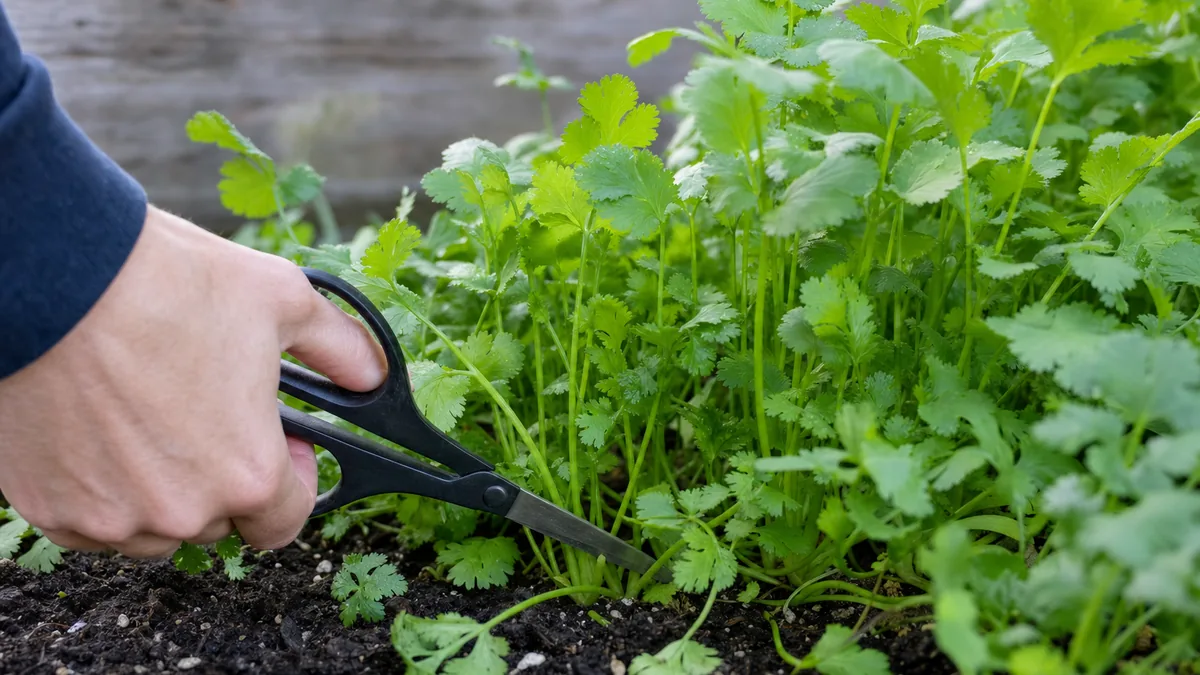
Harvest early and often. Cut the plant while it is young and leafy, because Illinois Extension notes that herbs are best harvested before they start to flower, otherwise leaf production declines. Illinois also recommends picking early in the day, after the plants dry off and before it gets hot. For a deeper walkthrough of cutting for regrowth, saving seed and storing leaves, see how to snip cilantro.
- Wait until the leaves are 4 to 6 inches long. That is the size Utah State, Maryland and Texas A&M all give.
- Cut the outer leaves first. Texas A&M says to cut the outer leaves once they reach 4 to 6 inches. For carrot-family herbs like cilantro, University of Vermont Extension advises cutting each leaf stalk at the base of the plant rather than just trimming off the leaf blades.
- Leave the center. The inner leaves keep growing, which is how you get cut-and-come-again harvests from one plant.
- Or cut the whole plant. UF/IFAS Extension says you can cut the whole plant 1 to 2 inches above the soil level.
- Store it quickly. Illinois Extension says dry leaves wrapped loosely in plastic keep about a week in the refrigerator, and Texas A&M recommends using it within 5 to 6 days.
How much can you cut? You may have read that you should never take more than a third of an herb at once. Illinois Extension gives that figure for perennial herbs. For annual herbs, which includes cilantro, it says they can be cut back 50 to 75 percent and still recover. Cut hard while the plant is young, then let it regrow.
How to Stop Cilantro From Bolting, and Saving Coriander Seed
Why cilantro bolts
Bolting is the plant switching from leaves to flowers and seed. Heat and long days trigger it. Texas A&M AgriLife Extension says cilantro starts to flower once temperatures exceed 85°F, UF/IFAS says it flowers quickly when days get long and warm, and Maryland Extension says it bolts in hot, humid weather. Oregon State says that in midsummer cilantro typically bolts and produces seed within four to six weeks, while in cooler seasons plants grow leaves for several weeks or months before flowering.
How to slow it down
You cannot stop bolting for good, only delay it. These steps help, and each one comes from the extension guidance above.
- Grow it in the right season: spring and fall in cooler areas, fall through early spring in hot ones.
- Give afternoon shade: Maryland Extension suggests a spot with light afternoon shade.
- Sow in succession: every 2 to 3 weeks (Maryland), so a new batch is always ready as the old one bolts.
- Harvest before flowering: Illinois Extension says leaf production declines once plants flower.
Once it has bolted, the leaves turn bitter, as Clemson Extension notes, but you get coriander seed in return.
How to save coriander seed
Cilantro and coriander are the same plant: the leaves are cilantro and the dried seeds are coriander. To collect seed, space plants 8 to 10 inches apart, as Utah State advises. Oregon State says to harvest the seeds before they drop. Utah State’s method is to cut off the seed heads when the plants begin to turn brown, put them in a paper bag, and hang the bag until the plant dries and the seeds fall to the bottom. Illinois Extension says to let the flower heads turn brown, cut the entire plant, and store it in a paper bag in a cool, dry place. Clemson Extension notes that these plants are prolific seeders, so leave a few seed heads to drop and you may get volunteers next season.
When the season ends and the bed is empty, our guide to winterizing your garden covers what to do with the spent plants, the soil and the hoses.
Free book · 23 pages, PDF
How to Grow Cilantro FAQ
How long does it take cilantro to grow?
Texas A&M AgriLife Extension and UF/IFAS Extension both give 45 to 70 days from planting to harvest. In summer heat it matures faster, in 40 to 45 days according to UF/IFAS, but it also bolts quickly. Leaves are ready to cut when they are about 4 to 6 inches long.
Does cilantro grow back after you cut it?
Yes, for a while. Illinois Extension says annual herbs can be cut back 50 to 75 percent and still recover, and Texas A&M advises cutting the outer leaves and leaving the center. Each plant still has a short life, so sow again every 2 to 3 weeks.
Why did my cilantro go to seed so fast?
Heat and long days. Texas A&M says cilantro begins to flower once temperatures exceed 85°F, and Oregon State says it can bolt within four to six weeks in midsummer. Plant in cool weather, give afternoon shade, and sow a new batch every 2 to 3 weeks.
Can cilantro grow in shade?
In part shade, yes. UF/IFAS lists full sun to part shade, and Maryland Extension suggests light afternoon shade in hot, humid weather, which helps delay bolting.
Can I grow cilantro in a pot indoors?
Yes. Iowa State Extension lists cilantro among the herbs that grow well indoors. Use a container of at least 10 inches, give it about eight hours of direct light from a south-facing window or 12 to 16 hours under a grow light, and let the mix dry a little between waterings.
Is cilantro the same as coriander?
They are the same plant, Coriandrum sativum. The leaves are cilantro and the dried seeds are coriander. Illinois Extension says it is called cilantro when the leaves are harvested and coriander when the seeds are harvested, and Clemson HGIC says coriander is the British term for the plant.
How big do cilantro plants get?
Extension guides give a range. UF/IFAS Gardening Solutions says about one foot, Illinois Extension says one to two feet, University of Maryland Extension says about 2 feet, and Utah State says 1 to 3 feet. You do not need to wait for full height, since leaves are ready to cut at 4 to 6 inches.
Can you transplant cilantro?
It is not recommended. Illinois Extension says cilantro is difficult to transplant because of its taproot. Sow seed where the plants will grow, in the garden or in the final pot.
Sources & further reading
Planting dates, spacing, depth, bolting and harvest figures come from Oregon State University Extension’s guide to growing cilantro and its note on planting cilantro in summer for coriander seed, Utah State University Extension, Illinois Extension on cilantro and its guide to harvesting herbs, University of Maryland Extension and Clemson HGIC. Southern timing comes from Texas A&M AgriLife Extension’s cilantro guide (EHT-032S) and its parsley and cilantro page, UF/IFAS Extension Hardee County and UF/IFAS Gardening Solutions. Container and indoor advice comes from the Illinois Extension container gardening guide, Iowa State University Extension and the University of Vermont Extension Master Gardener guide. For how we source the facts on this site, see our methodology page. When the season ends, see how to winterize your garden.
Free book · 23 pages, PDF
The Spacing & Planting Cheat Sheet
Sent