How to Use This Calculator
- Choose a mode: Unit Converter, Repotting Size-Up, or Plant Guide.
- Enter your pot size, current size, or select a plant, depending on the mode.
- Read your converted size, next size up, or minimum container size.
Free book · 23 pages, PDF
How Do You Determine the Right Pot Size?
Container size matters because it directly limits root development, and root development limits everything else the plant does above the soil line. A pot that’s too small restricts roots before the plant reaches its potential, forces more frequent watering as the small soil volume dries out fast, and can leave a plant permanently stunted or root-bound. A pot that’s too large has the opposite problem: roots can’t draw water from all that extra soil fast enough, so it stays wet for days after watering, starving roots of oxygen and inviting root rot.
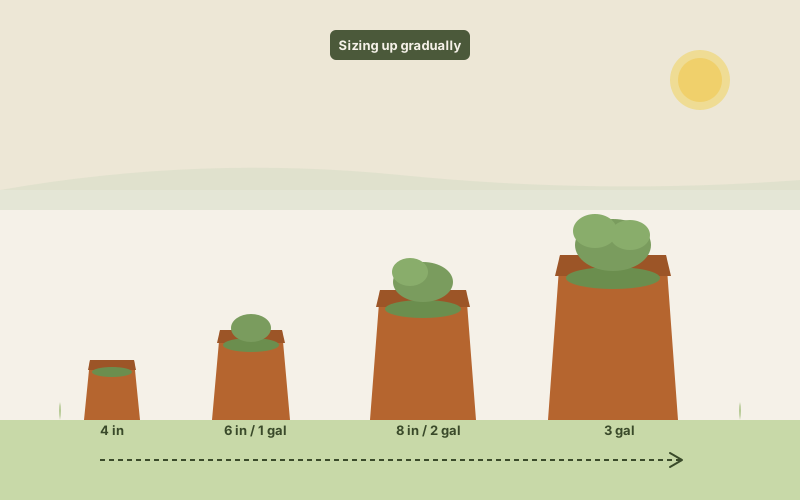
The right size, then, is the smallest container that comfortably fits the plant’s current root system with a little room to grow into, not the size it will eventually need at full maturity. That’s why repotting is a gradual, staged process (see the Repotting Size-Up mode above) rather than a one-time decision, and why the Container Size Guide below gives a minimum size for each plant’s mature form rather than a size to start it in as a seedling.
Depth matters as much as width for many plants. A wide, shallow pot and a narrow, tall pot can hold the same volume of soil but suit very different root structures. Taprooted vegetables like carrots need depth, while shallow-rooted plants like lettuce and most succulents do better in a wider, shorter container.
Standard Pot Sizes: Conversion Chart
Standard nursery containers, sorted by diameter. The American Standard for Nursery Stock (ANSI Z60.2-2025) gives each container class from #1 to #15 a volume range in cubic inches, not a single number. The volumes below are the midpoint of each range, and the last column shows the full range. The standard does not set diameters, so those are typical manufacturer figures; measure your own pot if precision matters. Rows marked with an asterisk are estimated (small starter pots are conventionally sold by diameter only, with no rated volume).
Important: nursery “gallon” sizes are a trade convention, not a precise liquid measurement. A “1-gallon” nursery pot is a #1 container, which the nursery standard allows to hold anywhere from 0.66 to 1.09 real US gallons (152 to 251 cubic inches, about 2.5 to 4.1 L). The midpoint is about 0.87 gallons. When plant guides say “needs a 1-gallon container,” treat that as a size category, not a literal gallon of soil volume. The actual volumes for each trade size are in the chart below.
| Size | Diameter | Volume (gal) | Volume (qt) | Volume (L) | ANSI class range (gal) |
|---|---|---|---|---|---|
| 2 in* | 2 in / 5.1 cm | ~0.03 | ~0.1 | ~0.1 | not a class |
| 3 in* | 3 in / 7.6 cm | ~0.09 | ~0.4 | ~0.3 | not a class |
| 4 in* | 4 in / 10.2 cm | ~0.22 | ~0.9 | ~0.8 | not a class |
| 1 quart | 4.25 in square | 0.25 | 1 | 0.95 | not a class |
| 6 in / 1 gal (#1) | 6 in / 15.2 cm | 0.87 | 3.49 | 3.3 | 0.66–1.09 |
| 8 in / 2 gal (#2) | 8.5 in / 21.6 cm | 1.72 | 6.87 | 6.51 | 1.39–2.05 |
| 3 gal (#3) | 10.5 in / 26.7 cm | 2.97 | 11.86 | 11.23 | 2.72–3.21 |
| 5 gal (#5) | 10.5 in / 26.7 cm | 4.39 | 17.55 | 16.61 | 3.40–5.38 |
| 7 gal (#7) | 12 in / 30.5 cm | 6.77 | 27.07 | 25.62 | 5.79–7.75 |
| 10 gal (#10) | 14.75 in / 37.5 cm | 10.23 | 40.92 | 38.72 | 9.00–11.45 |
| 15 gal (#15) | 17.5 in / 44.5 cm | 13.99 | 55.97 | 52.96 | 11.98–16.00 |
Pot Sizes in Litres
Pots sold in metric countries are labelled in litres, so matching a US gallon size is straight multiplication: one US gallon is 231 cubic inches, or about 3.785 litres. The table below converts the gallon label itself for common nursery sizes, rounded to one decimal place.
Keep in mind that the label is a trade size, not a measured volume. The ANSI nursery stock standard gives each container class a range rather than a single number: a #5 container, for example, can hold anywhere from about 12.9 to 20.4 litres. For the typical real volume of sizes up to 15 gallons, use the Volume (L) column in the chart above.
| Pot size (US gal) | Litres |
|---|---|
| 1 gal | 3.8 L |
| 2 gal | 7.6 L |
| 3 gal | 11.4 L |
| 5 gal | 18.9 L |
| 7 gal | 26.5 L |
| 10 gal | 37.9 L |
| 15 gal | 56.8 L |
| 20 gal | 75.7 L |
| 25 gal | 94.6 L |
Container Size Guide by Plant
Minimum container sizes below for vegetables and herbs draw on University of Maryland Extension guidance; houseplant categories reflect general nursery sizing convention rather than a single per-species standard.
| Category | Examples | Minimum Size |
|---|---|---|
| Large vegetables | Tomato, pepper, eggplant, cucumber, winter squash | 8–10 gal, 12–16 in deep |
| Medium vegetables | Dwarf tomato/pepper, summer squash, cole crops, beans, root veg, large herbs | 4–6 gal, 8–12 in deep |
| Small vegetables & herbs | Basil, cilantro, thyme, lettuce, radish, spinach, peas | 1–3 gal, 4–6 in deep |
| Succulents & cacti | Echeveria, jade, most cacti | 2–4 in diameter (snug fit preferred) |
| Small houseplants | Pothos, small ferns | 4–6 in diameter |
| Medium houseplants | Peace lily, snake plant, small monstera | 6–10 in diameter (~2–3 gal) |
| Large houseplants | Fiddle leaf fig, large monstera, floor palms | 10–14 in+ diameter (~5–15 gal) |
| Potatoes | n/a | 30 gal (deep, for hilling) |
| Dwarf fruit trees / shrubs | n/a | 25–30 gal |
Worked Example
Say you started a tomato seedling in a 6-inch pot (about 0.87 gal, per the conversion chart above) and it’s now filling that pot with roots.
- Check the target: per the Container Size Guide above, a full-size tomato needs a minimum of 8–10 gal at maturity.
- Compare to the size-up ladder: a 6-inch pot is several rungs below that. The standard ladder runs 6 in/1 gal → 8 in/2 gal → 3 gal → 5 gal → 7 gal → 10 gal.
- Decide on a strategy: for a slow-growing houseplant, the usual advice is to size up gradually, about one rung (roughly 2 in of diameter) at a time. But a tomato is a fast-growing annual with only one season to reach full size, so most growers move it directly from its seedling pot into its final 8–10 gal container once it outgrows the 6-inch pot and before it becomes root-bound, typically 3–4 weeks after transplanting and well before flowering.
So the practical move here is a single jump straight to a 10-gallon container with good drainage, rather than working through every intermediate size. The gradual, one-rung-at-a-time approach in the Repotting Size-Up mode above is the right call for houseplants and perennials, but fast-growing annual vegetables are usually better served by sizing up directly to their mature minimum.
Common Mistakes
- Potting up too large, too fast. Per University of Illinois Extension, choose a new container only modestly larger than the current one for most houseplants: an oversized jump surrounds the roots with more soil than they can use, and that excess wet soil is one of the most common causes of root rot. As a guide: size up by 1–2 inches in diameter for slow-growing plants (most succulents, cacti, and compact houseplants), or 2–3 inches for vigorous, fast-growing plants (tropicals in active growth, most edibles). Don’t skip several rungs at once just because a larger pot is available.
- Ignoring drainage at larger sizes. Every container needs drainage holes, but the stakes go up as pot size increases: a large pot with poor drainage holds a large volume of standing water against the roots. Don’t compensate for a bigger pot by watering less; fix the drainage instead.
- Confusing nursery “gallon” sizing with literal liquid gallons. As the conversion chart above shows, a “1-gallon” nursery pot can hold anywhere from 0.66 to 1.09 actual gallons under the nursery standard, and the exact figure varies by manufacturer. Don’t assume the label is a precise volume measurement.
- Not accounting for the plant’s mature size. Sizing a container to a seedling’s current size, rather than its eventual mature root system, sets up multiple rounds of stressful repotting. Check the Container Size Guide above for the plant’s minimum mature container size before you buy a “forever pot.”
Pot Size Calculator FAQ
What size pot do I need for my plant?
It depends on the plant’s mature size and root system, not its current size. As a rough rule: 1–3 gal for small herbs and salad greens, 4–6 gal for medium vegetables, and 8–10 gal or more for large fruiting vegetables like tomatoes and peppers. Check the Container Size Guide above for houseplants and specific crops.
How do I convert pot size from inches to gallons?
Diameter alone doesn’t determine volume. You also need height, since a wide, shallow pot and a narrow, tall pot of the same diameter hold very different amounts of soil. Use the calculator’s Unit Converter mode above: pick a standard nursery size to see its real gallon and liter equivalent, or enter a custom diameter and height to calculate volume directly.
Is a “1-gallon” pot actually one gallon?
No. nursery “gallon” sizing is a trade convention, not a literal liquid gallon. A 1-gallon nursery container is a #1 container class, which the American Standard for Nursery Stock (ANSI Z60.2-2025) sets at 152 to 251 cubic inches: 0.66 to 1.09 actual gallons, about 0.87 at the midpoint. Exact dimensions vary by manufacturer. Treat “gallon” labels as a size category rather than a precise volume, and check the conversion chart above if you need the real number.
What size container do vegetables need?
It depends on the vegetable’s mature size. Per University of Maryland Extension guidance, large fruiting vegetables like tomatoes, peppers, eggplant, and cucumbers need a minimum of 8–10 gallons; medium vegetables like summer squash and cole crops need 4–6 gallons; and small vegetables and herbs like lettuce, basil, and radishes do fine in 1–3 gallons.
When should I repot my plant into a larger container?
Repot once roots start growing out of the drainage holes, circle visibly around the inside of the root ball, or the plant dries out unusually fast between waterings. For slow-growing plants (most succulents, cacti, compact houseplants), size up by 1–2 inches of diameter at a time; for fast or vigorous growers (most tropicals in active growth, edible crops), 2–3 inches is appropriate. Either way, avoid jumping several sizes at once: an oversized pot surrounds the roots with more soil than they can use, which is a common cause of root rot.
How many litres is a 5, 10 or 15 gallon pot?
Multiply the gallon size by 3.785: a 5 gallon pot is about 18.9 litres, a 10 gallon pot about 37.9 litres and a 15 gallon pot about 56.8 litres. Those figures convert the label itself. Because nursery gallons are trade sizes, the soil a pot actually holds is usually less. The nursery standard (ANSI Z60.2-2025) puts a #5 pot at 12.9 to 20.4 litres, a #10 at 34.1 to 43.4 litres and a #15 at 45.4 to 60.6 litres; the midpoints are about 16.6, 38.7 and 53.0 litres.
How big is a quart pot?
Small: roughly 4 to 4.75 inches across and about 5 inches deep, holding close to one quart (0.95 litres) of potting mix. The calculator uses 4.25 inches square as its quart size. Makers differ: Landmark Plastic’s catalog lists a 4.75-inch round quart pot, 5.27 inches deep, at 970 mL, while its True Quart square pot is 3.95 inches across and 5.56 inches deep at 953 mL. The ANSI nursery stock standard puts the containers the trade calls “four-inch” or “quart” into one small-plant class, #SP4 (31 to 63 cubic inches); a true US quart is 57.75 cubic inches.
How many gallons is a 20 inch pot?
It depends on the height, so any figure is approximate. Using the calculator’s straight-sided cylinder formula, a 20-inch pot that is also 20 inches tall holds about 27.2 US gallons (about 103 litres), and one that is 16 inches tall holds about 21.8 gallons (about 82 litres). Most nursery pots taper toward the base, so they hold somewhat less than the cylinder figure. For comparison, the ANSI nursery stock standard treats a 20-inch box as equivalent to its #20 container class, 4,520 to 5,152 cubic inches (about 19.6 to 22.3 gallons). To check your own pot, the Custom pot option works as a pot capacity calculator: choose “I know diameter & height” and enter both measurements.
What is a 1.72 gallon pot in inches?
About 8 to 9 inches across and roughly as tall. 1.72 US gallons is about 397 cubic inches (6.5 litres), and the calculator’s volume mode, which assumes a round pot about as tall as it is wide, puts that at roughly 8 inches in diameter and 8 inches tall. That volume matches a trade 2-gallon pot: it sits inside the ANSI nursery stock standard’s #2 container class (320 to 474 cubic inches), and HC Companies’ 2-gallon thermoform pot, rated at 396.66 cubic inches, measures 8.8 inches across and 8.5 inches tall. Nursery sizes vary by maker, so measure the pot if the exact size matters.
Sources & further reading
Vegetable container size guidance draws on the University of Maryland Extension’s guide to container vegetable gardening. Repotting size-up guidance draws on the University of Illinois Extension’s tips for repotting houseplants. Gallon, quart, cubic-inch and litre conversions use the values in NIST Handbook 44, Appendix C: General Tables of Units of Measurement. Nursery container classes (#SP4, #2, #5, #20 and so on) and the volume ranges in the chart and the calculator come from Table 1 (section 1.1.3.1) of AmericanHort’s American Standard for Nursery Stock, ANSI Z60.2-2025, approved April 17, 2025, which supersedes ANSI Z60.1-2014. Example pot dimensions come from manufacturer specifications: HC Companies’ thermoform nursery pot, plus Landmark Plastic’s container catalog and True Quart square pot. For more on how we build and verify the formulas behind every calculator on this site, see our methodology page.