How to Use This Calculator
- Choose a mode: Granular, Liquid, or Blend.
- Enter your fertilizer’s N-P-K percentages.
- Enter your target rate, PPM/dilution, or ratio for that mode.
- Read your exact fertilizer application amount.
How Do You Calculate NPK Fertilizer Rates?
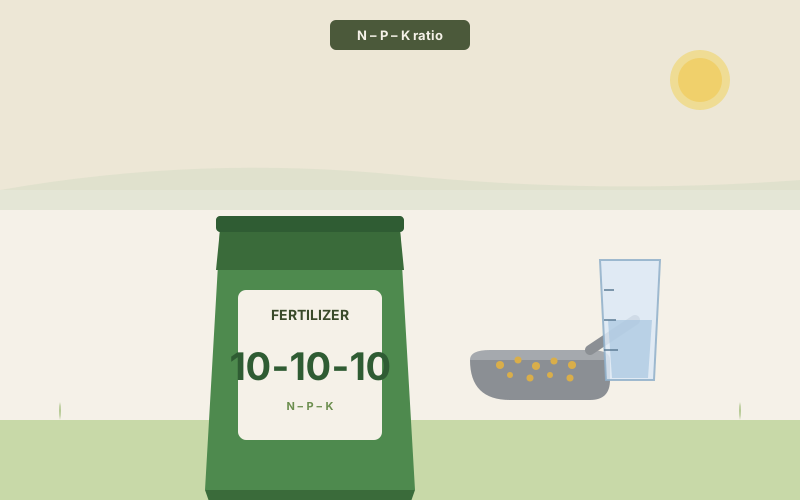
Every fertilizer label shows three numbers, like 10-10-10 or 24-8-16. These are the percentage, by weight, of nitrogen (N), available phosphate (P₂O₅, shown as “P”), and soluble potash (K₂O, shown as “K”) in the bag. A 50 lb bag of 10-10-10 contains 5 lb of actual nitrogen (10% of 50), 5 lb of phosphate, and 5 lb of potash. The rest is filler and carrier material.
Application rates are conventionally expressed as pounds of actual nitrogen per 1,000 sq ft, not pounds of product. That’s the standard unit turf and garden guides use, and it’s why the calculator above asks for a target N rate rather than a target bag weight: two different fertilizers with different N percentages need very different amounts of product to deliver the same amount of actual nitrogen.
For liquid feeding, the equivalent standard is parts per million (PPM) of nitrogen in the final solution. Common hydroponic and container-feeding programs target a specific PPM (often 100–250 for N depending on the crop and growth stage). For blending, the same underlying math applies: you’re solving for how much of each product delivers your target absolute amount of N, P, and K, in the right proportion. All of this is an estimate that should be adjusted based on plant response and, ideally, a current soil test. It is not a substitute for lab-based recommendations.
A quick visual check before reaching for fertilizer: yellowing leaves (especially older, lower leaves that yellow while newer growth stays green) are a classic sign of nitrogen deficiency, since the plant scavenges N from older tissue to feed new growth. A purple or reddish tint on leaf undersides, stems, or the whole plant (particularly in cool weather or on seedlings) often points to phosphorus deficiency, which blocks the pigment pathway. These visual cues are a useful starting signal, not a diagnosis: other causes (cold stress, root damage, certain diseases) can produce similar symptoms, so confirm with a soil test before correcting.
Common Fertilizer Application Rates
General starting-point ranges for actual nitrogen. Always defer to a current soil test or product label where available. These are typical ranges, not prescriptions for your specific soil.
| Use | Rate (lb N / 1,000 sq ft) | Frequency |
|---|---|---|
| Established lawn (maintenance) | 0.5–1 lb per application | 2–4 applications/year (2–4 lb/year total) |
| New lawn (at seeding) | ~1 lb, plus starter P | Once, at seeding |
| Vegetable garden (pre-plant) | 1–2 lb | Once before planting, plus side-dressing |
| Established trees & shrubs (root zone) | 1–3 lb | Annually, over the root zone area |
| Containers / hydroponic feed (liquid) | 100–250 PPM N | Every watering or per feeding schedule |
Worked Example: Application Rate
Let’s size a 10-10-10 bag for a 5,000 sq ft lawn at a target of 1 lb actual N per 1,000 sq ft.
- Total N needed: 1 lb × (5,000 ÷ 1,000) = 5 lb of actual nitrogen.
- Fertilizer needed: 5 lb ÷ (10 ÷ 100) = 50 lb of 10-10-10.
So a 5,000 sq ft lawn needs 50 lb of 10-10-10 to deliver 1 lb of actual N per 1,000 sq ft. That same 50 lb also delivers 5 lb of P₂O₅ and 5 lb of K₂O, since all three percentages are equal in a 10-10-10 product. With an unbalanced fertilizer like 24-8-16, the phosphate and potash delivered would scale differently.
Worked Example: Liquid Fertilizer Dilution
Say you have a 10-10-10 liquid concentrate and want to feed at 150 PPM nitrogen (a common general-purpose houseplant and container strength), mixed up in a 2-gallon watering can.
- Rate needed: 150 ÷ (10 × 74.9) = ~0.20 oz of concentrate per gallon of water.
- Total for a 2-gallon container: 0.20 oz × 2 = ~0.4 oz of concentrate.
- Check: 0.20 oz/gal × 10% N × 74.9 = 150 PPM, which confirms the math.
So for a 2-gallon can at 150 PPM N, you’d measure out roughly 0.4 oz of the 10-10-10 concentrate. That’s a small enough amount that a syringe or a marked measuring cap (the kind that ships with most liquid concentrates) is far more accurate than trying to eyeball a fraction of an ounce in a kitchen measuring spoon. If you wanted a stronger feed for a heavy-feeding vegetable instead, say 250 PPM, the same fertilizer would need about 0.33 oz per gallon (0.67 oz for the 2-gallon can). The calculator’s liquid mode recalculates this instantly for any target PPM, container size, or fertilizer strength.
Worked Example: Blending Two Fertilizers
Say you have Urea (46-0-0) and a 10-10-10 complete fertilizer on hand, and want to approximate a 3-1-2 ratio (a common lawn-program target) over that same 5,000 sq ft at 1 lb N/1,000 sq ft.
- Targets: 5 lb N, 1.67 lb P (5 × 1⁄3), 3.33 lb K (5 × 2⁄3).
- Solving for N and P exactly: ~7.25 lb Urea + ~16.67 lb of 10-10-10 hits 5 lb N and 1.67 lb P precisely.
- Check K: that combination only supplies 16.67 × 10% = 1.67 lb K, short of the 3.33 lb target.
The calculator flags this automatically: with only these two products, you cannot hit a 3-1-2 ratio exactly, because neither product supplies extra potassium without also changing the N and P amounts. Adding a third, potassium-only product (like muriate of potash, 0-0-60) makes an exact match solvable. The calculator’s 3-product blend mode handles that case directly.
Common Mistakes
- Confusing the three numbers. N-P-K percentages are not interchangeable, and none of them is "the fertilizer strength" on its own. Each governs a different nutrient with a different role (N for leaf growth, P for roots/flowers, K for overall plant health and stress tolerance).
- Over-applying nitrogen. More N doesn’t mean more growth past the plant’s ability to use it. Excess nitrogen leaches into groundwater, burns roots at high concentrations, and can push soft, disease-prone growth. Stick to the recommended rate range. If your total seasonal N is, say, 3 lb per 1,000 sq ft, split it into 2–3 lighter applications spaced a few weeks apart rather than applying it all at once: plants get a steadier nutrient supply, uptake is more efficient, and the risk of fertilizer burn drops significantly.
- Applying fertilizer right before heavy rain. Water moves fertilizer into the root zone, but a heavy downpour can carry soluble nutrients (especially nitrogen) straight off the surface and into storm drains before the soil absorbs them. That’s wasted product and a pollution problem. Check the forecast and skip the application if more than about half an inch of rain is expected within 24 hours.
- Skipping the watering-in step. Most granular fertilizers sit inert on the soil surface until water dissolves and carries them into the root zone. After applying, water with roughly ¼ to ½ inch (or let light rain do it) so nutrients actually reach the roots and start working. Skipping this step leaves fertilizer sitting on leaves and dry soil, where it can burn foliage and never benefit the plant.
- Ignoring soil test results. A soil test might show you already have adequate or excess phosphorus, in which case a high-P starter fertilizer is wasted money and, in some states, restricted by law near waterways. Test before you guess.
- Using lawn rates for vegetables (or vice versa). Turf and vegetable gardens have different nutrient demand curves and different tolerance for salt buildup from fertilizer. Match the rate to the crop, not just to what’s in the shed.
- Assuming any two fertilizers can hit any target ratio exactly. As the blending example above shows, two arbitrary products usually cannot be combined to hit an arbitrary target ratio precisely. The math only works out for specific combinations. A third, complementary product (or accepting an approximation) is often required.
NPK Calculator FAQ
How do I calculate NPK fertilizer application rate?
Multiply your target rate (lb of actual N per 1,000 sq ft) by your area in thousands of square feet, then divide by the fertilizer’s N percentage. A 10-10-10 product at a 1 lb N/1,000 sq ft target on a 5,000 sq ft lawn works out to 50 lb of product. The calculator above does this instantly for any fertilizer and area.
How much fertilizer do I need per acre or per square foot?
Convert your area to thousands of square feet (1 acre = 43.56), multiply by your target lb-N-per-1,000-sq-ft rate, then divide by the fertilizer’s N percentage. The calculator’s granular mode accepts any square footage directly, so you can enter acreage converted to square feet or use the metric toggle for m².
How do I make a liquid NPK fertilizer solution?
Dissolve fertilizer into water at a rate that hits your target PPM of nitrogen: divide target PPM by (fertilizer N% × 74.9) for ounces per gallon, or by (N% × 10) for grams per liter. For example, a 10-10-10 liquid concentrate dissolved at about 0.2 oz per gallon delivers roughly 150 PPM N, a common general feeding strength for houseplants and containers. Most edible and ornamental plants do well in the 100–250 PPM N range: seedlings and delicate container plants are usually fed toward the lower end, while heavy feeders like tomatoes or hydroponic crops in active growth are fed toward the higher end. Always check your specific crop’s recommendation before settling on a number. If you already know a dilution ratio you’ve used before (say, "1 oz per gallon") rather than a target PPM, switch the calculator’s liquid mode to Dilution Ratio and it solves in the other direction, showing you the resulting PPM for that mix so you can compare it against label guidance or a feeding chart. One practical note: always dissolve fertilizer into the full volume of water, stirring as you add it, rather than adding water to a concentrated fertilizer solution. This avoids transient over-concentration that can stress roots.
Can I use regular garden fertilizer for hydroponics?
Only if it’s fully water-soluble and free of fillers or micronutrient gaps. Most granular lawn and garden fertilizers contain insoluble carriers or lack the micronutrients hydroponic systems need. Purpose-made hydroponic nutrient lines are formulated for complete solubility and balanced micronutrients; this calculator’s PPM math applies either way, but product choice matters more than the math.
How do I read my soil test’s N-P-K recommendations?
A soil test report typically recommends pounds of actual N, P₂O₅, and K₂O per 1,000 sq ft or per acre. Plug those numbers directly into this calculator’s target rate field per nutrient. If your test gives a suggested product ratio instead, use blend mode to combine what you have on hand toward that ratio.
How is soil pH calculated?
Soil pH is measured with a soil test kit or meter on a 0–14 scale, where 7 is neutral. Most vegetables prefer slightly acidic to neutral soil, in the 6.0–7.0 range. pH matters alongside NPK because it controls how available those nutrients actually are to plant roots. Soil that’s too acidic or too alkaline can lock up nitrogen, phosphorus, and potassium even when they’re present in adequate amounts. A home test kit gives a rough read; a lab soil test is more accurate and usually includes lime or sulfur recommendations to correct pH before it becomes a fertility problem.
Can I blend two fertilizers to hit an exact target ratio?
Sometimes, but not always. Two arbitrary fertilizers can only hit an exact N-P-K ratio if the math happens to work out, which is the exception rather than the rule. The calculator checks this for you: if an exact match isn’t possible with your two products, it says so and shows the closest achievable result instead of a misleading number. Adding a third, well-chosen product usually makes an exact match achievable.
How do I use an N P K calculator?
Pick a mode (granular, liquid, or blend), type in the three numbers from the fertilizer bag, enter your target, and read the amount to apply. The math underneath is the same one extension guides teach: divide the pounds of nutrient you want by the decimal form of its percentage in the bag. Penn State Extension’s example is 0.13 lb of nitrogen per 100 sq ft with a 15-15-15 fertilizer, which is 0.13 ÷ 0.15 = 0.87 lb of product per 100 sq ft. Iowa State Extension’s example is 0.15 lb of nitrogen per 100 sq ft with a 10-2-6 fertilizer, which is 0.15 ÷ 0.10 = 1.5 lb of product. The granular mode here takes its target per 1,000 sq ft, so multiply a per-100 rate by 10 before you enter it.
What is corn nitrogen uptake, and does it set how much I should apply?
It is the nitrogen the corn plant takes in over the season. Iowa State University’s field-corn guidance puts total plant nitrogen at around 1 lb per bushel of grain, with about 70% of it taken up by silking. Uptake is not the rate to apply: Iowa State notes that grain nitrogen removal is less than the suggested nitrogen rates. Those figures are in pounds per acre for field corn, and we found no extension source that gives sweet corn uptake at garden scale, so we do not give one. For a garden, use the per-100-sq-ft rates in the next answer.
When should I be applying nitrogen to corn in a home garden?
Extension guides split it: some before planting, then a sidedress when the plants are about knee high. Utah State Extension says to sidedress with 1/2 lb of 21-0-0 per 100 sq ft when plants are near knee high (8 to 10 leaves), which is about 0.1 lb of nitrogen, and to add 1/4 lb when the first tassel or silks appear. The University of Arizona says 1/2 lb of 46-0-0 urea or 2 1/2 lb of 10-10-10 per 100 sq ft at 8 to 10 leaves, about 0.23 to 0.25 lb of nitrogen, and half as much when the first silks appear. UMass Extension says to sidedress when corn is 12 inches tall. The amounts differ by about a factor of two, so let a soil test settle it. Apply the fertilizer about 6 inches to the side of the row and water it in.
Sources & further reading
Application rate conventions and nutrient recommendation guidance in this article draw on the USDA Natural Resources Conservation Service’s Fertilizer Recommendations Guide. The worked fertilizer math in the FAQ follows Penn State Extension and Iowa State Extension. The sweet corn timing and rates come from Utah State Extension, the University of Arizona and UMass Extension, and the uptake figures from Iowa State University. For more on how we build and verify the formulas behind every calculator on this site, see our methodology page.