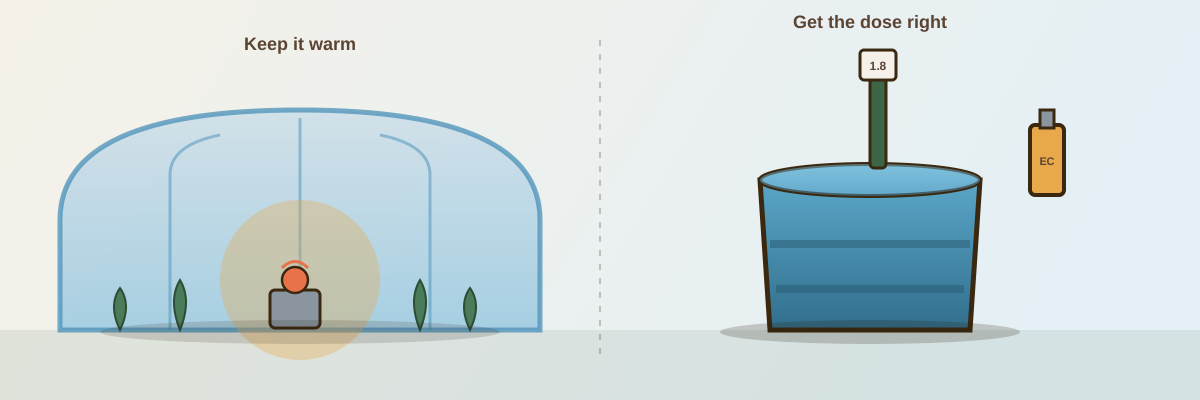
A hydroponic or greenhouse growing setup means taking over jobs that soil and outdoor weather normally handle for you — and two of those jobs matter more than any other: keeping the growing space warm enough, and delivering the right nutrients in the right amount. Neither one forgives guessing the way an established outdoor garden bed often does.
A greenhouse loses heat constantly through its glazing, and on a cold night an undersized heater (or a leaky structure) can mean frost damage to a crop that would’ve been fine outdoors in soil with more thermal buffering. A hydroponic reservoir has no soil at all to buffer a dosing mistake — nutrients are either in the water at the right concentration or they’re not, and there’s no soil chemistry slowly correcting an over- or under-feed the way it might in the ground.
This cluster’s two calculators address each job directly: the Greenhouse Heater Calculator sizes your heat source to your actual structure and climate, and the Hydroponic Nutrient Calculator scales any product’s label dose to your reservoir and untangles EC-versus-PPM confusion. They’re complementary tools for two different systems within the same controlled-growing setup, not steps in a sequence or alternatives to choose between.
Greenhouse Heating & Nutrient Dosing Calculators
Keeping Your Greenhouse Warm
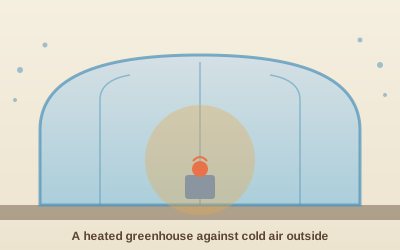
Heat loss comes down to three things multiplied together: the greenhouse’s surface area, the temperature difference between inside and outside, and a U-factor describing how much heat your glazing lets through. Single-layer poly film and single-pane glass (U-factor around 1.1–1.2) lose heat fastest; double-layer inflated poly or twin/triple-wall polycarbonate (U-factor 0.55–0.7) trap an insulating air gap that roughly halves heat loss for the same structure.
Undersizing a heater — or ignoring air leaks around vents, doors, and seams — is how a cold snap turns into crop damage overnight. A well-sealed structure with the right heater size holds its temperature; a leaky one loses heat faster than the surface-area math alone predicts, no matter how big the heater is.
Getting Nutrient Dosing Right
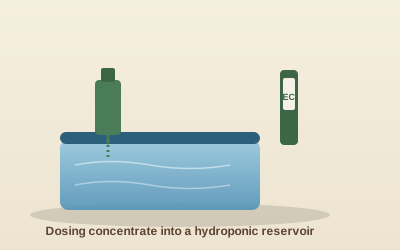
Hydroponic growing demands more precision than soil growing because there’s no soil to buffer a mistake — nutrients are either at the right concentration in the reservoir or they’re not, with nothing correcting an over- or under-feed the way soil chemistry might outdoors. A common real mistake is EC/PPM scale confusion: the same 1.8 EC reading translates to 900 PPM on the 500 scale, 1,152 PPM on the 640 scale, or 1,260 PPM on the 700 scale — three very different numbers off the identical solution, purely because of which conversion factor a meter uses.
Tracking EC directly, rather than a PPM number of unknown scale, is the more reliable way to compare readings over time — PPM is only useful once you know which scale both your meter and whatever chart you’re following actually use.
Growing through a low-light season? Our Grow Light & DLI Calculator (Indoor Plants cluster) helps you figure out if your setup needs supplemental lighting too — a greenhouse or indoor hydroponic system under cover often still comes up short on natural light in winter, even with climate and nutrients dialed in.
Why Precision Matters More Without Soil
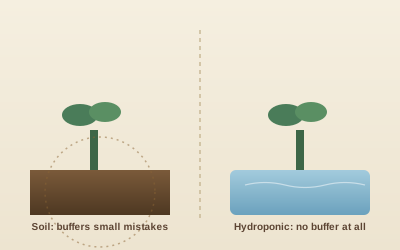
Soil-grown plants have a built-in buffer against small mistakes: soil holds onto extra water and nutrients, moderates temperature swings, and gives roots more room to average out an uneven feeding or a cold night. Hydroponic and greenhouse growing removes that buffer on both fronts at once — a reservoir has no soil to dilute a dosing error, and a glazed structure has none of the ground’s thermal mass to soften a temperature swing.
That’s why both of this cluster’s tools emphasize getting the actual numbers right — heat loss in BTU/hr, nutrient concentration in EC or a specific PPM scale — rather than approximating. In soil, “close enough” often is close enough. In a controlled-growing setup, close enough is frequently the gap between a healthy crop and a damaged one.