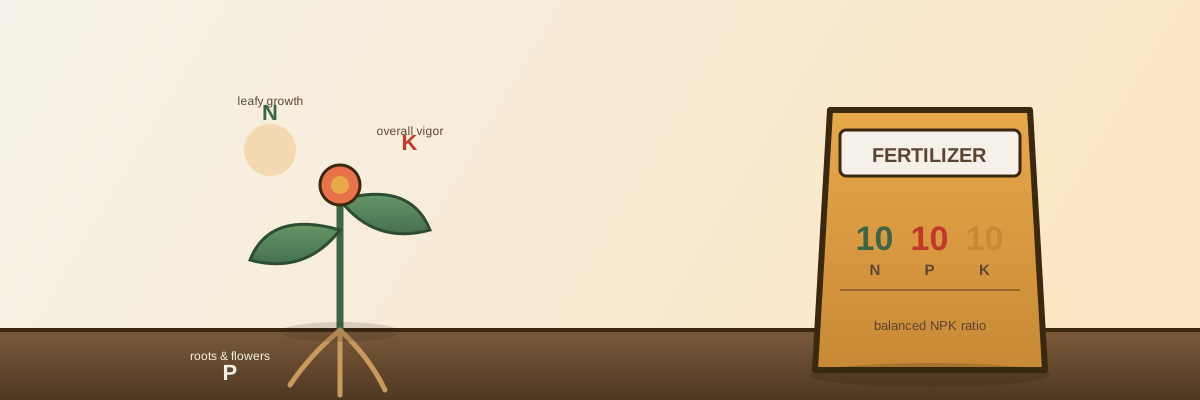
Every fertilizer bag is built around three numbers — N-P-K — and each one does a genuinely different job. Nitrogen drives leafy, green growth; phosphorus builds roots, flowers, and fruit; potassium supports overall vigor and stress tolerance. None of them substitutes for the others, and none of them is “the fertilizer strength” on its own.
How much of each a plant actually needs isn’t a fixed number — it depends on your soil (sandy soil drains nutrients fast and needs lighter, more frequent feeding; clay holds nutrients longer and needs less), your crop (a lawn, a tomato plant, and a young tree all have different demand curves), and its growth stage (a seedling and a fruiting plant want different ratios). And past a certain point, more isn’t better: excess nitrogen leaches into groundwater and can burn roots or push soft, disease-prone growth, while excess phosphorus is often just wasted money sitting in soil that didn’t need it.
This page walks through what N-P-K actually does, how your soil changes your feeding rate, how organic and synthetic sources differ, and a few common real-world feeding scenarios — with the NPK Calculator as the tool that turns any of this into an exact amount to apply.
NPK & Feeding Rate Calculators
What Your Plants Actually Need
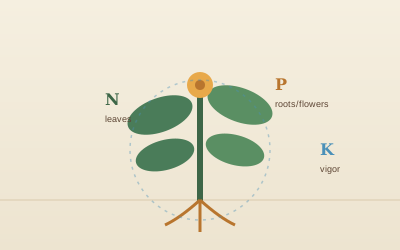
Nitrogen (N) drives leafy, green growth — it’s the nutrient behind lush foliage and fast vegetative growth, and it’s also the one plants scavenge from older leaves first when it’s in short supply, which is why yellowing lower leaves are the classic deficiency sign (see our guide to why leaves turn yellow for the full diagnostic rundown across all nutrients, not just nitrogen). Phosphorus (P) goes into roots, flowers, and fruit — it matters most at planting time (for root establishment) and again at flowering and fruit-set. Potassium (K) doesn’t drive a single visible feature the way N and P do; instead it supports overall plant vigor, water regulation, and resistance to drought, disease, and cold stress.
A fertilizer’s label numbers (like 10-10-10) tell you the percentage, by weight, of each — a 50 lb bag of 10-10-10 delivers 5 lb each of actual N, P₂O₅, and K₂O. Application rates are conventionally measured in pounds of actual nitrogen per 1,000 sq ft, not pounds of product, since two fertilizers with different N percentages need very different amounts of product to deliver the same nitrogen.
Soil Affects How Much Fertilizer You Actually Need
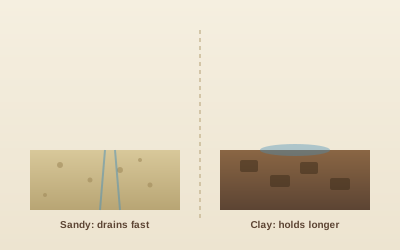
The same fertilizer rate doesn’t work the same way in every soil. Sandy soil drains fast, and dissolved nutrients drain right along with the water — so sandy soil needs more frequent, lighter feedings to keep nutrients available rather than one large dose that leaches away before the plant can use it. Clay soil holds both water and nutrients much longer, thanks to its enormous mineral surface area, but that same holding capacity can also lock some nutrients up, making a smaller, less frequent application more appropriate.
Not sure what you’re working with? Our Soil Type Calculator (Soil & Amendments cluster) classifies your soil texture using the USDA soil texture triangle, which directly affects your feeding schedule — sandy, loamy, and clay-heavy soils each call for a different approach.
Organic vs. Synthetic Nutrient Sources
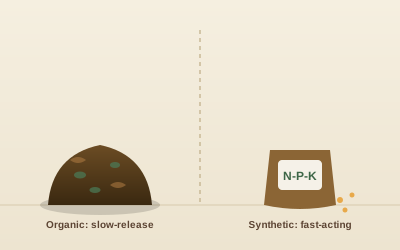
Compost and manure release nutrients slowly as soil microbes break them down, and they build soil structure and water-holding capacity along the way — a genuine long-term investment in the soil itself, not just a one-time feeding. Synthetic fertilizer is fast-acting and precise: you know exactly how much N-P-K you’re applying and roughly how quickly it’ll be available, but it does nothing to build soil structure, organic matter, or the microbial life that supports long-term fertility.
Compost is a real nutrient source too, not just a soil amendment — our Compost Calculator (Soil & Amendments cluster) helps you work out how much to add. Many gardeners use both: compost worked into the soil for structure and slow-release feeding, with synthetic fertilizer layered on top when a specific, fast-acting correction is needed.
Common Feeding Scenarios
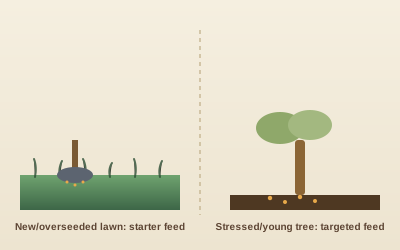
New and overseeded lawns both benefit from a starter fertilizer at seeding — new seedlings need available phosphorus for root development that established turf has often already depleted from the topsoil. Whether you’re starting a lawn from scratch or filling in bare patches, pair your seeding with a starter application: see our Grass Seed Calculator or Overseeding Calculator (Lawn & Landscaping cluster) for the seeding math, then use the NPK Calculator above for the fertilizer rate.
Stressed or young trees are one of the few cases where an established landscape planting actually needs supplemental feeding — not as routine maintenance, but when a tree is young and establishing, showing visible nutrient deficiency, or recovering from storm or drought stress. Our Trees & Shrubs guide covers exactly when feeding helps and when it doesn’t, alongside watering and mulching guidance for the rest of a tree’s care.