The best tomato fertilizer is the one your soil test and your growing method call for. In the ground, that usually means compost and a balanced granular mix before planting, then a nitrogen side-dress once the first fruits start to swell. In pots, it means slow-release pellets plus a weekly liquid feed. Skip heavy nitrogen, which grows leaves instead of tomatoes. If you have never tested your soil, start with our guide to reading soil test results.
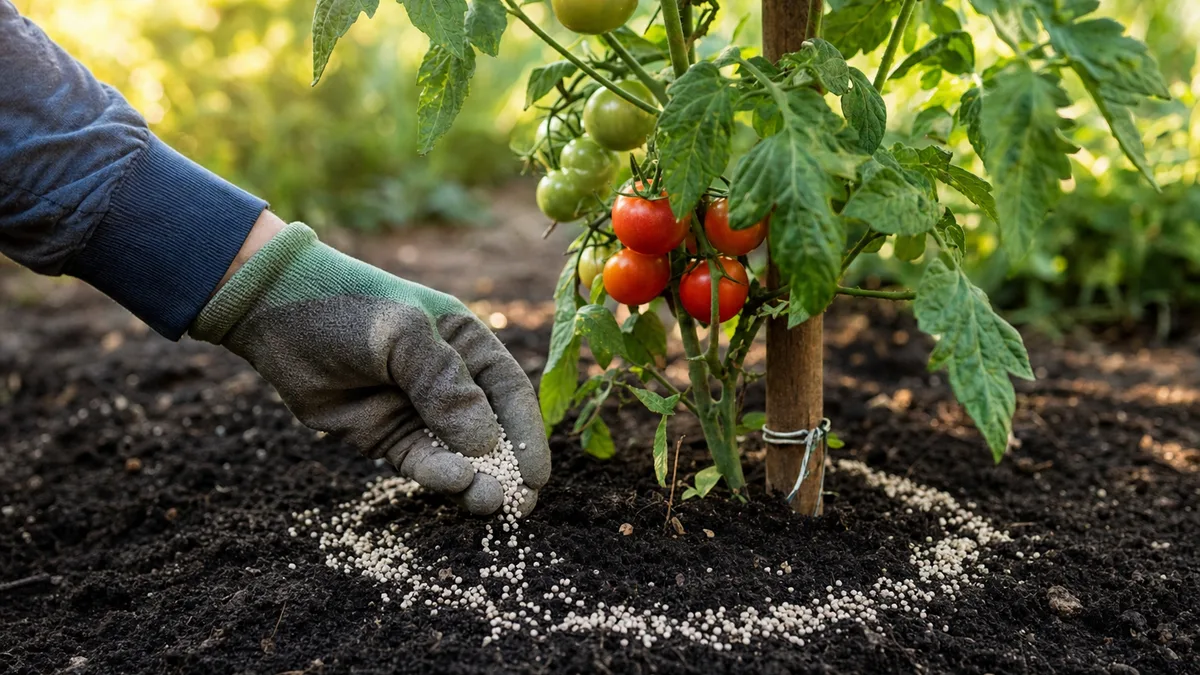
Best Tomato Fertilizer: Quick Facts
| Question | Short answer | Source |
|---|---|---|
| Before planting | Follow the soil test. With no test, 2 to 3 pounds of 10-10-10 per 100 square feet | Penn State Extension |
| First side-dress | When the first fruits start to enlarge (golf ball size) | Minnesota, Illinois extensions |
| Container tomatoes | Timed-release pellets at planting, then soluble fertilizer weekly from two weeks after planting | UNH Extension, Clemson HGIC |
| Main thing to avoid | Too much nitrogen: bushy, leafy plants slow to bear fruit | University of Minnesota Extension |
| Blossom end rot | Calcium supply and even watering, not extra fertilizer | Oregon State, Maryland, Washington State |
Best Fertilizer for Tomatoes: N-P-K Ratio and What a Soil Test Changes
Every label shows three numbers: nitrogen, phosphate and potash, in that order. Colorado State Extension explains that a 20-10-5 product is 20 percent nitrogen, 10 percent phosphate and 5 percent potash.
The best N-P-K ratio for tomatoes is not one number, because it depends on what your soil already holds. Penn State Extension suggests a complete 10-10-10 worked in before planting, at 2 to 3 pounds per 100 square feet, if you have no soil test. NC State Extension also names 8-8-8 and 10-10-10. The University of Minnesota says many of its soils already have enough phosphorus, so use a low or no phosphorus fertilizer unless the soil test asks for more. University of Illinois Extension says no phosphorus is suggested where soil tests 25 ppm or higher.
That is what a soil test changes. It shows whether you are buying phosphorus and potassium you do not need, and it sets the pH. University of Maryland Extension says that if the test shows high phosphorus and potassium, a nitrogen-only fertilizer fits. Our soil test guide walks through the report. With no test, choose a balanced product, and avoid heavy nitrogen: Washington State University’s Master Gardeners say to work in a balanced fertilizer before planting and avoid high-nitrogen products.
7 Types of Tomato Fertilizer, Ranked
This ranking is a judgment call, based on how often extension guides lean on each type for an in-ground garden and how forgiving it is. Container growers will reorder it. It lists types, not brands.
1. Compost and other organic matter
Compost is the base layer. Maryland Extension says tomatoes have a high need for nutrients, from soil organic matter or fertilizer. NC State Extension suggests 2 to 3 inches of compost turned into the top 6 to 9 inches. Utah State Extension caps it at 1 inch of well-composted material per 100 square feet if compost is your fertilizer. The University of Minnesota says you may not need more fertilizer, depending on how much you add, and warns against fresh manure, which can carry harmful bacteria and weed seed.
2. Balanced granular fertilizer
Maryland Extension defines a balanced fertilizer as one with N, P and K in roughly equal parts, like the 10-10-10 Penn State names. It is a before-planting feed, and the easiest to overdo, so measure.
3. Nitrogen side-dress
Colorado State Extension names 21-0-0 (ammonium sulfate), the University of Minnesota gives rates for 46-0-0, and Clemson names calcium nitrate (15.5-0-0). Timing and amounts are in the schedule below.
4. Water-soluble (liquid) fertilizer
Mixed in water, it acts fast, which suits transplants and visible shortages. Colorado State Extension recommends a water-soluble starter at transplanting.
5. Slow-release (timed-release) pellets
Clemson HGIC recommends a balanced, timed-release pellet for container tomatoes. Maryland Extension describes the pellet as a soluble fertilizer in a resin coat that releases a little at each watering. Colorado State says it releases faster, and lasts about half as long, in outdoor pots watered daily.
6. Blood meal, fish emulsion and bone meal
These are the single-ingredient organic options extension sources name. Blood meal is fast nitrogen, fish emulsion a liquid nitrogen feed, and bone meal mostly phosphorus. Numbers and cautions are in the organic section.
7. Tomato-labeled, higher-phosphorus mixes
UNH Extension suggests container growers choose a higher middle number (phosphorus) than first number (nitrogen), and calls tomato fertilizers or 5-10-10 good choices. It sits last for beds because of the Minnesota and Illinois advice that many garden soils do not need added phosphorus. Potting mix has no such reserve.
Tomato Fertilizer Comparison Table
| Type | Speed | Best use | Watch for |
|---|---|---|---|
| Compost | Slow | Bed preparation | Fresh manure |
| Balanced granular | Medium | Before planting, per soil test | Phosphorus the soil already has |
| Nitrogen side-dress | Fast | After first fruit swells | Burn; leafy growth |
| Water-soluble liquid | Very fast | Transplants, pots, quick fixes | Washes out; repeat often |
| Slow-release pellets | Steady | Containers | Faster release in hot pots |
| Blood meal, fish emulsion, bone meal | Rapid to moderate | Organic gardens | Salt and leaf burn |
| Higher-phosphorus mix | Varies | Pots | Unneeded phosphorus in beds |
Best Organic Fertilizer for Tomatoes vs. Synthetic
Organic fertilizers come from plant and animal by-products, as Colorado State Extension puts it, and synthetic ones are manufactured. The real difference is speed. Oregon State Extension says chemical fertilizers are usable at once, while most organic nutrients must first be converted by soil microbes, so it recommends adding a quick-acting nitrogen source early if you use mostly organics. Figures below are from Utah State Extension’s organic fertilizer guide unless noted.
- Blood meal: about 12 percent nitrogen, rapid release. Oregon State suggests 1.5 to 2 pounds per 100 square feet.
- Bone meal: 1 to 6 percent nitrogen and 11 to 30 percent phosphate, moderate release. Use it only if a soil test says phosphorus is low.
- Fish emulsion: a water-soluble liquid. Maryland Extension lists about 5 percent nitrogen and Colorado State about 8-4-2, so check the bottle.
- Compost: 1 to 3 percent nitrogen, so it builds soil more than it feeds.
- Greensand and kelp meal: UNH Extension lists these with fish emulsion and bone meal as organic feeds for container tomatoes.
Utah State warns that many organic materials hold salts that burn plants if over-applied, and that liquids like fish emulsion can burn leaves. For homemade options, see our list of homemade fertilizers.
Liquid vs. Granular Tomato Fertilizer
Use each where it is strongest. Oregon State Extension notes the water-soluble form works well for spring seedlings and transplants, and says to switch to granular as plants grow, because soluble nitrogen is used up or washes away faster. Colorado State Extension recommends watering the soil with the fertilizer solution, not just wetting the leaves.
Granular products last longer between applications and are the usual choice for side-dressing in a bed. Liquid products suit containers and quick rescues. University of Minnesota Extension says a soluble fertilizer is the best choice when plants need nutrients quickly, for example when a tomato’s lower leaves yellow from low nitrogen. If yellow leaves are your problem, our guide to yellowing tomato leaves separates hunger from watering trouble and disease.
Best Fertilizer for Tomatoes in Pots and Containers
Pots are different because the potting mix holds few reserves and every watering flushes nutrients out. University of Maryland Extension says watering leaches nutrients from containers, so regular fertilizing is needed, and that long-season crops like tomato may need light fertilizing every 2 weeks for a continuous harvest. If the potting mix already contains fertilizer, plants have enough for only a few weeks.
The pot recipe from the extension guides:
- Pick a big pot. UNH Extension says 4 to 5 gallon containers usually suffice for a single plant, with drainage holes and a quality soilless mix. Our guide to plant pot sizes explained decodes the labels.
- Add timed-release pellets at planting. Clemson HGIC recommends a balanced, timed-release product. Use the label rate, since extension sources give no universal amount.
- Start weekly soluble fertilizer two weeks after planting. That is UNH Extension’s schedule, and Clemson also lists a water-soluble fertilizer once per week as the alternative to pellets.
- Choose phosphorus at least equal to nitrogen. UNH suggests a higher middle number, and names 5-10-10 or a tomato fertilizer.
- Empty the drip tray. University of Minnesota Extension says soggy soil can cause nitrogen loss, and frequent watering can wash nutrients out.
How Often to Fertilize Tomatoes
The sources differ on intervals, so use the pattern they share: a little at planting, then fertilizer when fruit begins to size up, then a repeat. That pattern is mostly about nitrogen, and the in-ground schedules below are for beds. Count from your transplant date, which you can set from your local frost dates.
| Source | First feeding after planting | Repeat |
|---|---|---|
| Clemson HGIC | 3 to 4 weeks after planting | Twice on sandy soil, 3 to 4 weeks apart |
| Utah State Extension | 4 weeks after transplanting | Again at 8 weeks |
| University of Illinois Extension | When first tomatoes reach golf ball size | 3 and 6 weeks after the first |
| NC State Extension | After plants start to set fruit | Every 4 to 6 weeks through the season |
| Colorado State Extension | When first fruits are 2 inches across | Water-soluble every 2 to 4 weeks |
| Oregon State Extension | All-purpose fertilizer in the planting hole | About every 3 weeks until tomatoes ripen |
Put plainly, most gardeners land on one at planting, one when the first fruits swell, and one or two more at 3 to 6 week intervals. Clemson HGIC splits its side-dress into two applications on sandy soil, 3 to 4 weeks apart, to cut leaching losses. Colorado State Extension notes that on low-organic-matter soils tomatoes typically run out of nitrogen in mid to late summer, with yellowing starting on the lower leaves. For the growth stages that set those feeding dates, see how long do tomatoes take to grow.
The fertilizer and nutrients hub collects the rest of our feeding guides. Water matters just as much, so pair this with our tomato watering schedule.
How Much Fertilizer per Tomato Plant
Per plant, for side-dressing in a bed:
- Utah State Extension: 1/2 tablespoon of 21-0-0, at 4 and 8 weeks after transplanting, watered in.
- Colorado State Extension: 1 level tablespoon of 21-0-0, spread 12 to 20 inches from the plant. It warns that too much dry granular fertilizer can kill tomatoes.
- University of Illinois Extension: about 1 tablespoon of ammonium nitrate.
- NC State Extension: 2 to 3 tablespoons of a complete fertilizer such as 8-8-8 or 10-10-10, kept 4 to 6 inches from the stem.
Per row, the University of Minnesota gives 1/2 cup of 46-0-0, or 3 1/2 cups of 10-3-1, for every 100 feet, in a band about 6 inches wide. Per bed, Oregon State treats one tomato as roughly 5 square feet; by simple arithmetic from its 2 pounds of 15-15-15 per 100 square feet (for soil low in phosphorus), that is about 0.1 pound per plant before planting. Clemson’s side-dress is 1 pound of calcium nitrate per 100 square feet, 3 to 4 weeks after planting.
The spread reflects different products: stronger nitrogen needs less. The number on your bag rules, since Colorado State notes the nitrogen percentage sets the dose. The calculator below converts a target into pounds of your product.
Keep granules off leaves and stems. Oregon State says to scatter fertilizer close to the plants, scratch blends in lightly and water, and Clemson says to water overhead after broadcasting to wash granules off the leaves.
Fertilizing Tomato Seedlings and Young Plants
Seedlings need less than you think. Utah State Extension says to feed transplants weekly with a half-strength soluble complete fertilizer before they go into the garden. After the move, a starter solution helps them recover: University of Illinois Extension recommends dissolving fertilizer in water and pouring it into the transplant hole for tomato, pepper and lettuce. Penn State Extension suggests a diluted liquid starter high in phosphorus for strong root development, and Colorado State Extension recommends one to three applications of a water-soluble starter, depending on soil organic content. Heavy feeding early on can also leave seedlings weak and stretched, as our guide to leggy seedlings explains.
For the seedling stage itself, see our guide to growing tomatoes from seed, and for bed soil see growing tomatoes in raised beds.
Too Much Nitrogen: Leafy Plants and Little Fruit
This is the classic way to fertilize tomatoes wrong. The University of Minnesota says too much nitrogen leads to plants that are bushy, leafy and slow to bear fruit. Penn State Extension says a high-nitrogen fertilizer is not recommended, because it makes lush leaves while delaying flowering and fruiting. Colorado State Extension says excess nitrogen makes the vines grow large at the expense of fruit, and Utah State Extension adds that over-fertilizing delays fruit set and ripening. Washington State University Master Gardeners add that high nitrogen may worsen catfacing, lumpy fruit. Too much nitrogen can also make flowers drop, which our guide to tomato blossom drop explains.
The fix is to stop adding nitrogen and let the plant catch up. Our fertilizing mistakes guide covers the other common errors. The University of Minnesota also says not to use weed and feed products near vegetables because they may kill the plants.
Blossom End Rot Is a Calcium and Water Problem, Not a Fertilizer Fix
Dark, sunken patches on the bottom of the fruit send many gardeners to the fertilizer aisle, but fertilizer is not the cure. University of Maryland Extension says blossom end rot is caused by a shortage of calcium in enlarging fruits, with low pH, low soil calcium, uneven or shallow watering and drought all contributing. Oregon State Extension names calcium deficiency and moisture stress as the fundamental causes, and says excess nitrogen, magnesium, potassium or sodium fertilizer can interfere with calcium uptake. The Washington State University Master Gardeners put it mainly down to irregular watering.
So the cure is steady moisture and a soil test, not another scoop. Maryland Extension recommends deep watering at least once a week when rain is short, mulch, and 1/4 cup of gypsum in each planting hole when calcium is low, applied before planting. Our guide to organic vs. inorganic mulch helps you pick one. Oregon State Extension says to test first, and to work in limestone only to bring pH to 6.8 to 7.2. Both treat a calcium chloride spray as a temporary measure at best. Our full guide to blossom end rot covers prevention in detail.
Free book · 28 pages, PDF
Best Tomato Fertilizer FAQ
How often should you fertilize tomato plants?
Most extension schedules call for one feeding at planting, one when the first fruits begin to swell, and repeats every 3 to 6 weeks. Oregon State suggests about every 3 weeks until tomatoes ripen, NC State says every 4 to 6 weeks after fruit set, and Colorado State says every 2 to 4 weeks with a water-soluble product. Tomatoes in pots need feeding more often, weekly with a soluble product according to UNH Extension.
What is the best N-P-K ratio for tomatoes?
There is no single ratio. Penn State suggests a balanced 10-10-10 before planting when you have no soil test, and NC State names 8-8-8 or 10-10-10 for side-dressing. The University of Minnesota says to use a low or no phosphorus fertilizer unless a soil test asks for it. For pots, UNH Extension suggests phosphorus higher than nitrogen, such as 5-10-10.
How much fertilizer should I give each tomato plant?
It depends on the product. Utah State Extension gives 1/2 tablespoon of 21-0-0 per plant at 4 and 8 weeks after transplanting, Colorado State gives 1 level tablespoon of 21-0-0, and NC State gives 2 to 3 tablespoons of a complete fertilizer such as 10-10-10. Always keep granules 4 to 6 inches from the stem and water them in.
Can I fertilize tomato seedlings?
Yes, lightly. Utah State Extension says to feed transplants weekly with a half-strength soluble complete fertilizer before moving them outdoors. At transplanting, University of Illinois Extension recommends a dissolved starter solution poured into the planting hole.
What is the best organic fertilizer for tomatoes?
Compost worked into the bed is the base. For extra nitrogen, extension sources name blood meal (about 12 percent nitrogen per Utah State) and fish emulsion. Bone meal supplies phosphorus and is only needed when a soil test shows it is low. Oregon State advises adding a quick-acting nitrogen source early if you rely on slow organic materials.
Will more fertilizer fix blossom end rot?
No. Maryland Extension says blossom end rot comes from a shortage of calcium in the growing fruit, with uneven watering and low soil calcium contributing, and Oregon State says excess nitrogen can interfere with calcium uptake. Water deeply and evenly, mulch, and test the soil instead.
Sources & further reading
Soil test, side-dress and phosphorus guidance come from the University of Minnesota Extension’s tomato guide, Penn State Extension’s Tomatoes: From Seedlings to Fruit, Utah State University Extension’s tomato guide, Colorado State University Extension, NC State Extension, University of Illinois Extension’s tomato page, its garden fertilization article, Clemson HGIC’s tomato fact sheet and Oregon State Extension’s tomato page. Fertilizer types and nutrient figures come from University of Maryland Extension’s Fertilizing Vegetable Gardens, Utah State’s organic fertilizer guide, Oregon State’s EC 1503 and Colorado Master Gardener’s Understanding Fertilizers. Container advice is from UNH Extension, Clemson HGIC, Maryland Extension and University of Minnesota Extension. Blossom end rot facts come from Maryland Extension and Oregon State Extension’s FS 139, and catfacing from the Washington State University Master Gardener tip sheet. For how we source the facts on this site, see our methodology page.
Free book · 28 pages, PDF
The Fertilizer Cheat Sheet
Sent