Part of our Plant Problem Diagnosis series
Tomato flowers that wither and fall off before any fruit forms are almost always reacting to stress, most often heat, nights that are too warm or too cool, dry soil, or poor pollen transfer. Extension sources say there is little to do about the weather itself except keep watering evenly, ease off the nitrogen and wait, because new flowers set fruit once conditions return to normal.
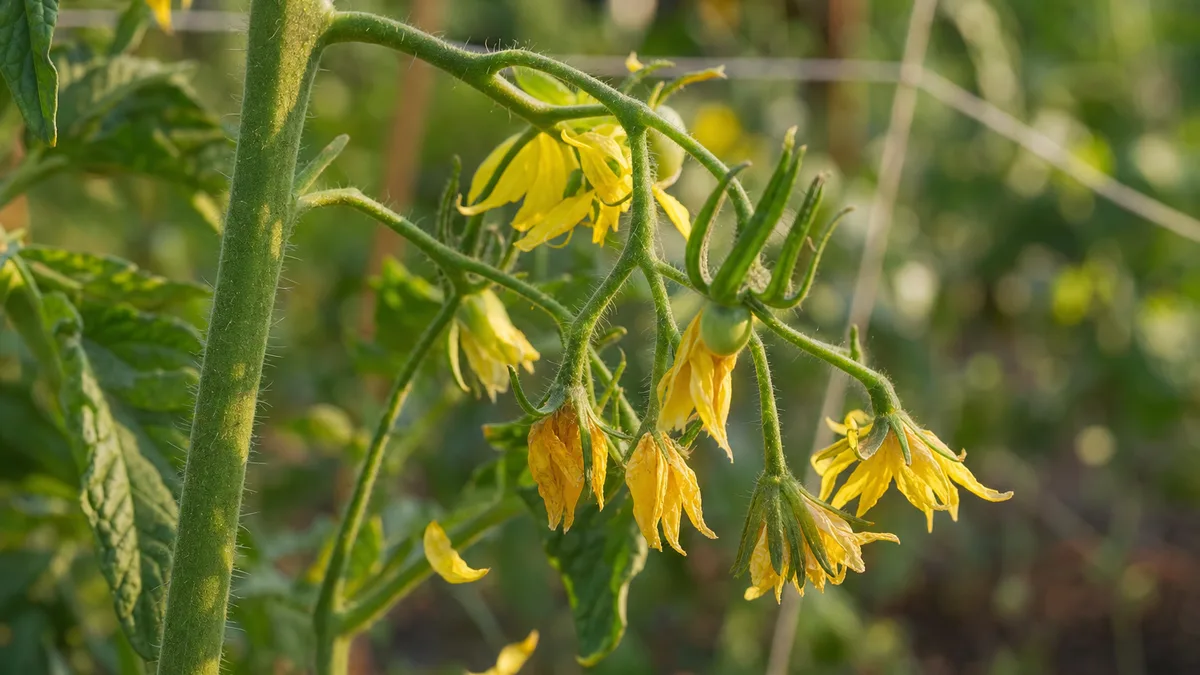
Quick Answer: Why Are My Tomato Flowers Falling Off?
Three questions narrow it down quickly.
What Blossom Drop Is
Blossom drop is what gardeners call it when tomato flowers open, wilt and fall off the truss instead of swelling into fruit. It is a stress response, not a disease, and nothing is infecting the plant.
A tomato flower has both male and female parts, and it only turns into a fruit if pollen gets from one to the other while the pollen is still viable. Anything that interferes with that, such as heat, cold, dry soil, shade or too much nitrogen, can end with the flower dropping. Oklahoma State University Extension describes blossom drop as the result of conditions that are less than ideal for the plant, and the University of Maryland Extension lists the same short group of causes for peppers and beans too. The sections below take them one at a time, starting with the one that matters most.
Temperature: The Numbers From Extension Sources
Temperature is the cause extension educators name first, and it works in both directions. The sources do not agree on a single set of cutoffs, so here is what each one says, side by side. Treat them as ranges, not as a switch that flips at one exact degree.
Night temperatures
- Too cool: Oklahoma State University Extension says fruit set suffers when nights fall below about 60°F. The University of Missouri, Oregon State University Extension and the University of Maryland Extension all give 55°F instead, so the low-end figure runs from 55°F to about 60°F depending on the source.
- Too warm: The University of Missouri, Oklahoma State, Mississippi State University Extension, Ohio State University Extension and the University of Minnesota Extension all point to nights staying above 70°F. North Carolina Cooperative Extension and the University of Arizona Cooperative Extension put the line a little higher, at 75°F.
Daytime temperatures
The daytime figure varies more. The University of Minnesota Extension, Ohio State and the University of Missouri point to sustained days above 85°F. Oregon State and Mississippi State name 90°F, Oklahoma State says consistently above about 92°F, and the University of Arizona and the University of Maryland say tomatoes drop blooms or reduce production above 95°F. Colorado State University Extension says pollen becomes unviable above 85 to 90°F depending on humidity, with 75°F as its night figure. In short, trouble can start in the mid 80s and is nearly certain by the mid 90s.
Why heat matters: the University of Missouri says pollen becomes tacky and non-viable once days exceed 85°F or nights exceed 70°F. The University of Minnesota Extension adds that each new flower has only about a 50-hour window for pollination, and that hot days and especially hot nights during that window can make a whole round of flowers drop. By our own arithmetic, 50 hours divided by 24 hours in a day is a little over 2 days, so one short hot spell can wipe out the flowers that opened that week.
Heat-set and cool-weather varieties
Variety choice changes how much of this you feel. Oregon State University Extension says cherry tomatoes and OSU-bred parthenocarpic varieties set fruit across a wider temperature range. Mississippi State recommends a heat-tolerant variety bred to set fruit under warm temperatures, and the University of Arizona notes that cherry types tolerate a wider range for fruit set than large-fruited types, without giving numbers. Ohio State Extension says heirloom and large slicing tomatoes were affected more often by heat than cherry types. The extension sources I read do not publish a ranked list of named varieties, so check your own state extension or seed catalog for what is bred for your climate.
Poor Pollination: Air Movement, Humidity and Bees
Tomatoes are self-fertile. The University of Missouri says tomatoes are about 98 percent self-pollinated, meaning a flower normally pollinates itself and does not need pollen from a second plant. What the pollen does need is a nudge. Colorado State University Extension explains that tomato flowers can largely self-pollinate with only slight air movement, and that wind helps by knocking pollen off the stamens. The University of Missouri agrees that the transfer from stamen to pistil most often happens because of air movement in the field. Bees help too, because the buzz of their wings vibrates the flower in much the same way.
Humidity plays a part as well. The University of Missouri gives an ideal relative humidity range of 40 to 70 percent for tomato pollination. Colorado State says that when the air is too humid, pollen does not fall off the male parts, and when it is too dry, pollen does not stick to the female parts. Hot and dry or hot and sticky weather can therefore each cause the same drop.
Wind cuts both ways. Gentle air movement is useful, but North Carolina Cooperative Extension says prolonged windy conditions can also cause blossom drop and suggests a windbreak where the wind is constant. The University of Maryland Extension likewise advises protecting vegetables from wind and mentions hot, dry winds as a cause of poor fruit set.
If the weather is fine and flowers still drop, you can help the pollen along. Colorado State says you can sometimes do it by lightly tapping the flower, and its author suggests an electric toothbrush as a vibration tool. The University of Missouri notes that growers shake flowers mechanically in greenhouses and high tunnels. None of the sources I read gives a time of day or a schedule for hand-shaking, and none shows it rescuing flowers during extreme heat, when the pollen itself is the problem.
Water Stress, Excess Nitrogen and Too Little Light
Uneven watering
Oklahoma State says dry soil can cause blossoms to dry and fall, and that root damage can reduce the plant’s moisture intake too. Its advice is to water tomatoes regularly and never let the soil dry out, and to mulch with straw, black plastic or another material to reduce moisture loss. Oregon State agrees that tomato, pepper and eggplant blossoms drop when the plants are water-stressed, and recommends watering deeply but not often. The University of Arizona stresses steadiness: it advises keeping a constant irrigation routine through the season because abrupt changes can aggravate blossom and fruit drop. Our guide to organic vs. inorganic mulch compares the options.
One disagreement is worth knowing about. The University of Maryland Extension says wetting plant foliage during hot, dry periods can reduce heat stress and encourage flower and fruit set, while Ohio State Extension says to water deeply at the root zone and not to overhead irrigate. Root-zone watering is the safer default for tomatoes, which is why a drip line is so useful. The Drip Irrigation Calculator can size one for your tomato row.
Too much nitrogen
If the plant is lush and dark green but short on flowers, look at what you have been feeding it. Oklahoma State says excess nitrogen promotes leaf growth at the expense of blossom and fruit formation, and advises reducing nitrogen applications if necessary. The University of Missouri also says to avoid excess nitrogen because it favors vegetative growth over fruit set, and the University of Minnesota Extension advises fertilizing according to the weather and the plant. North Carolina Cooperative Extension adds a useful reality check: excess high-nitrogen fertilizer can cause blossom drop, but extreme temperatures are the most common cause. Our guide to the best tomato fertilizer covers a balanced approach instead of a heavy nitrogen dose.
Too little light
Oklahoma State says plants receiving less than six hours of sunlight a day produce few blossoms, and suggests moving container plants to a sunny porch or patio if your yard is shady. The University of Maryland Extension lists excessive shade among the causes of poor fruit set, while also suggesting late afternoon shade for peppers and tomatoes in hot places. Those two ideas fit together: you want plenty of morning and midday light, not a plant buried in shade all day.
Peppers and Beans Drop Flowers Too
Peppers follow the same pattern with a few different numbers. The University of Maryland Extension says night temperatures below 60°F and above 75°F, or day temperatures above 95°F, can make pepper flowers and small fruits drop, and notes that plants often stop producing during mid-summer heat. Oregon State University Extension gives tighter figures: normal pollination and fruit set do not occur when night temperatures fall below 58°F or daytime temperatures rise above 85°F. Oregon State also says pepper plants need at least six hours of sun a day or they may not bloom. Ohio State Extension reports that bell peppers were affected by heat more than hot chili types. If you are growing from seed this year, our pepper seed-starting guide covers how they are started.
Beans drop flowers in heat as well. The University of Maryland Extension says bean plants stop flowering or flowers die when temperatures exceed 85°F. The University of Minnesota Extension, Oregon State and the University of Arizona put the threshold at 95°F for green or snap beans, and Minnesota adds that flowers abort more readily when the soil is dry and that heat reduces pollen, leading to fewer, smaller pods. Oregon State also lists under-watering as a cause. As with tomatoes, the sources differ by about 10°F, so watch your own plants rather than a single cutoff. Our bean growing guide covers the basics of getting a bean crop started.
What to Do, and What Not to Do
What helps
- Keep the water even. Water deeply at the root zone on a regular schedule, and mulch to hold moisture. Oklahoma State, Oregon State, Ohio State and the University of Arizona all point in this direction.
- Hold back on nitrogen. If the plant is all leaf, skip the next feeding and let the plant rebalance, per Oklahoma State and the University of Missouri.
- Shade the hottest hours where practical. The University of Maryland Extension suggests late afternoon shade for pepper and tomato plants. The University of Missouri describes shade cloth for greenhouses and high tunnels, and says shading does not change night temperatures, so it will not fix warm nights. Ohio State Extension describes a 30 percent shade cloth as a fabric that reduces light and heat penetration by 30 percent, and an educator there suggested it for high tunnel growers in July and August to protect fruit. Extension sources I read do not give a start date for shade cloth in a home garden bed.
- Give flowers a gentle tap or shake. Lightly tapping the truss helps move pollen, per Colorado State. Do not expect it to beat extreme heat.
- Time planting and pick varieties for your climate. Oklahoma State advises planting early, mid and late-season varieties at the appropriate time of year. Colorado State suggests planting earlier or later in the season to avoid the hottest weather during bloom, and choosing heat-resistant varieties. Use the Frost Date Calculator to find your frost date, then count back and forward from the date you need.
- Be patient. The University of Minnesota Extension says little can be done beyond waiting for heat to pass and that cooler nights should resolve many of these problems. North Carolina Cooperative Extension says the problem typically corrects itself when the weather moderates and that it is probably best to just wait it out. Ohio State Extension says heat causes a noticeable drop-off in harvest within a few weeks.
Our guide to growing tomatoes in raised beds covers spacing and soil.
What not to do: blossom set sprays
Hormone products sold as blossom set sprays come up often. Oklahoma State says they may reduce bloom drop caused by low night temperatures but have little effect on tomato set during high-temperature conditions. North Carolina Cooperative Extension says the sprays help when the problem is low temperatures, but the fruit usually ends up misshapen, and that they do not help with high temperatures. Neither source recommends spraying to solve heat drop, and I am not recommending any product. The other mistakes to avoid are piling on nitrogen to push the plant, swinging between drought and soaking, and pulling plants that are simply waiting out a hot week.
This Is Not Blossom End Rot
The two get confused because both have “blossom” in the name and both are tied to water and heat. They are different problems on different parts of the plant.
- Blossom drop: the flower itself withers and falls off before any fruit forms. The truss ends up bare or with a few tiny stubs.
- Blossom end rot: the fruit did form, but a dark, sunken, leathery patch develops on the bottom end of it. The plant holds onto the fruit.
Blossom drop means a lost flower, so there will be less fruit later. Blossom end rot damages fruit that is already growing. Even watering helps both, but the rest of the story differs, so use the guide that matches what you see.
Quick Reference Table
| Cause | What extension sources say | What to do |
|---|---|---|
| Hot days | Problems from 85°F to 95°F depending on source (Minnesota, Missouri, Oklahoma, Arizona) | Water evenly, shade the afternoon, wait for cooler weather |
| Warm nights | Above 70°F to 75°F (Missouri, Oklahoma, North Carolina) | Nothing changes night temperature; shade does not help, so be patient |
| Cold nights | Below 55°F to 60°F (Missouri, Oklahoma, Oregon State) | Wait it out; blossom set sprays are said to help only with cold |
| Poor pollination | Humidity 40 to 70 percent is ideal (Missouri); air movement moves pollen | Tap trusses gently; avoid constant strong wind |
| Water stress | Dry soil makes blossoms dry and fall (Oklahoma State) | Deep, regular watering and mulch |
| Excess nitrogen | Leaves grow at the expense of blossoms (Oklahoma State, Missouri) | Reduce nitrogen applications |
| Too little light | Under six hours of sun gives few blossoms (Oklahoma State) | Move containers to a sunnier spot |
| Peppers and beans | Peppers: nights below 58°F to 60°F or above 75°F; beans: flowers die from 85°F to 95°F | Same steps: even water, shade, patience |
If this does not match what you see, our full Plant Problem Diagnosis guide will point you to the right one.
Free book · 23 pages, PDF
Blossom Drop FAQ
Why are my tomato flowers falling off?
Extension sources most often point to temperature. Oklahoma State University Extension says fruit set suffers when nights are below about 60 degrees F or above 70 degrees F, or when days are consistently above about 92 degrees F. Dry soil, excess nitrogen, too little sun and poor pollination can also cause flowers to drop.
Will my tomatoes flower again after blossom drop?
Yes. The sources say the problem generally corrects itself when the weather moderates. North Carolina Cooperative Extension says it is probably best to just wait it out, and the University of Minnesota Extension says cooler nights should resolve many of these problems. New trusses should set once pollen is viable again.
Do tomatoes need bees to set fruit?
Not strictly. The University of Missouri says tomatoes are about 98 percent self-pollinated, and Colorado State University Extension says they can largely self-pollinate with slight air movement. Bees and wind help by vibrating the flower, and gently tapping a truss can do a similar job.
Do blossom set sprays work?
Only in limited cases. Oklahoma State University Extension says they may reduce bloom drop from low night temperatures but have little effect during high temperatures, and North Carolina Cooperative Extension says fruit often ends up misshapen when the sprays are used. Neither source recommends them for heat-related drop.
Can too much fertilizer make tomato flowers drop?
It can. Oklahoma State University Extension says excess nitrogen promotes leaf growth at the expense of blossom and fruit formation, so reduce nitrogen applications if needed. North Carolina Cooperative Extension adds that extreme temperatures are the more common cause.
Is blossom drop the same as blossom end rot?
No. Blossom drop means the flower falls off before fruit forms. Blossom end rot is a dark, sunken patch on the bottom of a fruit that has already developed, and it has its own cause and fix.
Sources & further reading
Temperature ranges, pollination, water, nitrogen and spray guidance come from these land-grant university extension pages. Where they disagree, the text above gives the range. Oklahoma State University Extension, tomato blossom drop and poor fruit set. University of Missouri, Understanding Tomato Fruit Set. University of Minnesota Extension, how excessive heat affects the vegetable garden. University of Maryland Extension, poor blossom and fruit set of vegetables. Oregon State University Extension, why vegetables drop blossoms. North Carolina Cooperative Extension, Burke County Center, blossom drop. University of Arizona Cooperative Extension, Flower and Fruit Drop. Mississippi State University Extension, why tomatoes do not produce fruit in late summer. Colorado State University Extension, Pueblo County, tomato flowers. Ohio State University Extension, Franklin County, keeping tomatoes healthy in hot weather. For how we choose sources, see our methodology page.
Free book · 23 pages, PDF
The Plant Problem Diagnosis Quick Reference
Sent