Growing tomatoes in raised beds is genuinely one of the better ways to grow them: better drainage, earlier-warming soil, and full control over the soil mix all work in your favor. But raised beds also introduce one specific problem that most general tomato guides never connect back to the bed itself: they make blossom end rot more likely, not less. This guide covers the bed-specific side of growing tomatoes (depth, spacing, soil, and that raised-bed connection) as the companion piece to our tomato seed-starting guide, which covers germination and the indoor side of the process.
Why Raised Beds Suit Tomatoes
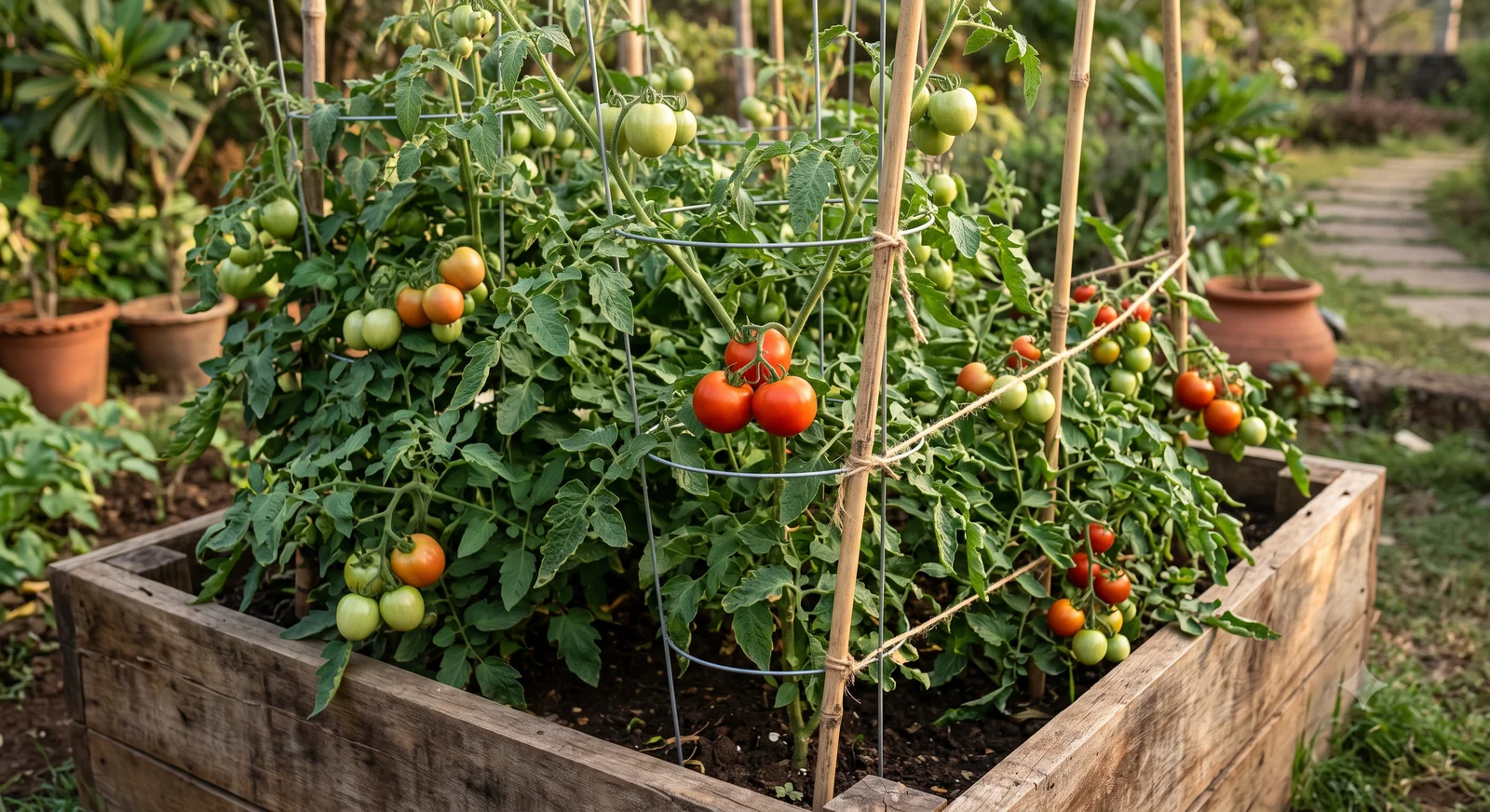
Tomatoes genuinely do better in raised beds than in compacted native soil, for a handful of concrete reasons rather than a vague sense that raised beds are “better.” Drainage is the biggest one: tomatoes are prone to root rot and various fungal problems in soil that stays soggy, and a raised bed’s elevated structure drains excess water far more reliably than flat ground. Soil in a raised bed also warms up earlier in spring, since it’s not insulated by the surrounding earth the way an in-ground bed is, which is useful for a warm-season crop that won’t tolerate cold soil at transplant time.
The other real advantage is control. You choose exactly what goes into the soil mix instead of working with whatever your yard happens to have, and amending a contained raised bed is far more practical than trying to rework the texture of an entire in-ground garden. Our Raised Bed Soil Calculator works out exactly how much soil mix a bed of any size needs.
How Deep Should a Raised Bed Be for Tomatoes?
Tomatoes are deep-rooted plants, and depth matters more for them than for most vegetables. 12 inches is a workable minimum, but 18 inches or more is genuinely better, especially for indeterminate varieties that keep growing and producing all season and need the root volume to support that.
One detail worth knowing before you over-build a bed: if it sits on open native soil rather than a hard surface like a patio or deck, it effectively gains depth beyond its own walls, since roots aren’t stopped by the bottom of the frame and can keep growing down into the ground underneath. Our Raised Bed Soil Calculator makes this same point directly: a bed on open ground doesn’t need to be filled to a towering height just to give tomato roots the room they want, since the frame’s walls aren’t a hard floor.
Tomato Spacing in Raised Beds
Space tomato plants about 24 inches apart in a raised bed, which gives each plant roughly 4 square feet. That fits about 4 plants in a 4×4 bed and 8 in a 4×8 bed. Single-stem tomatoes pruned to one vine and tied to a tall stake or string can go as close as 12 to 18 inches; large caged indeterminate varieties do better at the full 24 to 36 inches.
Tomato plant spacing in a raised bed runs noticeably tighter than the same crop in a traditional row garden, and there’s a real mechanical reason why. Our own Plant Spacing Calculator explains it well: because you never walk on the soil in a raised bed, it never compacts the way foot-trafficked soil between garden rows does, so roots can spread more freely in every direction. That’s why raised beds typically support roughly 20–30% tighter spacing than the same crop grown in rows. Tomatoes are the clearest example of this: spaced around 36 inches apart between rows in a traditional garden, they can often go down to about 24 inches in a well-built raised bed.
For a practical sense of how that plays out, here’s roughly how many tomato plants fit common raised bed sizes, based on the standard 4 square feet per plant a tomato needs at maturity (the same figure our Plant Spacing Calculator uses):
| Bed Size | Area | Tomato Plants |
|---|---|---|
| 2×4 ft | 8 sq ft | 2 plants |
| 3×6 ft | 18 sq ft | 4 plants |
| 4×4 ft | 16 sq ft | 4 plants |
| 4×8 ft | 32 sq ft | 8 plants |
These counts assume roughly 24-inch spacing in both directions, which is the tighter, raised-bed-appropriate end of a tomato’s range rather than the full 36-inch traditional row spacing. If you’re growing several sprawling indeterminate varieties in a smaller bed, leaning toward the wider end of that range (and toward the lower plant counts in the table) keeps airflow reasonable and makes staking easier later. Plug your own bed’s exact dimensions and variety into the Plant Spacing Calculator for a precise count, or see our Tomato Plant Spacing guide for the full staked-vs-caged-vs-sprawling breakdown. For the 4×8 size specifically, including how much soil it takes to fill and what else fits alongside the 8 tomato plants, see our 4x8 raised bed soil and planting guide.
Best Soil Mix for Raised Bed Tomatoes
Don’t fill a raised bed with straight topsoil or garden soil dug from the yard. It compacts hard in a raised bed and drains poorly. The standard raised bed soil mix is 60% topsoil, 30% compost, and 10% perlite or coarse sand for drainage, per our Raised Bed Soil Calculator, which also works out exactly how much of each component a bed of any size needs.
Tomatoes are heavy feeders specifically, so it’s worth leaning toward the compost-heavy end of that range rather than the minimum. Our Topsoil vs. Garden Soil article makes the same point from a slightly different angle: a 50/50 topsoil-to-garden-soil blend is a reasonable default for most raised beds, but for heavy feeders like tomatoes, shifting toward 60% garden soil and 40% topsoil gives the extra organic matter and nutrients tomatoes draw on over a full season.
Transplanting Tomatoes Into a Raised Bed
Planting tomatoes in raised beds successfully comes down to two things: depth and timing. Transplant depth matters more for tomatoes than for almost any other vegetable. Bury the stem deep, up to the lowest set of leaves, not just at the same soil line the plant was growing at in its pot. The buried section of stem, including the fine hairs visible along it, grows into roots underground, giving the plant a sturdier root system than a shallow transplant would have. This is the same guidance our tomato seed-starting guide covers for potting up and transplanting indoor-started seedlings, and it applies the same way whether the seedling came from your own seed tray or a nursery six-pack.
Wait until the soil has genuinely warmed before transplanting, not just until the calendar says it’s safe. Tomatoes are tender and stall out badly in cold soil. If you don’t know your last frost date, our Frost Date Calculator estimates it by ZIP code. And harden off transplants before they go in the ground: a week or so of gradually increasing outdoor exposure toughens the plant up so the move into full sun and wind doesn’t shock it.
Blossom End Rot: Why Raised Beds Are More Prone
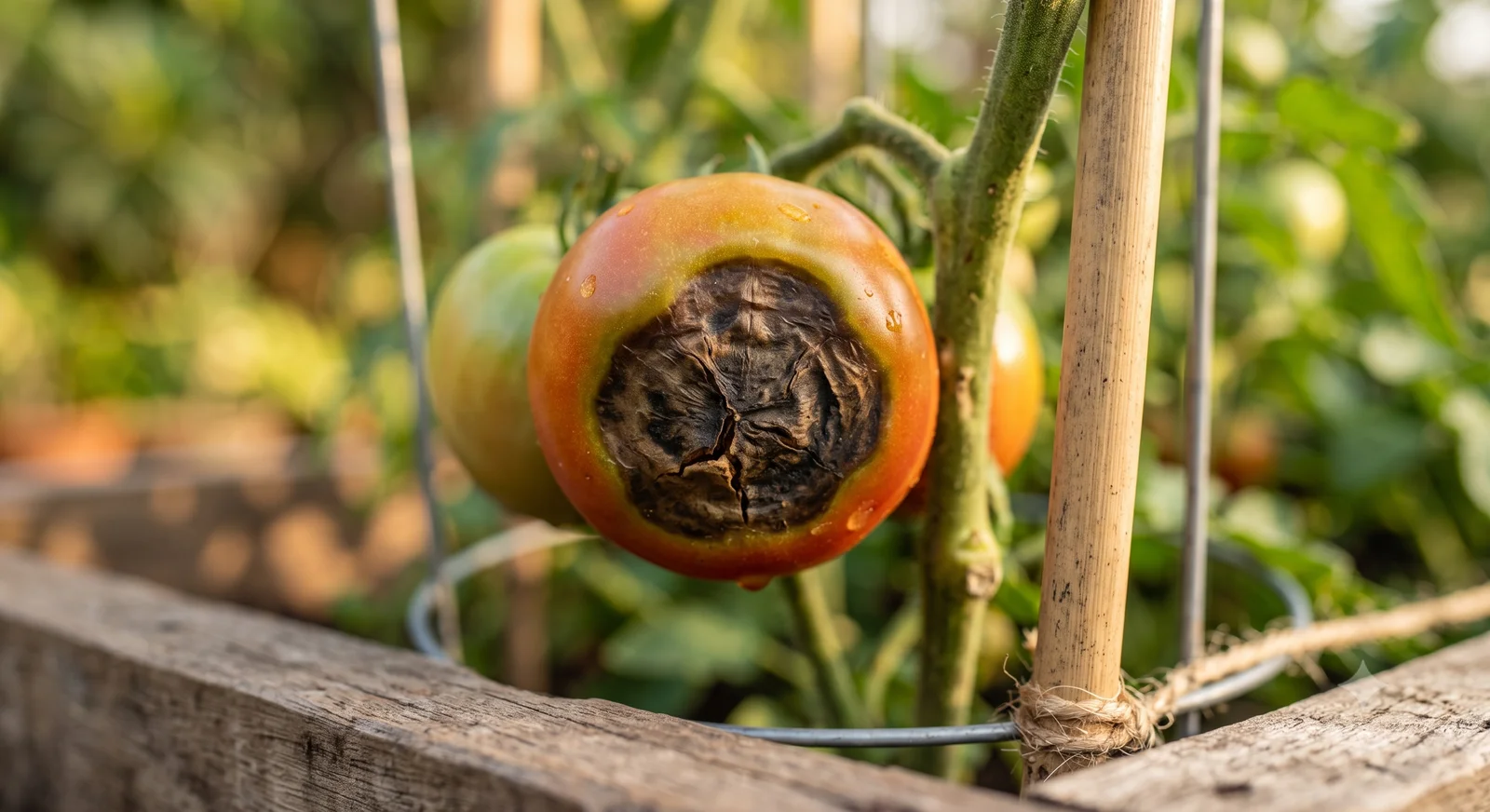
Blossom end rot shows up as a dark, sunken, leathery patch on the bottom of the fruit (the blossom end, opposite the stem), and it’s one of the most common problems tomato growers run into, especially in raised beds specifically.
It is genuinely a calcium deficiency in the developing fruit, but almost never because the soil actually lacks calcium. The real mechanism is inconsistent watering: calcium moves through the plant dissolved in water, and when soil moisture swings between too wet and too dry, the plant can’t move calcium into the fruit reliably as it forms, even when there’s plenty of calcium sitting in the soil the whole time.
This is the raised-bed connection specifically. Per the Pacific Northwest Pest Management Handbooks, blossom-end rot is more likely to develop in raised beds than in-ground, and especially in the south- or southwest-facing corners of a bed, where soil dries out fastest. It’s a direct consequence of the same qualities that make raised beds good for tomatoes in the first place: better drainage and faster-warming soil also mean moisture swings happen faster and more severely than in a larger, more thermally stable in-ground plot.
Don’t just add calcium as a first response. Utah State University Extension notes that most soils already have plenty of calcium, and calcium additions generally aren’t recommended without a soil test actually confirming a real deficiency. Our Soil Test Results article covers how to read one. Adding calcium to soil that already has enough of it doesn’t fix an inconsistent-watering problem, since the deficiency was never really about total calcium supply.
Excess nitrogen makes blossom end rot worse, not better, by increasing the plant’s overall calcium demand at exactly the wrong time. If you’re fertilizing on a fixed schedule rather than by soil test, our NPK Calculator can help you dose more precisely instead of guessing.
Some tomato varieties show it more than others. University of Connecticut’s Home Garden Education Center notes that larger and elongated varieties (paste and plum types especially) have a higher calcium demand and tend to show blossom end rot first and worst; cherry tomatoes rarely develop it at all.
One honest note: a bit of blossom end rot on a plant’s very first fruits of the season is fairly normal and doesn’t necessarily mean anything is wrong. Plants are under real stress during that initial fruit-set period, and it’s common for the problem to resolve on its own as the plant settles into a more consistent watering rhythm and later fruit sets normally.
Preventing Blossom End Rot in a Raised Bed
Since inconsistent watering is the real cause, consistent watering is the real fix. Aim for 1–2 inches of water per week, applied deeply enough to moisten the soil to at least 6 inches down rather than a light surface sprinkle that only wets the top inch. Check depth occasionally by digging a small hole after watering to confirm the water actually penetrated that far.
Heavy mulching helps a lot here, since it buffers the soil against the fast evaporation that makes raised beds especially prone to moisture swings in the first place. Our Mulch Calculator works out how much you’ll need for a bed of any size.
The most reliable fix, though, is taking manual watering out of the equation entirely with drip irrigation on a timer. Consistent, scheduled watering removes the human factor (a missed watering day during a hot stretch, or an overcorrection afterward) that’s usually what actually causes the swings. Our Drip Irrigation Calculator works out run time and water delivered for your specific setup.
Staking and Supporting Tomatoes in a Bed
In the confined space of a raised bed, how you support tomato plants matters more than it would in an open row garden. Cages are the simplest option and work well for determinate varieties that stay relatively compact. Staking takes more ongoing effort (tying the plant up as it grows) but takes up less lateral space, which matters in a smaller bed where every square foot is already accounted for. Trellising works especially well for indeterminate varieties that keep climbing all season, and it’s often the most space-efficient option of the three in a tight bed.
Whichever method you use, the goal is the same: keep fruit and foliage off the soil. Contact with wet soil is a common source of fungal disease, and lifting the plant up also means you’re making better use of a raised bed’s naturally limited footprint instead of letting sprawling vines eat into space you’d planned for something else. If yellowing or spotted leaves show up despite good airflow, our Why Are My Tomato Leaves Turning Yellow? guide walks through diagnosing the cause by symptom.
What to Plant With Tomatoes in a Raised Bed
Our own Companion Planting Chart lists basil, onions, chives, and lettuce as good companions for tomatoes, and specifically flags kale and dill as ones to keep apart from tomatoes. Basil is the classic pairing for a reason gardeners genuinely notice, but any of those four work well tucked in around tomato plants in the same bed without competing for the space tomatoes need.
Free book · 23 pages, PDF
Raised Bed Tomatoes FAQ
How many tomato plants can I grow in a 4x4 raised bed?
About 4 plants, based on the standard 4 square feet per tomato plant at maturity and roughly 24-inch spacing appropriate for a raised bed. That figure assumes determinate varieties or careful staking. If you're growing several large indeterminate varieties, 3 plants gives you more room to stake and maintain airflow. See our Plant Spacing Calculator for an exact count based on your variety.
Is it better to plant tomatoes in the ground or in a raised bed?
Raised beds have real, genuine advantages for tomatoes (better drainage, earlier-warming soil in spring, and full control over the soil mix), which is why they're such a common choice. The tradeoff is that raised beds are more prone to blossom end rot specifically, since they drain and dry out faster than in-ground soil, so watering consistency matters more in a raised bed than it does in the ground.
How do you stop blossom end rot on tomatoes?
Water consistently rather than adding calcium as a first response: 1-2 inches per week, applied deeply enough to moisten soil to at least 6 inches down. Heavy mulch and drip irrigation on a timer both help maintain that consistency, which is usually the actual fix, since blossom end rot is almost always a watering problem rather than a true soil calcium shortage.
Is it better to stake or cage tomatoes?
It depends on the variety and how much space you have. Cages are simpler and work well for compact determinate varieties. Staking takes more regular tying-up effort but uses less lateral space, which matters in a tight raised bed. Indeterminate varieties that keep climbing all season often do best trellised, which tends to be the most space-efficient option of the three in a confined bed.
How deep should soil be for tomatoes?
12 inches is a workable minimum, but 18 inches or more is better, especially for indeterminate varieties with a full season of root growth ahead of them. If a raised bed sits on open native soil rather than a hard surface, it effectively gains depth beyond the frame itself, since roots can keep growing down past the bottom of the bed.
Sources & further reading
For the raised-bed connection to blossom end rot specifically, see the Pacific Northwest Pest Management Handbooks’ tomato blossom-end rot page. For watering guidance and variety susceptibility, see the University of Connecticut Home Garden Education Center’s guide to blossom-end rot. For the calcium-testing guidance, see Utah State University Extension’s blossom end rot guidance. For more on how we source and review the facts behind every calculator and guide on this site, see our methodology page. And for more on spacing, timing, and companion planting across the whole garden, see our complete guide to spacing and planting.