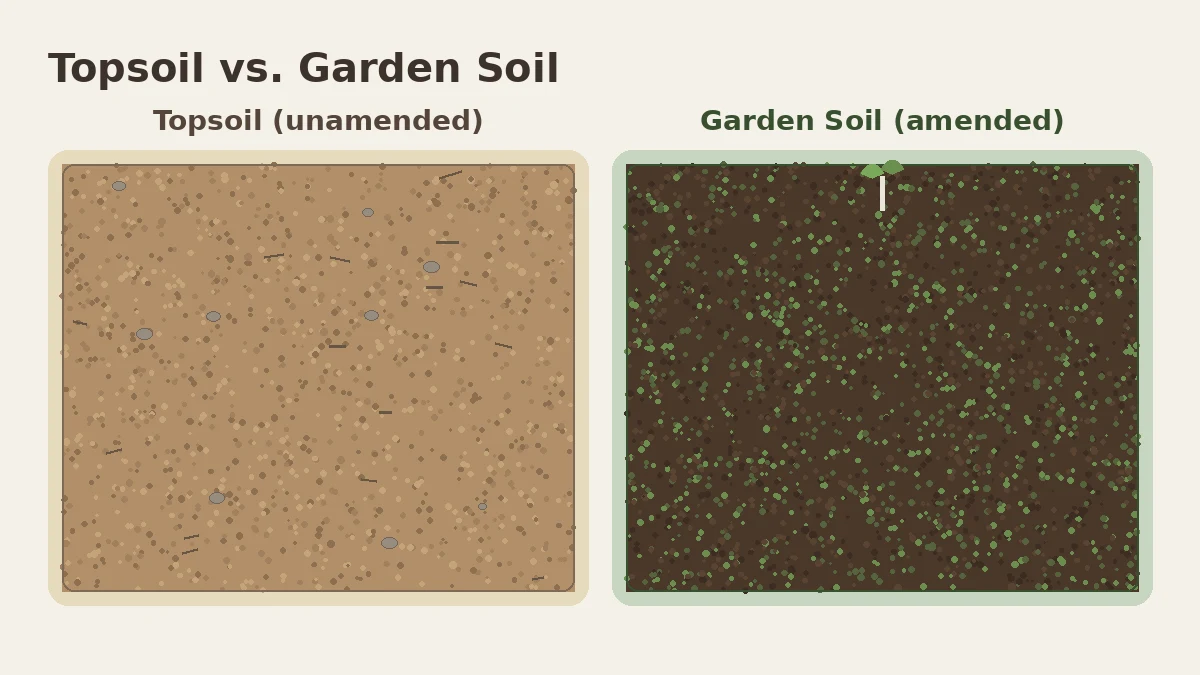
The short version, side by side:
| Topsoil | Garden Soil | |
|---|---|---|
| Composition | Native sand, silt, and clay in whatever ratio occurs on site, with no compost added | Topsoil (or a similar base) blended with compost and other organic matter |
| Moisture retention | Depends entirely on the native clay/sand mix: it can drain too fast or hold too much water | Improved by organic matter, which holds moisture while still allowing drainage |
| Nutrient content | Low to moderate and unstandardized: fertility varies by where it was dug | Higher and more consistent: compost adds nutrients and evens out fertility |
| Best use | Bulk fill, grading, building volume under a bed | Direct planting: raised beds, containers, vegetable and annual beds |
| Relative cost | Lower: a raw material | Higher: a finished, ready-to-plant product |
What Is Topsoil?
Topsoil is exactly what it sounds like: the top layer of native ground, typically the first 2–12 inches, where most biological activity and organic matter naturally accumulate. Bulk and bagged topsoil sold at garden centers is usually stripped from a field or excavation site, then sold with little to no amendment. It’s a raw material, not a finished growing medium: it may contain clay, sand, rocks, weed seeds, or debris depending on where it was sourced, and its fertility varies widely because nothing has been added to standardize it.
As a rough composition benchmark, soil scientists generally consider a mix of about 40% sand, 40% silt, and 20% clay (a texture called loam) to be ideal for plant growth: enough sand for drainage, enough clay to hold nutrients and moisture, and enough silt to bridge the two. Native topsoil rarely lands exactly on that ratio; it’s a useful reference point for judging what you’ve got, not a spec you should expect a truckload of raw topsoil to meet.
Topsoil vs. Fill Dirt
“Topsoil” and “fill dirt” (sometimes sold as “clean fill”) get used interchangeably at some supply yards, but they’re not the same material. Fill dirt is typically subsoil or excavation spoil dug from well below the surface, largely sterile mineral material with little to no organic matter or biological activity. It’s sold cheap because its only job is occupying volume, not supporting plant life. Topsoil, even unscreened and unamended, comes from the biologically active surface layer and retains some organic matter, though far less than garden soil does.
If a supplier’s listing doesn’t specify which one you’re getting, ask. Filling a low spot or a utility trench with fill dirt is perfectly fine: that’s exactly what it’s for. But using it as the top layer under new turf or plantings will leave you with dead, compacted ground that nothing establishes well in.
What Is Garden Soil?
Garden soil starts from topsoil (or a similar base) and adds compost, aged manure, or other organic matter specifically to make it suitable for planting. The blending improves drainage, adds nutrients, and creates a looser structure that plant roots can actually move through. Bagged “garden soil” products are formulated this way on purpose. It costs more than plain topsoil because it’s a finished, ready-to-plant product rather than a raw material.
When Should You Use Each One?
The distinction comes down to filling versus planting:
- Use topsoil for grading, filling low spots in a lawn, building up a large volume under a raised bed before a thinner layer of better soil goes on top, or anywhere you need bulk fill and plants won’t be rooting directly in it.
- Use garden soil (or topsoil blended with compost yourself) for raised beds, containers, and any spot where you’re planting directly: vegetables, annuals, perennials all do better in an amended mix than in plain topsoil alone.
A common, cost-effective approach for a deep raised bed: fill the bottom two-thirds with plain topsoil (cheaper, and roots won’t reach it right away), then blend the top layer where roots actually live. A 50/50 topsoil-to-garden-soil blend is a reasonable default for most raised beds: mixed vegetables, herbs, and annuals generally do fine in it. For heavy feeders like tomatoes and squash, shift the ratio toward 60% garden soil / 40% topsoil; the extra compost and organic matter supports the higher nutrient demand those crops put on the soil over a full season.
Price is a real part of that decision, not just horticulture. Bulk topsoil typically runs $12–55 per cubic yard, while garden soil blends run $35–120 per cubic yard, a wide enough gap that the fill-with-topsoil, top-with-garden-soil approach above is also a legitimate cost-saving strategy, not just a horticultural one. On a bed that needs several cubic yards of fill, reserving the pricier garden soil for only the top layer roots actually reach (instead of using garden soil for the whole depth) can cut the total material cost substantially without giving up anything the plants need.
The right choice also depends on what’s going in the ground. Vegetables are heavy feeders and genuinely need garden soil, not topsoil alone: a season of tomatoes, squash, or leafy greens pulls more nutrients out of the soil than unamended topsoil can supply. Root crops like carrots and potatoes need loose, well-draining soil more than they need rich soil: dense or overly rich ground tends to produce forked or misshapen roots, so texture and drainage matter more here than fertility. Established native plants and many perennials, on the other hand, often actually prefer leaner, topsoil-only conditions over rich amended soil: plants adapted to their native range’s naturally lower-nutrient soil can respond to extra fertility with legginess or reduced flowering rather than better growth.
What Is Screened Topsoil?
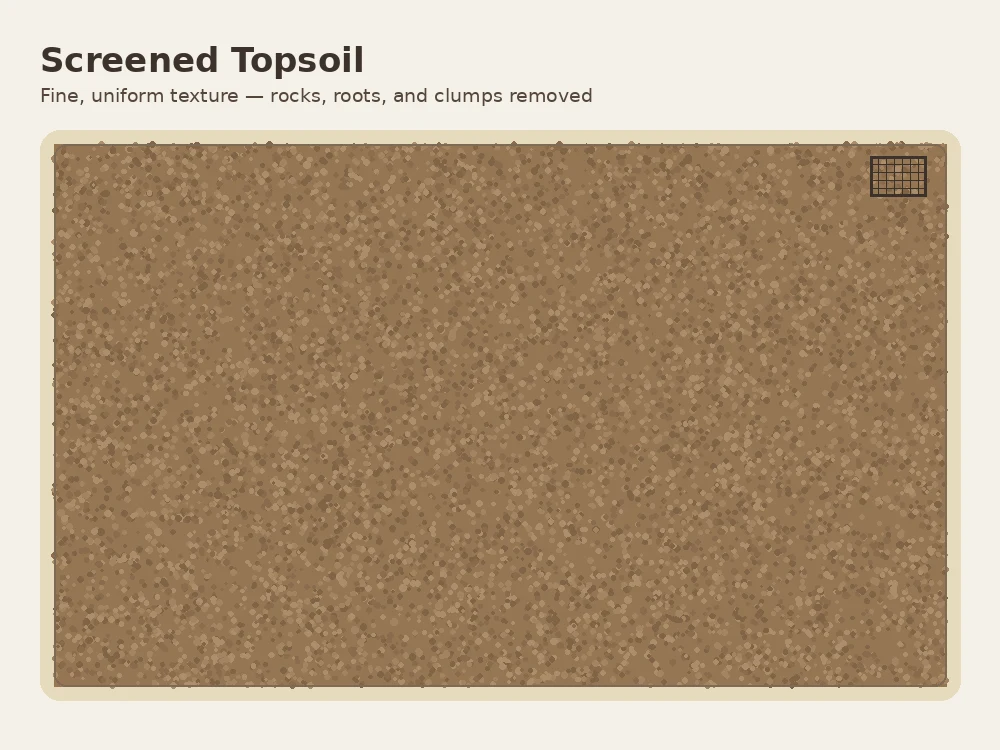
Screened topsoil has been passed through a mesh screen to remove rocks, roots, clumps, and other debris, leaving a finer, more uniform texture. It costs more than unscreened topsoil because of the extra processing step, but it’s worth it anywhere a smooth, workable finish matters: leveling a lawn before seeding, filling around delicate plantings, or any surface you’ll be working by hand. For deep bulk fill where nobody will ever touch the material directly, unscreened topsoil does the job for less money.
How Much Do You Need?
Once you know which one you need, the next question is volume. If you’re ordering plain fill topsoil in bulk, our Topsoil Calculator converts your area and depth into cubic yards and tons. If you’re building a raised bed specifically for planting, the Raised Bed Soil Calculator handles the standard topsoil-compost-perlite blend ratio for you. And if you’re filling containers, an irregular bed, or need the answer in liters as well as cubic feet, the Soil Volume Calculator covers rectangular and cylindrical spaces alike.
Free book · 23 pages, PDF
Sources & further reading
For more on how we build and verify the formulas behind every calculator on this site, see our methodology page. And for the bigger picture on topsoil, garden soil, compost, and mulch working together in one project, see our complete guide to soil and amendments.