A cubic yard of topsoil weighs about 2,000 to 3,400 pounds (1.0 to 1.7 tons), with 2,400 pounds (1.2 tons) a common planning figure. Published dry numbers sit near the light end: Penn State Extension’s dry silt loam works out to about 2,240 pounds. Water and compaction push a delivered load higher. Garden soil mixed with compost is lighter, and our guide to topsoil vs garden soil explains the difference.
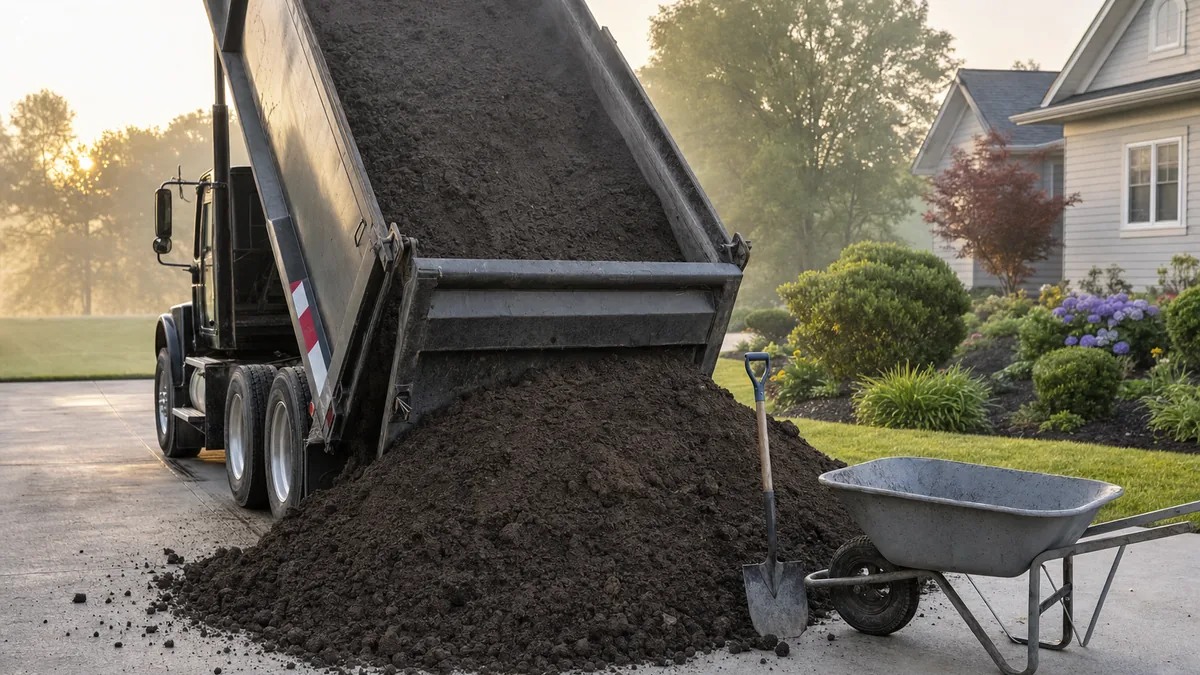
The same pile can differ by a thousand pounds between a dry week and a wet one, so treat any single number as an estimate. The volume side of the conversion is in how many cubic feet are in a cubic yard.
Topsoil Weight Quick Facts
| What | Answer | Source |
|---|---|---|
| Planning range, delivered topsoil | 2,000 to 3,400 lb per cubic yard (1.0 to 1.7 tons) | HarvestMath Topsoil Calculator |
| Planning baseline | 2,400 lb per cubic yard (1.2 tons) | HarvestMath Topsoil Calculator |
| Dry silt loam | 82.99 lb per cubic foot, about 2,241 lb per cubic yard | Penn State Extension |
| Loose dry and loose moist dirt | 76 and 78 lb per cubic foot, about 2,052 and 2,106 lb per cubic yard | Engineering Toolbox |
One cubic yard is 27 cubic feet, so every per-foot figure in this guide is multiplied by 27 to get a per-yard figure. The “dry” in the Penn State number matters. It comes from a bulk density measurement, which our guide to soil bulk density explains, and bulk density counts dry soil only.
How Much Does a Cubic Yard of Each Material Weigh?
The table puts topsoil next to the materials it is usually ordered with. Every row gives its source. Where two sources give different numbers, both are shown, because they do not agree and no single figure is right for every pile. Published sources do not separate screened topsoil from unscreened topsoil, so ask your supplier for the weight of the product you are buying.
| Material | Pounds per cubic yard | Tons per cubic yard | Source |
|---|---|---|---|
| Topsoil, bulk delivery | 2,000 to 3,400 (baseline 2,400) | 1.0 to 1.7 (baseline 1.2) | HarvestMath planning range |
| Dirt, loose and dry | 2,052 | 1.03 | Engineering Toolbox, 76 lb per cu ft |
| Dirt, loose and moist | 2,106 | 1.05 | Engineering Toolbox, 78 lb per cu ft |
| Silt loam, dry | 2,241 | 1.12 | Penn State Extension, 82.99 lb per cu ft |
| Garden soil (topsoil with compost) | 1,800 to 2,200 | 0.9 to 1.1 | HarvestMath planning range |
| Compost | About 1,000 at 50% moisture; 800 to over 1,600 in all | About 0.5; 0.4 to over 0.8 in all | Oregon State University Extension (EM 9217); UNH Extension |
| Clay, dry and wet | 2,700 and 2,970 | 1.35 and 1.49 | Engineering Toolbox, 100 and 110 lb per cu ft |
| Sand, dry and wet | 2,619 and 3,213 (dry 2,800 in one other source) | 1.31 and 1.61 (dry 1.4) | Engineering Toolbox, 97 and 119 lb per cu ft; Minnesota Stormwater Manual, 1.4 tons |
| Gravel | 2,400 to 2,900 planning range; dry 2,835 and wet 3,375 in one other source | 1.2 to 1.45; dry 1.42 and wet 1.69 | HarvestMath planning range; Engineering Toolbox, 105 and 125 lb per cu ft |
| Wood chip mulch | About 230 to 710, median about 490; 400 to 800 planning range | About 0.12 to 0.36; 0.2 to 0.4 | Minnesota Stormwater Manual, 0.138 to 0.422 g/cm³; HarvestMath planning range |
The topsoil and garden soil ranges are the planning ranges our own calculators use. They are not taken from one published study, so the published dry figures from Penn State and Engineering Toolbox are listed beside them. Those fall at the light end of the planning range, as you would expect for a dry, loose pile. The Minnesota Stormwater Manual gives wood chip bulk density in g/cm³, converted here at 62.4 pounds per cubic foot for each g/cm³, the factor Penn State Extension uses.
The Oregon State University Extension publication EM 9217 says screened compost at 50 percent moisture has a bulk density of about 1,000 pounds per cubic yard, and that it can range from 800 to more than 1,600 depending on moisture, particle size and compaction. University of New Hampshire Extension uses 1,000 pounds per cubic yard, give or take a few hundred. The type of mulch is one reason its range is so wide.
Why Does Moisture Change the Weight of Topsoil?
Air in soil weighs almost nothing, but water weighs about 62.4 pounds per cubic foot, the same factor Penn State Extension uses to convert grams per cubic centimeter. That conversion is part of the method in our soil bulk density guide. When rain fills the spaces between grains, those pounds are added to the pile while the volume barely changes. A wet yard of soil is still a yard, but heavier.
The USDA Natural Resources Conservation Service measures this directly. In its Soil Health Guide on bulk density, soil water content is the moist weight minus the dry weight, divided by the dry weight, in grams of water per gram of dry soil. The same guide gets dry weight by dividing moist weight by one plus the water content. Turn that around and moist weight equals dry weight times one plus the water content. The table applies it to Penn State’s dry silt loam of 2,241 pounds per yard. The three water contents are examples picked to show the effect. They are not measurements of any real pile. Raised bed builders feel the effect most, since a bed is filled all at once, and how to fill a raised garden bed covers how to stage the work.
| Water content (g of water per g of dry soil) | Working | Weight per cubic yard |
|---|---|---|
| 0.00 (dry) | 2,241 × 1.00 | 2,241 lb, 1.12 tons |
| 0.10 | 2,241 × 1.10 | 2,465 lb, 1.23 tons |
| 0.20 | 2,241 × 1.20 | 2,689 lb, 1.34 tons |
| 0.30 | 2,241 × 1.30 | 2,913 lb, 1.46 tons |
Sources disagree on how much moisture matters for ordinary dirt. Engineering Toolbox lists loose dirt at 76 pounds per cubic foot dry and 78 moist, a gain of only about 3 percent. For sand its figures are 97 dry and 119 wet, a gain of about 22 percent, for gravel 105 dry and 125 wet, about 19 percent, and for clay 100 dry and 110 wet, 10 percent. The upper end of our topsoil planning range, 1.7 tons, is for topsoil that is both wet and packed. Compost is the most sensitive of all. Oregon State University Extension says very wet compost can have a bulk density of over 1,500 pounds per cubic yard, against about 1,000 at 50 percent moisture.
A truckload from an open stockpile after a rainy week can be heavier than the same volume in August. If you buy by weight, you pay for the water. A weight quote and a yard quote for the same pile will not convert cleanly, because the pounds per yard change with the weather.
Does Soil Texture Change the Weight?
It does, and the sources do not fully agree on the direction. USDA NRCS gives bulk density limits by texture in its Soil Quality Indicators sheet. Which layer you sample matters, and soil profile horizons explains the layers. The “ideal for plant growth” limit is below 1.60 g/cm³ for sandy soil, below 1.40 for silty soil and below 1.10 for clayey soil. The level that restricts root growth is above 1.80, above 1.65 and above 1.47 for the same three textures.
Those are root-health limits, not weights of delivered topsoil, but they can be converted to show the pattern. The table multiplies each limit by 62.4 to get pounds per cubic foot, then by 27 for a yard. It describes dry soil in place, not loose soil in a pile, so use it to compare textures rather than to size a truck. Engineering Toolbox, which lists loose materials and not soil in place, has dry clay at 100 pounds per cubic foot and dry sand at 97, so clay comes out slightly heavier there. Both can be true: one measures packed soil in the ground, the other a loose pile.
| Texture | NRCS ideal limit | Dry lb per cu yd at that limit | NRCS root-restricting limit | Dry lb per cu yd at that limit |
|---|---|---|---|---|
| Sandy | Below 1.60 g/cm³ | About 2,696 | Above 1.80 | About 3,033 |
| Silty | Below 1.40 | About 2,359 | Above 1.65 | About 2,780 |
| Clayey | Below 1.10 | About 1,853 | Above 1.47 | About 2,477 |
Penn State Extension adds that bulk density is usually higher than 1.33 g/cm³ for sandy soils and lower for organic soils, so a topsoil rich in organic matter should weigh less than a sandy one. If you are not sure what you have, a lab report helps, and how to read soil test results shows what the numbers mean.
How Many Tons Is a Yard of Topsoil?
A US ton is 2,000 pounds, so divide the pounds per cubic yard by 2,000. At the 2,400 pound baseline that is 2,400 ÷ 2,000 = 1.2 tons. Going the other way, divide 2,000 by the pounds per yard to see how much of a yard one ton buys. The table does both for the figures used in this guide.
| Weight per cubic yard | Tons per cubic yard | Cubic yards in one ton | Where the figure comes from |
|---|---|---|---|
| 2,000 lb | 1.00 | 1.00 | Light end of the planning range |
| 2,241 lb | 1.12 | 0.89 | Penn State Extension, dry silt loam |
| 2,400 lb | 1.20 | 0.83 | Planning baseline |
| 3,400 lb | 1.70 | 0.59 | Heavy end of the planning range |
So one ton of topsoil is roughly 0.6 to 1.0 cubic yard, and about 0.83 yard at the baseline. Ask a supplier who quotes in tons which pounds per yard they use.
Worked Example: How Heavy Is Soil for a 4x8 Bed at 12 Inches?
A 4 by 8 foot bed filled 12 inches deep holds 4 × 8 × 1 = 32 cubic feet. Divide by 27 and that is 1.185 cubic yards, about 1.2 yards, the same volume given in our guide to soil for a 4x8 raised bed. Now multiply by the weight of a cubic yard.
| Weight basis | Working | Total weight |
|---|---|---|
| Light end of the planning range | 1.185 × 2,000 | About 2,370 lb, 1.2 tons |
| Penn State dry silt loam | 32 × 82.99 | About 2,656 lb, 1.3 tons |
| Planning baseline | 1.185 × 2,400 | About 2,844 lb, 1.4 tons |
| Heavy end of the planning range | 1.185 × 3,400 | About 4,030 lb, 2.0 tons |
So plan on about 2,400 to 4,000 pounds of straight topsoil, call it a ton and a half, and expect it to be at the high end if the pile is wet. A finished raised bed mix is lighter because it contains compost and coarse material. The 4x8 guide uses about 53.3 pounds per cubic foot for a blended bed mix, which gives roughly 1,700 pounds at 12 inches, against about 2,400 to 2,850 pounds for straight topsoil of the same volume. If your bed is a different size, our guide to raised bed garden designs compares common widths and lengths, and the same arithmetic applies.
How Much Topsoil Fits in a Truck or Trailer?
Dump trucks are described by bed volume. The Texas Department of Transportation Maintenance Operations Manual says single-axle trucks normally carry 6 cubic yards of aggregate and that bed capacity for tandem-axle trucks is usually 12 or 14 cubic yards. TxDOT gives no weight or payload figure on that page, so the table below is our arithmetic: bed volume times the pounds per yard used in this guide. A hauler decides how much to load, and a bed that is full by volume can be over its weight limit when the soil is wet.
| Bed volume (TxDOT) | At 2,000 lb per yard | At 2,400 lb per yard | At 3,400 lb per yard |
|---|---|---|---|
| 6 cubic yards, single axle | 6.0 tons | 7.2 tons | 10.2 tons |
| 12 cubic yards, tandem axle | 12.0 tons | 14.4 tons | 20.4 tons |
| 14 cubic yards, tandem axle | 14.0 tons | 16.8 tons | 23.8 tons |
For a pickup or trailer there is no standard bed size, so we give no yard figure. Use the rating instead. Purdue Extension’s publication PPP-106 defines gross vehicle weight rating as the maximum loaded weight a truck or trailer can safely carry, and says it always includes the weight of the truck or trailer itself. Payload is the rating minus the empty weight. Purdue says trailer ratings are usually on a tag near the tongue, and that the weakest component sets the limit for the whole outfit.
To turn a payload into soil, divide it by the pounds per yard. Purdue’s own trailer example has a payload of 1,400 pounds. At 2,000 pounds per yard that is 0.70 cubic yard, at 2,400 it is 0.58 and at 3,400 it is 0.41. Read your own tag for the real figure. Plain topsoil and a blend weigh differently, which is part of topsoil vs garden soil, so say which one you are hauling.
How to Order Topsoil by Weight or by the Yard
Ask the supplier a few questions before the order, not at the gate. Moisture and compaction cause the big swings, so the answers matter more than the base number.
- Work out the volume first. Length times width times depth in feet gives cubic feet, and dividing by 27 gives cubic yards. The Topsoil Calculator above does this and adds a weight estimate.
- Ask what moisture the supplier’s weight assumes. A figure for dry soil and a figure for a rained-on stockpile can differ by hundreds of pounds per yard, as the moisture table shows.
- Ask whether the price is per yard or per ton. If it is per ton, convert both ways before you compare quotes, using the pounds per yard the supplier gives.
- Ask how many yards the truck will actually carry. TxDOT lists bed volumes, but the hauler sets the load, so the answer is their number, not the bed’s.
- If you haul it yourself, check the tag. Subtract the empty weight from the rating to get payload, and divide by 2,400 to 3,400 pounds per yard.
- Round up a little. Loose soil settles after it is placed and watered, a point covered in our 4x8 raised bed soil guide.
For how topsoil, compost and other amendments fit together in a plan, see our complete guide to soil and amendments.
Free book · 23 pages, PDF
Topsoil Weight FAQ
How much does a cubic yard of topsoil weigh?
About 2,000 to 3,400 pounds, or 1.0 to 1.7 tons, with 2,400 pounds (1.2 tons) as a common planning figure. Published dry numbers sit at the lighter end: Penn State Extension's dry silt loam is 82.99 pounds per cubic foot, about 2,241 pounds per yard, and Engineering Toolbox lists loose dry dirt at 76 pounds per cubic foot, about 2,052 pounds per yard. Moisture and compaction move it up.
How many tons is a yard of topsoil?
Roughly 1.0 to 1.7 tons. Divide the pounds per yard by 2,000: at 2,400 pounds that is 1.2 tons, and at Penn State Extension's dry 2,241 pounds it is about 1.12 tons. One ton of topsoil is therefore about 0.6 to 1.0 cubic yard.
How much does a yard of dirt weigh?
Engineering Toolbox lists loose dry dirt at 76 pounds per cubic foot and loose moist dirt at 78, which is about 2,052 and 2,106 pounds per cubic yard. Clay is heavier in the same source at 100 pounds per cubic foot dry and 110 wet, about 2,700 and 2,970 per yard. Fill dirt and topsoil are usually ordered by the same 2,000 to 3,400 pound planning range.
How many cubic yards of topsoil are in a ton?
About 0.83 cubic yard at the 2,400 pound baseline, found by dividing 2,000 by 2,400. Across the 2,000 to 3,400 pound planning range, a ton covers about 1.0 yard down to 0.59 yard. A wetter, heavier pile gives you less volume per ton.
How much does wet topsoil weigh?
More than dry, by the weight of the water. The USDA NRCS Soil Health Guide gives moist weight as dry weight times one plus the water content in grams per gram. Applied to Penn State Extension's dry 2,241 pounds, a water content of 0.20 gives about 2,689 pounds per yard. Our planning range reaches 3,400 pounds, 1.7 tons, for topsoil that is wet and packed.
How much does a yard of compost weigh?
About 1,000 pounds at 50 percent moisture, according to Oregon State University Extension (EM 9217), which says bulk density can run from 800 to more than 1,600 pounds per cubic yard with moisture, particle size and compaction. University of New Hampshire Extension also uses 1,000 pounds per yard, give or take a few hundred. That is well under half the weight of a yard of topsoil.
Sources & further reading
The dry soil weight of 82.99 pounds per cubic foot, the 62.4 conversion factor and the note that bulk density is higher in sandy soils and lower in organic soils come from Penn State Extension’s What is an acre furrow slice of soil?. The bulk density limits by texture come from the USDA NRCS Soil Quality Indicators: Bulk Density sheet, and the soil water content and dry weight relationship from the NRCS Bulk Density Soil Health Guide.
Compost weights come from Oregon State University Extension’s Interpreting Compost Analyses (EM 9217) and the University of New Hampshire Extension Purchasing Compost tip sheet. Wood chip bulk density comes from the Minnesota Stormwater Manual page Wood chips and applications of wood chips in stormwater, and the clean sand figure from its page on material conversions for winter maintenance. Dirt, clay, sand and gravel densities come from the Engineering Toolbox page Dirt and Mud: Densities.
Truck bed sizes come from the TxDOT Maintenance Operations Manual page on haul truck size, and the payload and rating definitions from Purdue Extension’s The Truck-Trailer Combination Vehicle: Making Sure the Numbers Add Up. The topsoil, garden soil, gravel and mulch planning ranges are the ones used by our own Topsoil, Cubic Yard and Soil Weight calculators. For how we source the facts behind every guide, see our methodology page.
Free book · 23 pages, PDF
The Soil & Amendments Cheat Sheet
Sent