A yard of mulch is 27 cubic feet, according to Mississippi State University Extension, and one cubic yard covers 108 square feet at a depth of 3 inches, according to UF/IFAS Gardening Solutions. Below: what that looks like, how the coverage changes at other depths, and how to work out an order. Not sure which material to buy? See organic vs. inorganic mulch first.
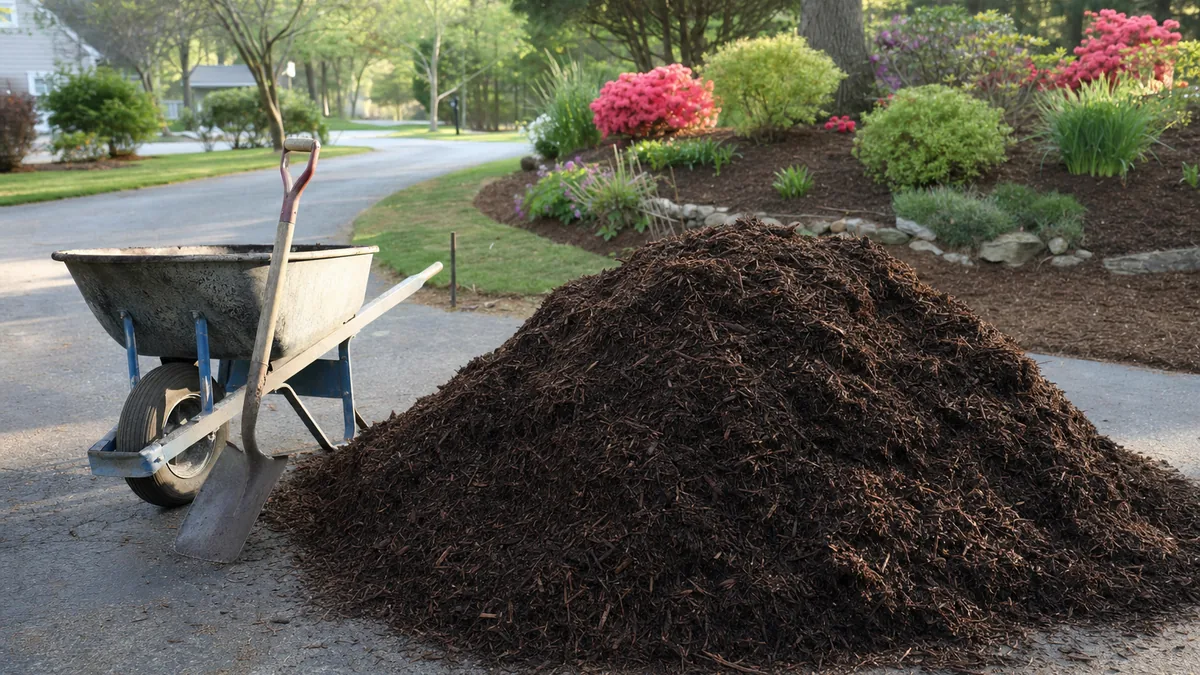
- 1 cubic yard = 27 cubic feet (Mississippi State University Extension).
- 1 cubic yard covers 324 square feet at 1 inch, or 108 square feet at 3 inches (UF/IFAS).
- Formula: cubic yards = depth in inches x area in square feet, divided by 324.
- Most extension guides put mulch depth between 2 and 4 inches.
How Many Cubic Feet Are in a Yard of Mulch?
There are 27 cubic feet in a yard of mulch. Mississippi State University Extension states it plainly (“One cubic yard equals 27 cubic feet”), and the Clark County Master Gardeners, a Washington State University Extension program, say the same in their garden math sheet: divide cubic feet by 27 to get cubic yards. The number comes from the length of a yard. A cubic yard is 3 feet long, 3 feet wide and 3 feet high, and 3 x 3 x 3 is 27.
That conversion does not depend on what you are spreading. Bark, wood chips, compost and soil all use the same 27, which is why the same math runs through our guide to how to fill a raised garden bed. What changes from material to material is the weight and how far a yard spreads, and the rest of this guide deals with both. The full conversion, with a chart, is in how many cubic feet are in a cubic yard, and how many bags of mulch are in a yard turns a yard into bag counts.
How Big Is a Cubic Yard of Mulch?
Picture a cube of mulch 3 feet wide, 3 feet deep and 3 feet high. That is 27 cubic feet, one cubic yard. In practice, delivered mulch is dumped in a loose heap rather than stacked square, so a yard looks like a mound that is wider than 3 feet at the base and lower than 3 feet at the peak. The volume is the same either way.
Two practical points follow from this. First, a yard of mulch is a lot more than most people expect from the word “yard,” because it is a volume, not a length. Second, how much one yard fits in a vehicle depends on the vehicle and on how the supplier measures a load, so ask the supplier how they measure a yard rather than assuming a pickup holds one. When you are not sure how many yards a bed needs, a calculator that converts square feet and inches into yards saves the guesswork.
How Much Area Does a Yard of Mulch Cover?
UF/IFAS Gardening Solutions says one cubic yard of mulch covers 324 square feet of ground at 1 inch deep, or 108 square feet at 3 inches deep. Those two figures come from one formula. A cubic yard is 27 cubic feet, a 1-inch layer is one-twelfth of a foot, and 27 divided by one-twelfth is 324 square feet. Every other depth is 324 divided by the depth in inches. Soil sizes the same way: a 4x8 raised bed filled to 12 inches takes 1.19 cubic yards, as our 4x8 raised bed soil guide shows.
| Mulch depth | Math | Area covered by 1 cubic yard | Cubic yards for 1,000 sq ft |
|---|---|---|---|
| 1 inch | 324 / 1 | 324 sq ft | 3.09 |
| 2 inches | 324 / 2 | 162 sq ft | 6.17 |
| 3 inches | 324 / 3 | 108 sq ft | 9.26 |
| 4 inches | 324 / 4 | 81 sq ft | 12.35 |
Mississippi State University Extension publishes the same formula for working in the other direction: cubic yards equal the thickness of the layer in inches times the area in square feet, divided by 324. The 3-inch row is the one most people need, and the 4-inch row shows why thick layers get expensive in volume: going from 3 inches to 4 inches takes a third more mulch. The last column matches the larger-area table in the Clark County Master Gardeners sheet, which lists 6.17, 9.26 and 12.35 cubic yards per 1,000 square feet at 2, 3 and 4 inches.
One small wrinkle: the same Clark County sheet also gives a rule of thumb that a cubic yard covers about 100 square feet at 3 inches, and a more precise 324 square feet at 1 inch. The 100 is a rounded version of 108, so use 108 if you are buying by the yard. If you think in cubic feet instead, one cubic foot covers 12 square feet at 1 inch or 4 square feet at 3 inches, which is the same math with a smaller unit. The 324 figure works for any loose material spread over flat ground, topsoil included, and topsoil vs. garden soil explains which one a bed needs.
How Deep Should Mulch Be?
Most extension sources land between 2 and 4 inches for organic mulch, but they do not agree exactly, so here is the range and who says what. Penn State Extension says to apply a 2 to 4 inch layer of organic mulch and no more, and to use 1 to 2 inches for fine or double-shredded mulch. University of Minnesota Extension gives 2 to 4 inches for beds. UF/IFAS recommends 3 inches and says not to go deeper. University of Maryland Extension keeps it at 1 to 3 inches, and Colorado State University Extension says 4 inches for general beds.
| Where it goes | Depth | Source |
|---|---|---|
| Flower beds and annuals | About 3 inches | University of Wisconsin Extension Horticulture, UF/IFAS |
| Shrubs and perennial beds | 2 to 4 inches | University of Minnesota Extension, Penn State Extension |
| Trees | 2 to 4 inches (UF/IFAS says 2 to 3) | Penn State Extension, UF/IFAS |
| Vegetable garden, established plants | About 3 inches | University of Wisconsin Extension Horticulture |
| Seedlings, young transplants, small vegetables | About 1 inch | UF/IFAS, University of Wisconsin Extension Horticulture |
| Straw or hay in the vegetable garden | 4 to 6 inches | University of Wisconsin Extension Horticulture |
For vegetables, University of Wisconsin Extension Horticulture says most organic mulches go on about 3 inches deep, but that young transplants need only about 1 inch at first, and low crops such as lettuce and radishes only 1.5 to 2 inches. Compost can serve as a light mulch, and our guide to what you can compost covers what goes into a pile worth spreading.
Depth also depends on the material. Snohomish County, Washington lists wood chips at 3 to 6 inches, bark nuggets at 2 to 4 inches and compost at 1 inch on beds. Mississippi State University Extension lists 2 to 3 inches for pine or hardwood bark and 2 to 4 inches for wood chips, but also says mulch around trees and shrubs in a lawn should be about 4 to 6 inches deep, which is the deepest figure in this guide. A depth of 3 inches sits inside the range given by UF/IFAS, Penn State, Minnesota, Maryland, Wisconsin, Snohomish County and the Mississippi State wood chip table, so it is the safest single number when you are choosing. Apply it after the ground has warmed, and our guide to soil temperature for planting shows how to check.
Why Depth Is Not the Only Rule: Avoid Volcano Mulching
Piling mulch against a trunk is called volcano mulching, and Penn State Extension says it “is never recommended and should not be utilized.” UF/IFAS adds that mulch against a tree base holds moisture and encourages trunk rot, and that the pile can shelter rodents that chew young bark. Our guide to the 8 mulch mistakes that hurt plants explains the root flare and girdling roots in more detail.
Extension sources give different clearances around the trunk. University of Maryland Extension says to keep mulch about 3 inches from the base, University of Minnesota Extension and Colorado State University Extension say 6 inches, and UF/IFAS says about 1 foot for large trees and a couple of inches for smaller plants. For trees you can also lean on the principle Penn State gives for new plantings, “mulch wide, not deep”: spread a flat layer outward rather than heaping it up.
Worked Example: Mulching a Flower Bed
Take a flower border that is 4 feet wide and 20 feet long, which is 80 square feet, and mulch it 3 inches deep as the Wisconsin and UF/IFAS figures suggest. Using the Mississippi State formula:
- Multiply depth by area: 3 inches x 80 square feet = 240.
- Divide by 324: 240 / 324 = 0.74 cubic yards.
- Convert to cubic feet if you are buying bags: 0.74 x 27 = about 20 cubic feet.
The shortcut is the coverage table: a yard covers 108 square feet at 3 inches, so 80 square feet takes 80 / 108, which is the same 0.74. At 2 inches the same border takes 0.49 cubic yards, about 13 cubic feet. If part of the bed already has an old layer, measure what is there and top up to your target depth rather than adding a fresh full layer, since most of the extension sources above cap organic mulch at 3 or 4 inches. If you top beds up in fall, our winterize your garden checklist covers mulch depths before the ground freezes.
Worked Example: Mulching a Tree Ring
A ring is a circle with a hole in the middle, so the area is the full circle minus the mulch-free zone around the trunk. Say you mulch a young tree in a 6-foot-wide circle and keep a 1-foot-wide circle at the center clear of mulch (our example sizes; Penn State Extension says to mulch as far out as the drip line, which grows with the tree, so a mature tree gets a wider ring):
- Full circle: 3.14 x 3 ft x 3 ft = 28.3 square feet.
- Clear center: 3.14 x 0.5 ft x 0.5 ft = 0.8 square feet.
- Ring area: 28.3 - 0.8 = about 27.5 square feet.
- Depth 3 inches: 3 x 27.5 / 324 = 0.25 cubic yards, about 7 cubic feet.
So one tree takes about a quarter of a yard. Widen the ring to 10 feet across and the same math gives about 77.7 square feet and 0.72 cubic yards, nearly three times as much, which is why a mulched ring for a large tree is often a job for bulk delivery. If you are mulching a tree you have just planted, can you plant trees in the winter covers how to mulch and water one that goes in during the cold months.
How Much Does a Yard of Mulch Weigh?
It varies with the type of mulch and how wet it is, so treat any single number with caution. The only government figures we found are the U.S. Environmental Protection Agency’s volume-to-weight conversion factors, which list wood chips at 473 pounds per cubic yard when green and 243 pounds per cubic yard when dry. That is nearly a two-to-one swing for the same volume, and EPA does not list bark mulch or dyed mulch at all. Divided by 27, those figures work out to about 17.5 and 9 pounds per cubic foot. Soil scientists call weight per volume bulk density, and soil bulk density explains how it is measured.
The practical lesson is that fresh, damp mulch is much heavier than dry mulch, and a yard of it is a real load for a wheelbarrow, a trailer or a vehicle with a weight limit. Snohomish County, Washington makes a related point on slopes, warning that wet mulch can become too heavy and contribute to slope failure, which is why you should not exceed the recommended thickness there. For an exact weight, ask the supplier for the specific product, since a calculator cannot know how wet it is.
When Is It Worth Ordering Bulk Mulch?
The answer is when the job is measured in yards rather than a few bags. Bulk mulch is sold by the cubic yard, so the coverage table above converts directly into an order. A 3-inch layer over 1,000 square feet is 9.26 cubic yards, and a big raised bed project, covered in how to fill a raised garden bed, is also counted in yards. Anything at that scale is easier to order loose than to carry out of a store in bags.
Before you order, measure each bed, decide the depth, run the formula and then round up a little for uneven ground. Ask the supplier how they measure a yard, what the mulch is made from, and whether it is aged. Fresh wood chips and mulch from unknown sources can cause problems, covered in the nitrogen and herbicide residue notes in the mistakes guide linked above.
Free book · 23 pages, PDF
Cubic Feet in a Yard of Mulch FAQ
How many cubic feet are in a yard of mulch?
27 cubic feet. Mississippi State University Extension states that one cubic yard equals 27 cubic feet, and the Clark County Master Gardeners (Washington State University Extension) give the same conversion. It holds for any loose material, so a yard of bark, wood chips or compost is 27 cubic feet either way.
How big is a cubic yard of mulch?
A cubic yard is 3 feet by 3 feet by 3 feet, which is 27 cubic feet, the volume Mississippi State University Extension gives. Delivered mulch arrives as a loose mound rather than a neat cube, so it looks wider and lower than 3 feet high, but the volume is the same.
How much area does a yard of mulch cover?
At 3 inches deep, one cubic yard covers 108 square feet, according to UF/IFAS Gardening Solutions. The same source gives 324 square feet at 1 inch. For other depths, divide 324 by the depth in inches: 162 square feet at 2 inches and 81 square feet at 4 inches.
How deep should mulch be?
Most extension guides say 2 to 4 inches. Penn State Extension and University of Minnesota Extension both give 2 to 4 inches, UF/IFAS says 3 inches, and University of Maryland Extension says 1 to 3 inches. Sources differ a little, and finer mulch goes thinner, so about 3 inches is a safe middle for beds.
How many yards of mulch do I need for 1,000 square feet?
At 3 inches deep you need 9.26 cubic yards, according to the larger-area table in the Clark County Master Gardeners sheet. The same table gives 6.17 cubic yards at 2 inches and 12.35 cubic yards at 4 inches. The formula is depth in inches times 1,000, divided by 324.
How much does a yard of mulch weigh?
It depends on the type and the moisture. The U.S. Environmental Protection Agency lists wood chips at 473 pounds per cubic yard when green and 243 pounds per cubic yard when dry. Other mulches will differ, so ask the supplier for the weight of the product you are buying.
Sources & further reading
- UF/IFAS Gardening Solutions, Choosing and Installing Mulches: 324 and 108 square feet per cubic yard, 3-inch depth, volcano mulching and rodents.
- Mississippi State University Extension, Mulches for the Landscape: 27 cubic feet per cubic yard, the 324 formula, depth by material.
- Clark County Master Gardeners (Washington State University Extension), Garden Math: cubic yard conversion and coverage tables per 100 and 1,000 square feet.
- Penn State Extension, Mulching Landscape Trees: 2 to 4 inch depth, volcano mulching, mulching to the drip line.
- University of Minnesota Extension, Mulching for soil and garden health: 2 to 4 inch depth and a 6-inch clear ring.
- University of Wisconsin Extension Horticulture, Mulches for Home Gardens and Plantings: flower bed and vegetable garden depths.
- University of Maryland Extension, Mulching Trees and Shrubs: 1 to 3 inch depth and trunk clearance.
- Colorado State University Extension, Mulching (GardenNotes 245): 4-inch depth, a 6-inch clear zone and no mulch volcanoes.
- Snohomish County, Washington, Mulch: depth by material and the slope warning.
- U.S. Environmental Protection Agency, Volume-to-Weight Conversion Factors: wood chip weights per cubic yard.
For more on how we source and review the facts behind every calculator and guide on this site, see our methodology page. And for the full picture on mulch alongside topsoil, garden soil and compost, see our complete guide to soil and amendments.
Free book · 23 pages, PDF
The Soil & Amendments Cheat Sheet
Sent