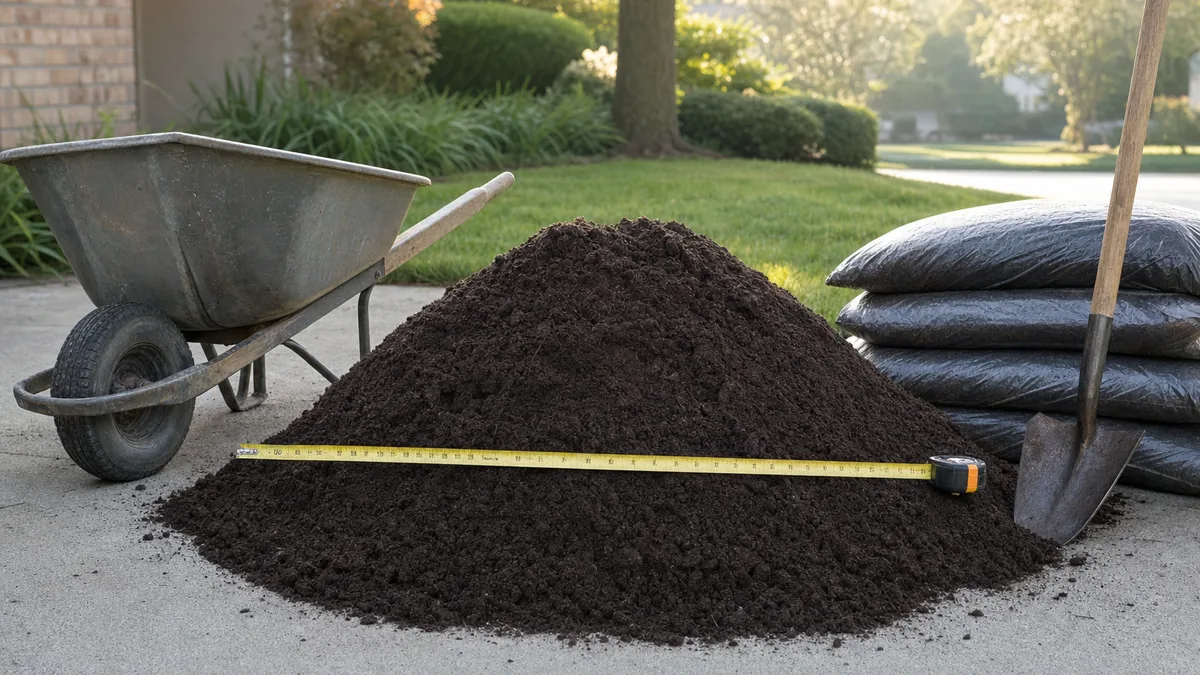
There are 27 cubic feet in a cubic yard. A cubic yard is a cube 3 feet long, 3 feet wide and 3 feet tall, and 3 × 3 × 3 = 27. Washington State University Extension’s Clark County Master Gardeners say it the same way: one cubic yard equals 27 cubic feet. NIST defines the yard as exactly 0.9144 meter, which is 3 feet.
That one number turns any measurement in cubic feet into the cubic yards a supplier sells by. If you have already worked out a bed in cubic feet, our guide to how to fill a raised garden bed shows the soil math, and the rest of this page covers the conversion, bags, coverage and weight.
Cubic Feet to Cubic Yards: Quick Conversion Table
Every row below is the cubic feet divided by 27. The exact fraction is shown because decimals like 0.037 are awkward to read off a delivery quote, and the rounded column is the one to use for an order.
| Cubic Feet | Cubic Yards (exact) | Cubic Yards (rounded) |
|---|---|---|
| 1 cu ft | 1/27 | 0.04 cu yd |
| 2 cu ft | 2/27 | 0.07 cu yd |
| 3 cu ft | 1/9 | 0.11 cu yd |
| 5 cu ft | 5/27 | 0.19 cu yd |
| 10 cu ft | 10/27 | 0.37 cu yd |
| 20 cu ft | 20/27 | 0.74 cu yd |
| 27 cu ft | 1 | 1.00 cu yd |
| 54 cu ft | 2 | 2.00 cu yd |
| 81 cu ft | 3 | 3.00 cu yd |
| 100 cu ft | 100/27 | 3.70 cu yd |
The most common slip is treating a cubic yard as 3 cubic feet. Three feet is the length of one edge, not the volume of the cube. A reader who asks for 3 yards of soil when the bed needs 3 cubic feet would be ordering 81 cubic feet, 27 times too much. For a real bed, our guide to soil for a 4x8 raised bed finds 32 cubic feet at the standard 12-inch depth, and 32 ÷ 27 is 1.19 cubic yards, so that bed needs a little more than one yard.
How Do You Convert Cubic Feet to Cubic Yards?
Divide the cubic feet by 27. The Clark County Master Gardeners guide from Washington State University Extension puts it as one sentence: one cubic yard is equal to 27 cubic feet, so to convert cubic feet to cubic yards, divide by 27. Iowa State University Extension gives the same rule for mulch, noting that mulch is commonly sold by the cubic yard when bought in bulk, and writing it as 1 yd³ = 27 ft³.
The sum only works when the units match. WSU warns that you cannot multiply inches by feet, so a bed measured in feet and a depth measured in inches must be put into the same unit before you multiply. The usual fix is to turn the depth into feet by dividing the inches by 12. Iowa State’s table does exactly that: 1.5 inches is 0.125 feet and 3 inches is 0.25 feet.
Worked Example: Ordering Soil for a 6 by 20 Foot Bed
Suppose you are filling a new border that is 20 feet long and 6 feet wide, to a depth of 6 inches. These are made-up measurements chosen to show the steps, not a recommendation for how deep to fill any bed. If part of the fill will be compost, what you can compost covers what goes into the pile.
- Measure in feet. Length is 20 ft and width is 6 ft, so the area is 20 × 6 = 120 square feet.
- Put the depth in feet. 6 inches ÷ 12 = 0.5 ft.
- Find the volume. 120 sq ft × 0.5 ft = 60 cubic feet.
- Divide by 27. 60 ÷ 27 = 2.22 cubic yards.
- Round up. Texas A&M AgriLife Extension (Travis County) advises rounding up to the nearest yard or half yard, depending on how you are buying, so the order is 2.5 cubic yards, or 67.5 cubic feet.
The same page offers a shortcut: multiply the area in square feet by the depth in inches and then by 0.0031. For this bed that is 120 × 6 × 0.0031 = 2.23 cubic yards, which agrees with the long way. If the supplier only sells bags, divide the 60 cubic feet by the bag size instead: 30 bags of 2 cubic feet, or 20 bags of 3 cubic feet.
Cubic Yards to Cubic Feet: Multiply by 27
Going the other way is a multiplication. A quote for 3 yards is 3 × 27 = 81 cubic feet. Texas A&M AgriLife Extension gives the same instruction: multiply the number of yards by 27 to find the total cubic feet. This is the direction to use when a supplier quotes in yards and you want to check the number against bags or against a bed you measured in feet. If the bed has never been tested, how to read soil test results explains what a lab report says before you order.
| Cubic Yards | Cubic Feet | Working |
|---|---|---|
| 0.25 cu yd | 6.75 cu ft | 0.25 × 27 |
| 0.5 cu yd | 13.5 cu ft | 0.5 × 27 |
| 1 cu yd | 27 cu ft | 1 × 27 |
| 1.5 cu yd | 40.5 cu ft | 1.5 × 27 |
| 2 cu yd | 54 cu ft | 2 × 27 |
| 5 cu yd | 135 cu ft | 5 × 27 |
| 10 cu yd | 270 cu ft | 10 × 27 |
Cubic Inches and Cubic Meters in a Cubic Yard
The 27 comes from cubing the 3 feet along each edge. The same trick works for the other units. NIST’s conversion tables list the foot as exactly 0.3048 meter, the inch as exactly 0.0254 meter and the yard as exactly 0.9144 meter. Those figures make a foot 12 inches and a yard 36 inches. Cube them and a cubic foot holds 12 × 12 × 12 = 1,728 cubic inches, while a cubic yard holds 36 × 36 × 36 = 46,656 cubic inches. Those two totals are our arithmetic from the NIST lengths, not figures printed on the NIST page.
For metric volumes, NIST’s table gives a cubic foot as 0.02831685 cubic meter and a cubic yard as 0.7645549 cubic meter. NIST does not mark those two as exact, because they are rounded. Its simpler approximate-conversion page rounds them to 0.03 and 0.76 cubic meter, and lists one cubic inch as 16.39 milliliters. Our guide to soil bulk density uses the longer 16.387 cubic centimeters per cubic inch when it turns a pipe core into grams per cubic centimeter.
| Unit | Cubic Feet | Cubic Inches | Cubic Meters |
|---|---|---|---|
| 1 cubic yard | 27 | 46,656 | 0.7646 |
| 1 cubic foot | 1 | 1,728 | 0.0283 |
| 1 cubic meter | 35.31 | 61,024 | 1 |
The cubic meter row is our calculation from the NIST factors: 1 ÷ 0.7645549 is about 1.308 cubic yards, and 1 ÷ 0.02831685 is about 35.31 cubic feet. So a cubic meter is roughly 31 percent bigger than a cubic yard, which matters if you compare a European supplier’s quote with a US one.
How Many Square Feet Does a Cubic Yard Cover?
It depends on how deep you spread it. The Clark County Master Gardeners guide gives the rule of thumb that one cubic yard of organic material covers about 100 square feet to a depth of 3 inches, and 324 square feet to a depth of 1 inch. Its formula is to multiply the area in square feet by the depth in inches and divide by 324. The 324 is just 27 cubic feet × 12 inches, so every other depth follows by dividing 324 by the depth in inches. Deeper is not always better for mulch, and our guide to the 8 mulch mistakes that hurt plants covers piling it too thick.
| Depth | Square Feet per Cubic Yard | Working |
|---|---|---|
| 1 in | 324 sq ft | 324 ÷ 1 |
| 2 in | 162 sq ft | 324 ÷ 2 |
| 3 in | 108 sq ft (WSU rounds to about 100) | 324 ÷ 3 |
| 4 in | 81 sq ft | 324 ÷ 4 |
| 6 in | 54 sq ft | 324 ÷ 6 |
| 12 in | 27 sq ft | 324 ÷ 12 |
Iowa State’s mulch example works the same way from the other side. A 265-square-foot bed mulched 1.5 inches deep needs 265 × 0.125 = 33.125 cubic feet, which Iowa State divides by 27 to get 1.22 cubic yards. The 324 shortcut agrees: 265 × 1.5 ÷ 324 is 1.23. Which material to spread over that area is a separate decision, and our comparison of organic vs inorganic mulch covers it.
Does a Cubic Yard Always Weigh the Same?
No. A cubic yard is a measure of space, always 27 cubic feet, so it says nothing about weight. What fills the space decides the weight, and so does how wet it is. Washington State University’s compost guide for farmers says a cubic yard of compost weighs approximately 1,150 pounds at 50 percent moisture content, and gives the rule for converting a bulk density in pounds per cubic foot into pounds per cubic yard: multiply by 27. Its worked example turns 39 pounds per cubic foot into 1,053 pounds per cubic yard.
Soil is heavier. Penn State Extension takes a bulk density of 1.33 grams per cubic centimeter, which it says approximates a silt loam, and multiplies by 62.4 to get 82.99 pounds of dry soil per cubic foot. Applying the same 27 gives about 2,241 pounds, or roughly 1.1 tons, for a cubic yard of that soil when dry. That is nearly twice WSU’s figure for compost. Moist soil weighs more than the dry figure, so treat 2,241 as a floor rather than a delivery weight. Our topsoil vs garden soil guide explains how the two differ, and the ordering method is the same for both: work out the volume first, then check the weight against your truck, trailer or wheelbarrow.
How Many Bags Make a Cubic Yard?
Divide 27 by the cubic feet printed on the bag. Bag sizes vary, and the sources disagree a little on which are typical. Iowa State University Extension says mulch is commonly sold in 2- or 3-cubic-foot bags. Texas A&M AgriLife Extension says retailers usually sell soil and mulch in 1 or 2 cubic foot amounts, and its bag table also lists 0.75 and 1.25 cubic foot bags. Always read the label on the bag in front of you, because it is the number that counts.
| Bag Size | Bags in 1 Cubic Yard | Working |
|---|---|---|
| 0.75 cu ft | 36 bags | 27 ÷ 0.75 |
| 1 cu ft | 27 bags | 27 ÷ 1 |
| 1.25 cu ft | 22 bags | 27 ÷ 1.25 = 21.6, rounded up |
| 2 cu ft | 14 bags | 27 ÷ 2 = 13.5, rounded up |
| 3 cu ft | 9 bags | 27 ÷ 3 |
The 14-bag line for 2 cubic foot bags matches Texas A&M’s own example: 1 yard times 27, divided by 2 cubic feet per bag, is 13.5 bags, rounded up to 14. Round bags up, never down, because a bed that is half a bag short is still a bed that is short. For a bag size not in the table, such as 1.5 cubic feet, the same division gives 27 ÷ 1.5 = 18 bags. When the order grows past a bed or two, how to fill a raised garden bed compares bagged and bulk soil for the cost.
How to Measure a Space and Round Up
Texas A&M AgriLife Extension writes the whole calculation as one formula: total cubic yards = length in feet × width in feet × (depth in inches ÷ 12) ÷ 27. The measuring is the part that goes wrong, so follow it in order.
- Measure length and width in feet. Use a tape measure. If you read 7 feet 6 inches, write 7.5 feet, because 6 inches is half a foot.
- Decide the depth in inches. Then divide by 12 to get feet, as in the Iowa State table of 3 inches equals 0.25 feet.
- Split odd shapes. For an L-shaped or curved bed, break it into rectangles, calculate each one and add the cubic feet together.
- Multiply, then divide by 27. Length × width × depth in feet gives cubic feet, and dividing by 27 gives cubic yards.
- Round up. Texas A&M advises rounding up to the nearest yard or half yard, depending on how you are buying the material.
For a raised bed, measure the inside of the frame, because the frame’s walls take some length and width off the outside measurement and the order is for the space the soil will fill. If you are still choosing a size, raised bed garden designs compares widths and layouts from extension sources. Once the number is in cubic yards, our complete guide to soil and amendments helps with what to buy.
Free book · 23 pages, PDF
Cubic Feet in a Cubic Yard FAQ
How many cubic feet are in a yard of dirt, mulch or soil?
27 cubic feet, whatever the material. A cubic yard is a measure of space, and Washington State University Extension's Clark County Master Gardeners state that one cubic yard equals 27 cubic feet. What changes between dirt, mulch and soil is the weight: WSU's compost guide puts a cubic yard of compost at approximately 1,150 pounds at 50 percent moisture, while Penn State Extension's dry silt loam figure works out to about 2,241 pounds.
How do you convert cubic feet to cubic yards?
Divide by 27. Washington State University Extension's Clark County Master Gardeners give the rule as one cubic yard equals 27 cubic feet, so to convert cubic feet to cubic yards, divide by 27. For example, 54 cubic feet is 2 cubic yards and 100 cubic feet is 3.7 cubic yards.
How many square feet does a cubic yard cover?
About 100 square feet at a depth of 3 inches, according to the Clark County Master Gardeners guide from Washington State University Extension, which also gives 324 square feet at a depth of 1 inch. To find your own depth, divide 324 by the depth in inches: 6 inches covers 54 square feet and 12 inches covers 27.
How many 2 cubic foot bags make a yard?
14 bags. Texas A&M AgriLife Extension works the example as 1 yard times 27 cubic feet, divided by 2 cubic feet per bag, which is 13.5 bags, rounded up to 14. For 3 cubic foot bags the same division gives 9, and for 1 cubic foot bags it gives 27.
Is a cubic yard the same as a yard?
No. A yard is a length, exactly 0.9144 meter or 3 feet according to NIST, while a cubic yard is a volume, a cube 3 feet on each side, holding 27 cubic feet. When a supplier says a yard of mulch or soil, they mean a cubic yard. Iowa State University Extension notes that mulch is commonly sold by the cubic yard when bought in bulk.
How many cubic meters are in a cubic yard?
About 0.7646 cubic meter. NIST's conversion table lists a cubic yard as 0.7645549 cubic meter, and its approximate-conversion page rounds that to 0.76. A cubic meter is therefore about 1.308 cubic yards, a figure calculated from the NIST factor.
Sources & further reading
The 27-cubic-feet definition, the 324 square feet per cubic yard rule and the 100 square feet at 3 inches figure come from the Washington State University Extension Clark County Master Gardeners guide “Garden Math”. The yard, foot and inch lengths and the cubic meter factors come from the NIST Guide to the SI, Appendix B.8 and its approximate conversions from U.S. customary measures to metric.
The bag sizes, depth in feet table and worked mulch example come from Iowa State University Extension’s “How to Determine the Amount of Mulch Needed for a Garden Bed”. The measuring formula, the 0.0031 shortcut, the bag table and the rounding advice come from Texas A&M AgriLife Extension’s “How Much Compost, Soil or Mulch?”. The compost weight comes from the WSU Compost Outreach Project guide for farmers, and the dry soil weight from Penn State Extension’s “What is an acre furrow slice of soil?”. All pages were read in November 2026. For how we source the facts behind every guide, see our methodology page.
Free book · 23 pages, PDF
The Soil & Amendments Cheat Sheet
Sent