How to Use This Calculator
- Enter your bed dimensions (length × width, or total sq ft).
- Enter your desired mulch depth in inches.
- Read your result in cubic feet, cubic yards, and bag count.
How Much Mulch Do I Actually Need?
The rule of thumb is simple: 2–3 inches of mulch over most garden beds, refreshed every year or two. That depth is enough to suppress weeds, hold moisture, and regulate soil temperature without smothering the roots underneath. Go thinner and you’ll be re-weeding within a month; go thicker than 4 inches and you start blocking water and air from reaching the root zone.
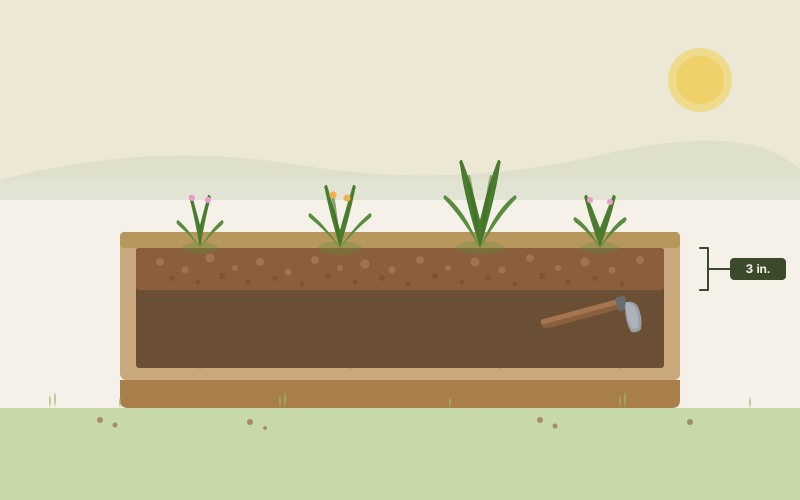
Depth matters more than people give it credit for. Every extra inch over a 100-square-foot bed is another 8 cubic feet of mulch, roughly 4 extra bags. Most gardeners underestimate depth, buy too few bags, and end up with a thin layer that doesn’t do its job. Measure depth before you order, not after. If you’re filling a brand-new raised bed, start by calculating your topsoil needs first, then come back here to figure out how much mulch to add on top.
Bag size vs. bulk delivery changes the math too. Bagged mulch is sold in 2-cubic-foot bags (sometimes 1.5), while bulk is sold by the cubic yard (27 cubic feet, or about 13.5 standard bags). Mulch coverage per cubic yard at 3 inches deep is roughly 100 square feet. Past about 3 cubic yards (call it 40 bags), bulk almost always wins on price. Below that, bags are easier and not much more expensive once you factor in delivery fees. The calculator gives you all three cubic yards, cubic feet, and bag counts so you can compare apples-to-apples at the register. Need to convert a bulk delivery quoted in tons into cubic yards instead? Our Cubic Yard Calculator handles that conversion directly.
Worked Example
Let’s say you have a 10 × 20 foot bed and you want a 3-inch layer of mulch. Here’s the math, step by step:
- Area: 10 ft × 20 ft = 200 square feet.
- Convert depth to feet: 3 inches ÷ 12 = 0.25 feet.
- Cubic feet: 200 sq ft × 0.25 ft = 50 cubic feet of mulch.
- Cubic yards: 50 ÷ 27 = 1.85 cubic yards (round to 2 yards if you’re buying bulk).
- 2-cubic-foot bags: 50 ÷ 2 = 25 bags (round up, since you can’t buy a partial bag).
So for a 10×20 bed at 3 inches deep, you need 50 cubic feet, 1.85 cubic yards, or 25 standard 2-cubic-foot bags. If you’re buying bulk, round up to 2 yards. It’s always better to have a little extra for settling and touch-ups than to come up half a bag short.
Pine Straw Coverage
Pine straw isn’t sold by the cubic yard or the bag. It’s sold by the bale, and sometimes by the roll. Switch to the Pine Straw option above the depth field and this calculator gives you a bale count instead of a bag count, scaled to whatever area and depth you enter.
As a reference point, a standard 40 lb bale of pine straw typically covers about 100 sq ft at a 2-inch depth, according to North Carolina Cooperative Extension (citing Texas AgriLife Extension Service). The calculator converts that figure into an equivalent volume and scales it to your chosen depth, so a deeper layer still gets a real bale count instead of a rough guess.
Bales and rolls vary by supplier, though. If you want to enter the coverage printed on your own bale or roll, add a price to see the cost, or see bales for common areas at a glance, use the dedicated Pine Straw Calculator.
Common Mulch Mistakes
- Volcano mulching around tree trunks. Piling mulch against the bark does more than invite rot and disease. Buried bark tissue responds to the constant moisture and darkness by growing adventitious roots, roots that form directly from stem tissue instead of the root system below. Those roots often grow sideways and circle back around the trunk instead of out into the soil, and as both the roots and the trunk thicken, the roots can girdle the trunk, slowly strangling it from the outside. The result is reduced growth, a visibly weak point at the base, and in severe, longstanding cases, a trunk that snaps at that exact spot in a storm. Keep a 3–6 inch gap around the base of every tree and shrub, mulch in a flat ring rather than a mound, and never let mulch touch the bark itself.
- Applying too deep and suffocating roots. Anything over 4 inches blocks water and air from reaching the root zone. Stick to 2–3 inches on beds and 3–4 inches around trees, max.
- Using the wrong mulch type for the bed. Dyed hardwood looks sharp but isn’t always food-safe; arborist chips and natural hardwood are better for edibles. Rubber and stone don’t decompose, so they’re fine for paths but wrong for beds that need organic matter.
- Not accounting for settling over the season. Bagged and shredded mulch can settle 10–15% after the first rain. Round up, not down, or you’ll be back at the store in a month.
- Buying bagged when bulk is cheaper. Past about 3 cubic yards (roughly 40 bags), bulk delivery almost always wins on price. Run the calculator first and get a bulk quote if you’re over that line.
- Forgetting existing mulch. If a bed already has 1–2 inches of mulch in decent condition (not matted down or decomposed to soil), you’re topping it up, not starting from bare ground. Don’t run the calculator as if the bed were empty. As a rough rule, half the calculated new-project amount is usually enough for a top-up; only calculate for the full depth if you’re clearing out old mulch first or the existing layer has broken down to almost nothing.
- Confusing mulch with compost. Mulch sits on top of the soil to retain moisture and block weeds; compost is a soil amendment that gets worked into the ground to feed plants. They’re not interchangeable. If you’re looking to add nutrients rather than just cover the bed, use our Compost Calculator instead.
Mulch Calculator FAQ
How many bags of mulch do I need?
Take your bed’s square footage, multiply by your depth in inches divided by 12 to get cubic feet, then divide by 2 (the size of a standard bag). A 4×8 bed at 3 inches deep needs 8 cubic feet, which is 4 bags. The calculator above does this live as you type.
How often should I reapply mulch?
Most beds need a top-up every 1–2 years because mulch decomposes and settles. You don’t always need a full depth. A 1-inch refresh is usually enough to keep weed suppression and moisture retention where they should be. Pull back the old mulch first if it has matted into a dense layer.
Does mulch depth differ for trees vs flower beds?
Yes. Flower and vegetable beds do well at 2–3 inches. Trees and shrubs want 2–4 inches spread evenly to the drip line, but keep a 3–6 inch gap around the trunk so the bark can breathe. Going deeper than 4 inches around a tree suffocates roots and invites rot.
Is bagged or bulk mulch cheaper?
Bulk (sold by the cubic yard) usually wins past about 3 cubic yards, which is roughly 40 standard bags. Below that, bags are easier and not much more expensive once you factor in delivery fees. Get a bulk quote if your calculator output is over 14 bags.
How much does mulch coverage vary by type (wood chips vs shredded vs rubber)?
Coverage is set by depth, not material: a 3-inch layer of wood chips, shredded hardwood, or rubber mulch all covers the same square footage per cubic yard. What changes is settling: shredded mulch compacts 10–15% in the first rain, so buy a little extra. Rubber and stone don’t settle and don’t decompose, so one application lasts years.
How do I calculate mulch for a circular bed or tree ring?
Measure the radius (distance from the center to the outer edge, i.e. half the diameter). Square the radius and multiply by π (3.14159) to get square feet, then multiply by depth in feet. Use the Circle toggle in the calculator above. Enter the radius and it handles the π × r² math for you. For a tree ring, the radius is the distance from the trunk to the outer edge of the mulched area. A 6-foot-diameter ring has a 3-foot radius, giving 3² × π ≈ 28.3 square feet, which many people underestimate when buying bags.
How many bales of pine straw do I need?
It depends on your area and depth, but as a reference point, a standard 40 lb bale covers roughly 100 sq ft at a 2-inch depth (North Carolina Cooperative Extension, citing Texas AgriLife Extension Service). Switch to the Pine Straw option in the calculator above, enter your area and depth, and it converts that reference figure into an exact bale count, rounded up since you can’t buy a partial bale. For a count you can tune to your own bale, with a cost estimate, use the Pine Straw Calculator.
Why is pine straw popular for landscaping?
Mainly cost and handling: pine straw is often the least expensive mulch available across the Southeast, it’s lightweight enough to spread by hand, and it interlocks as it settles, which helps it stay put on slopes better than loose mulches do. One popular belief about it doesn’t actually hold up. North Carolina Cooperative Extension’s soil scientists have found pine straw doesn’t meaningfully acidify soil any more than other mulches do, so it’s not a special pick for acid-loving plants on that basis.
Sources & further reading
Mulch depth and coverage guidance in this article draws on general recommendations from university cooperative extension services (such as your state’s land-grant extension office) and the USDA Natural Resources Conservation Service. The pine straw bale coverage figure and the note on pine straw and soil pH both come from North Carolina Cooperative Extension’s “Pine Needle Mulch: the Myths and Legends”, which itself cites Texas AgriLife Extension Service for the bale figure. For more on how we source and review the formulas behind every calculator, see our methodology page. For region-specific guidance, especially on mulch type, fire risk, and pest considerations, search “mulch” on Extension.org or your local extension office’s website.
For how mulch fits with topsoil, garden soil, and compost as part of a full planting project, see our complete guide to soil and amendments.