How to Use This Calculator
- Select your crop, or choose “Custom” to enter your own spacing.
- Choose Row Garden or Square Foot Gardening.
- Enter your bed dimensions.
- Read your total plant count and layout.
How Much Space Do Plants Need?
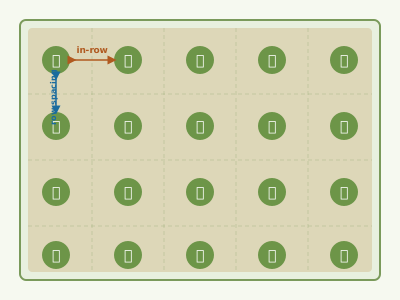
Every plant has two spacing requirements: in-row spacing (the gap between individual plants within a single row) and between-row spacing (the gap from one row to the next). Both numbers come from how large the plant grows at maturity: roots competing underground, leaves competing for light above, and air movement between plants that slows down fungal disease.
Airflow matters more than most gardeners realize. Crowded plants create humid microclimates that accelerate powdery mildew, blight, and other fungal diseases. Proper spacing lets air circulate around leaves, drying them faster after rain or irrigation. This is why tomatoes at 24–36 inches apart dramatically outperform tomatoes crammed at 12 inches, even in the same soil.
Competition for nutrients and root space is the other factor. Tightly packed plants fight for the same water and mineral supply, resulting in smaller yields from every plant. It’s almost always better to plant fewer, well-spaced plants than to fill every inch of bed and have all of them underperform.
Square foot gardening uses a slightly different framework: each plant is assigned a square-foot block (e.g., 1 sq ft for a pepper, 4 sq ft for a tomato), and the bed is treated as a grid. This simplifies planning but uses the same underlying principle: each plant gets the area it needs at maturity.
Raised beds change the equation, too. Because you never walk on the soil in a raised bed, it never compacts the way a traditional row garden does, so roots can spread more freely in every direction instead of being blocked by dense, foot-trafficked soil between rows. That’s why raised beds typically support 20–30% tighter spacing than the same crop in a traditional row garden, and sometimes more for the most space-hungry crops. Tomatoes are the clearest example: spaced 36 inches apart between rows in a traditional garden, they can often go down to 24 inches in a well-built raised bed. The spacing chart below reflects standard row-garden and square-foot-gardening figures. If you’re working in a raised bed specifically, you can generally lean toward the tighter end of a crop’s range.
Plant Spacing Chart
Reference spacing for 20+ common vegetables, herbs, and flowers. “In-row” is the space between individual plants; “between-row” is the space between rows. The SFG column is square feet per plant for square foot gardening. Invert it and you get plants per square foot, which is how many plants per square foot each crop supports at full maturity.
| Crop | In-row spacing | Between-row spacing | SFG (sq ft/plant) |
|---|---|---|---|
| Basil | 12 in | 18 in | 1 |
| Bean (bush) | 4 in | 18 in | 0.25 (9/sq ft) |
| Bean (pole) | 6 in | 24 in | 0.25 (9/sq ft) |
| Beet | 4 in | 12 in | 0.25 (9/sq ft) |
| Broccoli | 18 in | 24 in | 1 |
| Carrot | 3 in | 12 in | 0.0625 (16/sq ft) |
| Cilantro | 6 in | 12 in | 0.25 (4/sq ft) |
| Corn | 12 in | 30 in | 1 |
| Cucumber | 12 in | 36 in | 1 |
| Garlic | 6 in | 12 in | 0.25 (4/sq ft) |
| Kale | 12 in | 18 in | 1 |
| Lettuce (head) | 12 in | 12 in | 1 |
| Lettuce (leaf) | 6 in | 12 in | 0.25 (4/sq ft) |
| Marigold | 12 in | 18 in | 1 |
| Onion | 4 in | 12 in | 0.25 (4/sq ft) |
| Parsley | 8 in | 12 in | 0.25 (4/sq ft) |
| Pepper | 18 in | 24 in | 1 |
| Radish | 2 in | 12 in | 0.0625 (16/sq ft) |
| Spinach | 6 in | 12 in | 0.25 (4/sq ft) |
| Squash (summer) | 24 in | 36 in | 4 |
| Squash (winter) | 36 in | 48 in | 9 |
| Swiss Chard | 6 in | 18 in | 0.25 (4/sq ft) |
| Tomato (determinate) | 24 in | 36 in | 4 |
| Tomato (indeterminate) | 24 in | 48 in | 4 |
| Zucchini | 24 in | 36 in | 4 |
Plant Density: Plants per Square Foot and per Acre
Spacing and plant density are the same math, read from opposite directions. Spacing tells you the distance between plants; density tells you how many plants fit in a given area. The plant density formula is simple:
That’s how to calculate plant density from a spacing figure: square the spacing (in feet) and take the reciprocal. The same formula scales up to plants per acre (multiply by 43,560, the number of square feet in an acre), though that’s rarely what a home garden or landscape bed needs. This plant spacing calculator doubles as a plant density calculator already: switch to square foot gardening mode above and the plants-per-square-foot figure is exactly this number, worked out for you from the spacing chart.
Trees & Shrubs: Why Spacing Is Different
Tree and shrub spacing works on a different logic than vegetable spacing, and it's worth understanding before you use the Trees & Shrubs mode above. Vegetable spacing is a seasonal decision: get it wrong and you fix it next year. Tree spacing is a permanent decision. You can't re-space a mature tree once its roots and canopy have filled in; moving or removing an overcrowded tree years later is a far bigger job than pulling up a badly spaced pepper plant.
The number that matters is mature canopy width, not the size of the sapling you're planting. This is the single most common tree-spacing mistake: a 4-foot bare-root sapling spaced 20 feet from its neighbor looks absurdly over-spaced on planting day, so people plant it closer “to fill the gap,” and within a decade both trees are fighting for the same light, water, and root space anyway. Space for the tree it will become, not the tree it is today.
Crowded trees and shrubs run into real, long-term problems that don't show up right away: competition for light and water that stunts growth and reduces fruit production, poor air circulation that increases fungal disease pressure (the same airflow principle covered above for vegetables, just at a much larger scale), and structural issues as trunks and branches grow into each other, sometimes requiring corrective pruning or removal years later.
Tree and Shrub Spacing Chart
The tree spacing chart below covers the fruit and nut trees and landscape shrubs available in the Trees & Shrubs mode above, at typical mature spacing. If you're looking for a fruit tree spacing chart specifically, the first several rows cover apple, pear, peach, plum, and cherry at both standard and dwarf/semi-dwarf spacing, because rootstock changes the spacing requirement enough that treating “apple” as one single number would be genuinely misleading.
| Tree / Shrub | Category | Mature spacing |
|---|---|---|
| Apple (Standard) | Fruit tree | 25–30 ft |
| Apple (Semi-Dwarf) | Fruit tree | 15 ft |
| Apple (Dwarf) | Fruit tree | 8–10 ft |
| Pear (Standard) | Fruit tree | 20–25 ft |
| Pear (Dwarf/Semi-Dwarf) | Fruit tree | 8–15 ft |
| Peach / Plum (Standard) | Fruit tree | 15–20 ft |
| Peach / Plum (Dwarf) | Fruit tree | 8–10 ft |
| Cherry, Sweet (Standard) | Fruit tree | 25–30 ft |
| Cherry, Sweet (Dwarf/Semi-Dwarf) | Fruit tree | 6–15 ft |
| Pecan | Nut tree | 60–80 ft |
| Large Shrub / Small Tree (lilac, dogwood) | Landscape shrub | 12–15 ft |
| Medium Shrub (forsythia, rhododendron) | Landscape shrub | 7–10 ft |
| Small Shrub (azalea, dwarf yew) | Landscape shrub | 3–6 ft |
| Trimmed Hedge, Low (boxwood, barberry) | Landscape shrub | 18–24 in |
| Trimmed Hedge, Tall (privet, hemlock) | Landscape shrub | 26–48 in |
| Ground Cover Shrub (juniper, cotoneaster) | Landscape shrub | 24–36 in |
Worked Example
You have a 4×8 ft raised bed and want to grow tomatoes (determinate) at the recommended spacing of 24 inches in-row and 36 inches between rows. Here’s the math:
- Plants per row: 8 ft ÷ (24″ ÷ 12) = 8 ÷ 2 = 4 plants per row.
- Number of rows: 4 ft ÷ (36″ ÷ 12) = 4 ÷ 3 = 1.33 → 1 row (floor to whole rows).
- Total plants: 4 × 1 = 4 tomato plants.
Four plants is a reasonable crop for a standard 4×8 bed using the row method above. Switch to square foot gardening mode, though, and the count roughly doubles: each tomato takes 4 sq ft, so 32 sq ft ÷ 4 = 8 plants. That's not because the plants need less room in SFG mode. It's because SFG uses the entire bed area without row paths between plants, while the row method above set aside space for a 36-inch aisle. The calculator handles both methods automatically.
Need to prep the soil first? Use the raised bed soil calculator to figure out how many cubic feet of mix you need before you plant.
Common Mistakes
- Planting at transplant size, not mature size. A 4-inch tomato seedling looks tiny at 24-inch spacing. Plant it anyway. The spacing is for the mature plant, not the seedling you can barely see in week one.
- Ignoring between-row spacing. Most gardeners use in-row spacing only and crowd rows together. The result is poor airflow down the row and fungal problems by midsummer. Both dimensions matter.
- Using the same spacing for every crop. A universal 12-inch spacing is fine for mid-size crops but disastrously tight for squash and far too loose for carrots. Always use crop-specific numbers.
- Mixing up row garden and square foot gardening math. Row garden spacing includes path space between rows; SFG doesn’t. Using row spacing numbers in an SFG grid leads to overcrowding.
- Forgetting to account for paths and borders. The calculator assumes the full bed area is planted. If you leave a border or a central stepping path, deduct that area from your dimensions first.
- Planting the whole bed edge to edge. Leave at least 18 inches of pathway space somewhere in the layout (between beds, down the middle of a wide bed, or along one side) so you can actually water, weed, and harvest without stepping on your plants or compacting the soil you just worked to loosen. It’s tempting to count every square foot as growing space, but a bed you can’t comfortably reach isn’t one you’ll maintain well.
Plant Spacing Calculator FAQ
How do I calculate plant spacing?
Divide your bed length by the in-row spacing to get plants per row, then divide bed width by between-row spacing to get number of rows. Multiply those two numbers for total plants. For a 4×8 ft bed with tomatoes at 24-inch spacing: 8÷2 = 4 plants per row, 4÷3 = 1.3 → 1 row, total 4 plants. The calculator above does this automatically.
How far apart should I plant vegetables?
It depends on the crop. Compact vegetables like radishes and carrots need 2–4 inches in-row; mid-size crops like lettuce and peppers need 6–18 inches; large spreading plants like squash and tomatoes need 24–48 inches. Always use both in-row and between-row spacing, because they are usually different. See the spacing chart below for specific crops.
How far apart does corn need to be planted?
Corn needs 12 inches in-row and 30 inches between rows. Plant it in blocks of at least 4 rows, not single long rows. Corn is wind-pollinated, and a single row produces poor ear fill. A 4×8 ft bed fits about 4 corn plants in one row, which is not enough for reliable pollination; corn is better suited to larger plots.
How many plants per square foot should I plant?
It varies by crop. The right plants per sq ft figure depends entirely on the crop’s mature size. In square foot gardening: large plants like tomatoes and squash need 4 sq ft per plant; peppers, broccoli, and similar mid-large crops get 1 per sq ft; medium plants like lettuce get 1–4 per sq ft; small plants like carrots get 16 per sq ft; tiny seeds like radishes get 16 per sq ft. The square foot gardening mode in the calculator uses these presets automatically.
What's the difference between in-row and between-row spacing?
In-row spacing is the distance between individual plants along a single row. Between-row spacing (also called row spacing) is the distance between one row and the next. Both are required to plan a bed. Using only one number will either overcrowd plants or waste space. Most seed packets list both values.
How far apart should fruit trees be planted?
It depends heavily on rootstock. Standard apple and sweet cherry trees need about 25-30 ft; semi-dwarf varieties need about 15 ft; dwarf varieties need as little as 8-10 ft. Pear, peach, and plum fall in similar ranges, generally 18-20 ft standard and 10-12 ft dwarf. Pecan needs far more room than any common fruit tree: 60-80 ft for a home orchard. All of these are mature-canopy figures, not planting-day distances. The Trees & Shrubs mode above has spacing presets for each.
How do you calculate tree spacing?
Use the tree's expected mature width (its canopy spread at full size, not its size at planting), and space trees at least that distance apart center-to-center. For two trees with similar mature spreads, that generally means using the larger of the two widths as your spacing distance. The Trees & Shrubs mode above works as a tree spacing calculator and does this automatically: pick a preset (or enter a custom spacing), enter your available area, and it returns how many trees fit and the layout.
How far apart should arborvitae be planted for a hedge?
It depends almost entirely on the variety's mature width. 'Emerald Green' grows about 3 to 4 ft wide, and Clemson University Extension advises spacing it no closer than that; 24 inches works only if you keep the plants thinned so they never grow into each other. 'Green Giant' is a different scale: NC State Extension lists a mature width of 12 to 18 ft, and University of Georgia Extension recommends 15 ft apart in the row for screening and wind resistance. For any other variety, use the mature width on the plant tag. To use the Trees & Shrubs mode as an arborvitae spacing calculator, choose Custom, enter that spacing, and set the width to one spacing for a single row: a 60 ft row at 3 ft returns 20 'Emerald Green'.
What's the formula for how many plants fit in rows?
Plants = area ÷ (in-row spacing × row spacing), with both spacings in feet. For corn planting at this page’s chart spacing of 12 inches in-row and 30 inches between rows, each plant takes 1 ft × 2.5 ft = 2.5 sq ft, so a 20 × 25 ft plot (500 sq ft) holds 500 ÷ 2.5 = 200 plants, laid out as 10 rows of 20. Scaled up, 43,560 sq ft per acre ÷ 2.5 = about 17,400 plants per acre, in line with Ohio State University Extension’s seed spacing table for 30-inch rows. Row Garden mode in the calculator runs this same math and also rounds down to whole rows and whole plants.
Sources & further reading
Spacing values in the chart above are based on recommendations from university cooperative extension services. For plant quantity formulas, see Iowa State University Extension’s “How to Determine Plant Quantity for Planting Beds”. For fruit tree spacing by rootstock, see the University of Maine Cooperative Extension’s guide to spacing trees in an orchard. For pecan spacing, see the University of Georgia’s “Pecan Trees for the Home or Backyard Orchard”. For landscape shrub spacing, see Cornell Cooperative Extension’s “Spacing Landscape Plants”. For arborvitae hedge spacing, see Clemson University Extension’s answer on spacing ‘Emerald Green’ arborvitae, Penn State Extension’s “The Mighty Arborvitae”, NC State Extension’s ‘Green Giant’ plant profile, and the University of Georgia’s ‘Green Giant’ planting guidance. For corn plant populations by row width and seed spacing, see Ohio State University Extension’s “Useful Tables: Adjustments and Conversions on Corn and Soybean Parameters”. For more on how we source and validate the formulas used on this site, see our methodology page.