How to Use This Calculator
- Toggle New Lawn or Overseeding.
- Select your grass type.
- Enter your lawn area (length × width, sq ft, or acres).
- Read your pounds of seed, bag count, and per-acre rate.
Free book · 23 pages, PDF
How Much Grass Seed Do I Need?
The right amount of grass seed depends on three things: your lawn area, your grass type, and whether you’re seeding bare soil or overseeding an existing lawn. Grass species vary enormously in seed size and germination habit (a pound of tiny Bermuda seed covers far more ground than a pound of larger Perennial Ryegrass seed), so there is no single “correct” rate that works for every lawn.
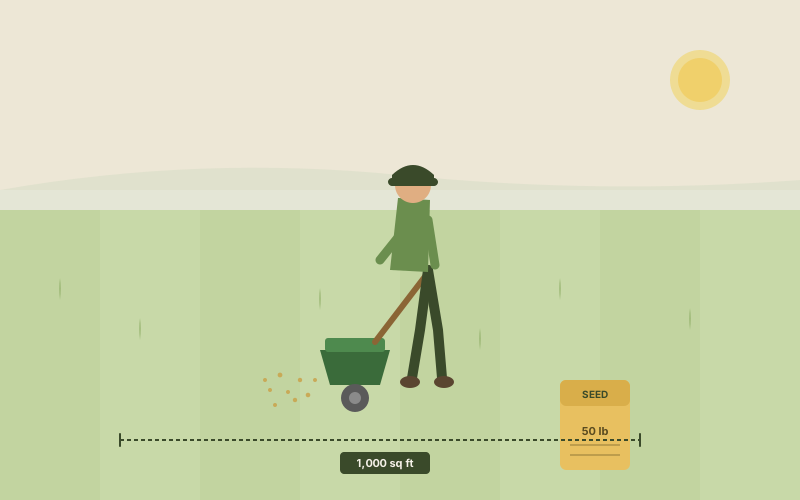
New lawn establishment needs the highest rates because every seed has to survive and every square inch of soil has to be covered from scratch. Overseeding an already-established lawn needs roughly half that rate, since existing turf is already holding most of the ground, so you’re filling in thin spots and thickening the stand rather than starting over.
That’s why the calculator above asks for your grass type first: selecting Kentucky Bluegrass, Tall Fescue, Perennial Ryegrass, Fine Fescue, Bermuda, or Zoysia automatically loads the recommended seeding rate for that species, in both new-lawn and overseeding modes. Enter your area in whatever unit you know (length × width, total square feet, or acres) and the total pounds and 50 lb bag count update immediately.
Grass Seed Rate Chart
Reference seeding rates for six common lawn grasses, in pounds per 1,000 sq ft and pounds per acre. These are general midpoints drawn from university turfgrass extension guidance. Always check the rate printed on your specific seed bag, since blends and cultivars shift it slightly.
| Grass type | New lawn (lb/1,000 sq ft) | Overseeding (lb/1,000 sq ft) | New lawn (lb/acre) | Overseeding (lb/acre) |
|---|---|---|---|---|
| Kentucky Bluegrass | 2 lb | 1 lb | ~87 lb | ~44 lb |
| Tall Fescue | 7 lb | 3.5 lb | ~305 lb | ~152 lb |
| Perennial Ryegrass | 8 lb | 4 lb | ~348 lb | ~174 lb |
| Fine Fescue | 5 lb | 2.5 lb | ~218 lb | ~109 lb |
| Bermuda (hulled) | 2 lb | 1 lb | ~87 lb | ~44 lb |
| Zoysia | 1.5 lb | 0.75 lb | ~65 lb | ~33 lb |
Grass Seed Per Acre Chart
For a big lot or a large lawn, it is easier to shop by the acre. Each figure below is the per-1,000 sq ft rate from the chart above multiplied by 43.56, since one acre is exactly 43,560 sq ft. The bag count divides those pounds by 50 and rounds up to whole 50 lb bags, the same way the calculator does, with the unrounded bag figure in parentheses.
| Grass type | New lawn (lb/acre) | New lawn (50 lb bags/acre) | Overseeding (lb/acre) | Overseeding (50 lb bags/acre) |
|---|---|---|---|---|
| Kentucky Bluegrass | 87.1 lb | 2 bags | 43.6 lb | 1 bag |
| Tall Fescue | 304.9 lb | 7 bags | 152.5 lb | 4 bags |
| Perennial Ryegrass | 348.5 lb | 7 bags | 174.2 lb | 4 bags |
| Fine Fescue | 217.8 lb | 5 bags | 108.9 lb | 3 bags |
| Bermuda (hulled) | 87.1 lb | 2 bags | 43.6 lb | 1 bag |
| Zoysia | 65.3 lb | 2 bags | 32.7 lb | 1 bag |
Rounding up matters most where the pounds land just past a bag boundary. An acre of new Tall Fescue needs 304.9 lb, so six bags (300 lb) leave you about 5 lb short and a seventh bag covers the gap. Most of that seventh bag can go toward the extra seed buffer covered under Common Mistakes below.
Worked Example
Let’s walk through a 5,000 sq ft new lawn being seeded with Tall Fescue.
- Area: 5,000 sq ft ÷ 1,000 = 5 (thousand-sq-ft units).
- Rate: Tall Fescue, new lawn = 7 lb per 1,000 sq ft.
- Total seed: 5 × 7 lb = 35 lb of seed.
- 50 lb bags: 35 ÷ 50 = 0.7 → round up to 1 bag (you’ll have about 15 lb left over for touch-ups or next season).
- Per-acre reference: at the same rate, a full acre of Tall Fescue would need 7 × 43.56 = ~305 lb, or about 6.1 bags, which rounds up to seven 50 lb bags.
So for a 5,000 sq ft new lawn of Tall Fescue, you need roughly 35 lb of seed, which rounds up to one 50 lb bag. If this were an overseeding job instead of a new lawn, the rate drops to roughly half that. See our Overseeding Calculator for the exact number adjusted to your lawn’s condition, plus a topdressing amount.
Covering Seed With Straw
This is a different job than mulching an established bed. Here, straw protects seed that hasn’t germinated yet, so how much straw to cover grass seed and how thick to lay it both matter more than they would for a finished lawn. Too little, and the seed dries out and blows or washes away before it can root. Too much, and you block the light and airflow seedlings need to come up.
As a reference point, roughly one 50 lb bale of straw covers about 1,000 sq ft (University of Tennessee Extension). So how thick should straw be on grass seed? Thin enough that you can still see soil through it. Aim for about 50–75% coverage, not a solid mat. A heavier, unbroken layer traps moisture unevenly and can smother germinating seedlings before they reach the surface.
Use weed-free straw, not hay. Hay is cut with its seed heads still attached and will introduce a fresh weed problem into the exact bare soil you’re trying to establish turf on. And once it’s down, you generally don’t need to remove it: at this application rate, straw mulch breaks down on its own and can be left in place to decompose.
Common Mistakes
- Over-seeding the lawn. More seed isn’t better past the recommended rate: seedlings crowd each other, compete for light and water, and you get thinner, weaker turf instead of a thicker lawn. Stick to the rate for your grass type and seeding mode.
- Ignoring grass type. Using a Perennial Ryegrass rate (8 lb/1,000 sq ft) for Zoysia (1.5 lb/1,000 sq ft) means applying more than 5× too much seed. Always match the rate to the species you’re actually planting.
- Skipping soil prep before seeding. For a new lawn, till the top 3 inches of soil to break up compaction and give roots somewhere to go. For overseeding, you only need to loosen the surface. A stiff rake or power dethatcher that scratches the top ½ inch is enough to get seed-to-soil contact without disturbing existing turf. After spreading seed, cover it with straw at the right thickness (see Covering Seed With Straw above).
- Ignoring soil pH. Most lawn grasses germinate and establish best at a soil pH of 6.0–7.0. Below 6.0, nutrient uptake suffers and germination slows even at the correct seeding rate. Test before you seed (lime raises pH; sulfur lowers it) so you’re not fighting chemistry all season.
- Buying exactly the calculated amount with no buffer. Plan to buy about 30% more seed than the calculator shows: roughly 10% accounts for measurement error in irregular lawns, 10% for seed lost to birds and wind before germination, and 10% to keep in reserve for spot repairs later in the season. That buffer is much cheaper than a second store trip when you run short.
- Using a new-lawn rate for overseeding (or vice versa). Overseeding at a full new-lawn rate wastes seed and can smother existing turf; using an overseeding rate to establish a lawn from bare soil leaves it too thin and open to weeds and erosion. Set the correct mode in the calculator above before you buy seed.
- Not accounting for waste at the edges. Beds, curves, and borders always use a bit more seed per square foot than open, rectangular lawn. Round your bag count up rather than down.
Grass Seed Calculator FAQ
How much grass seed do I need?
It depends on your lawn area, grass type, and whether you’re seeding bare soil or overseeding existing turf. As a rule of thumb, new lawns need roughly 1.5–8 lb of seed per 1,000 sq ft depending on species, while overseeding uses about half that. Enter your area and grass type in the calculator above for an exact number.
How much grass seed do I need per 1,000 square feet?
Rates range from about 1.5 lb (Zoysia, new lawn) up to 8 lb (Perennial Ryegrass, new lawn) per 1,000 sq ft. Tall Fescue, a common cool-season lawn grass, runs about 7 lb per 1,000 sq ft for a new lawn and 3.5 lb for overseeding. See the rate chart above for all six common types.
How many 50 lb bags of grass seed do I need per acre?
For a new lawn, one acre takes 7 bags of Tall Fescue (304.9 lb) or Perennial Ryegrass (348.5 lb), 5 bags of Fine Fescue (217.8 lb), and 2 bags of Kentucky Bluegrass, hulled Bermuda, or Zoysia. Overseeding an acre takes 4 bags of Tall Fescue or Perennial Ryegrass, 3 of Fine Fescue, and 1 of Kentucky Bluegrass, Bermuda, or Zoysia. These counts are rounded up to whole 50 lb bags, as in the per-acre chart above. Use the acres mode in the calculator above to get an exact bag count for your grass type.
How many pounds of grass seed per acre?
Anywhere from about 33 lb to 349 lb, depending on the grass and whether you’re starting a new lawn or overseeding. At new-lawn rates, an acre takes 348.5 lb of Perennial Ryegrass, 304.9 lb of Tall Fescue, 217.8 lb of Fine Fescue, 87.1 lb of Kentucky Bluegrass or hulled Bermuda, and 65.3 lb of Zoysia. Overseeding rates are half of those, from 174.2 lb of Perennial Ryegrass down to 32.7 lb of Zoysia.
How much grass seed do I need per acre?
Multiply the per-1,000-sq-ft rate by 43.56 (since 1 acre = 43,560 sq ft). For a new lawn, that’s about 87 lb/acre for Kentucky Bluegrass, 305 lb/acre for Tall Fescue, and 348 lb/acre for Perennial Ryegrass. The full per-acre chart is above, and the calculator computes it automatically when you switch to acres mode.
Do I need less seed when overseeding than for a new lawn?
Yes. Overseeding rates are roughly half the new-lawn rate for the same grass type. Existing turf already covers most of the ground, so you’re filling gaps and thickening the stand rather than establishing an entire lawn from bare soil. Using a new-lawn rate when overseeding wastes seed and can cause overcrowding. For a rate that also adjusts for how thin or patchy your lawn is (plus a topdressing amount), use the dedicated Overseeding Calculator.
How much straw do I need to cover grass seed?
Roughly one 50 lb bale of weed-free straw per 1,000 sq ft, spread so 50–75% of the soil is still visible through it rather than a solid blanket (University of Tennessee Extension). Heavier coverage blocks light and can smother the seedlings you just planted. Left at that rate, it generally doesn’t need to be removed; it breaks down on its own.
Sources & further reading
Seeding rate guidance in this article draws on general recommendations from university cooperative extension turfgrass programs, including UMass Extension’s “Seeding Rate Considerations” fact sheet. The straw mulch coverage and thickness guidance comes from University of Tennessee Extension’s “Turfgrass Establishment: Seeding” (W160-B). The per-acre chart uses the exact acre of 43,560 sq ft defined in NIST’s Handbook 44, Appendix C: General Tables of Units of Measurement. For more on how we build and verify the formulas behind every calculator on this site, see our methodology page. For grass type selection, overseeding an existing lawn, and lawn care timing, see our complete guide to lawn care.