How to Use This Calculator
- Enter your area (length × width, or total square feet).
- Enter your desired depth in inches.
- Read your result in cubic feet, cubic yards, bags, and estimated weight.
How Much Compost Do I Need?
How much compost you need depends on what you’re doing with it. Top-dressing an existing bed or lawn (spreading a thin layer over the surface to feed the soil without digging it in) typically calls for 1 to 3 inches of compost. Mixing compost into new bed soil, by contrast, means blending it through the whole root zone at a much higher proportion: the standard raised bed mix used throughout this site’s soil calculators is 60% topsoil, 30% compost, and 10% perlite or coarse sand for drainage.
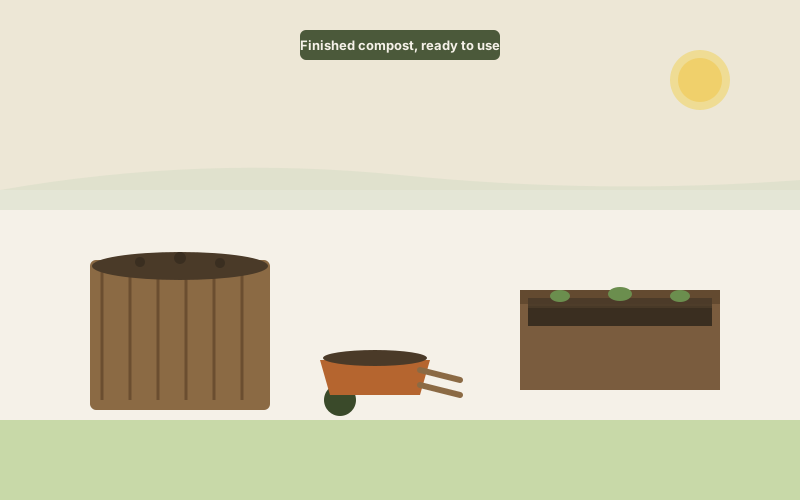
Once you know your target depth, the volume math is straightforward: multiply your area by the depth (converted to feet) to get cubic feet, then convert to cubic yards or bags depending on how you’re buying it. The calculator above does this for any area and depth, and also estimates the weight of what you’re hauling, useful if you’re the one carrying the bags or filling the wheelbarrow.
One practical note: compost settles after it’s spread, especially if it’s not fully finished or if it’s watered in heavily. Buying the exact calculated amount with zero margin can leave you slightly short a few weeks later (see Common Mistakes below).
Compost Application Rates by Use
Application depth and coverage vary significantly by use case. The table below shows typical reference rates; always use the calculator above to convert these to your exact area.
| Use Case | Depth / Rate | Coverage (1 cu yd) |
|---|---|---|
| Incorporating into new bed soil | 3–4 in (tilled in) | ~100–150 sq ft per cu yd |
| Top-dressing existing garden beds | 1–3 in | ~100–300 sq ft per cu yd |
| Topdressing over grass seed / lawn | ¼–½ in | ~650–1,300 sq ft per cu yd |
| Raised bed mix (compost component) | ~30% of total volume | Depends on bed depth; use the Raised Bed Soil Calculator |
| Container potting mix (amendment) | 20–30% by volume | Blended into potting mix at fill time |
How Much Does Compost Weigh?
A cubic yard of finished compost typically weighs somewhere between 800 and 1,600 lb, and moisture is the biggest reason for that spread. Oregon State University Extension notes that a screened compost at about 50% moisture weighs roughly 1,000 lb per cubic yard, while very wet compost can top 1,500 lb; particle size and how tightly the material is packed move the number too. University of New Hampshire Extension uses the same 1,000 lb per cubic yard benchmark, give or take a few hundred pounds.
To get the weight of one cubic foot, divide the per-yard figure by 27. That puts a typical cubic foot of compost at roughly 30 to 60 lb, with about 37 lb for the 50%-moisture benchmark.
| Compost condition | Per cubic foot | Per cubic yard |
|---|---|---|
| Drier, loose (the calculator’s low figure) | ~30 lb | ~800 lb |
| Screened, about 50% moisture (the calculator’s estimate) | ~37 lb | ~1,000 lb |
| Very wet (the calculator’s high figure) | 56+ lb | 1,500+ lb |
The calculator above converts your volume into a weight using the extension benchmark: about 37 lb per cubic foot (1,000 lb per cubic yard) for screened compost at 50% moisture. It also shows the dry-to-wet range, from about 30 lb per cubic foot (800 lb per cubic yard) to about 56 lb (1,500 lb per cubic yard) for very wet compost, so you can plan trailer loads for a soggy delivery. Tightly packed or very wet material can weigh more still. For an exact figure on a specific batch, weigh a bucket of known volume: Washington State University’s method fills a 5-gallon bucket to its 5-gallon line in three stages, settling each stage by dropping the bucket from about a foot, then multiplies the compost’s weight in pounds (not counting the bucket) by 40 to get pounds per cubic yard.
Finished vs. Unfinished Compost
Not all compost is ready to use the moment it comes out of the bin or bag. Finished (mature) compost is dark, crumbly, and smells earthy, like forest floor, not ammonia or rotting food. It has fully broken down and is biologically stable: it can be applied at any time, even directly around established plants, without risk of harming roots or stealing nitrogen from the soil.
Unfinished compost is still actively decomposing. The microbes doing that decomposition consume soil nitrogen as fuel, which can temporarily reduce the nitrogen available to your plants, a process called nitrogen immobilization or nitrogen tie-up. Unfinished compost can also release compounds (organic acids, heat from microbial activity) that stress tender roots if applied right at planting time. The practical rule: apply unfinished compost at least 2–4 weeks before planting and work it into the soil so decomposition can continue in place and nitrogen levels can restabilize before seeds or transplants go in. For top-dressing around established plants, finished compost is strongly preferred. Unfinished material sitting on the surface breaks down slowly in open air and can mat, impeding water infiltration.
If you’re buying bagged compost from a garden center, most products are finished. Check that the label says “fully composted” or “mature compost.” Compost from a home pile is finished when it no longer heats up when turned, has a uniform dark color and earthy smell, and you can’t identify any of the original input materials.
What Can (and Can’t) Go in Compost
A working compost pile needs a rough balance of “greens” (nitrogen-rich material like vegetable scraps, coffee grounds, and fresh grass clippings) and “browns” (carbon-rich material like dry leaves, cardboard, and straw). A commonly cited starting ratio is roughly 2 to 3 parts browns for every 1 part greens by volume: too many greens and the pile turns slimy and smells like ammonia; too many browns and it barely breaks down at all. You don’t need to measure precisely, just keep adding browns whenever you add a load of kitchen scraps.
A few things are generally kept out of a home compost pile. Meat, eggs, and dairy attract rodents and other pests, produce strong odors as they decompose, and carry a higher risk of pathogens that a backyard pile’s heat usually isn’t sustained or high enough to fully neutralize. Industrial composting facilities can process these safely because they maintain much higher, more consistent temperatures than a home bin. Ash is a subtler problem: even a modest amount pushes the pile’s pH sharply alkaline, which can slow down the microbes doing the actual decomposing, and charcoal or coal ash specifically can carry residues that are harmful to plants. A light dusting of plain wood ash is sometimes tolerated, but it’s easy to overdo, so most guides simply recommend leaving ash out of the pile entirely and using it elsewhere in the garden if at all.
Diseased plant material and anything treated with pesticide or herbicide are also worth keeping out. A home pile usually won’t get hot enough to reliably kill plant pathogens or break down chemical residues, and either one can end up right back in your garden bed.
Worked Example
Say you’re top-dressing a 4 × 8 ft raised bed with a 2-inch layer of compost.
- Area: 4 ft × 8 ft = 32 sq ft.
- Cubic feet: 32 × (2 ÷ 12) = ~5.3 cu ft.
- Cubic yards: 5.3 ÷ 27 = ~0.2 cu yd (most suppliers round this up to a 1/4 yard minimum delivery).
- Bags: at 1.5 cu ft per bag, 5.3 ÷ 1.5 = 4 bags (rounded up).
- Estimated weight: 5.3 cu ft × 37 lb/cu ft = ~198 lb (about 90 kg) at 50% moisture, or about 158 to 296 lb from dry to very wet.
So a 4×8 bed at a 2-inch top-dressing needs roughly 4 bags of compost, weighing roughly 200 lb in total (closer to 300 lb if it is soaking wet), worth knowing before you decide whether to haul it in bags or have it delivered loose by the yard. The calculator above runs this same math instantly for any bed size, depth, or bag size.
Common Mistakes
- Applying unfinished compost right at planting time. As explained in the Finished vs. Unfinished section above, compost that’s still actively decomposing temporarily ties up soil nitrogen and can stress tender roots. Finished compost is safe to apply anytime; unfinished compost needs at least 2–4 weeks worked into the soil before planting. If it still looks like recognizable food scraps or smells sour or ammonia-like, it’s not ready.
- Wrong greens-to-browns ratio. A pile that’s too heavy on greens turns anaerobic and smells bad; too heavy on browns and it stalls out. If your pile smells off or isn’t breaking down, adjust the ratio before adding anything else.
- Not accounting for settling. Fresh compost settles as it beds in and water works through it, so a layer that looked like 2 inches on delivery day can settle to noticeably less within a few weeks. Buying 10-15% extra covers this without much added cost.
- Over-applying. More compost isn’t automatically better. Piling on several inches every season can throw off soil nutrient balance and, in containers, crowd out the mineral component the roots also need. Stick to the recommended depth for the job you’re actually doing.
Compost Calculator FAQ
How much compost do I need?
Multiply your area by your desired depth: for top-dressing, 1-3 inches over the area is typical; for mixing into new bed soil, plan on roughly 30% of the total soil volume. Enter your dimensions into the calculator above for exact cubic feet, cubic yards, bags, and weight.
Why shouldn’t you put ash in compost?
Ash, especially in more than a light dusting, pushes compost pH sharply alkaline, which can slow down the microbes that do the actual decomposing. Charcoal or coal ash is worse: it can carry residues that are outright harmful to plants. A thin sprinkle of plain wood ash is sometimes tolerated, but it’s easy to overdo, so most guides simply leave it out of the pile.
Why can’t you compost meat, eggs, or dairy?
They break down slowly in a home compost pile, attract rodents and other pests, and produce strong odors while they do it. Home piles also rarely reach the sustained high heat that industrial composting operations use to safely process animal products. Stick to plant-based scraps and yard waste for a backyard bin.
How much compost do I need for 1,000 sq ft?
Multiply 1,000 sq ft by the depth in feet, then divide by 27 to get cubic yards. At 1 inch deep: 1,000 × 1/12 = 83.3 cu ft, and 83.3 ÷ 27 = about 3.1 cubic yards (roughly 56 bags of 1.5 cu ft). At 2 inches deep: 1,000 × 2/12 = 166.7 cu ft, or about 6.2 cubic yards (roughly 112 bags of 1.5 cu ft). Enter 1,000 as your area in the calculator above to get the same numbers for any other depth.
How many bags of compost are in a cubic yard?
A cubic yard is 27 cubic feet (3 ft × 3 ft × 3 ft), so it depends on the bag size printed on the label: 27 bags of 1 cu ft, 18 bags of 1.5 cu ft, or 13.5 bags of 2 cu ft (buy 14). Pick your bag size in the calculator above and it rounds the bag count up to whole bags for you.
How much compost should I mix into raised bed soil?
The standard raised bed mix is 60% topsoil, 30% compost, and 10% perlite or coarse sand, per the ratio used throughout this site’s soil calculators. At minimum, aim for 25-30% compost by volume so the bed holds moisture and feeds plants without compacting.
Sources & further reading
Volume and bag-count formulas here draw on Texas A&M AgriLife Extension’s “How Much Compost, Soil or Mulch?” guide. Compost weight ranges come from Oregon State University Extension’s “Interpreting Compost Analyses” (EM 9217) and University of New Hampshire Extension’s “Purchasing Compost” tip sheet, and the bucket method for measuring your own batch is from Washington State University’s “Compost Bulk Density” procedure. For more on how we build and verify the formulas behind every calculator on this site, see our methodology page. For how compost fits alongside topsoil, garden soil, and mulch in a full project, see our complete guide to soil and amendments.