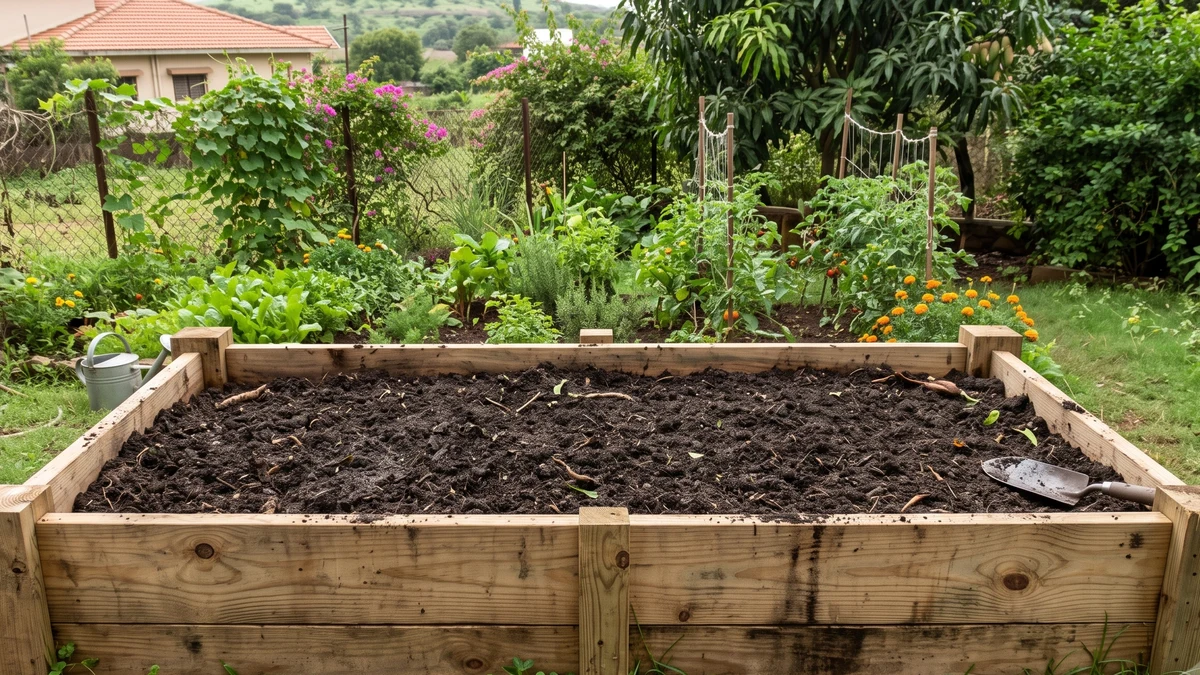
If you’re wondering how much soil for a 4x8 raised bed you actually need (or how much dirt for a 4x8 raised bed, if that’s the word you use), the short answer is 32 cubic feet (about 1.19 cubic yards) at the standard 12-inch depth. Go shallower and you need less: an 8-inch bed takes about 21.3 cubic feet. Go deeper and you need more: 18 inches takes a full 48 cubic feet. The table below breaks down the exact volume, in cubic feet, cubic yards, and bag count, for every depth gardeners actually build to.
Soil and dirt get used interchangeably for this, and the answer is the same either way. Once the bed’s full, the next question is usually what to put in it, which is the second half of this guide.
4x8 Raised Bed Soil Volume by Depth
A 4×8 ft bed has a 32-square-foot footprint no matter how deep you build it. However you phrase it (how much soil for raised bed 4x8 dimensions, or how many cubic feet in a 4x8 raised bed), the answer comes down entirely to depth. The table below uses the same 1.5 cu ft and 2 cu ft bag sizes and the same ~53.3 lb per cubic foot weight estimate as our own Raised Bed Soil Calculator, so these numbers and the calculator never disagree.
| Depth | Cubic Feet | Cubic Yards | Bags (1.5 cu ft) | Bags (2 cu ft) | Approx. Weight |
|---|---|---|---|---|---|
| 6 in | 16.0 cu ft | 0.59 cu yd | 11 bags | 8 bags | ~853 lbs |
| 8 in | 21.3 cu ft | 0.79 cu yd | 15 bags | 11 bags | ~1,135 lbs |
| 10 in | 26.7 cu ft | 0.99 cu yd | 18 bags | 14 bags | ~1,423 lbs |
| 12 in | 32.0 cu ft | 1.19 cu yd | 22 bags | 16 bags | ~1,706 lbs |
| 18 in | 48.0 cu ft | 1.78 cu yd | 32 bags | 24 bags | ~2,558 lbs |
The 10-inch row matches the worked example on our Raised Bed Soil Calculator exactly: 26.7 cubic feet, about 0.99 cubic yards, 18 bags at 1.5 cu ft. If your bed is a different size, the calculator runs this same math for any dimensions, and weight will vary somewhat with how moist the soil is. Once you know how many bags of dirt for a 4x8 raised bed you’ll need from the table above, the next question is what to actually fill it with, and that’s where most of the bad advice online starts.
How to Fill It (And the Mistake Most People Make)
The most common shortcut advice for a raised bed is to save money by stuffing the bottom with logs, branches, or cardboard before adding soil on top, sometimes called hugelkultur, or lasagna-style bottom-filling. It’s a real technique, but it’s built for something different than what most people are using it for. Traditional hugelkultur mounds are two to three feet tall or more, built to develop over several years as buried wood slowly breaks down and feeds the soil above it. Washington State University Extension, reviewing the technique, found that even properly built hugelkultur mounds typically need to be rebuilt from scratch every five to six years as the decomposing wood collapses and the mound loses its shape.
In a standard 10–12 inch raised bed, you get the downside without ever getting the payoff. Decomposing wood mixed into soil ties up nitrogen your plants need while microbes work to break it down. Oregon State University Extension’s research on wood chips mixed into garden soil found a measurably greater tendency to tie up nitrogen than the same material left as surface mulch, and the buried layer compresses as it breaks down, so the bed sinks well below its frame within a season or two. Fill the full depth with an actual soil mix instead. It costs more up front, but the bed is productive immediately instead of fighting a nitrogen deficit for a year.
None of that means hugelkultur itself is a bad technique. It’s a genuinely useful way to fill a bed that’s 24 inches or deeper, where there’s enough soil depth above the buried wood to keep roots away from the nitrogen-hungry decomposition zone, and enough time ahead of you to let a multi-year mound mature. The mismatch is specifically using it as a cost-saving shortcut in a standard-depth rectangular bed, where the wood ends up in the same root zone as this season’s plants instead of well beneath it.
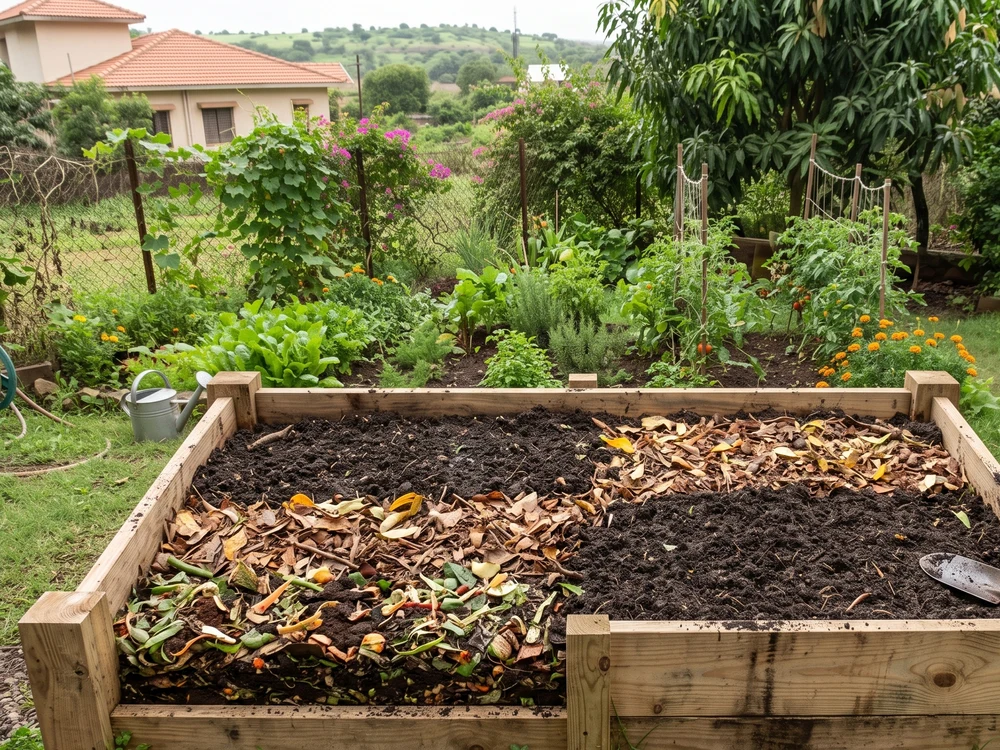
Once the bottom-filling question is settled, the mix itself is simpler. The standard raised bed soil mix is 60% topsoil, 30% compost, and 10% perlite or coarse sand for drainage, the same ratio our Raised Bed Soil Calculator uses to work out exactly how much of each component your bed needs. A 50/30/20 blend with more perlite or sand is a common alternative for heavier native soils, and Square Foot Gardening’s well-known “Mel’s Mix” skips topsoil entirely for equal thirds compost, peat moss or coco coir, and vermiculite. Any of the three works well; what actually hurts a bed is straight garden soil dug from the yard, which compacts hard and drains poorly once it’s boxed in.
Whatever mix you use, plan for it to settle. Loose soil typically loses 10–20% of its volume in the first year alone, as organic matter breaks down, watering compacts loose material, and air pockets close up. Fill a couple of inches proud of the bed’s frame when you first build it, and expect to top off with a bag or two each spring to hold the bed at full depth. That’s normal maintenance, not a sign anything went wrong.
Building a bed that isn’t 4x8? See our guide covering filling methods and cost-saving options for a raised bed of any size, including the bulk-vs-bagged cost breakdown and a properly sourced look at whether a gravel layer at the bottom actually helps drainage.
What Actually Fits in a 4x8 Bed
If you searched for a 4x8 raised garden bed planting layout, the honest version skips the pretty diagram: layout comes down to how much square footage each crop needs at full size, not how it looks the day you transplant. A 4×8 bed is 32 square feet, and dividing that by the space a mature plant needs gives a real count instead of a guess, the same method our Plant Spacing Calculator uses.
One thing the table below isn’t: a planting plan. These are single-crop maximums: what fits if the entire bed were devoted to just that one crop, not a recommendation to actually do that. Nobody plants a 4x8 bed with 512 carrots and nothing else. Use the numbers to see how much room a section devoted to one crop would need, then divide the bed’s 32 square feet among however many crops you’re actually growing.
| Crop | Space Needed | Max Plants if Bed Is All One Crop |
|---|---|---|
| Tomato (spacing guide) | 4 sq ft per plant | 8 plants |
| Pepper (spacing guide) | 1 sq ft per plant | 32 plants |
| Bush beans (spacing guide) | 0.25 sq ft per plant | 128 plants |
| Carrots (spacing guide) | 0.0625 sq ft per plant | 512 plants |
The most common version of this question is how many tomato plants in a 4x8 raised bed actually fit. Using the standard 4 square feet a tomato needs at maturity, the same figure used in our raised bed tomato guide, the answer is 8. Smaller crops fit in much higher numbers for the same reason: bush beans need only a quarter square foot each, and carrots need a sixteenth of a square foot, which is why the counts above range so widely for the same 32-square-foot bed. For any crop or variety not listed here, plug your bed’s exact dimensions into the Plant Spacing Calculator for a precise number.
Square Foot Gardening in a 4x8 Bed
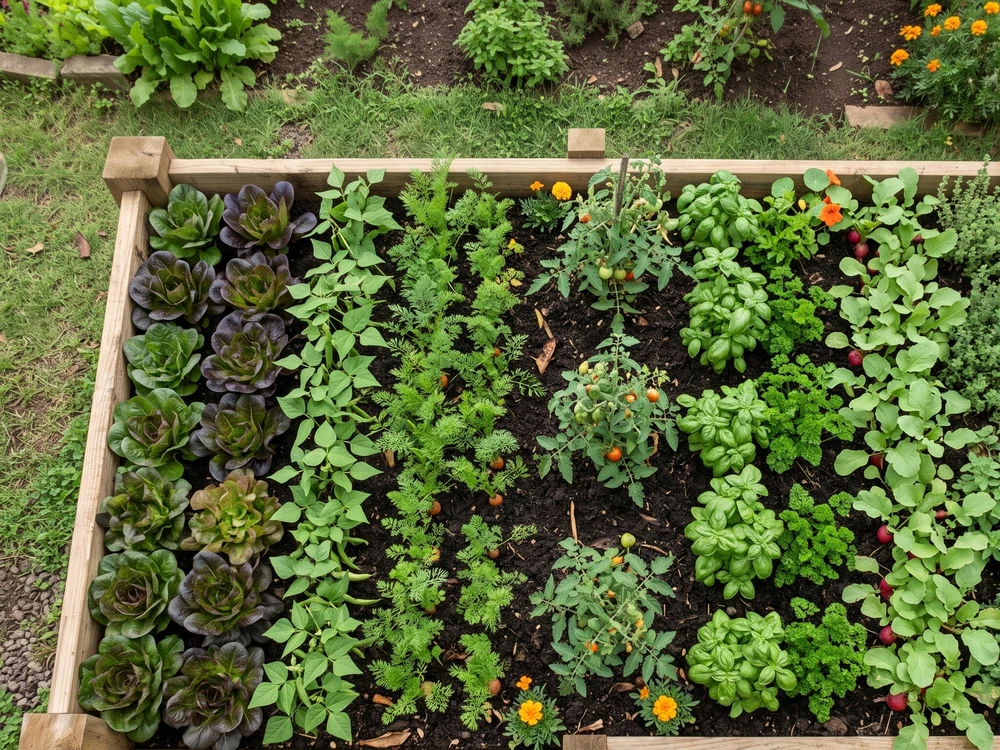
A 4×8 bed divides cleanly into 32 one-foot squares (4 across by 8 down), which is exactly the grid Square Foot Gardening is built around. Once you’re thinking in squares instead of rows, the spacing figures from the table above translate directly: a plant that needs 4 square feet takes up 4 whole squares, which is why tomatoes work out to 8 plants total rather than 32. A plant that needs 1 square foot gets its own square, and small crops like carrots can be packed many to a single square. It’s the same math as the layout table above, just organized by the grid instead of by the whole bed.
Worth flagging: the spacing figures above come from our own Plant Spacing Calculator, not from Mel Bartholomew’s original Square Foot Gardening chart, and the two don’t always match. Carrots and peppers happen to line up with the classic SFG numbers exactly (16 and 1 per square, respectively), but bush beans don’t: the original SFG chart lists 9 bush beans per square, while this site uses a more conservative 4 per square to leave more room for airflow. If you’re building strictly to the classic SFG chart rather than this site’s spacing, expect to fit more bush beans per square than shown above.
The grid also matters for the soil question this whole guide starts with: because a square foot bed is planted so densely, it uses its full depth of soil productively square by square, instead of leaving gaps of bare soil between rows that a traditional layout would. That’s part of why the method, popularized by Mel Bartholomew’s original square foot gardening system, tends to get more harvest out of the same 32 cubic feet of soil than a conventional row layout in the same footprint.
Once you know your depth and mix, our Raised Bed Soil Calculator runs the exact numbers for your bed’s real dimensions: cubic feet, cubic yards, bags of either size, and estimated weight, all in one place.
Free book · 23 pages, PDF
4x8 Raised Bed Soil FAQ
How much soil do I need for a 4x8x12 raised bed?
However you phrase it (how much soil to fill a 4x8 raised bed, or how much dirt to fill a 4x8 raised bed), the answer at the standard 12-inch depth is 32 cubic feet: about 1.19 cubic yards, or 22 bags at 1.5 cubic feet each (16 bags if you're buying 2 cubic foot bags). That's the depth most all-purpose vegetable beds are built to; see the table above for other depths.
Should I fill the bottom of a raised bed with logs or cardboard?
For a standard 10-12 inch bed, no. That's a hugelkultur technique built for tall, multi-year mounds, and Washington State University Extension found even purpose-built hugelkultur mounds typically need to be rebuilt from scratch every five to six years as the buried wood breaks down. In a shallow bed, that same decomposition ties up nitrogen your plants need and causes the bed to sink well below its frame within a season or two. Fill it with actual soil mix instead.
How many bags of soil do I need for a 4x8 raised bed?
It depends on depth and bag size: anywhere from 8 bags (2 cu ft bags, 6-inch depth) to 32 bags (1.5 cu ft bags, 18-inch depth). The most common setup, a 12-inch-deep bed filled with 1.5 cu ft bags, takes 22 bags. Full counts for every depth and bag size are in the table above.
How many tomato plants fit in a 4x8 raised bed?
8 plants, based on the standard 4 square feet a mature tomato plant needs and roughly 24-inch spacing, the tighter end appropriate for a raised bed. See our Plant Spacing Calculator for an exact count by variety.
Do I need to add more soil to a raised bed every year?
Plan on topping it off, yes. Soil settles 10-20% in the first year alone as organic matter breaks down and watering compacts loose material, and it keeps settling gradually after that. Fill a couple inches proud of the frame initially, and expect to add a bag or two each spring to keep the bed at full depth.
Sources & further reading
The 60/30/10 soil mix ratio, bag sizes, and settling estimate above come from our own Raised Bed Soil Calculator, which runs the same volume math for any bed size. For the hugelkultur mound lifespan and structural concerns, see Washington State University Extension’s “Hügelkultur: What Is It, and Should It Be Used in Home Gardens?”. For nitrogen tie-up from wood mixed into soil, see Oregon State University Extension’s “Wood chips for mulch?”. For raised bed depth guidance generally, see Utah State University Extension’s raised bed gardening guide. For more on how we source and review the facts behind every calculator and guide on this site, see our methodology page. And for the bigger picture on choosing between topsoil, garden soil, and compost, see our complete guide to soil and amendments.