A good raised bed design is 3 to 4 feet wide so you can reach the middle from both sides (Clemson Extension), holds at least 6 to 12 inches of soil (Missouri and Iowa State Extension), and sits where it gets 6 or more hours of sun (University of Maryland Extension). Washington State Extension calls 8 feet a convenient length, and paths of 2 to 3 feet leave room for a wheelbarrow (Missouri Extension). Our garden layout guide covers the whole yard; this page covers the beds.
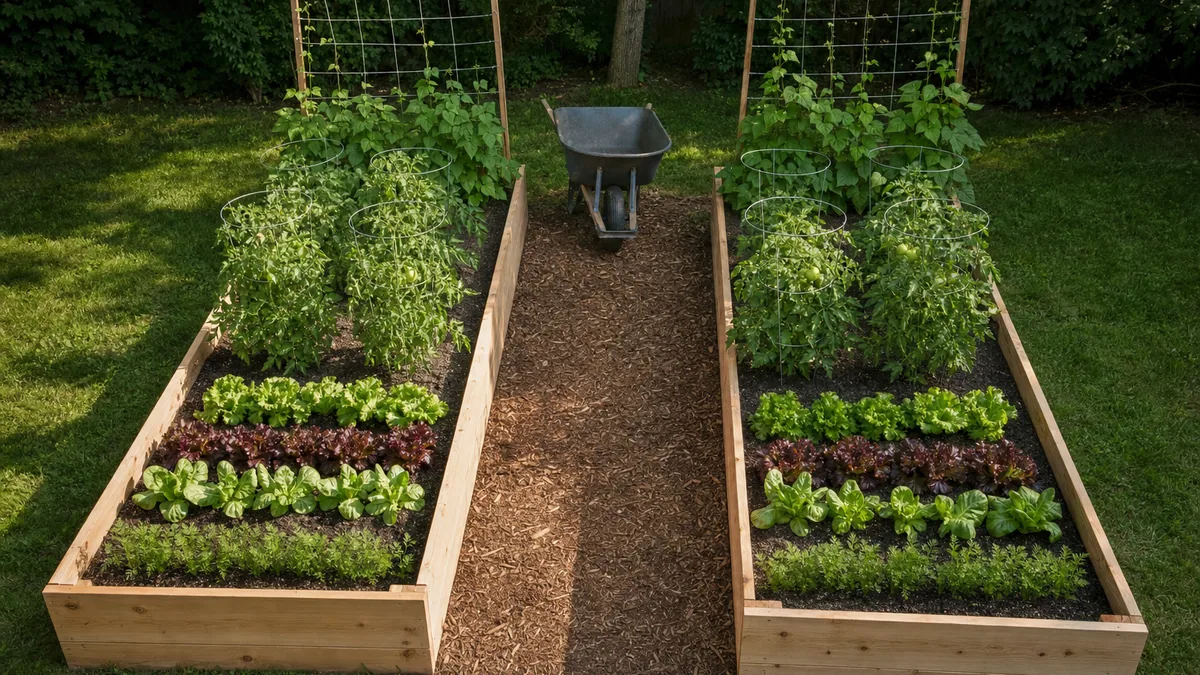
Quick Answer: Raised Bed Garden Designs at a Glance
Every line below comes from an extension service. Where they disagree, the sections that follow say who says what. Tomato growers can find the bed-specific numbers in growing tomatoes in raised beds.
| Design question | Answer | Source |
|---|---|---|
| Width | 3 to 4 ft if you reach from both sides, 1.5 to 3 ft if you reach from one side | Clemson, Iowa State, Illinois, Missouri |
| Length | 8 ft is a convenient size; reinforce beds longer than 6 ft | Washington State, Oregon State |
| Soil depth | 6 to 12 in. is the rooting zone to plan for; 12 to 24 in. for tomatoes, peppers and squash on a hard surface | Missouri, Iowa State, University of Maryland |
| Paths | 2 to 3 ft for a wheelbarrow; 3 to 4 ft for a wheelchair | Missouri, Clemson, Oregon State |
| Sun | 6 hours at least; 8 or more for fruiting crops such as tomatoes and peppers | Clemson, Oregon State |
| Direction | Sources split: north to south, east to west, or whichever suits the site | Iowa State, Illinois, Colorado State |
| First-garden size | 25 to 50 sq ft; one 4 x 8 bed is 32 sq ft | University of Maryland |
Before you build, decide what the beds are for. Our vegetable garden planning guide starts from the crops you want to eat and works back to the space they need.
How Wide, Long and Tall Should a Raised Bed Be?
Width is the number to get right, because it decides whether you can work the bed without stepping on it. Clemson Extension says 3 to 4 feet lets you reach the middle from both sides. Colorado State Extension goes further and calls four feet ideal for most vegetables. Reach from one side is shorter, and the sources differ on how much shorter.
| Source | Reach from both sides | Reach from one side |
|---|---|---|
| Iowa State Extension | 3 to 4 ft | 1.5 to 2 ft |
| University of Minnesota Extension | Up to 5 ft | Up to 2.5 ft |
| University of Illinois Extension | 4 ft at most | 3 ft at most |
| University of Missouri Extension | 4 ft is convenient | 3 ft at most |
Oregon State Extension says no more than 4 feet for adults and 3 feet for children. Length is looser. Washington State calls 8 feet convenient, and Oregon State says beds longer than 6 feet, or taller than about 18 inches, should be reinforced. The University of Missouri suggests splitting a 50-foot run into two 24-foot beds with a 2-foot walkway between them. With less room, how to start a small vegetable garden compares a 4 by 4 bed with big pots.
Height and soil depth are two different things. Iowa State Extension says bed walls range from 6 to 20 inches or more, with 11 inches common when you stack two 2 x 6 boards, and that most plants need at least 6 to 12 inches of soil. Missouri Extension agrees, and adds that deeper would be better. The University of Maryland gives the most crop-specific numbers for beds built on hard surfaces: at least 8 inches for leafy greens, beans and cucumbers, and 12 to 24 inches for peppers, tomatoes and squash. A bed that sits on open ground can use the soil below it, so the frame can be lower. Our 4x8 raised bed soil guide works out the volume at each depth from 6 to 18 inches.
For a first garden, the University of Maryland says a starter garden of 25 to 50 square feet is a good size. One 4 x 8 bed is 32 square feet, inside that range, and two come to 64, just over the top of it. Penn State Master Gardeners add to start small until you know how much time you have to spend.
How Far Apart Should Raised Beds Be, and Which Way Should They Face?
Path width is set by what you push through it. The University of Missouri says 1 foot is enough for foot traffic and 2 to 3 feet for a wheelbarrow or cart. Clemson gives 2 to 3 feet between mounded beds and calls 3 to 4 feet comfortable for enclosed beds. Colorado State uses 18 to 24 inches. For a wheelchair, Oregon State says 3 to 4 feet to accommodate both wheelchairs and wheelbarrows, and the University of Illinois calls a 4-foot path standard for easy access. Our vegetable garden layout for beginners guide shows how paths fit a whole plot.
Direction is where the extension sources do not agree. Iowa State and Washington State say beds should run north to south. The University of Illinois says east to west gives better light distribution for longer beds. Colorado State says either works: east to west has a slight advantage in collecting heat, and north to south has a slight advantage of sun on both sides of the plant row, so orient the beds in whatever direction works best for the site. The point most sources share is about crop height. The University of Maryland says to place taller crops on the north and west sides of a bed, and Clemson says to put a trellis on the north side, so nothing tall shades the shorter crops.
Sun matters more than direction. Clemson, Iowa State, Washington State and the University of Maryland all give 6 hours of direct sun as the minimum, and Oregon State says fruiting crops such as tomatoes, cucumbers and peppers want 8 or more. A plan also needs a layout, planting dates and a shopping list, and you can draw all three on paper. If you would rather have them worked out together, Try it free with two beds in the demo, or read about the full garden planner, which lays out beds square by square, with watering, planting dates and the list of what to buy.
Raised Bed Garden Layout Ideas: Designs Compared
Extension pages describe vegetable beds as plain rectangles. Texas A&M says most are square or rectangular, and Oklahoma State says beds can be made any shape. So the useful choice is not the shape but how many beds you build and how you arrange them.
| Layout | What the extension sources say | Source |
|---|---|---|
| One 4 x 8 bed | 32 sq ft, inside the 25 to 50 sq ft starter range | University of Maryland |
| Two parallel beds with a path | Several smaller beds beat one long bed for crop rotation and disease management; paths of 2 to 3 ft | University of Minnesota, Clemson |
| Bed along a fence or wall | Trellis on the north side; vertical gardens on fences or trellises save floor space | Clemson, Oregon State |
| Terraced beds on a slope | Follow the contour; 8 to 12 in. tall, no wider than 4 ft | University of Maine |
| Keyhole bed | 6 to 8 ft across and 2 to 3 ft high, with an entrance about 2 ft wide | South Dakota State |
An L or a U is simply two or three rectangles meeting at a corner, so each arm follows the same width limits. Wherever you put the beds, our guide to filling a raised garden bed covers the soil mix once the frames are in.
Do This in HarvestMath Garden Instead of by Hand
Everything above works on graph paper, and for one bed paper is enough. What the app does is the repetitive part: sizing the beds to the crops you pick, placing every crop square by square, and building the shopping list. Here is one example from this guide, two 4 x 8 beds of tomatoes, cucumbers, bush beans and lettuce, done in the free HarvestMath Garden demo, which is capped at two beds.
- On the Where step, enter your ZIP code. Frost dates come from the nearest NOAA weather station.
- On the What step, pick the crops, here tomatoes, cucumbers, bush beans and lettuce, or start from a starter garden.
- On the Space step, the app compares the square feet you have with what your crops need. If you are short, it offers to add beds, 4 x 8 first with a 4 x 4 for a small remainder, and the Add a bed buttons cover 4 x 8, 4 x 4, 3 x 6, 4 x 12, 2 x 8 and a 10 x 10 plot.
- On the Layout step, it fills each bed square by square. Fruiting crops go to full-sun beds, tall crops go on the north side, good companions touch and bad ones stay apart.
- To change anything, choose Arrange this bed, pick a crop button and repaint squares. Each button shows how many of that crop are placed, and Eraser clears a square.
- On the Supplies step, a crop that climbs adds a line for trellis netting, with the feet needed and a note that it goes on the north side.
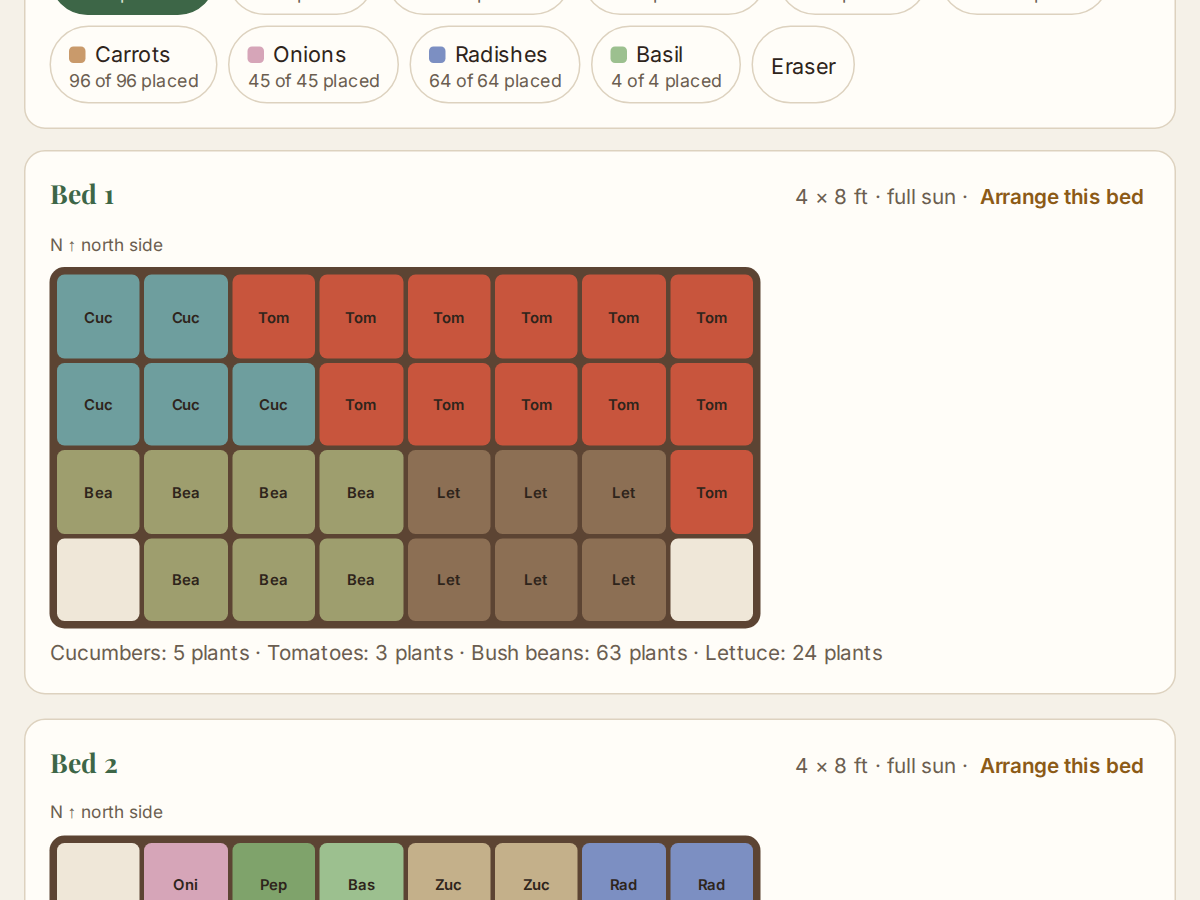
The app keeps your beds and every finished season on your device. In a later year, the Layout step moves plant families away from where they grew last time and lists the moves under a Rotation heading, which saves the bookkeeping that crop rotation otherwise takes. It does not build the frame or water the bed; it plans, and you build.
Paper versus app, in plain terms: for one bed, graph paper with one square per foot and the tall crops in the north row is quick and enough. The app saves time when you have several beds, want rotation to carry over from year to year, and want the layout, planting dates and shopping list worked out together. If that sounds useful, see the HarvestMath Garden page.
Raised Bed Materials: Best Wood and Other Options
The frame decides how long the bed lasts and, for some materials, what ends up in your soil.
| Material | What extension says | Source |
|---|---|---|
| Cedar, redwood, black locust | Decay-resistant choices; cost more than pine or fir but last much longer. Oklahoma State notes they still rot faster than treated lumber in soil contact | University of Maryland, Minnesota, Oklahoma State |
| Untreated Douglas-fir or pine | After 6 years, over half of the cross-section of untreated Douglas-fir 2x12 beds had decayed on the inside; untreated southern pine may last only a few years | Oregon State, Virginia |
| Modern treated lumber (ACQ, copper azole) | No arsenic; Clemson cites a 2007 risk assessment finding no expected harm to adults or children. Penn State says avoid it, and Delaware says it is safe but not recommended for organic gardening | University of Maryland, Clemson, Penn State, Delaware |
| Old CCA lumber, railroad ties, tires | Best avoided for food crops. Minnesota says railroad ties and CCA are harmful to vegetables, Oklahoma State says ties are not recommended unless well aged, and NC State says tires are not recommended | University of Minnesota, Oklahoma State, NC State |
| Concrete or cinder blocks | Last over 100 years and stack without mortar up to 2 ft; may raise soil pH at first; Maryland raises a concern about fly ash in some blocks and suggests sealing with polymer paint | Virginia, Missouri, UF/IFAS, University of Maryland |
| Galvanized steel | Rust-resistant for upwards of 50 years; zinc may leach below pH 5 | University of Minnesota |
Costs are a fair tiebreaker. Virginia Cooperative Extension priced a 4 x 8 bed 12 inches tall in 2022 at about $188 for untreated wood, $213 for treated wood, $155 for cinder block and $177 for a galvanized kit. Treat those 2022 averages as a ratio between materials, not a quote.
Tall and long beds need bracing: Oklahoma State says freeze and thaw can bow wood outward and suggests rebar every 4 feet, and Penn State suggests inside corner posts for a 2x6 bed 18 to 24 inches deep. For tunneling animals, the University of Minnesota and Oregon State both suggest hardware cloth under the bed. And on city lots, test the soil first: the US EPA says soil at 200 to 400 ppm lead calls for raised beds and no deep-root crops, and above 400 ppm for at least 16 inches of clean soil over garden fabric. How to read soil test results explains the numbers.
Raised Garden Bed Ideas for Small Yards, Slopes and Patios
Tall beds you can work from a chair
Heights differ by source. The University of Illinois says wheelchair beds should be 24 inches tall, the University of Minnesota says 27 inches is comfortable, and Virginia Cooperative Extension says 30 inches is usually satisfactory for an adult. South Dakota State says 28 to 34 inches with at least 28 inches of clearance underneath for fully accessible beds. Iowa State says a tabletop bed is 30 to 33 inches tall and 36 to 48 inches wide with 6 to 12 inches of soil, and Washington State says pathways are 4 feet wide, with turnaround areas of at least 6 by 6 feet.
Keyhole and terraced beds
South Dakota State describes the keyhole bed as 6 to 8 feet across and 2 to 3 feet high, with an entrance about 2 feet wide and a compost basket in the center (what can you compost lists what goes in it), and says to use seasoned wood because fresh wood can tie up nitrogen. On a slope, the University of Maine says to build permanent terraced beds parallel with the contours, 8 to 12 inches tall and no more than 4 feet wide. The University of Arizona adds walkways of 3 feet and a maximum length of about 24 feet.
Hoop tunnels and wicking beds
A raised bed takes a low tunnel easily. Oregon State Extension says hoops stand 2 to 3 feet above the ground, spaced every 4 to 5 feet, and that plastic 5 to 7 feet wide covers a 3 to 4 foot bed. The University of Kentucky describes a raised wicking bed with a built-in water reservoir, which waters plants from below.
Raised garden bed on concrete, patios and decks
The University of Maryland says beds on hard surfaces dry out faster, need the 8 to 24 inches of depth given earlier, and, if lined with plastic, need drainage holes. The University of Minnesota suggests a permeable liner such as landscape fabric rather than plastic on a patio. The University of Minnesota says containers suit sidewalk and balcony areas.
A word on hugelkultur
Beds filled with logs and branches are popular, but the extension view is cautious. Washington State Extension says there are no peer-reviewed studies, that the mounds last 5 to 6 years, and that it advises standard raised beds instead. South Dakota State is milder but warns that fresh wood can deplete nitrogen. Our raised bed filling guide explains why a standard mix is the safer default.
How to Plant Inside the Bed: Grid, Blocks and Trellis
A raised bed lets you plant closer than a row garden. Colorado State Extension says block layouts can increase yields fivefold compared with rows, and Kansas State says block planting at about 6 inches between plants gives the highest return. The most popular version is the grid method, which divides the bed into 1 foot squares and plants 1, 4, 9 or 16 plants per square (the rule University of Wisconsin Extension states). The counts differ a little between sources.
| Crop | Plants per square foot | Source |
|---|---|---|
| Radishes | 16 | Cornell, Clemson |
| Carrots | 16 (UF/IFAS, Washington State, Clemson); 9 (Cornell) | As listed |
| Lettuce and leafy greens | 4 | UF/IFAS, Cornell |
| Bush beans | 4 (Cornell); 9 (Washington State, Clemson) | As listed |
| Peppers | 1 | Cornell, Clemson |
| Tomatoes | 1, staked or caged (Clemson, Washington State); Cornell gives a caged tomato 2 squares | As listed |
Where sources differ, start with the wider spacing and tighten it as you learn, which is also Colorado State’s advice. Cornell is the one extension source that criticizes the grid: it says weeds are tedious to pull out of the grid, plants will have wet leaves for longer, and they will likely need more water and nutrients, so it advises trying the method in a small area first. Our companion planting garden layout guide shows which crops to put in neighboring squares.
Put tall crops where they will not shade the rest: Oklahoma State says to plant corn and okra on the north side so they will not shade other vegetables, and Clemson says to put a trellis on the north side of the bed. Colorado State says beans and peas do better in single or double rows than in blocks, and that trellised tomatoes want at least 24 inches between plants in a single row. Succession planting explains how to follow lettuce or radishes with a summer crop.
Rotation is easier with several beds than with one. The University of Minnesota says to avoid planting the same plant family in a bed for 3 to 4 years, and Oklahoma State says to rotate related vegetables each year, since tomatoes, peppers and eggplant share pests.
Watering a Raised Bed
Raised beds drain well and dry out fast. The University of Minnesota says they dry out more quickly than in-ground gardens and need watering more often, and taller beds dry faster. Utah State says a raised bed garden must be irrigated, with drip or trickle the most efficient. Colorado State says drip is well suited to raised beds and sprinklers are less desirable because of disease problems. Kansas State says to aim for one or more inches of water a week, and Oregon State says to set up inline irrigation before the bed is filled.
If tomatoes are going in, how often to water tomatoes gives a schedule.
Raised Bed Garden Plans: Design Yours Step by Step
- Find the spot with 6 or more hours of sun, and 8 or more for tomatoes and peppers (Clemson, Oregon State).
- Choose a width you can reach across: 4 feet if you reach from both sides, 3 feet or less from one side, 3 feet if children will use it (how to plan a garden layout shows where the beds sit in the yard).
- Pick a length of 8 feet or less unless you will reinforce it, and 6 to 12 inches of soil depth for most crops.
- Set the paths: 2 to 3 feet for a wheelbarrow, 3 to 4 feet for a wheelchair.
- Choose a frame material from the table above and add hardware cloth under it if gophers, moles or mice are a problem.
- Draw the squares, put tall crops on the north side, and fill the bed with a blended mix.
If you would rather see these steps worked out for your ZIP code and your own crops, try the free demo. More guides to what goes in the beds are in the spacing and planting hub.
5 free books · 120 pages, PDFs
Raised Bed Garden Designs FAQ
What is the best size for a raised garden bed?
Four feet wide and 8 feet long is the common answer. Colorado State Extension calls four feet ideal for most vegetables, Washington State Extension calls 8 feet a convenient length, and the University of Maryland says a starter garden of 25 to 50 square feet is a good size. A 4 x 8 bed is 32 square feet. Drop to 3 feet wide if you can reach only from one side or if children will garden it.
How deep should a raised garden bed be?
Plan for 6 to 12 inches of soil. Missouri and Iowa State Extension both give that range, and Missouri adds that deeper would be better. Texas A&M recommends 12 to 18 inches for vegetables. On a hard surface the University of Maryland says at least 8 inches for leafy greens, beans and cucumbers, and 12 to 24 inches for peppers, tomatoes and squash.
How far apart should raised beds be?
At least 2 feet for a wheelbarrow. The University of Missouri says 1 foot is enough for foot traffic and 2 to 3 feet for a wheelbarrow, Clemson gives 2 to 3 feet, and Oregon State says 3 to 4 feet to accommodate both wheelchairs and wheelbarrows. The University of Illinois calls a 4-foot path standard for easy access.
Which direction should raised garden beds face?
Extension sources disagree. Iowa State and Washington State say run beds north to south, the University of Illinois says east to west gives better light distribution for longer beds, and Colorado State says to use whichever direction suits the site. They agree on crop height: the University of Maryland says to put taller crops on the north and west sides.
What are good raised bed ideas for a small yard or patio?
Use one or two 4 x 4 beds, a tabletop bed or containers. The University of Maryland says a bed on a hard surface needs 8 to 24 inches of soil depending on the crop and dries out faster, and the University of Minnesota says to use a permeable liner such as landscape fabric rather than plastic on a patio. Iowa State says a tabletop bed is 30 to 33 inches tall and 36 to 48 inches wide with 6 to 12 inches of soil.
How tall should a raised garden bed be?
It depends on who works it and how deep the roots go. For most vegetables the soil depth is 6 to 12 inches (Missouri and Iowa State Extension), and Texas A&M recommends 12 to 18 inches, so a low frame is enough. For working from a chair, the University of Illinois says 24 inches, the University of Minnesota says 27 inches is comfortable, and Virginia Cooperative Extension says 30 inches is usually satisfactory for an adult. South Dakota State says 28 to 34 inches with at least 28 inches of clearance underneath, and Iowa State describes a tabletop bed as 30 to 33 inches tall.
What is the best wood for a raised garden bed?
Cedar, redwood and black locust are the decay-resistant choices. The University of Maryland, University of Minnesota and Oklahoma State say they cost more than pine or fir but last much longer, though Oklahoma State notes they still rot faster than treated lumber in soil contact. Untreated Douglas-fir or pine is cheaper but decays sooner: Oregon State found over half the cross-section of untreated Douglas-fir 2x12 beds had decayed on the inside after 6 years, and Virginia says untreated southern pine may last only a few years.
What is the cheapest material for a raised garden bed?
In Virginia Cooperative Extension's 2022 pricing of a 4 x 8 bed 12 inches tall, cinder block was cheapest at about $155, then a galvanized kit at $177, untreated wood at $188 and treated wood at $213. Treat those as a ratio between materials, not a quote. Concrete blocks also last over 100 years and stack without mortar up to 2 feet (Virginia and Missouri), though the University of Maryland raises a concern about fly ash in some blocks.
Can I put a raised garden bed on concrete?
Yes. The University of Maryland says beds on hard surfaces dry out faster and need 8 inches of soil for leafy greens, beans and cucumbers and 12 to 24 inches for peppers, tomatoes and squash. If you line the bed with plastic it needs drainage holes, and the University of Minnesota suggests a permeable liner such as landscape fabric rather than plastic on a patio.
Is treated lumber safe for a raised vegetable bed?
Extension sources split. The University of Maryland says modern micronized copper azole lumber has no arsenic and is considered low in toxicity, and Clemson cites a 2007 risk assessment that did not expect harm to adults or children. Penn State says to avoid treated lumber, and Delaware calls it safe but not recommended for organic gardening. Missouri says leftover CCA wood probably should not be used for food crops, and Minnesota says railroad ties and CCA are harmful to vegetables.
Can I build a raised bed from cinder blocks?
Yes, with a few cautions. Virginia Cooperative Extension says concrete blocks can last over 100 years, and Missouri says stacks under 2 feet need no mortar. The University of Maryland raises a concern about fly ash in some blocks and suggests sealing them with polymer paint, and UF/IFAS says concrete may make soil more alkaline at first, an effect that declines over time.
Sources & further reading
Bed size, depth, path and orientation figures come from Clemson HGIC’s Raised Beds, Oregon State Extension’s Raised bed gardening (FS 270), University of Maryland Extension’s Growing Vegetables in Raised Beds, Iowa State Extension’s Creating Raised Bed Planters, University of Minnesota Extension’s Raised bed gardens, University of Missouri Extension’s Raised-Bed Gardening (G6985), Colorado State Extension’s Block Style Layout in Raised Bed Vegetable Gardens, Washington State University Extension’s Raised Bed Gardening, University of Illinois Extension’s Raised Bed Checklist and University of Maryland Extension’s Planning a Vegetable Garden, Clemson HGIC’s Small-Scale Gardening and Oregon State Extension’s Gardens are for everyone (EM 9403).
Materials and safety come from University of Maryland Extension’s The Safety of Materials Used for Building Raised Beds, Oregon State Extension’s Pressure-treated wood for raised bed construction, Clemson HGIC’s Treated Wood in the Landscape, Virginia Cooperative Extension’s Comparison of Raised Bed Methods, Materials, and Costs (SPES-425), Oklahoma State Extension’s Raised Bed Gardening, Penn State Extension’s Raised Bed Gardening, University of Delaware’s Raised Bed Gardening, UF/IFAS’s Building Raised Beds, NC State Extension’s tires article and the US EPA’s Healthy Gardening Practices to Reduce Exposure to Lead-Contaminated Soil.
Design ideas and planting layouts come from University of Illinois Extension’s Raised Bed Gardening infosheet, NC State Extension Gardener’s Accessible Gardening, Washington State’s A Guide to Garden Adaptations, University of Minnesota Extension’s Gardening in small spaces, Kansas State’s Wheelchair Accessible Gardening, Virginia Cooperative Extension’s HORT-66 Therapeutic Gardening, South Dakota State’s P-00301, South Dakota State’s Keyhole Gardens, University of Maine’s Gardening on slopes, University of Arizona’s Raised Beds, Texas A&M’s A Raised Bed Garden (E-560), Oregon State’s Low tunnels for season extension (EM 9333), University of Kentucky’s AEN-157 Wicking container, University of Kentucky’s AEN-158 Raised Wicking Bed, Washington State’s Hugelkultur publication, UF/IFAS’s Square-Foot Garden, Cornell’s Square Foot Gardening, University of Wisconsin Extension’s Square Foot Gardening and Kansas State’s MF2134 Raised Bed Gardening.
Local codes, soil and climate differ, so treat these figures as ranges and check with your county extension office before you build.
5 free books · 120 pages, PDFs
The Garden Starter Bundle
Sent