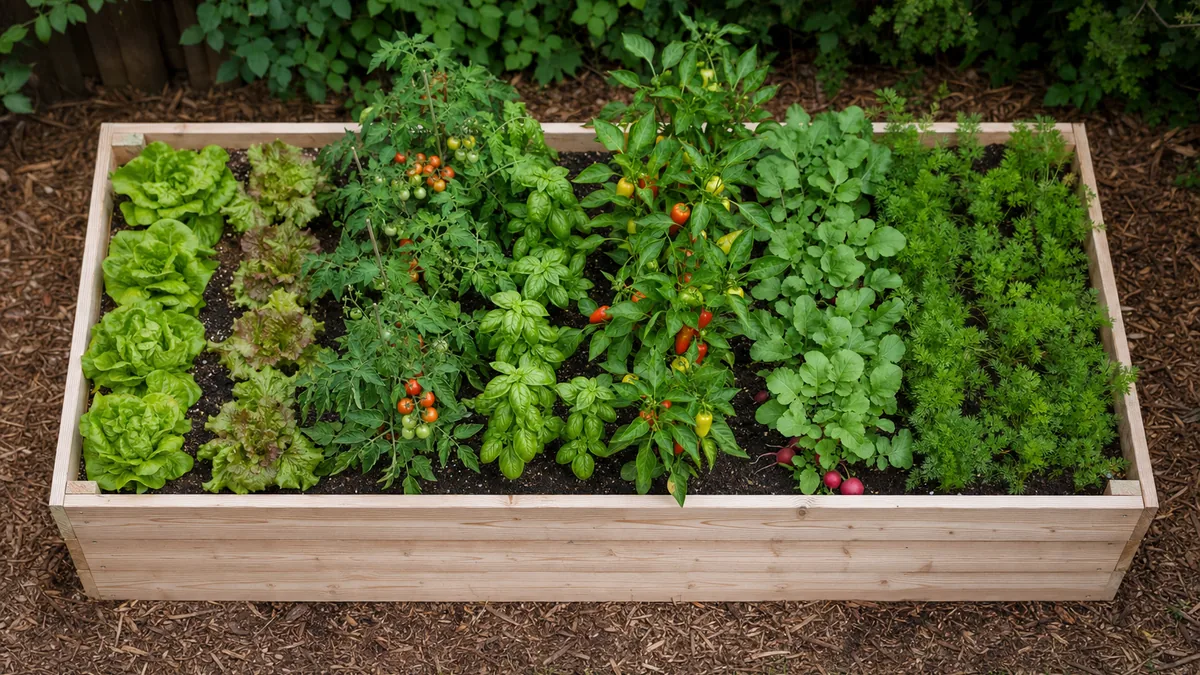
A companion planting layout turns a list of good pairs into a map: tall crops placed so they do not shade shorter ones, shade-tolerant greens tucked into that shade, and every plant at its normal spacing. Extension guides describe three patterns (alternate plants in a row, alternate rows, or scatter-mix) and one fixed design, the Three Sisters mound. Pick your pairs from our companion planting chart first, then place them with the numbers below.
Companion Planting Layout Quick Facts
| What | Answer | Source |
|---|---|---|
| Layout patterns | Alternate plants within a row, alternate rows within a bed, or scatter-mix | University of Maryland Extension |
| Raised bed width | 3 to 4 feet, no more than 4 so you can reach the middle | NC State, Oklahoma State, Colorado State |
| Raised bed height | 8 to 12 inches | NC State Extension |
| Walkways | 18 to 24 inches | Colorado State Extension |
| Sun | At least 6 hours of direct sun, 8 to 10 ideal | NC State Extension |
| Tall crops | North side of the bed or garden, so they do not shade shorter plants | NC State, Oklahoma State |
| Salad greens | North side of tall crops such as corn, tomatoes or eggplant | University of Maryland Extension |
| Three Sisters mound | About 12 inches high, 18 inches to 3 feet across, mounds 3 to 4 feet apart | University of Arkansas, University of Georgia |
From Companion Planting Chart to Garden Map
A chart answers who gets along. A layout answers where each plant goes, and a companion planting map is the bed drawn to scale with that answer on it. Sketch the bed on graph paper, then work through these steps. If you are building the bed first, our guide to filling a raised garden bed covers what goes inside it.
- Fix the bed size first. Raised beds are generally 3 to 4 feet wide, according to NC State Extension, and Oklahoma State Extension says to keep the width to about four feet because most adults can reach about two feet in from each side.
- Mark north. Everything about shade depends on it.
- List your crops and pairs. Use the chart, and keep onions and garlic away from beans, as West Virginia University Extension advises.
- Choose a pattern from the next section for each pair.
- Divide the bed into zones and divide each zone’s length by the crop’s spacing to count plants, as the worked examples below do.
If you would rather not draw it by hand, HarvestMath’s Companion Bed Designer app lays out a bed square by square from the crops you pick.
Companion Planting Vegetable Garden Layout: Three Patterns
University of Maryland Extension describes three ways to arrange companions, and they suit different beds.
Alternate plants within a row
Maryland’s example is basil, tomato, basil, tomato down one row. This is the neatest pattern for a single trellised row of tomatoes, and University of Minnesota Extension says intercropping with basil may even help promote tomato growth. Our guide to what to plant with tomatoes goes through the other pairs that fit this pattern.
Alternate rows within a bed
Maryland’s example here is a row of peppers beside a row of onions. This is also the natural pattern for carrots and radishes: Maryland says to sow them together and harvest the radishes before they begin to crowd the carrots. Our guide to growing carrots from seed covers the slow germination that makes the radish trick useful.
Scatter-mix
Scatter-mix means mixing various species throughout the bed. University of Minnesota Extension notes that a plot of one plant is easier for insects to find than a variety of plants with different heights, colors and textures, which is the argument for this pattern. It is the best fit for tucking herbs and flowers between vegetables, as in our guide to companion planting flowers with vegetables.
Layouts can also pair crops by timing instead of by place. Maryland says to plant radishes at the base of broccoli, and to sow lettuce about a week after transplanting cabbage so the lettuce keeps growing after the cabbage is cut. NC State Extension describes peppers and radishes sharing a bed, with the radishes harvested before the peppers crowd them.
Sun and Shade: Which Side the Tall Crops Go
Two extension rules sit side by side, and they are the same idea. NC State Extension says to plant north to south and to place tall crops (corn, okra, sunflowers) and trellised vines (peas, beans, squash) on the north side so they do not shade shorter plants. Oklahoma State Extension also says to build beds in a north/south orientation for the best light. Maryland adds the exception that makes a companion layout work: put low-growing, shade-tolerant salad greens on the north side of corn, tomatoes or eggplants. In our reading, that means nothing short and sun-loving should sit north of a tall crop, while lettuce is welcome there. The same north-side rule applies when you set bed widths, paths and crop positions for the whole garden, as laid out in how to plan a vegetable garden.
How much light a crop needs decides what can take the shade. NC State says a garden needs at least 6 hours of direct sun a day, with 8 to 10 hours ideal, and that fruiting crops such as tomatoes, peppers, eggplants and melons need more light than leafy and root crops. For partial or filtered shade it lists collards, spinach, cabbage, carrots, kale, turnips, parsley, radishes and lettuce, and it says to avoid tomatoes, beans and eggplant in shade. Our guide to growing lettuce from seed covers the cool-season timing for the shaded end of the bed.
Spacing Numbers for a Companion Garden Layout
Extension spacing tables disagree because they describe different gardens. NC State’s table is for intensive planting, Colorado State’s is for block beds with no walkways inside, and University of Missouri Extension’s is for rows you cultivate by hand. Oklahoma State explains why raised beds differ from the seed packet: because a bed has no between-row access, packet row spacing does not apply, and beans spaced 4 inches apart in a row can be sown 4 inches apart in any direction.
| Crop | NC State (intensive), inches | Colorado State (block), inches | Missouri (in row / between rows), inches |
|---|---|---|---|
| Tomato | 18 to 24 | At least 24, trellised | 18 / 42 (staked) |
| Pepper | 9 to 12 | 15 | 18 / 30 |
| Leaf lettuce | 4 to 6 | 7 to 9 | 3 / 18 |
| Head lettuce | 10 | 10 to 12 | 6 / 18 |
| Carrot | 2 to 3 | 2 to 3 | 3 / 18 |
| Radish | 1 to 2 | 2 to 3 | 1 / 18 |
| Bush bean | 2 to 3 | 4, in double rows 12 apart | 3 / 24 |
| Onion, dry | 2 to 4 | 4 to 6 | 3 / 18 |
Basil is not in those tables. University of Maryland Extension says to thin basil seedlings to 12 inches between plants and 18 inches between rows. Our plant spacing guides by crop give single-crop figures if you want more detail on any one plant.
Companion Planting for Raised Beds: Two Plans
NC State Extension says beds are generally 8 to 12 inches high and 3 to 4 feet wide, and that one 4 × 8 foot raised bed can supply most produce for one or two people. Colorado State recommends 18 to 24 inch walkways between beds and says a 4 foot width is ideal because you can reach the whole bed from the path. Both plans below put the tall crop in the middle of the bed rather than at the north edge, so the lettuce can sit in its shade.
A 4 × 8 raised bed
Run the bed north to south, as Oklahoma State advises, so it is 96 inches long and 48 inches wide. Split the length into four zones. The counts divide a distance by a spacing; where two extension sources differ, both results are shown. If you start the peppers from seed, our guide to growing peppers from seed covers the early weeks.
| Zone (from north end) | Crops | Arithmetic | Plants |
|---|---|---|---|
| 0 to 12 inches | Leaf lettuce | NC State 6 inches: 48 ÷ 6 = 8 per row, 2 rows. Colorado State 9 inches: 48 ÷ 9 = 5 per row, 1 row | 16 (or 5) |
| 12 to 36 inches | Tomatoes on a trellis, with basil in front | Tomatoes at 24 inches: 48 ÷ 24 = 2. Basil at 12 inches (Maryland): 48 ÷ 12 = 4 | 2 tomatoes, 4 basil |
| 36 to 60 inches | Peppers, with a row of radishes | Peppers at 12 inches (NC State): 48 ÷ 12 = 4, or 3 at Colorado State’s 15 inches. Radishes at 2 inches: 48 ÷ 2 = 24 | 4 peppers, 24 radishes |
| 60 to 96 inches | Carrots sown with radishes | Carrots on a 3 inch grid: 48 ÷ 3 = 16 across, 36 ÷ 3 = 12 rows, 16 × 12 = 192 | 192 carrots |
The zones add up: 12 + 24 + 24 + 36 = 96 inches. Only 26 of the plants are large ones (16 lettuce, 2 tomatoes, 4 basil and 4 peppers). At NC State’s tighter 2 inch carrot spacing, the carrot zone would hold 24 × 18 = 432, so the 3 inch figure is the safer first-year plan. Tomatoes get the most thought, so our guide to growing tomatoes in raised beds covers depth, watering and blossom end rot in a bed this size.
How much soil does it take? At the 12 inch maximum height, the bed holds 4 × 8 × 1 = 32 cubic feet, and 32 ÷ 27 = about 1.2 cubic yards. At 8 inches (0.67 feet), it is 4 × 8 × 0.67 = about 21 cubic feet, or 0.8 cubic yard. Our guide to filling a raised garden bed covers the layers, and the 4x8 raised bed soil guide works through this exact size.
A 3 × 6 raised bed
Colorado State says tomatoes suit a bed 24 to 36 inches wide with one row down the middle, so a 3 foot wide bed works for a single trellised row. Use the alternate-within-a-row pattern: 6 feet is 72 inches, and 72 ÷ 12 = 6 positions at basil’s 12 inch spacing. Alternate them tomato, basil, tomato, basil, tomato, basil. That gives 3 tomatoes 24 inches apart, which matches the minimum Colorado State gives, and 3 basil plants.
The bed is 36 inches wide and the tomato row sits at 18, leaving a strip about 9 inches wide on each side. Each strip takes one row of leaf lettuce. At NC State’s 6 inches, 72 ÷ 6 = 12 per side, or 24 in all. At Colorado State’s 9 inches, 72 ÷ 9 = 8 per side, or 16. The tomatoes cast shade on the lettuce as they grow, which NC State’s list of crops for partial shade says lettuce can take.
Garden Plot Layout: An In-Ground Row Garden
In the ground, spacing moves from squares to rows, and the row gaps decide how big the plot is. University of Missouri Extension gives hand-cultivated row distances of 42 inches for staked tomatoes and 18 inches for lettuce, carrots and radishes. When two crops sit side by side, this plan uses the larger gap, which is our own rule of thumb and not an extension figure. Three rows run east to west across the plot, each 12 feet (144 inches) long, with the lettuce row on the north side of the tomatoes as Maryland advises. If you are starting a new plot from scratch, our guide to starting a vegetable garden covers the basics beyond layout.
- North row, head lettuce: Missouri gives 6 inches between plants. 144 ÷ 6 = 24 plants.
- Middle row, tomatoes and basil: staked tomatoes at 24 inches, the minimum Colorado State gives, with basil in each gap. 144 ÷ 24 = 6 tomatoes and 6 basil.
- South row, carrots with radishes: Missouri gives 3 inches between carrots. 144 ÷ 3 = 48 carrots, with radishes sown in the same row and pulled early.
With 42 inches between each pair of rows, the outer rows are 2 × 42 = 84 inches, or 7 feet, apart. The planted area between them is 12 × 7 = 84 square feet. Compare that with a block. Colorado State says block plantings can increase yields fivefold over traditional rows, and fifteenfold for smaller kitchen garden vegetables. Our 48 carrots on a 3 inch grid need 48 ÷ 16 = 3 square feet, against the 12 × 1.5 = 18 square feet a single row uses with its 18 inch gap, which is six times as much room.
Three Sisters Mound Layout, With Counts
The Three Sisters is the one companion layout with a fixed recipe. Extension sources agree on the plan and differ on details, so here is the range. The University of Arkansas Division of Agriculture and University of Georgia Extension both say to build a mound about 12 inches high and 18 inches to 3 feet across, and Georgia says to space mounds 3 to 4 feet apart in all directions. Plant it in this order.
- Wait for warm soil and a sunny site. West Virginia University Extension says soil should have warmed to 60°F and the site should get 6 to 8 hours of sun. Arkansas says corn can go in once night temperatures are in the 50°F range, but no later than June.
- Plant the corn. West Virginia says to sow 4 to 7 seeds about 6 inches apart in the center of the mound. Arkansas and Georgia thin to 3 or 4 plants.
- Add pole beans. Plant them in a ring about 6 inches from the corn and thin to the 3 or 4 healthiest. Sources differ on when: West Virginia says when the corn is 4 to 6 inches high, Georgia says at least 4 inches, and Arkansas says at least 6 inches.
- Add squash or pumpkin. West Virginia says to plant 4 seeds on the outer ring of the mound, spaced 3 to 4 feet apart. Arkansas and Georgia plant 4 seeds about a foot from the beans and thin to one plant.
Here is the count for a 12 × 12 foot patch. At 4 foot spacing, 12 ÷ 4 = 3 mounds per side, so 3 × 3 = 9 mounds. With 3 or 4 corn plants and 3 or 4 bean plants per mound, that is 27 to 36 of each, plus 9 squash. At the tighter 3 foot spacing, 12 ÷ 3 = 4 per side and 16 mounds, which gives 48 to 64 corn, 48 to 64 beans and 16 squash. Our growing guides for squash, pumpkins and beans cover the spacing and care of each sister once the mound is planted. Squash from that mound can be stored once harvested, and how long spaghetti squash is good for covers storage for one type.
Keeping the Layout Working All Season
A map drawn for May is wrong by July. University of Minnesota Extension suggests planting early, short-season crops in the same beds as later-maturing ones, which is why the lettuce and radishes above can go in first. When they come out, our guide to succession planting shows what to sow in their place.
Keep last season’s map. Penn State Extension, cited in our chart guide, advises against planting the same plant family in the same place in succession, so a saved map tells you where tomatoes and peppers grew. For the spacing, timing and calendar tools that sit behind every layout, see our complete guide to spacing and planting.
Free book · 23 pages, PDF
Companion Planting Layout FAQ
What is the best companion planting vegetable garden layout?
There is no single best one. University of Maryland Extension describes three: alternate plants within a row, alternate rows within a bed, or scatter-mix. Rows are easiest to manage, a single basil and tomato row suits a narrow bed, and scatter-mix suits herbs and flowers tucked between vegetables.
Which side of the bed do tall crops go on?
The north side. NC State Extension says to put corn, okra, sunflowers and trellised peas, beans and squash on the north so they do not shade shorter plants, and Oklahoma State Extension gives the same advice. University of Maryland Extension makes an exception for low, shade-tolerant salad greens, which can go on the north side of tall crops like tomatoes.
How do I plan companion planting for raised beds?
Keep the bed 3 to 4 feet wide and 8 to 12 inches high, as NC State Extension describes, and give each plant its own spacing. A 4 by 8 foot bed is 96 inches long and 48 wide, so tomatoes at 24 inches give 48 divided by 24, or 2 per row, and basil at 12 inches (Maryland) gives 4.
How do I make a companion planting map?
Draw the bed to scale on graph paper, mark north, and divide it into zones. Divide each zone's length by the crop's spacing to count plants. Colorado State Extension plants block beds with equal spacing in both directions, such as carrots on a 3 by 3 inch grid, which is a 5 by 5 block of 25 plants.
How far apart should Three Sisters mounds be?
University of Georgia Extension says 3 to 4 feet apart in all directions, with each mound about 12 inches high and 18 inches to 3 feet across. West Virginia University Extension plants the squash 3 to 4 feet apart on the outer ring of one mound, so allow at least that much room around it.
Can I plant companions closer together to fit more in a bed?
Somewhat. Oklahoma State Extension says row spacing on seed packets does not apply in a raised bed, and Colorado State Extension says to start with the wider spacing and reduce it as soil fertility improves. Colorado State also warns that overcrowding reduces air circulation and can increase disease.
Sources & further reading
Layout patterns, shade advice and raised bed dimensions come from University of Maryland Extension’s guide to vegetable succession and companion planting, the NC State Extension Gardener Handbook chapter on vegetable gardening, Oklahoma State University Extension’s raised bed gardening fact sheet and University of Minnesota Extension’s companion planting guide. Block spacing and plant counts come from Colorado State University Extension on block-style layout in raised beds, and row distances come from the University of Missouri Extension planning and planting guide table. Basil spacing comes from University of Maryland Extension’s basil guide. Three Sisters details come from West Virginia University Extension, the University of Arkansas Division of Agriculture and the University of Georgia Extension Three Sisters guide. Crop rotation advice is from Penn State Extension, and the onion and bean warning is from West Virginia University Extension’s companion planting page. For how we source the facts on this site, see our methodology page.
Free book · 23 pages, PDF
The Companion Planting Chart
Sent