How to grow squash comes down to warmth, room and timing. Sow seed or set transplants in full sun after your last spring frost, once the soil is at least 60 to 70°F depending on the guide, and give each plant space for its vine habit. Summer squash is ready in roughly 50 to 75 days, winter squash in 80 to 135. Our spacing and planting guides cover the wider picture.
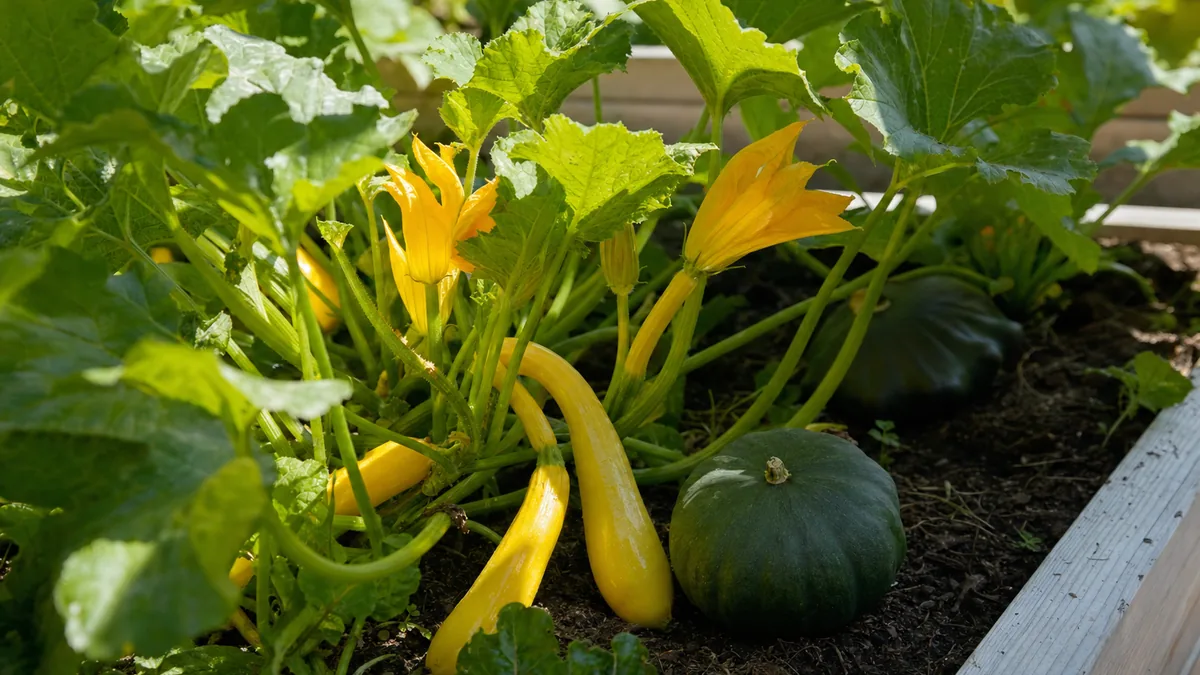
Squash Growing at a Glance
Extension guides agree on the basics and differ on details, mostly because climate and variety differ. Each row names the sources, and ranges are shown where they disagree.
| Question | Short answer | Source |
|---|---|---|
| Soil temperature to sow | 60 to 70°F or warmer, depending on the guide | Clemson, Utah State, Minnesota, South Dakota State |
| Seed depth | 1/2 inch to 2 inches | Clemson, South Dakota State, Washington State, Utah State |
| Summer squash to first harvest | About 50 to 75 days | Clemson, South Dakota State, Washington State |
| Winter squash to harvest | About 80 to 135 days | Georgia, South Dakota State, Washington State |
| Water | About 1 to 2 inches a week | Georgia, Utah State, South Dakota State |
| Soil pH | About 5.8 to 7.5, with 6.0 to 6.5 the common target | Clemson, Georgia, Washington State |
| Acorn squash storage | Up to about 2 months at 50 to 60°F | South Dakota State Extension |
How Does Squash Grow? Summer vs Winter, Bush vs Vining
Squash is a warm-season crop in the same family as pumpkins and cucumbers. The two groups behave very differently. Summer squash such as zucchini, yellow crookneck and pattypan is picked while the fruit is immature and the skin is soft. Winter squash such as acorn, butternut and Hubbard is left to ripen fully, until the rind is hard enough to keep for weeks or months. Washington State University Extension lists acorn, butternut, buttercup, turban, Hubbard and spaghetti as winter types.
Plant habit follows the same split. Mississippi State University Extension describes summer squash as a bush plant suited to small gardens, and winter squash as strongly vining, with Table Queen, a small acorn type, as a bush exception. University of Minnesota Extension suggests bush types for small gardens and says small-fruited squash such as acorn can be trained up a trellis. The University of Georgia puts winter squash into weight classes, from 1 to 4 pounds (including acorn and butternut) up to 50 to 100 pounds or more for jumbo types.
Growth is leaves first, then flowers, then fruit. Our guide to growing pumpkins covers the giant-fruit end of the family, so this page stays on zucchini, yellow squash and the smaller winter types.
How to Plant Squash: Soil Temperature and Timing
The seed will sit and rot in cold ground, so wait. Clemson Extension says squash seeds do not germinate well in cold soil and advises waiting until after the last frost, with soil at 60°F at 4 inches deep. Utah State University Extension says to sow when soil reaches 65°F or after the last frost, and University of Minnesota Extension also gives 65°F, measured at 2 inches. South Dakota State University Extension gives 70°F. Oregon State University Extension lists 60°F as the minimum for squash germination, 70 to 95°F as the optimum range and 100°F as the maximum.
The safe reading is to wait until the soil is at least 65°F, nearer 70°F if you can, and use a soil thermometer rather than guessing. Our soil temperature guide shows how to take a reading. Winter squash can wait a little longer: the University of Georgia says to plant it a few weeks after summer squash, once the soil is warm. For your own dates, our planting calendar pages are a good start.
Early planting is possible with protection. Utah State says plastic mulch and row covers allow planting 2 to 3 weeks before the last frost, and Clemson says spun-bonded row cover gives about 4 degrees of frost protection, down to 28°F.
How to Grow Squash from Seed, or from Seedlings
Direct seeding is the easy route, and South Dakota State Extension prefers it. For bought transplants, Utah State and the University of Georgia both say to look for 2 to 3 mature leaves and a well-developed root system.
- Warm and loosen the soil. Utah State suggests working in up to 2 inches of compost.
- Sow at the right depth. Guides differ: Clemson and South Dakota State say about 1/2 inch, Washington State says 1 inch, and Utah State says 1 to 2 inches. About an inch is a safe middle in average soil.
- Plant extra seeds. For hills or mounds, Georgia and Utah State say to sow 4 to 6 seeds per mound and Washington State says 4 to 5. Clemson sows 2 to 3 per hill.
- Thin early. Thin once seedlings have 1 or 2 true leaves (Clemson), or two to three leaves (Washington State).
If your season is short, start indoors. University of Maryland Extension lists 3 to 5 weeks before transplanting for squash, and says elsewhere on the same page that squash needs only 2 to 4 weeks as a transplant. About 3 weeks is a reasonable middle. Maryland sows two or three seeds per cell, keeps the strongest, and recommends a potting mix at 65 to 75°F for germination. Our guide to growing cucumbers from seed covers the same indoor routine.
How Far Apart to Plant Squash
Spacing depends on whether you plant in rows or mounds, and on bush versus vining habit. Here is what the guides say.
| Source | Plants or mounds | Rows |
|---|---|---|
| Clemson (summer, rows) | 12 to 15 inches after thinning; 15 inches for transplants | 3 feet |
| Clemson (summer, hills) | 3 to 4 feet between hills | 4 to 6 feet |
| South Dakota State (summer, rows) | 8 to 12 inches after thinning | 2 to 3 feet each side for vines |
| Utah State (transplants) | 2 feet | 4 to 6 feet |
| Georgia (mounds) | 4 feet for summer, 6 to 8 feet for winter | Not stated |
| Washington State (hills) | 4 to 5 feet | Not stated |
| Clemson (winter, bush or short-vined) | 2 to 3 feet | 3 to 5 feet |
| Clemson (winter, large-vined) | 3 to 5 feet | 6 to 8 feet |
| Minnesota (winter) | 24 to 36 inches, closer for bush types | 5 to 6 feet |
The pattern is clear even if the numbers are not identical. Summer bush types can sit 1 to 4 feet apart, while vining winter types want 3 to 8 feet each way. In practical terms, a good default for zucchini and yellow squash is one plant every 2 to 3 feet in rows 4 feet apart, and for vining acorn or butternut about 4 feet in rows 6 feet apart. That is a judgment call inside the published ranges, not a single source’s number.
Short on ground? A bush summer variety fits a raised bed, and our guide to filling a raised garden bed covers the soil. Our plant spacing pages compare other crops.
How Long Does Squash Take to Grow?
The answer is short for summer squash and long for winter squash. Clemson Extension says summer squash is ready about 55 days after planting, South Dakota State gives 50 to 75 days depending on variety, and Washington State gives 60 to 70 days to first harvest.
Winter squash needs far longer. The University of Georgia gives 80 to 120 days, South Dakota State 80 to 115, and Washington State 90 to 135, which that university notes may be too long for some cooler areas. Mississippi State says winter squash needs 60 to 70 days from pollination to maturity. If your frost arrives early, pick a variety at the low end of the range.
Summer types are picked small. Utah State says to harvest 3 to 5 days after the flower opens. Clemson says to pick crookneck and straightneck at 1.5 to 2 inches across and zucchini at 7 to 8 inches long. South Dakota State says zucchini is generally 6 to 10 inches and should be picked before the seeds toughen, and the University of Georgia says to pick about every other day. For planning, Utah State expects 75 to 100 pounds per 100 feet of row.
To keep zucchini coming into fall, plant again rather than hoping one planting lasts. Wisconsin Extension suggests a new squash planting every 2 to 3 weeks, and our guide to succession planting shows how to schedule it.
Sun, Soil and Water for Squash
Choose a spot with full sun, as Clemson and the University of Georgia advise. Clemson gives a pH of 6.0 to 6.5, the University of Georgia 5.8 to 6.8 and Washington State 6.0 to 7.5, so the overlap is easy to hit with a standard test. Our guide on how to read soil test results helps you decode it.
Go easy on nitrogen. Clemson says excess nitrogen promotes vine growth and reduces fruiting. Without a soil test, Georgia suggests 3 tablespoons of 5-10-15 fertilizer per mound at planting.
For water, think inches per week. The University of Georgia says 1 to 1.5 inches, Utah State 1 to 2 inches, and South Dakota State at least 1 inch from rain or irrigation. Clemson says to water in the morning and moisten the soil to a depth of 6 inches, because light watering encourages shallow roots. Drip irrigation or soaker hoses beat wetting the leaves. Moisture matters most during fruit set (Clemson), and Georgia and Utah State both say to cut back as fruit ripens to avoid fruit rot. South Dakota State links blossom end rot to low soil calcium or uneven watering.
Good neighbors help too. Our companion planting chart lists what grows well beside squash.
Squash Pollination and Hand Pollinating
Each squash plant carries separate male and female flowers. University of Minnesota Extension says the first blossoms often drop and are male, which is not a problem, and that female flowers open later with a swelling at the base that becomes the fruit. Bees do the work, and Minnesota says cold, rainy or cloudy weather can reduce pollination.
If fruit set is poor, you can pollinate by hand. Texas A&M AgriLife Extension describes the method: pick a male flower, remove the petals to leave an exposed anther on a stem about 4 to 6 inches long, and rub it gently on the stigma in the center of an open female flower. One anther can pollinate about five flowers. Do it as soon as flowers open. Texas A&M adds that if you cover plants with row cover to keep out borers, you can pollinate in the late afternoon, because borers are most active before noon. To protect bees, Clemson advises applying any insecticide late in the evening, and Washington State says to minimize insecticide use during bloom.
Squash Bugs and Vine Borers
Squash shares pests with its cousins. Washington State describes squash bug adults as about 5/8 inch long, with yellow specks on leaves that turn brown, and says to handpick eggs and bugs and to clean up plant debris in autumn to remove overwintering sites. Cucumber beetles are the other regular visitor, and South Dakota State says they can spread bacterial wilt and squash mosaic virus. For leaf holes and disease, see our guides on holes in plant leaves and powdery mildew, the white coating South Dakota State calls common in hot weather.
The squash vine borer is the one that kills plants suddenly. University of Illinois Extension says adult moths emerge from mid-June to early July and lay eggs mainly near the base of stems. Eggs hatch in about 10 to 14 days and the larvae feed inside the stem for 4 to 6 weeks. Signs are a small hole with sawdust-like frass and a vine that wilts in the heat of the day. Wisconsin gives slightly different timing (eggs hatch in 7 to 15 days, larvae feed for 2 to 4 weeks), so check often.
- Choose less susceptible types. Illinois says summer squash, zucchini, acorn and Hubbard are most susceptible, while butternut and crookneck are far less so.
- Cover young plants. Illinois and Wisconsin both mention floating row cover, to be removed or replaced by hand pollination once females bloom. Wisconsin says it works only where squash was not grown the previous year.
- Bury a few nodes. On vining types, Illinois and Wisconsin say rooting a few nodes helps plants survive borer damage.
- Operate early. At the first frass, Illinois and Wisconsin both say to slit the vine lengthwise, remove the larva and cover the stem with soil.
How to Grow Acorn Squash
Acorn squash is a small winter squash. University of Minnesota Extension places it in the Cucurbita pepo group with delicata and spaghetti squash, and the University of Georgia puts it in its 1 to 4 pound class. It follows the winter squash rules above, with a long season: South Dakota State says winter squash and pumpkins take 80 to 115 days, and gives no separate figure for acorn.
Spacing for acorn depends on the variety. A bush acorn such as Table Queen, which Mississippi State lists as a bush plant, fits Clemson’s 2 to 3 feet for bush types, while a vining acorn wants Clemson’s 3 to 5 feet in rows 6 to 8 feet apart. Minnesota says acorn can be trained up a trellis, which saves ground. University of Illinois Extension lists acorn among the squash most susceptible to vine borers, so watch the stem bases in midsummer and consider the rooted-node trick above.
Minnesota says to hold off on straw or compost mulch until the soil reaches at least 75°F, and the University of Georgia says to ease off the water once fruit ripens. For a close relative in the kitchen, see how long spaghetti squash lasts. If this is your first plot, our guide to starting a vegetable garden shows where a sprawling squash fits.
How to Pick Acorn Squash
Color alone is not enough. South Dakota State Extension says to harvest acorn squash when the ground spot, the patch where the fruit rests on the soil, turns dark orange (its growing guide says golden orange). It says the traditional test is a rind too hard to puncture with a fingernail, which works for many but not all types, and that a better sign is stem corking, where the stem loses its green color and develops brown, woody stripes. Fruit left on the vine after corking gains no quality or storage life and may rot. The University of Georgia and Washington State add dying-back vines and a hard rind, and say to cut with the stem attached.
Mind the weather. South Dakota State says squash is sensitive to temperatures below 45°F, although fruit can tolerate brief exposure to 35°F. University of Minnesota Extension says a light frost that kills the vine usually will not harm the fruit. Either way, pick before a hard freeze.
Curing is where the sources part ways. Clemson cures winter squash for about 10 days at 80 to 85°F, but South Dakota State says not to cure acorn squash that way, and that holding fruit above 80°F for a week or two after harvest can raise sugar and flavor without shortening storage life. Acorn is a short-keeper. South Dakota State says it stores up to 2 months, against 2 to 3 months for butternut and 5 to 6 for Hubbard, at 50 to 60°F and 50 to 70 percent humidity, away from apples, ripe pears and tomatoes.
Free book · 23 pages, PDF
How to Grow Squash FAQ
How do you plant squash seeds?
Sow seeds about 1/2 to 2 inches deep (Clemson says 1/2 inch, South Dakota State 1/2 inch, Washington State 1 inch, Utah State 1 to 2 inches) once the soil is at least 65°F. Sow several seeds per mound and thin to the strongest plants when they have one or two true leaves.
How far apart should you plant squash?
It depends on the type. Clemson gives 12 to 15 inches for summer squash in rows and 3 to 4 feet between hills, Georgia 4 feet between summer mounds and 6 to 8 feet for winter squash, and Washington State 4 to 5 feet between hills. Bush types need less room than vining ones.
How long does squash take to grow?
Summer squash is ready roughly 50 to 75 days after planting (Clemson about 55, South Dakota State 50 to 75, Washington State 60 to 70). Winter squash takes 80 to 135 days (Georgia 80 to 120, South Dakota State 80 to 115, Washington State 90 to 135).
What is the difference between summer and winter squash?
Summer squash is picked young while the skin is soft, and the University of Georgia says to pick it every other day. Winter squash is left until the rind is hard and the vines die back, then stored. Washington State says winter squash keeps 3 to 5 months, depending on the type.
When is acorn squash ready to pick?
South Dakota State Extension says to harvest when the ground spot turns dark orange and the stem corks, with brown woody stripes where it meets the fruit. Cut it with the stem attached before a hard freeze, then store at 50 to 60°F, where acorn keeps up to about 2 months.
Do you need to hand pollinate squash?
Not usually, because bees do the work. If fruit set is poor, Texas A&M AgriLife Extension says to remove the petals from a male flower and touch its anther to the center of an open female flower; one anther can pollinate about five flowers. University of Minnesota Extension says early male flowers that drop are normal.
How do you stop squash vine borers?
University of Illinois Extension says the moths lay eggs near stem bases from mid-June to early July. It suggests row cover (with hand pollination), a second planting in early July, burying a few nodes on vining types, and slitting the stem to remove larvae at the first sign of frass.
Sources & further reading
Timing, spacing, water, pH and harvest figures come from Clemson HGIC’s Summer Squash and Pumpkins and Winter Squash, Utah State University Extension’s guide to summer and winter squash, University of Georgia Extension’s Homegrown Summer and Winter Squash, Mississippi State University Extension’s Squash, Washington State University Extension’s Growing Squash in Home Gardens, University of Minnesota Extension’s guide to pumpkins and winter squash, and South Dakota State University Extension on summer squash, pumpkins, squashes and gourds and harvesting and storing winter squash. Germination temperatures are from Oregon State University Extension, and indoor seed starting from University of Maryland Extension. Pest and pollination details are from University of Illinois Extension, University of Wisconsin Extension and Texas A&M AgriLife Extension. For how we source the facts on this site, see our methodology page.
Free book · 23 pages, PDF
The Spacing & Planting Cheat Sheet
Sent