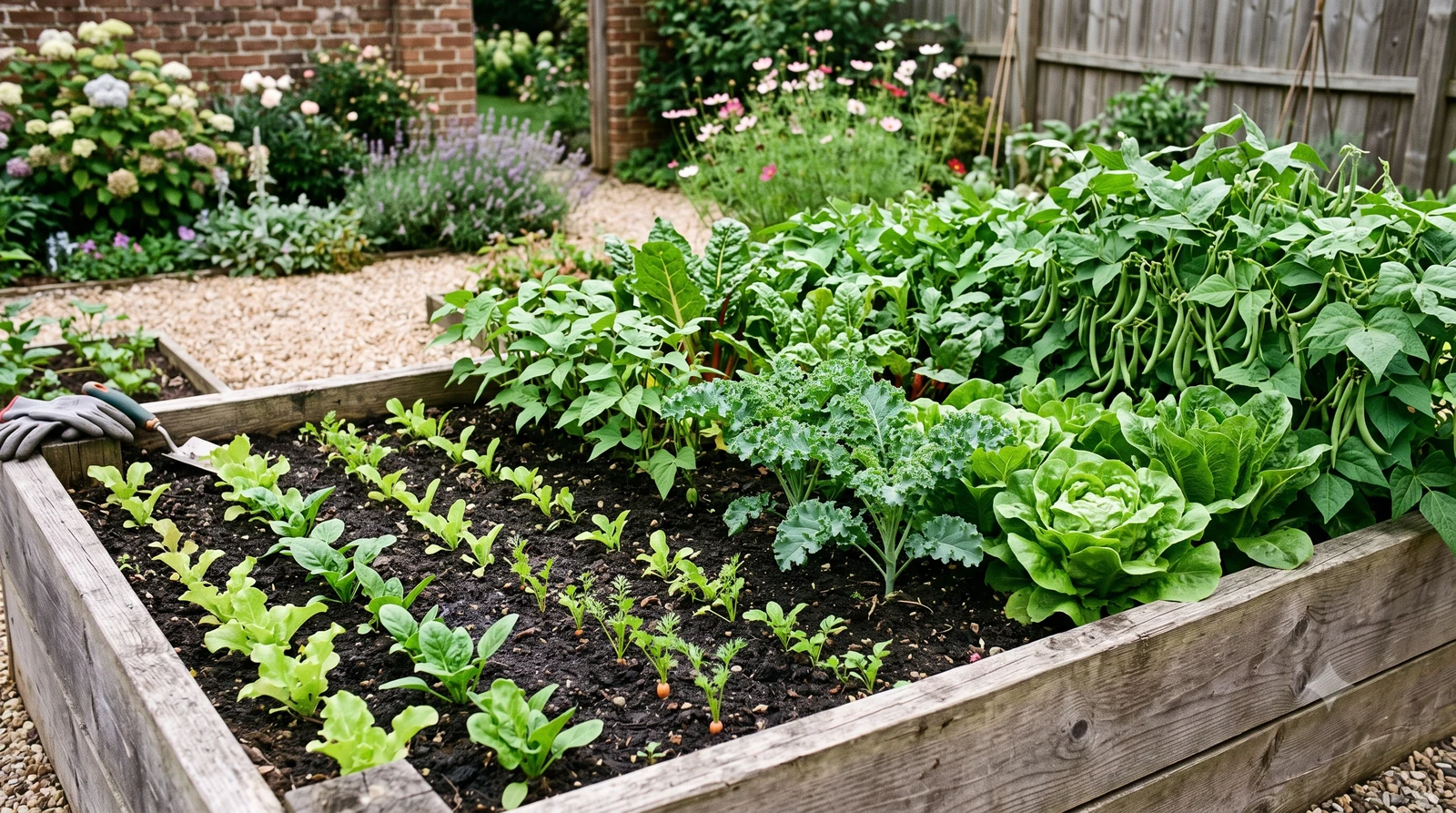
Succession planting means one crop following another in the same space, so the work and the harvest spread across the whole season instead of getting crammed into the weeks right after the last frost. Done well, it turns a single bed into two, three, or more harvests without adding a single square foot of garden.
What Is Succession Planting?
Succession planting is the practice of planning what goes into a bed next, before the current crop is even finished, so there’s no gap where the soil sits empty and unproductive. It covers three distinct techniques (staggered sowing, staggered-maturity varieties, and interplanting) and most productive vegetable gardens use some combination of all three without necessarily naming them. The three methods below cover most succession planting vegetables scenarios, whether you’re working a single raised bed or a full garden plot.
Method 1: Staggered Sowing
This is the most literal form of succession planting: the same crop, planted more than once, at different times, so the harvests land weeks apart instead of all at once. Potatoes are a straightforward example: sow a batch in May for an August harvest, then sow the same variety again in July for a harvest in October. The same approach works for quick crops like lettuce, radishes, and bush beans, sown every two to three weeks through the growing season instead of all in one go. The tradeoff is simple: one big harvest you have to use or preserve all at once, versus a steady, manageable trickle spread over months.
Method 2: Staggered-Maturity Varieties
Instead of staggering when you plant, this method staggers what you plant: multiple varieties of the same crop, all planted together on the same day, but bred to mature at different rates. Tomatoes are the clearest example: cherry tomatoes ripen early, paste tomatoes come in at mid-season, and beefsteak varieties finish last, so a single spring planting day still produces a rolling harvest from mid-summer into fall. (If you’re starting any of those from seed, see our How to Grow Tomatoes from Seed guide for the full process and variety-specific notes.) Potatoes work the same way: a roughly 90-day variety like Yukon Gold planted alongside a longer, 130-day variety spreads the dig-up window instead of concentrating it. If you already grow a few different varieties of the same vegetable side by side, there’s a good chance you’re already doing this without having a name for it.
Method 3: Interplanting
Interplanting pairs a fast crop with a slow one in the same footprint, using the space efficiently while the slow crop is still small and hasn’t filled in yet. Radishes (roughly 30 days to harvest) tucked in between newly transplanted cabbage (which takes several months to mature) are the classic pairing: the radishes are pulled and eaten well before the cabbage needs the room, so you get a full extra harvest out of space that would otherwise just be idle soil around young transplants. The same logic applies to lettuce under young tomato plants, or spinach between rows of slower brassicas.
Starting Seeds Indoors for Precise Timing
Direct-sowing everything works, but it gives up a real advantage: control over exact timing. Starting seeds indoors under lights lets you have a transplant-ready seedling on the exact day the previous crop comes out, instead of sowing directly and waiting weeks for germination and early growth while the bed sits half-empty. That precision is what actually makes tight successions possible: without it, you’re often stuck with a gap between one harvest and the next planting being ready. Our Seed Starting Calculator works out exactly when to start each crop indoors based on your frost dates, so transplants are ready right when you need them.
Frost Dates Are Only a Ballpark
Every succession schedule gets built around frost dates, so it’s worth being honest about what those dates actually are: a statistical estimate, not a guarantee. Your last spring frost and first fall frost shift by a week or two most years, sometimes more, and planning a tight succession around an exact date rather than a range is how a late cold snap or an early frost wipes out a planting. Use a real estimate to build the schedule, but stay flexible near both ends of the season: watch the actual forecast rather than the calendar as those windows approach. Our Frost Date Calculator gives you that estimated range by zone or ZIP code, which is the honest starting point for planning successions rather than a single fixed date.
Worked Example
Here’s how all three methods stack up across a single season in one 4×8 raised bed, effectively a succession planting chart for one bed, laid out in words instead of a spreadsheet. In early spring, interplant lettuce with young broccoli transplants: the lettuce is harvested well before the broccoli fills out and needs the space. Once the broccoli is pulled in early summer, replace that section with a staggered planting of tomato varieties (cherry, paste, and beefsteak sown the same day) for a rolling harvest from mid-summer through fall. As the tomatoes wind down in early fall, use the freed-up space for a final staggered sowing of quick fall crops like spinach or radishes, timed against your first fall frost estimate. Three distinct methods, one bed, and the soil is never sitting empty for more than a few days at a time. Since the whole point is more total harvest from the same footprint, our Vegetable Yield Calculator is useful here too: it estimates the harvest you can expect from a given crop and area, which makes it easier to see how much a full season of succession actually adds up to compared with one planting.
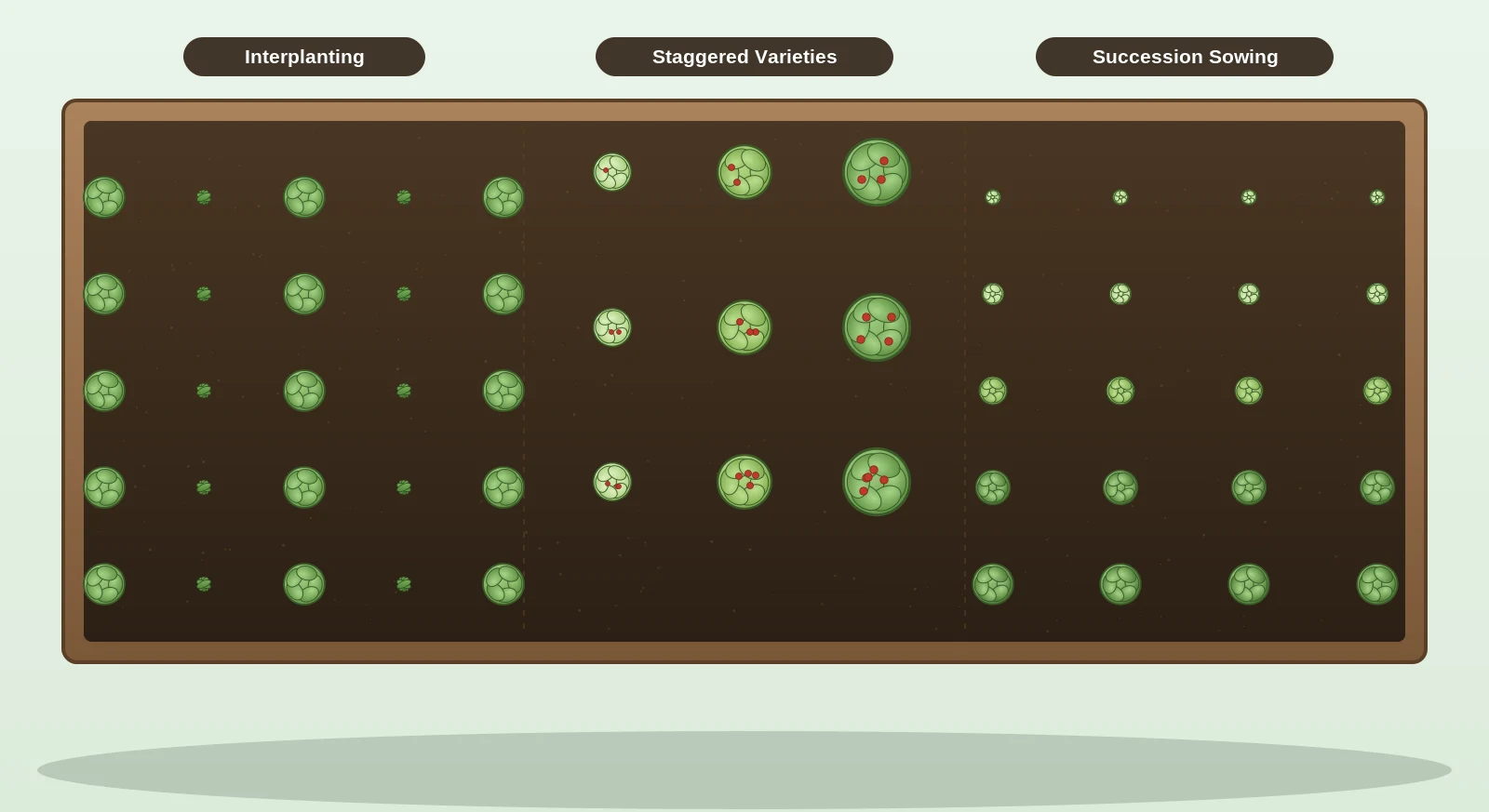
The same 4×8 bed, three methods at once: interplanting, staggered varieties, and succession sowing.
Common Mistakes
The most common misstep is not tracking each variety’s actual days-to-maturity: that number is printed right on the seed packet, and skipping it means guessing at timing instead of planning around a real figure. A close second is succession planting without starting the next round of seedlings in advance: if nothing is transplant-ready when the current crop finishes, the bed sits empty anyway, which defeats the entire point. Finally, don’t assume later plantings behave identically to the first: as the season’s daylight and temperature shift, the same variety can mature faster or slower than it did earlier in the year, so later sowings may need adjusted spacing or a revised timeline rather than an exact copy of the spring schedule.
Free book · 23 pages, PDF
Succession Planting FAQ
What is succession planting?
Succession planting means planning the next crop for a space before the current one is finished, so the bed stays productive all season instead of sitting empty after one harvest. It covers three techniques: staggered sowing, staggered-maturity varieties, and interplanting a fast crop with a slow one.
How do I extend my growing season?
Start seeds indoors so transplants are ready the moment a bed opens up, and plan around your estimated frost dates rather than the calendar. Succession planting itself extends what you get out of the season you already have, by keeping every bed in use instead of idle.
When should I start planting my vegetable garden?
Timing depends on your last spring frost date and each crop's cold tolerance: hardy crops like lettuce and peas can go in weeks before the last frost, while warm-season crops like tomatoes wait until after it. Our Frost Date Calculator gives you that estimated window by zone.
Is it possible to grow the same plant twice in one year?
Yes: this is staggered sowing, one of the core succession planting methods. Fast-maturing crops like lettuce, radishes, and bush beans are commonly sown two or three times across a season, and even longer-season crops like potatoes can be sown again in mid-summer for a fall harvest.
What can I do to make a late-season garden successful?
Sow fast-maturing, cold-tolerant crops (spinach, radishes, lettuce) timed against your first fall frost estimate rather than a fixed date, and have transplants started indoors ready to go the moment summer crops finish. Treat the frost date as a range to watch, not a hard deadline.
Sources & further reading
The methods above follow West Virginia University Extension’s Succession Planting guide. For a deeper, season-long treatment of the same ideas, Meg Cowden’s book Plant Grow Harvest Repeat is a useful further-reading resource. For more on how we source and review the facts and formulas behind every calculator and guide on this site, see our methodology page. And for the full picture on getting the most out of your growing space, see our complete guide to spacing and planting.