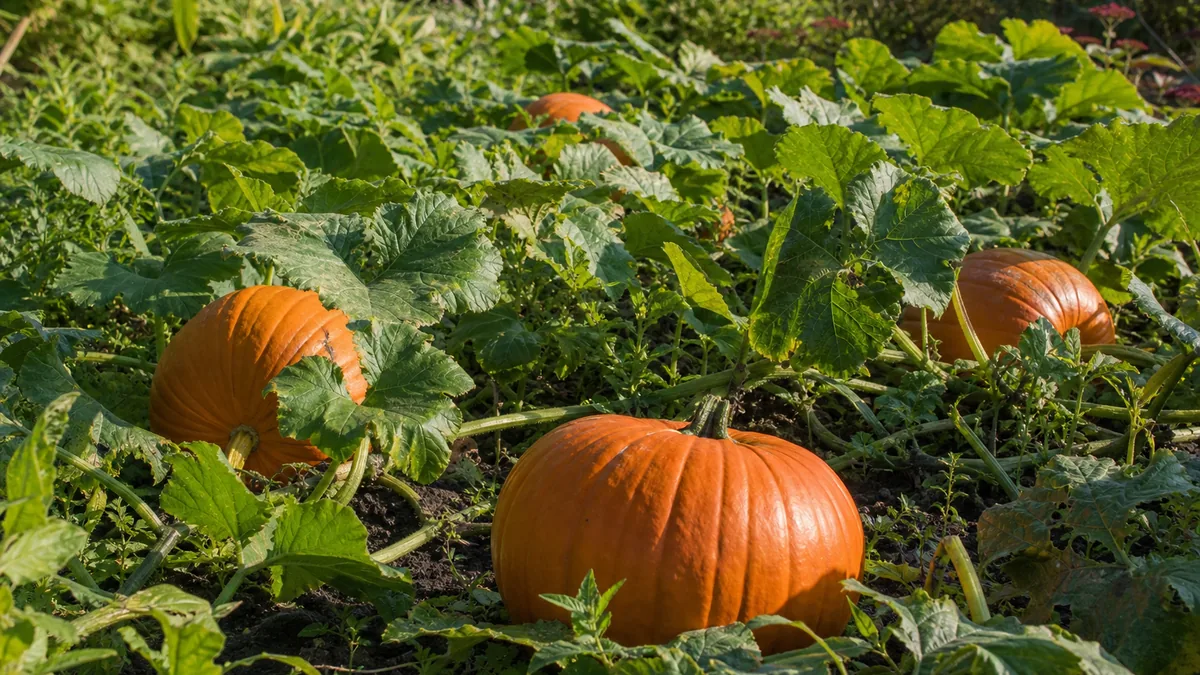
To grow pumpkins, sow seeds in hills after your last spring frost, once the soil is warm, in full sun with room for sprawling vines. Most varieties need 90 to 120 days from seed to harvest, steady water and a bee-friendly garden. Space matters most: a standard vining pumpkin wants roughly 40 to 64 square feet to itself, and our spacing and planting guides cover the wider picture.
Pumpkin Growing at a Glance
Extension guides agree on the broad strokes and differ on details, because seasons differ so much by state. Each row names its sources.
| Question | Short answer | Source |
|---|---|---|
| Soil temperature to sow | 60 to 70°F or warmer, depending on the guide | UNH, Clemson, WVU, Mississippi State, Nebraska |
| Days to harvest | About 70 to 120, by variety | Nebraska, Clemson, UGA, UNH |
| Hill spacing | 2 to 8 feet by variety; 5 feet is a common middle | Mississippi State, Iowa State, Nebraska, UGA |
| Between rows | 4 to 12 feet by vine length | Mississippi State, Iowa State, UMD, UNH |
| Sun | Full sun, at least 6 hours; 8 to 10 is better | UMD, Nebraska |
| Water | About 1 to 2 inches a week, topped up by irrigation when rain falls short | Mississippi State, UGA, Nebraska |
| Soil pH | About 6.0 to 6.8 | Mississippi State, WVU |
| Vine length | Up to 20 to 30 feet on long-vining types | University of Nebraska-Lincoln Extension |
Best Time to Plant Pumpkins
Pumpkins are a warm-season crop and the seed will not germinate well in cold ground. Mississippi State Extension says seeds need soil of at least 70°F to germinate, and University of Nebraska-Lincoln Extension gives the same 70°F, measured after the last frost. Other guides accept cooler ground: Clemson says the soil should be above 60°F at 4 inches deep, the University of New Hampshire says 60°F, and West Virginia University says at least 65°F. The safe reading is to wait until the soil is at least 65°F, and nearer 70°F if you can, before sowing outdoors.
Calendar dates then depend on where you garden and when you want the fruit. Iowa State University Extension sows seed in mid-May in central Iowa and gives mid-June as the last practical date there. The University of New Hampshire says late May to early June. For fall carving pumpkins you can plant later: West Virginia University says June and early July, the University of Georgia says mid to late June for an early October harvest, University of Maryland Extension lists June 15 to July 1 for a second crop, and Clemson lists June 15 to July 15 in the South Carolina Piedmont. If you do not know your own frost date, our comparison of Farmers’ Almanac frost dates and NOAA data explains which numbers to trust.
There is a simple way to check any date. Take the days to maturity on your seed packet and count backward from the day you want to harvest. Counting back from October 15, a 90-day variety goes in around July 17 and a 120-day variety around June 17 (simple arithmetic, not a sourced figure). That lines up with the University of Georgia’s mid to late June window. State planting calendars are on our planting calendar pages.
How Long Does It Take to Grow a Pumpkin?
Sources give a range because variety is the main driver. Nebraska Extension says 75 to 100 days, Clemson says 70 to 120 days depending on conditions, West Virginia University says most varieties mature in 90 to 110 days, and the University of Georgia and University of New Hampshire both give 90 to 120 days. Seeds usually sprout fast: University of Maryland Extension puts germination at 7 to 10 days, so most of the wait is vine growth and fruit ripening.
Mississippi State Extension lists days to harvest by variety, which is the best way to see how much size costs you in time.
| Size class | Example varieties | Days to harvest |
|---|---|---|
| Mini | Munchkin, Jack-Be-Little | 85 to 95 |
| Small | Spookie | 85 to 90 |
| Medium | Trick or Treat, Jack-O-Lantern | 80 to 100 |
| Large | Casper, Connecticut Field | 90 to 100 |
| Jumbo | Big Max, Dill’s Atlantic Giant | 115 to 120 |
Source: Mississippi State University Extension, Growing Pumpkins for the Home Garden (Table 1, selected rows).
If your season is short, choose a variety at the low end of the range.
How Far Apart to Plant Pumpkins: Hills and Rows
Pumpkins are normally grown in hills, which are low mounds with a few seeds each, set in widely spaced rows. The spread in the guides reflects vine habit: a bush type needs far less room than a long-vining one.
| Source | Between hills or plants | Between rows |
|---|---|---|
| Clemson (bush or short-vined) | 2 to 3 feet | 3 to 5 feet |
| Clemson (large-vined) | 3 to 5 feet | 6 to 8 feet |
| Mississippi State | 2 to 5 feet | 4 to 8 feet |
| Iowa State | 4 to 5 feet | 5 to 7 feet |
| Nebraska | 4 to 6 feet (small), 6 to 8 feet (large) | Not stated |
| University of Maryland | 3 to 4 feet | 8 to 12 feet |
| University of Georgia | At least 8 feet on all sides (its planting table lists a tighter 72 by 48 inches) | At least 8 feet |
The University of New Hampshire breaks it down by fruit size: 18 to 24 inches apart in the row for small fruit, 24 to 36 inches for medium and 36 to 72 inches for large, with 4 to 5 feet between rows for bush types and 10 to 12 feet for long-vining ones. West Virginia University says large pumpkins need 5 feet between plants and small ones 4 to 5 feet, with vining rows 10 feet apart.
A workable default for a standard vining pumpkin is hills 5 feet apart in rows 8 feet apart. That is a judgment call inside the published ranges, and it gives each plant 40 square feet. The University of Georgia’s 8 feet on every side works out to 64 square feet (8 times 8).
As simple arithmetic from those figures, a 20 by 20 foot patch is 400 square feet, which fits 10 hills at 40 square feet each or about 6 at 64. If space is tight, Nebraska Extension suggests trellising smaller varieties, and a bush type at Clemson’s 2 to 3 feet fits a raised bed. Our guide to filling a raised garden bed covers the soil for that. For the bigger picture on crop spacing, see the plant spacing pages.
Vine Length and Space Needed
University of Nebraska-Lincoln Extension says pumpkin vines can reach 20 to 30 feet, which is why the spacing numbers look so large. West Virginia University describes the plants as producing extensive vines that need ample space. Plan which way they will run before they take over a path.
How to Plant Pumpkins, Step by Step
- Wait for warm soil. Check the temperature a few inches down with a soil thermometer. Aim for the 65 to 70°F range described above, and make sure frost is behind you.
- Build the hills. Loosen the soil and work in compost, then mound it into a low hill at each station. Mississippi State Extension advises raised rows or mounds because plants can start dying after 48 hours in waterlogged soil.
- Sow the seeds. Depth varies by guide: University of Maryland Extension says about half an inch, Iowa State and Clemson say 1 inch, and Mississippi State says 1 to 1.5 inches. About an inch is a safe middle. Sow 2 to 3 seeds per hill (Clemson, Mississippi State), or 4 to 5 if you will thin later (Iowa State).
- Thin to the strongest plants. Clemson and Mississippi State thin to one plant per hill; Iowa State keeps 2 to 3 once seedlings have one or two true leaves.
- Or start transplants. University of Maryland Extension sows indoors in 3-inch containers about 3 weeks before planting time, and Iowa State starts them 3 to 4 weeks ahead and hardens plants outdoors for a few days first. Iowa State suggests peat or other plantable containers. Our guide to growing tomatoes from seed covers the general indoor-start routine.
Sun, Soil and the Best Place to Plant Pumpkins
Pick the sunniest, most open spot you have. University of Maryland Extension says pumpkins need at least 6 hours of sun a day and prefer 8 to 10, and Nebraska Extension gives 6 to 8 hours of direct sun. Iowa State, Georgia and New Hampshire all just say full sun. Open ground also helps with air flow, which matters for leaf disease.
The best soil is fertile, loose and drains well. Mississippi State Extension and West Virginia University both give a pH of 6.0 to 6.8, while Clemson and Georgia give a narrower 6.2 to 6.5. If you have never tested, a lab report tells you both pH and what to add, and our guide on how to read soil test results walks through the numbers.
Fertilizer advice is consistent in one respect: go easy on nitrogen. Clemson warns that too much promotes vines at the expense of fruit, and Mississippi State says over-fertilizing delays yields and raises the risk of fruit rot and leaf disease. Iowa State suggests 1 to 2 pounds of an all-purpose fertilizer such as 10-10-10 per 100 square feet before planting in average soil. A site that follows squash, cucumber or melons is a poor choice, because Clemson says to wait at least three years before planting pumpkins after other cucurbits.
How Often to Water Pumpkins
Think in inches per week, not in a fixed schedule. Mississippi State Extension says about 1 inch a week early in the season, rising to as much as 2 inches in the 30 days before harvest. The University of Georgia and Nebraska Extension both give 1 to 2 inches of supplemental water a week, and the University of New Hampshire says about 1 inch of irrigation when rainfall falls short. Iowa State puts it simply: water once a week in dry weather.
So the practical answer to how often is once or twice a week, with a deep soak each time. The University of New Hampshire recommends watering in the morning until the soil is moist 6 to 8 inches down, and Clemson says to avoid overhead watering and keep the soil moist to a depth of 6 inches. West Virginia University adds that water matters most during flowering and fruit set, and drought stress then can cut yield. A drip line or soaker hose at the base of the plants does all of this with the least effort, and it keeps the big leaves dry.
How to Care for Pumpkin Plants
Care is mostly weeds, water and feeding. Iowa State recommends frequent shallow cultivation and hand pulling to keep weeds down.
Mulch helps hold soil moisture. Our guide to organic and inorganic mulch helps you choose a material. For feeding, Clemson side-dresses with calcium nitrate at first bloom, and Mississippi State splits nitrogen so that part goes on at vine run. Follow your soil test or the label, and keep fertilizer off the leaves.
How Pumpkins Grow and Get Pollinated
A pumpkin plant grows leafy vines first, then flowers, then fruit. Mississippi State Extension explains that each plant carries separate male and female flowers. Male flowers appear first: University of Maryland and the University of Minnesota both say 1 to 2 weeks before the females. The female flower has a tiny pumpkin at its base. If the flower is not pollinated, that baby fruit yellows and drops.
Bees do the work. Washington State University Extension says squash flowers open at dawn, wilt and close by midday, so pollination happens early, and that native squash bees are likely pollinators of backyard pumpkins. Mississippi State notes that rain, high wind and high humidity reduce bee activity, and West Virginia University lists few, small or misshapen fruit as signs of poor pollination. Early blooms that drop without fruit are often just males, which open first.
To protect pollinators, Clemson says to remove row covers during the day once plants bloom, University of Maryland Extension says to avoid pesticides during bloom, and Mississippi State says to spray, if you must, late in the afternoon when bees are less active. If fruit will not set, the University of Minnesota describes hand pollination: move pollen from a male flower to an open female flower. The same cucurbit logic applies to cucumbers, covered in our guide to growing cucumbers from seed.
Pumpkin Pests and Diseases
Pumpkins share their problems with the rest of the squash family. University of Maryland Extension lists cucumber beetles, squash bugs, squash vine borers, powdery mildew, downy mildew and viruses among the main trouble. Clemson adds bacterial wilt, which cucumber beetles spread. Iowa State suggests hand-picking squash bug adults and egg masses and cleaning up plant debris in fall. For summer squash, acorn and other types, see how to grow squash.
Powdery mildew, a white coating on the leaves, is the one most gardeners see. Iowa State recommends giving plants full sun and good air flow and avoiding overhead watering. Our powdery mildew guide shows how to tell it from downy mildew and what actually works. For ragged leaves, see why plant leaves get holes, and for a plant that droops in the afternoon heat, why a plant is wilting separates heat stress from disease. If you cannot tell what you are looking at, start with the plant problem diagnosis guide.
How to Grow Large Pumpkins
Big pumpkins are a project, not a bigger version of the same plant. The grower starts with the right seed: Oregon State University Extension recommends Dill’s Atlantic Giant, and Mississippi State lists it at 115 days, with Big Max at 120. Oregon State says to allow 130 or more days in Western Oregon, so check how long your own season runs.
- Space: The University of Minnesota says to give each plant at least 400 square feet, Clemson lists 50 to 60 for giants, and Oregon State says up to 1,200. The sources disagree widely, so more is better.
- Soil: Minnesota targets pH 6.0 to 7.5 with 3 to 10 percent organic matter, avoids heavy clay, and recommends a soil test at least one month ahead.
- Feeding: For giants, Clemson suggests 4 to 6 bushels of manure or compost plus 1 to 2 pounds of 10-10-10 per hill. University of Maryland Extension feeds weekly with a water-soluble fertilizer, or every 2 weeks with a dry one.
- Water: Minnesota says peak demand is about 500 gallons per week from late July to August, with watering every 1 or 2 days in midsummer when the surface is dry.
- One fruit: Minnesota says to keep a single pumpkin. University of Maryland Extension keeps the largest fruit when it is 6 to 8 inches across and pinches back the vine ends afterward.
- Vines: Minnesota buries them in shallow trenches 2 inches deep, and hand pollinates with pollen from a male flower on a giant plant (not jack-o’-lantern pollen).
The payoff is startling. Minnesota says growth can reach as much as 30 pounds a day at its peak, and University of Maryland Extension gives about 4 months to reach 100 pounds or more.
When to Harvest Pumpkins
Iowa State Extension says harvest when the pumpkin has an even orange color and a hard rind. Cut the stem with pruners, leaving a handle of 3 to 4 inches (Iowa State and University of Maryland Extension). Maryland adds that temperatures under 28°F can injure fruit, and Iowa State says a light frost kills the vines but usually spares the pumpkins. Store them at 50 to 55°F in a cool, dry, ventilated place. Iowa State also says to clear plant debris in fall, and our winterize garden checklist shows how to close the bed. Winter squash such as spaghetti squash keeps by similar rules, and how long spaghetti squash is good for gives the storage times for whole, cut and cooked fruit.
Free book · 23 pages, PDF
How to Grow Pumpkins FAQ
When is the best time to plant pumpkins?
Plant after the last spring frost, when the soil has warmed to roughly 65 to 70°F. Spring planting starts in mid-May in central Iowa, while fall carving pumpkins go in from mid-June to early July in other states (University of Georgia, West Virginia University, University of Maryland). Count back from your target harvest date using the days to maturity on the seed packet.
How far apart should pumpkins be planted?
It depends on the vine. Clemson gives 2 to 3 feet for bush types and 3 to 5 feet for large-vined types, Iowa State 4 to 5 feet between hills, and the University of Georgia at least 8 feet on all sides. Rows are 4 to 12 feet apart in different guides. A standard vining pumpkin does well with about 40 to 64 square feet.
How long does it take for a pumpkin to grow?
Most varieties need 90 to 120 days from seed to harvest, according to the University of Georgia and the University of New Hampshire. Nebraska Extension says 75 to 100, and Clemson says 70 to 120. Mississippi State lists minis at about 85 to 95 days and giants such as Big Max at 120.
How much sun do pumpkins need?
Full sun. University of Maryland Extension says at least 6 hours a day, preferring 8 to 10. Nebraska Extension says 6 to 8 hours of direct sun. Iowa State also advises full sun and good air flow to limit powdery mildew.
How often should you water pumpkins?
Aim for 1 to 2 inches of water per week (Mississippi State, University of Georgia, Nebraska). In practice that is a deep soak once or twice a week, applied at the base of the plant in the morning. Water most during flowering and fruit set.
How long do pumpkin vines grow?
University of Nebraska-Lincoln Extension says vines can reach 20 to 30 feet. Bush and semi-bush varieties stay far shorter, and Nebraska suggests trellising smaller varieties to save ground. Check the vine habit on the seed packet before choosing a spot.
Sources & further reading
Timing, spacing, water, pH and fertilizer figures come from University of Maryland Extension’s Growing Pumpkins in a Home Garden, Mississippi State University Extension’s Growing Pumpkins for the Home Garden, Clemson HGIC’s Pumpkins and Winter Squash, Iowa State University Extension’s All About Pumpkins, West Virginia University Extension, University of Georgia Extension’s Homegrown Pumpkins, University of New Hampshire Extension and University of Nebraska-Lincoln Extension’s Pumpkins. Giant pumpkin advice is from the University of Minnesota Extension’s guide to growing giant pumpkins and Oregon State University Extension. Squash bee details come from Washington State University Extension. For how we source the facts on this site, see our methodology page.
Free book · 23 pages, PDF
The Spacing & Planting Cheat Sheet
Sent