To winterize your garden, clear spent plants and weeds, throw away diseased material, test and amend the soil, add mulch, sow a cover crop, and protect perennials, trees and tender plants, then drain your hoses and irrigation before the first hard freeze. Count from your first fall frost date: cover crops go in before it, and perennials are cut back only after several hard frosts.
The 7-Step Winterize Garden Checklist
- Clear spent plants. Pull finished crops and annuals, and leave hardy ones that are still growing.
- Bin diseased material. Bag it and throw it out. Do not compost it.
- Pull the weeds. Take them out with the plant debris.
- Test and amend the soil. Add lime and compost now, and save nitrogen fertilizer for spring.
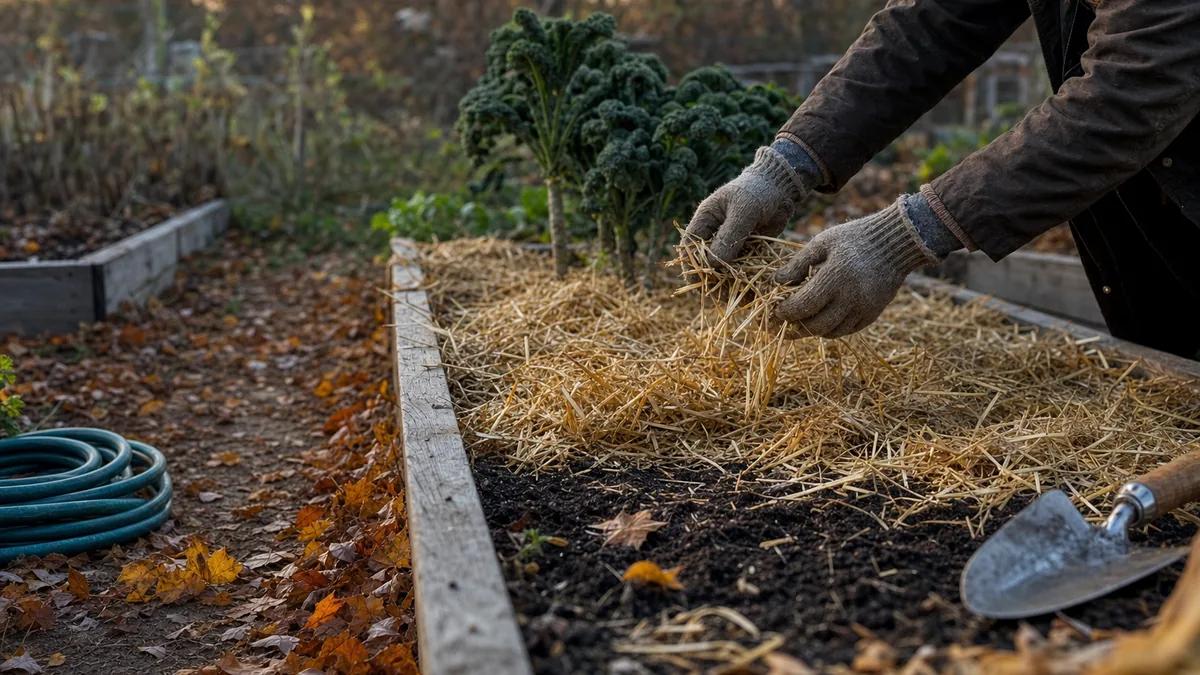
- Mulch. Cover bare soil and insulate perennials with 3 to 5 inches of straw or leaves.
- Plant a cover crop. Sow winter rye or a winterkilled mix on empty beds.
- Protect plants. Water trees, wrap young trunks, leave mum tops, and mulch the crowns.
After the seven steps, finish with the equipment: clean and oil your tools, and drain every hose and irrigation line before the first hard freeze.
When to Winterize Your Garden: Count From Your First Frost
The calendar date matters less than your first frost date, because the jobs fall into a sequence around it. The extension sources below do not give one universal date. They give anchors: a job that must happen before frost, one that comes right after a killing frost, one that waits until the ground is cold. Find your average first fall frost, and then place each job on that line.
| When | Job | Source |
|---|---|---|
| Before the first frost | Sow cover crops. In Pennsylvania that means before the end of September, with winter rye still possible in October. | Penn State |
| Around the first killing frost | Pull spent annuals and vegetables. Garlic goes in 1 to 3 weeks after the frost. | University of Minnesota, South Dakota State |
| After several hard frosts | Cut back healthy perennials to about 2 inches. Leave garden mums alone. | Purdue, Penn State |
| As the ground cools toward freezing | Mulch perennials with 3 to 5 inches of straw. | Penn State |
| Before the first hard freeze | Disconnect and drain hoses, drain irrigation, shut off outdoor faucets. | Illinois Extension, Oklahoma State |
| Until the ground freezes | Water trees and shrubs on days above 40°F, when the soil is dry. | Illinois Extension |
Sources: Penn State Extension, Purdue Extension, University of Minnesota Extension, South Dakota State University Extension, Illinois Extension and Oklahoma State University Extension. The Penn State cover crop dates are for Pennsylvania, so shift them with your own frost date.
Not sure which frost date to trust? Our comparison of Farmer’s Almanac frost dates and NOAA data explains where the numbers come from, and USDA hardiness zones explained shows what your zone says about winter cold.
The 7 Steps to Winterize Your Garden
Step 1: Clear spent plants
South Dakota State University Extension says to pull unharvested beets and carrots if you are not overwintering them, and to leave kale, spinach and Brussels sprouts. Healthy plant material can go in the compost, or be chopped with a mower and spread on the soil. Pull the rest, because Colorado State University Extension notes that leaving infected plant material in the garden increases the chance of spreading diseases such as early blight and tomato spotted wilt virus. Tomatoes still carrying green fruit when frost threatens can be finished indoors, as our guide to how to ripen green tomatoes explains.
Step 2: Bin diseased material, do not compost it
South Dakota State says to remove any plant that had a disease, roots and all, bag it and put it in the trash, and never to save seed from diseased plants. Colorado State explains why: home compost systems usually do not reach a high enough temperature to kill the pathogens. The University of Georgia Extension agrees, noting that a fall compost pile may not get hot enough to destroy weed seeds, diseases or insect eggs. If mulch was part of a disease or insect problem, UGA says to remove it too. For what can safely go in the pile, see what can you compost.
Step 3: Pull the weeds
Colorado State lists removing weeds along with the dead and diseased plant material, and UGA says to pull up all weeds and spent vegetable plants and dispose of them. A clean bed is easier to mulch and sow, and there is less for pests and disease to overwinter in.
Step 4: Test and amend the soil
Fall is the right time for a soil test, because some amendments work slowly. Our guide to reading soil test results explains the pH and nutrient numbers. UGA says to collect samples from about 10 random spots, up to 6 inches deep, and mix 1 to 2 cups of the combined soil for the lab. The University of New Hampshire Extension says to apply lime in fall, since it works slowly and needs time to change the soil’s pH, and to apply nitrogen and potassium fertilizer in spring, since they leach out of the soil over winter. Compost and manure can go on in fall if your test shows low phosphorus and organic matter. South Dakota State says manure should be at least six months old, and gives about 1 inch per year of cow or horse manure, or one-half inch of chicken manure.
Step 5: Mulch
Mulch insulates roots and protects bare soil. Penn State Extension suggests three to five inches of straw to insulate plant roots from severe winter cold. For raised beds, NC State Extension says 3 to 6 inches of mulch gives winter protection, and Colorado State suggests a layer of mulch or straw over root crops to keep soil temperatures steadier and extend the harvest. Our guides to organic vs. inorganic mulch and 8 mulch mistakes help with the choice of material.
Step 6: Plant a cover crop
A cover crop keeps empty beds covered and feeds the soil. University of Minnesota Extension says winter rye gives excellent weed suppression and nitrogen scavenging, and its deep roots help break up compacted soil and prevent erosion. Oats, peas and berseem clover winterkill, and break down quickly in spring so early crops can go in. NC State’s raised bed guide lists winter rye, crimson clover, Austrian winter peas, hairy vetch and oats. Timing is the catch: Penn State says to plant cover crops before the end of September in Pennsylvania, with winter rye possible in October, so sow before your first frost. In spring, Minnesota says to allow 3 weeks after cutting down the cover crop before you plant the next vegetable.
Step 7: Protect perennials, trees and tender plants
Leave the tops of marginally hardy perennials like garden mums, water young trees and evergreens until the ground freezes, wrap thin-barked young trunks, and mulch crowns. Each one gets its own section below. Asparagus is a long-lived perennial too, and our guide to how asparagus grows explains its fall care and when to cut the ferns back.
How to Winterize Garden Beds and Raised Beds
The seven steps above are the whole job for a vegetable bed. A few details apply to raised beds. NC State Extension says to remove diseased or insect-infested plant material and discard it rather than compost it, top-dress with finished, weed-free compost, shredded leaves or aged manure, and check that bed frames are intact and the soil has not slumped. It also suggests row covers for overwintering greens such as spinach, kale and lettuce, and 3 to 4 inches of mulch around garlic.
If you plan to plant garlic, it goes into the freshly cleaned bed 1 to 3 weeks after your first killing frost. If the soil settled over the season, topping it up now saves work in spring. Our guides to filling a raised garden bed and the soil for a 4x8 raised bed give the volumes.
How to Winterize Trees and Shrubs
Trees and shrubs need water, mulch and sometimes trunk protection, and then they are left alone.
- Check the soil weekly. Illinois Extension says to dig a small hole 4 to 6 inches deep under the drip line and water if the soil is dry.
- Water on mild days. Illinois says to water only when the temperature is above 40°F, and to stop once the ground freezes. Newly planted trees and shrubs get water weekly, and established trees about once a month in dry periods.
- Do not forget evergreens. Illinois notes that evergreens do not go dormant in winter and keep losing water through their needles.
- Use enough water. The Colorado State Forest Service says to water slowly at about 10 gallons per inch of trunk diameter.
- Mulch in a doughnut. Illinois gives 2 to 4 inches of mulch, kept 2 to 4 inches away from the trunk, out to the drip line. Colorado State Forest Service also says to keep it off the trunk itself.
- Wrap young trunks. Colorado says to wrap the trunks of younger trees up to the first branches with commercial tree wrap, and to remove the wrap in early April.
- Prune later. Late winter is the best time to prune most trees, according to Colorado State Forest Service. Some flowering shrubs set next year’s buds well before winter, so check how to cut back hydrangeas or prune a lilac bush before cutting either one in fall.
How to Winterize Mums and Perennials
The rule for perennials is to wait. Purdue Extension says to leave tops standing unless disease is present, until after several hard frosts have killed back the tops, then cut them back to about 2 inches above the soil. Garden mums and phlox need different handling.
- Mums: do not cut them back in fall. Penn State says the tops of marginally hardy plants like garden mums help them survive winter, and Purdue says waiting until early spring to cut back the dead tops can improve a plant’s chances.
- Phlox and bee balm with powdery mildew: Purdue says to cut these back in fall, along with peonies and Rudbeckia that have blackened foliage and iris that harbor borers.
- Lavender: it is a perennial with its own pruning and fall care, which our lavender how-to guide covers.
- Mulch the crowns: Penn State suggests three to five inches of straw to insulate roots from severe winter temperatures.
How to Winterize Garden Tools
Tools are the cheapest part of winterizing and the most often skipped. University of Arkansas Extension says that dirt and clumped grass left on equipment can lead to rust.
- Clean. Scrape off soil and dried plant matter before you store anything.
- Disinfect. If you pruned diseased plants, Colorado State says to use a dilute bleach solution of 1/3 cup bleach per gallon of water, or an alcohol solution.
- Sharpen. Arkansas says to sharpen blades before storing them, or take them to a repair shop.
- Oil. A light coat of oil prevents rust on the metal and prevents drying and cracking of wooden handles, according to Arkansas.
- Store. Keep tools in a protected spot, out of the weather. Coil hoses before storing them.
For mowers and tillers, Arkansas says to drain the oil before storing for winter and to try to run the tool out of gas, to avoid sludging.
How to Winterize Hoses, Faucets and Irrigation
Water left in a hose, a faucet line or an irrigation pipe can freeze and damage them. Illinois Extension’s advice for outdoor plumbing is to disconnect garden hoses, and to shut off and drain the water from pipes leading to outside faucets. New Mexico State University Extension also advises disconnecting hoses from the outdoor valve in winter. For what counts as a hard freeze, see the frost temperature guide linked at the top of this page.
- Disconnect and drain the hoses. Oklahoma State University Extension says to drain the hose and store it out of the sun.
- Shut off the indoor valve to each outdoor faucet. Then open the outdoor faucet to drain the pipe, as Illinois Extension advises.
- Turn off the irrigation water and the timer. Oklahoma State says to shut off the water first, then turn off the automatic timer.
- Drain the system. Oklahoma State says to drain backflow prevention devices and pipes exposed to freezing, and to open drains to empty the pipes and sprinkler heads. The University of Minnesota says to leave the drain valve open over winter while the water supply stays off.
- Insulate above-ground parts. That includes the main shut-off valve and backflow preventers, with foam or a backflow blanket, per Oklahoma State and Minnesota.
What about blowing out the lines? Oklahoma State Extension says to have a professional blow the system out with compressed air, and that it is not something a homeowner should do alone, because improper pressure can damage the system. So draining is your job, and the compressed-air blowout is best left to an irrigation contractor.
5 Winterizing Mistakes to Avoid
- Composting diseased plants. South Dakota State, Colorado State and UGA all say to bag and trash them, since home piles rarely get hot enough.
- Spreading nitrogen fertilizer in fall. UNH says it leaches out of the soil before your spring crops can use it. Fall is for lime and compost, spring is for nitrogen and potassium.
- Piling mulch against a trunk. Illinois Extension says to keep mulch 2 to 4 inches away from the trunk, and Colorado State Forest Service says near the base but not against it.
- Cutting back mums in fall. Their tops help them survive winter, according to Penn State, and Purdue says early spring cutback can improve survival.
- Leaving hoses connected and lines full. Water left in them can freeze. Disconnect, drain, and keep the water supply off, as Illinois, Oklahoma State and Minnesota advise.
Winterize Now, Plant Cool-Season Crops Next
Putting the garden to bed does not have to mean the end of growing. Cool-season herbs like cilantro tolerate light freezing, and a clean, mulched bed is a good place to plant garlic. See how to grow cilantro in the cool months. Once it is up, how to snip cilantro shows how to cut it so it keeps growing. Our guide on how to plant onion sets covers when fall planting makes sense for onions.
Free book · 23 pages, PDF
How to Winterize Your Garden FAQ
When should I winterize my garden?
Time the jobs from your first fall frost date. Sow cover crops before it (Penn State says before the end of September in Pennsylvania), pull spent plants around the first killing frost, cut back healthy perennials after several hard frosts (Purdue), and drain hoses before the first hard freeze.
Do I need to pull out all my plants?
No. South Dakota State Extension says to leave kale, spinach and Brussels sprouts, and to pull beets and carrots only if you are not overwintering them. Remove anything that was diseased, roots and all. Healthy perennials stay standing until after several hard frosts, according to Purdue Extension.
Should I fertilize my garden in fall?
Only with lime and organic matter. University of New Hampshire Extension says to apply lime in fall because it works slowly, and to apply nitrogen and potassium fertilizer in spring, since they leach out over winter. Compost and manure can go on in fall if a soil test shows low phosphorus and organic matter.
How do I winterize raised beds?
Clear diseased plants, top-dress with finished compost, shredded leaves or aged manure, then cover the soil with a cover crop or 3 to 6 inches of mulch. NC State Extension also says to check that frames are intact and the soil has not slumped, and to use row covers over overwintering greens.
Do I need to blow out my irrigation lines?
Oklahoma State University Extension says to have a professional do the compressed-air blowout, because a homeowner can damage the system with the wrong pressure. You can do the rest: shut off the water and the timer, drain the backflow devices and pipes, open the drains, and insulate above-ground parts.
Should I water my garden in winter?
Trees and shrubs, yes, when it is dry. Illinois Extension says to check the soil weekly, water only when the temperature is above 40°F, and stop once the ground freezes. Evergreens need the most attention because they keep losing water through their needles.
Can I leave dead plants in the garden over winter?
Healthy ones, yes. South Dakota State says healthy plant material can be composted or chopped with a mower and spread on the soil. Diseased plants should go in the trash, since Colorado State Extension says infected material left in the garden increases the chance of spreading disease.
Sources & further reading
Cleanup, composting and soil advice come from South Dakota State University Extension, Colorado State University Extension, University of Georgia Extension and University of New Hampshire Extension. Mulch, cover crop, raised bed and perennial advice comes from Penn State Extension’s fall garden tasks, NC State Extension on raised beds, University of Minnesota Extension on cover crops and Purdue Extension on cutting back perennials. Tree and shrub advice comes from Illinois Extension and the Colorado State Forest Service. Tool, hose and irrigation advice comes from University of Arkansas Extension, Oklahoma State University Extension, the University of Minnesota turf program, Illinois Extension on frozen pipes and New Mexico State University. For how we source the facts on this site, see our methodology page. For a cool-season crop to follow, see how to grow cilantro.
Free book · 23 pages, PDF
The Spacing & Planting Cheat Sheet
Sent