How to cut back hydrangeas starts with knowing which type you own. Panicle and smooth hydrangeas bloom on new wood, so cut them back in late winter or early spring. Bigleaf, oakleaf and mountain hydrangeas bloom on old wood, so prune them right after the flowers fade. Cutting at the wrong time can remove next summer’s flowers. Check your hardiness zone and the plant tag before you pick up the pruners.
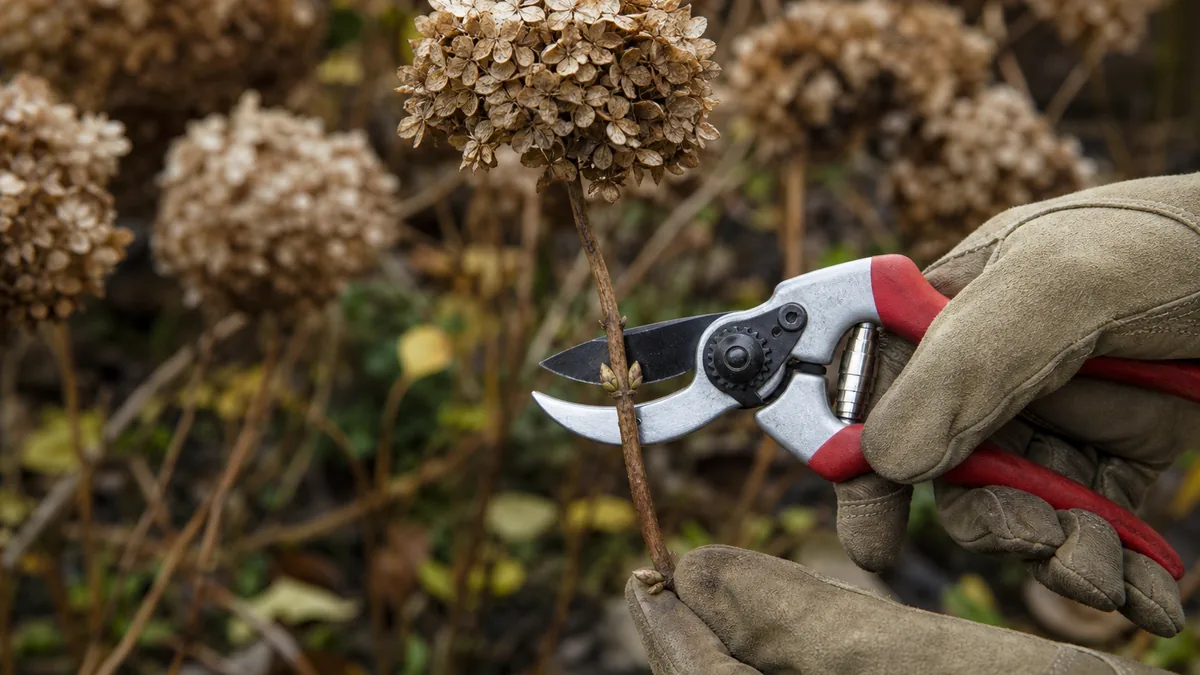
Hydrangea Pruning at a Glance
Extension guides agree on the rule and differ on the details, such as how short to cut. This table gives the timing each source recommends and the cut heights they name. Where a source gives no height, the cell says so.
| Type | Blooms on | When to cut back | How far |
|---|---|---|---|
| Panicle (Limelight, PeeGee) | New wood | Late winter or early spring (Illinois, Cornell); fall also works (University of Minnesota) | Two or three pairs of buds (WSU); about 12 inches or taller (University of Maryland) |
| Smooth (Annabelle) | New wood | Late winter or early spring, before leaf-out (Cornell) | 2 to 4 inches (WSU), 6 to 12 inches (Cornell), about 12 inches (Maryland) |
| Bigleaf (mophead, lacecap) | Old wood | Right after flowering, and not after August 1 (Clemson) | Can be cut to about 12 inches (Maryland), or remove selected older stems (WSU) |
| Oakleaf | Old wood | Right after flowering (Illinois, Cornell) | Little needed: dead twigs, spent flowers, rubbing branches (Nebraska) |
| Reblooming bigleaf (Endless Summer) | Old and new wood | Early spring or after the first flush (Maryland); Clemson says any time | As little as possible (Maryland) |
Old Wood or New Wood: Which Hydrangea Do You Have?
Every hydrangea pruning rule comes down to one question: does the shrub make its flower buds on last year’s stems or on this year’s? University of Illinois Extension says hydrangeas that bloom on new wood, which is growth from the current season, are pruned in late winter or early spring just before new growth starts, while those that bloom on old wood are pruned after flowering. The Washington State University Skagit County Master Gardeners add a practical tip: keep the plant tag, because pruning at the wrong time can remove all the flowers.
- New wood: panicle (Hydrangea paniculata, such as Limelight and Quick Fire) and smooth (H. arborescens, such as Annabelle), according to Illinois Extension.
- Old wood: bigleaf (H. macrophylla), oakleaf (H. quercifolia), mountain (H. serrata) and climbing hydrangea, per the University of Maryland Extension.
- Both: reblooming bigleaf types such as the Endless Summer series, which the University of Minnesota Extension says bloom on old and new wood.
If you cannot identify the plant, the safest move is to wait and watch. Cut only clearly dead stems until it blooms, then note when the flowers appear and where on the stems. Illinois Extension lists insufficient sun, an early frost and incorrect pruning as the usual reasons a hydrangea does not flower, so a quiet year is not always a pruning error.
How to Cut Back Hydrangeas in Fall
This is where the advice is least uniform, because the answer depends on the type. For bigleaf hydrangeas, fall is the wrong time. Cornell Cooperative Extension of Orange County says pruning bigleaf too late in the fall, after September, is harmful because it removes flower buds, and Clemson Extension advises avoiding pruning bigleaf hydrangeas after August 1. The University of Minnesota Extension explains why: standard bigleaf types form next year’s buds in August and September, so cut them after flowering and before August.
Panicle hydrangeas are more forgiving. The University of Minnesota says panicle types can be pruned in fall, late winter or spring, but it suggests leaving the dry tan flower heads until late winter or spring because they add winter interest. The Skagit County Master Gardeners go further and say no winter pruning is needed, and that leaving dead flower heads on may protect emerging buds from freezing. So for most gardeners, cutting back hydrangeas for winter means very little: remove anything clearly dead or broken and leave the rest.
If you want a fall checklist for the rest of the yard, our guide to winterizing your garden works through it by frost date. You can look up yours in the frost dates by city pages.
How to Prune Hydrangeas in Spring
Spring is the main window for the new-wood types. Illinois Extension says that for panicle and smooth hydrangeas you can remove as much as one-third to one-half of the total mass of the shrub, which is a generous allowance. Nebraska Extension gives a later window of April, May or June for smooth hydrangea, noting that it blooms on current-season growth and flowers reliably even after harsh winters or severe spring pruning.
- Wait for late winter. Cornell says to prune smooth and panicle types in late winter or early spring, before leaf-out.
- Cut out dead wood first. The WSU Skagit County Master Gardeners say dead stems are usually three or more years old, with brown, crisp, very dry bark and no buds or leaves, and that dead wood on any hydrangea can be cut to the ground.
- Choose a height. For smooth hydrangea, WSU says cut stems to 2 to 4 inches from the ground, Cornell says 6 to 12 inches, and Maryland says about 12 inches. Cutting less severely gives a larger shrub, as Cornell notes.
- Cut panicle stems to buds. WSU says to cut last season’s stems back to two or three pairs of buds for a low structure. Minnesota describes a heading cut about a quarter inch above a fat bud.
- Skip the hard cut on young smooth hydrangeas. Minnesota says to let new plants grow a season or two before cutting them to the ground, and that for a larger shrub you can skip pruning altogether.
Because the sources give three different heights for smooth hydrangea, treat the range as your choice, not a rule. A cut to the ground gives a tidy mound of tall new stems. A cut to a foot gives a sturdier frame that holds up the heavy blooms.
How to Prune Bigleaf, Oakleaf and Mountain Hydrangeas After Bloom
For old-wood types the best plan is the lightest one. Nebraska Extension recommends refraining from pruning bigleaf hydrangeas other than removing dead wood, because rough winters and hard pruning can destroy the buds they flower from. The WSU Skagit County Master Gardeners add that hard pruning a standard bigleaf makes it regrow to its original height with weak stems and no flowers that year. If you need to shrink one, they suggest cutting select older stems to the ground, accepting that some flowers are lost.
- Prune right after the flowers fade. Clemson says the best time to remove dead canes or rejuvenate an older bigleaf is immediately after flowering.
- Stop by August 1. Clemson advises avoiding pruning big leaf hydrangeas after that date to protect next year’s flower buds.
- Thin, do not shear. Maryland says thinning removes whole stems to improve airflow and reduce leaf spot, and is most useful for bigleaf and mountain types. Better airflow also helps against powdery mildew.
- Keep some old stems. Cornell says to keep several stems of old productive wood plus enough sturdy new stems to flower the next season.
- If you must cut in winter or spring, Clemson says to remove no more than one-third of the canes to keep some flowers for next season.
Oakleaf hydrangeas need even less. Illinois Extension says to prune them immediately after flowering, and Nebraska Extension limits the job to dead twigs, spent flowers and rubbing branches. WSU warns that over-pruning an oakleaf produces weak, floppy stems.
Reblooming bigleaf types
The Endless Summer series is the easy case. Clemson Extension says everblooming types can be pruned any time without losing flowers because they bloom on old and new wood. The University of Maryland suggests early spring or just after the first flush of flowers, removing as little wood as possible to avoid delaying new blooms. Nebraska cautions that even these can suffer in hot, dry stretches during the growing season.
How to Trim a Hydrangea Tree
A hydrangea tree is usually a panicle hydrangea trained on a single trunk. The University of Maryland Extension says tall panicle hydrangeas can be kept as a standard that resembles a small tree, and that the trunks should not be cut down. Cornell notes that PeeGee can be trained as a single or multi-stemmed tree and can become quite large without regular pruning.
- Prune in late winter or early spring. It is a new-wood type, so the timing matches other panicles.
- Head back the branches, not the trunk. Use WSU’s two or three pairs of buds as a starting point on last year’s stems, or cut selected older stems harder and leave others longer, which WSU also describes.
- Renew only if you want a shrub again. Maryland says renewal pruning is appropriate only if you want to convert the plant back to a shrubby form with lower branches.
The size matters when you plan. WSU says panicle stems can reach 10 feet and flowers can be up to 12 inches long, and that without pruning the flowers eventually grow too high to enjoy.
Deadheading and Renewal Pruning
Deadheading means cutting off spent flowers. The University of Maryland Extension says it can be done any time after the flowers fade and is not necessary for plant health. The WSU Skagit County Master Gardeners call it optional on bigleaf hydrangeas, saying that in late spring, once the danger of a hard frost has passed, you can cut back to a pair of healthy fat buds, and that plants still bloom if you skip it. Cornell is the exception: for reblooming bigleaf cultivars, it advises removing faded blooms regularly to get flowers on current-year growth.
Renewal pruning is the reset button for an old, sparse or misshapen shrub. Maryland describes it as removing most of the old wood, and warns that the plant may not flower for a year or longer. Clemson says to rejuvenate a bigleaf right after flowering, and Illinois says panicle and smooth types can lose as much as one-third to one-half of the total mass of the shrub.
Why Hydrangeas Do Not Bloom After Pruning
If a pruned hydrangea sulks, there are a few common suspects.
- Winter killed the buds. Nebraska Extension says bigleaf blooms primarily on old wood, which rough winters can destroy. Cornell says to delay pruning an unprotected bigleaf until buds swell, then cut back below the point of injury.
- A late cold snap. Clemson says late cold snaps can freeze buds and suggests covering canes with frost blankets.
- Too little light. Clemson says hydrangeas need a minimum of 3 hours of morning sun to flower, and that too much sun can drain energy needed for bud production.
- Pruning old wood in the wrong season. Cornell says that early spring pruning of bigleaf in March sacrifices that season’s bloom.
There is a fix for most of these: identify the type, mark your calendar, and prune less. For more shrub guides, see the trees and shrubs hub, or compare with how spring-flowering shrubs are handled in our guide to pruning a lilac bush, which follows the same bloom-time rule.

Free book · 23 pages, PDF
How to Cut Back Hydrangeas FAQ
When is the best time to cut back hydrangeas?
It depends on the type. Illinois Extension says panicle and smooth hydrangeas, which bloom on new wood, should be pruned in late winter or early spring, and old-wood types such as bigleaf and oakleaf should be pruned after flowering. Reblooming bigleaf types are flexible, and Clemson says they can be pruned any time without losing flowers.
Can you cut back hydrangeas in the fall?
Only some of them. Cornell says pruning bigleaf after September is harmful because it removes flower buds, and Clemson says to avoid pruning bigleaf after August 1. The University of Minnesota says panicle hydrangeas can be pruned in fall, late winter or spring, but suggests leaving the dry flower heads until late winter or spring.
How far down do you cut back a hydrangea?
For smooth hydrangea, WSU says 2 to 4 inches from the ground, Cornell says 6 to 12 inches and the University of Maryland says about 12 inches. For panicle types, WSU says to cut to two or three pairs of buds. Bigleaf and oakleaf types need little cutting, and Nebraska Extension recommends removing only dead wood on bigleaf.
What happens if you prune hydrangeas at the wrong time?
You can remove the flower buds. The Skagit County Master Gardeners say pruning at the wrong time can remove all the flowers, and Cornell says early spring pruning of bigleaf sacrifices that season's bloom.
Do you have to deadhead hydrangeas?
No. The University of Maryland Extension says deadheading is not necessary for plant health, and the Skagit County Master Gardeners call it optional on bigleaf types. Cornell advises removing faded blooms on reblooming bigleaf cultivars to encourage flowers on current-year growth.
How do you prune a hydrangea tree?
Prune a tree-form panicle hydrangea in late winter or early spring and shorten the branches, but do not cut down the trunk. The University of Maryland says renewal pruning is only appropriate if you want to turn the plant back into a shrub with lower branches.
Sources & further reading
Type-by-type timing and amounts come from University of Illinois Extension’s How to properly prune hydrangeas, University of Minnesota Extension’s Pruning hydrangeas, University of Maryland Extension’s Pruning hydrangeas, Nebraska Extension’s Pruning Hydrangeas, WSU Extension Skagit County Master Gardeners’ Pruning Hydrangeas, Cornell Cooperative Extension of Orange County’s Hydrangeas: Types and How to Prune and Clemson Home and Garden Information Center’s Pruning Hydrangeas. Where they differ, we show each source’s figure. For how we source the facts on this site, see our methodology page.
Free book · 23 pages, PDF
The Tree Care Cheat Sheet
Sent