How to Use This Calculator
- Enter your 5-digit US ZIP code.
- Read your estimated USDA Plant Hardiness Zone.
- Check the average annual minimum winter temperature range that zone represents.
What Is a USDA Hardiness Zone?
A USDA hardiness zone is a rating of how cold winter typically gets in a given area, based on average annual minimum winter temperature and nothing else. It's the standard reference behind every "hardy to zone 5" or "hardy to zone 8" label on a plant tag or seed catalog, telling you whether a perennial, shrub, or tree can be expected to survive winter outdoors in your area without special protection. A hardiness zone lookup like the one above simply automates matching your location to that number, instead of you having to cross-reference a printed map by hand.
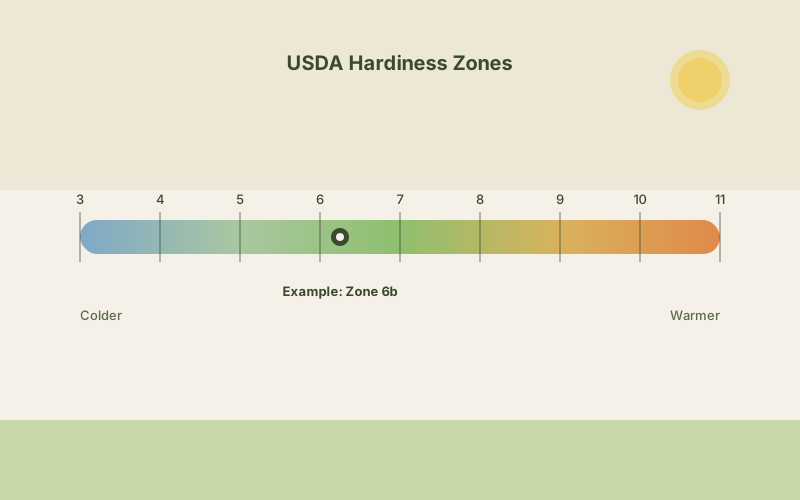
What a hardiness zone is not is a general climate summary. It says nothing about summer heat, rainfall, humidity, or overall growing conditions. Two places in the same zone can have very different summers. It's specifically and only a winter-cold rating, which is exactly why it's useful for one job (will this perennial survive winter here) and not the job of telling you your whole growing season.
Zone Reference Table
Each USDA hardiness zone represents a 10°F band of average annual minimum winter temperature, split into two 5°F half-zones ("a" is the colder half, "b" the warmer half of the same zone number).
| Zone | Avg. Annual Minimum (°F) | Avg. Annual Minimum (°C) | Frost dates |
|---|---|---|---|
| Zone 3a | -40°F to -35°F | -40°C to -37°C | |
| Zone 3b | -35°F to -30°F | -37°C to -34°C | Zone 3b frost dates |
| Zone 4a | -30°F to -25°F | -34°C to -32°C | Zone 4a frost dates |
| Zone 4b | -25°F to -20°F | -32°C to -29°C | Zone 4b frost dates |
| Zone 5a | -20°F to -15°F | -29°C to -26°C | Zone 5a frost dates |
| Zone 5b | -15°F to -10°F | -26°C to -23°C | Zone 5b frost dates |
| Zone 6a | -10°F to -5°F | -23°C to -21°C | Zone 6a frost dates |
| Zone 6b | -5°F to 0°F | -21°C to -18°C | Zone 6b frost dates |
| Zone 7a | 0°F to 5°F | -18°C to -15°C | Zone 7a frost dates |
| Zone 7b | 5°F to 10°F | -15°C to -12°C | Zone 7b frost dates |
| Zone 8a | 10°F to 15°F | -12°C to -9°C | Zone 8a frost dates |
| Zone 8b | 15°F to 20°F | -9°C to -7°C | Zone 8b frost dates |
| Zone 9a | 20°F to 25°F | -7°C to -4°C | Zone 9a frost dates |
| Zone 9b | 25°F to 30°F | -4°C to -1°C | Zone 9b frost dates |
| Zone 10a | 30°F to 35°F | -1°C to 2°C | Zone 10a frost dates |
| Zone 10b | 35°F to 40°F | 2°C to 4°C | Zone 10b frost dates |
| Zone 11a | 40°F to 45°F | 4°C to 7°C | Zone 11a frost dates |
| Zone 11b | 45°F to 50°F | 7°C to 10°C | Zone 11b frost dates |
The calculator above covers the full range published on the official map (zones 1–13); the table shows zones 3–11, which covers the large majority of the continental United States.
Hardiness Zones by State
Zone ranges vary widely by state, mostly driven by latitude, elevation, and distance from the coast. Enter your ZIP code in the calculator above for your exact match. These are just the broad strokes for four of the most-searched states, checked against the same official 2023 zone data the calculator itself uses.
Florida runs almost entirely warm: most of the peninsula falls in zones 9a–11a, and the Florida Keys reach 11b, among the warmest zones in the continental US. Even the panhandle (Pensacola, Tallahassee) only drops to zone 9a. Florida has no truly cold zones anywhere in the state.
California has the widest range of any state in the continental US, a direct result of its elevation and coastal variation. Mountain towns like Mammoth Lakes and Truckee sit at zone 6a, while coastal and southern cities (Los Angeles, San Diego, Santa Barbara) run 10b–11a. The Central Valley (Sacramento, Fresno, Bakersfield) lands in between, mostly zone 9a–9b. Two addresses 50 miles apart can be several zones different depending on elevation.
Texas spans zone 7a in the Panhandle (Amarillo) up to 10a along the Gulf Coast and Rio Grande Valley (Corpus Christi, Brownsville, McAllen). Most of central Texas (Austin, San Antonio, Dallas–Fort Worth) falls in zone 8b–9a.
Michigan runs cooler and more uniform: zone 4b in the Upper Peninsula (Ironwood) up to zone 6b in southeast Michigan (Detroit) and along the Lake Michigan shoreline, which moderates winter lows near the water. Most of the Lower Peninsula sits in zone 5b–6a.
Planting Zones by ZIP Code in 2026: Which Map, and Where to Get a PDF
There is no separate 2026 zone map. The USDA's current edition is the 2023 USDA Plant Hardiness Zone Map, released in November 2023 and still the official map in 2026. It replaced the 2012 edition, and many areas moved half a zone warmer between the two. The finder above uses the 2023 data, so the zone it gives you for your ZIP code is your zone for 2026.
To keep your own result, look up your ZIP code and press Export Zone Result (PDF) under the finder: it saves your zone and its winter temperature range as a PDF. The first time, it asks for your email to send you a free garden guide; after that, it saves straight away. If you want the map itself as a file, the USDA's Map Downloads page offers the national map, six regional maps and a map for every state and territory. Standard downloads are PNG images; the print-quality versions also come as PDF, JPG, SVG and other formats, with the largest national map sized to 36 by 24 inches. A printed map shows zone bands rather than ZIP codes, so it's best for seeing your whole region at a glance, while the lookup above gives the exact match for one address.
Worked Example
Say you enter ZIP code 60601 (Chicago, IL). The calculator matches it to Zone 6b, which represents an average annual minimum winter temperature of -5°F to 0°F (about -21°C to -18°C). That number is what a "hardy to zone 6" plant tag is rated against. A shrub or perennial labeled hardy to zone 6 should survive a typical winter low in that -5°F to 0°F range without dying back to the ground or needing extra winter protection. A plant rated only to zone 7 or 8, on the other hand, is a real risk in a zone 6b winter and would need siting against a protected wall, mulching, or treating as an annual.
Why Your Zone Matters
The most direct use of your zone is at the nursery or when ordering online: a plant tag rated "hardy to zone 7" is telling you it should survive winter outdoors in zones 7 and warmer, and is a gamble (or an annual, replaced every year) in anything colder. Checking your zone against that rating before buying a perennial, shrub, or tree is the single most practical use of this number.
It's worth being precise about what zone does and doesn't predict. Hardiness zone tells you about winter minimum temperature survival for perennials that stay in the ground year-round. It does not tell you your frost dates: the specific spring and fall dates when frost risk starts and ends, which matter for timing annual vegetables and flowers. Those are a related but genuinely different question. Already know your zone and want your actual planting timeline instead? Use our Frost Date Calculator for that.
Common Mistakes
- Confusing hardiness zone with frost date or planting timing. Zone tells you whether a perennial survives winter where you live; it doesn't tell you when to start seeds or when it's safe to transplant. Use the Frost Date Calculator for timing questions, and your zone for plant-buying decisions.
- Assuming zone alone determines what will grow. Zone only measures winter cold. Summer heat, humidity, soil type, and microclimates (a sheltered wall, a low frost pocket, an exposed hilltop) all affect what actually thrives in a given spot, even within the same zone.
- Using an outdated zone map. The USDA updated zone boundaries in its most recent map revision, shifting many areas by a half-zone or more as long-term averages changed. A zone reference from an old book, plant tag, or bookmarked page may no longer match the current official map for your area. When in doubt, check the current map directly.
Hardiness Zone Finder FAQ
What are the USDA planting zones for 2026?
The zones in use for 2026 are the ones on the 2023 USDA Plant Hardiness Zone Map, released in November 2023. The USDA has not published a newer edition, so a "2026 zone" is your 2023 zone. Enter your ZIP code above to see it.
Can I get a planting zone map by ZIP code as a PDF?
Yes, two ways. For your own ZIP code, look up your zone above and press "Export Zone Result (PDF)" to save the result as a PDF (the first time, it asks for your email to send a free garden guide). For the map itself, the USDA publishes print-quality national, regional and state maps, including PDF files, on its Map Downloads page (linked in Sources below).
What does Zone 5 mean in gardening?
Zone 5 means the area’s average annual minimum winter temperature falls between -20°F and -10°F (split into 5a and 5b). It tells you which perennials, shrubs, and trees are rated to survive winter there. A plant labeled "hardy to zone 5" should survive that cold without special protection.
What is the purpose of USDA hardiness zones?
USDA plant hardiness zones are the standard reference for winter plant survival across the US. They exist to give gardeners a standardized way to judge whether a perennial will survive winter in their area. Every zone reflects average annual minimum winter temperature only. It’s a survival rating, not a full description of a region’s climate.
Is there a European equivalent of US hardiness zones?
The Royal Horticultural Society (RHS) publishes its own hardiness rating system for the UK, and much of Europe references either the RHS system or an adapted version of the USDA scale. The underlying concept (rating plants against average annual minimum temperature) is the same, but the exact zone numbers and boundaries differ between systems, so a "zone 7" label isn’t automatically the same in both.
How do I look up my hardiness zone by ZIP code?
Enter your ZIP code into the calculator above. It matches you to the nearest of 826 reference points, each checked against the official 2023 USDA zone map. For the official, address-level zone, see Sources below.
Sources & further reading
Zone boundaries and temperature bands are checked against the official USDA Plant Hardiness Zone Map, published by the USDA Agricultural Research Service. National, regional and state maps, including print-quality PDF files, are on the USDA's Map Downloads page. The November 2023 release date is from N.C. Cooperative Extension. For more on how we build and verify the formulas and reference data behind every calculator on this site, see our methodology page. For the full picture on what a zone number actually means and doesn't mean, see how zones actually work.