What is overwintering? Iowa State Extension defines it as the process of protecting a plant over the winter season: bring it indoors, cover or mulch it, or store it dormant. Hardy perennials in a suitable zone need nothing. For cover choices, see how to protect plants in winter.
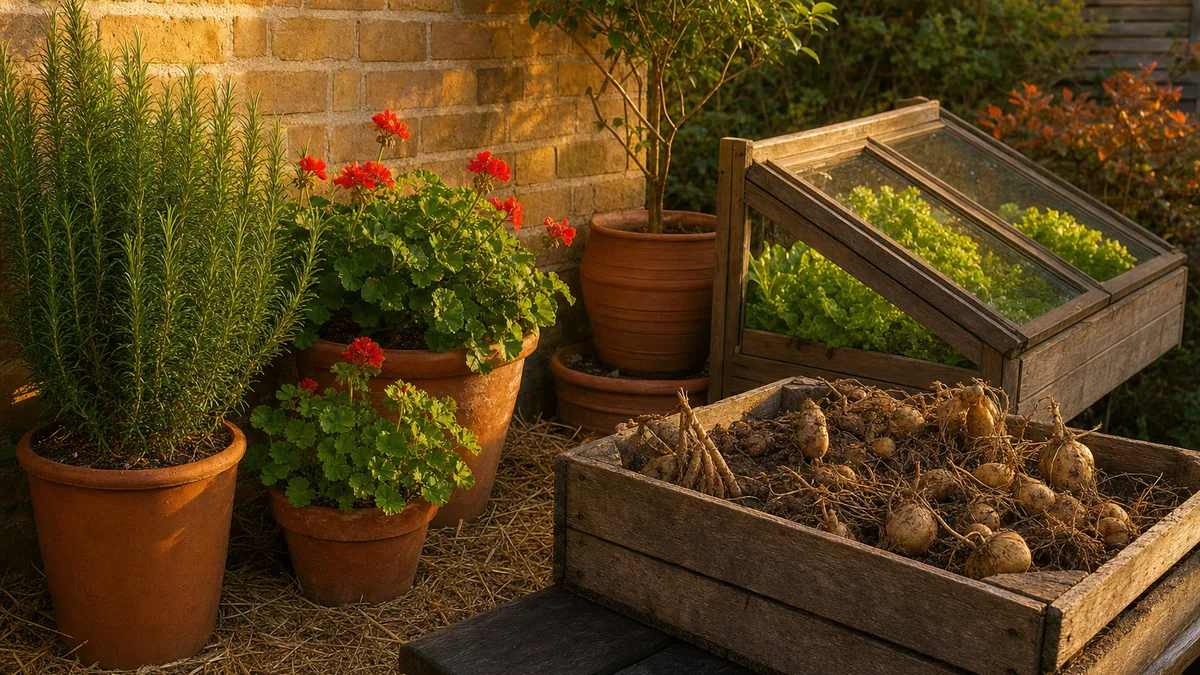
Overwintering Quick Reference
| Plant or situation | Method | What to do | Source |
|---|---|---|---|
| Hardy perennial, in the ground, in its zone | None needed | Check the zone; mulch only if newly planted | Iowa State, USDA |
| Tropical or tender shrub (hibiscus, mandevilla) | Bring inside | Move in before first frost and cut back | Penn State |
| Canna, dahlia, gladiolus | Lift and store | Dig after frost kills tops; store cool, dark, dry | Iowa State, Penn State |
| Coleus, begonia, impatiens | Cuttings | Root indoors before first frost | Iowa State, UVM |
| Perennial in a pot | Cold storage or grouping | Plan for a plant hardy two zones colder; keep at 20 to 45°F | Penn State, Illinois, Iowa State |
| Strawberries | Mulch | 3 to 5 inches of straw before temperatures drop below 20°F | Iowa State |
| Tomatoes | Usually replace | Frost kills them; bring a pot in only if you have bright light | Colorado State, NC State, Maryland |
| Peppers in pots | Bring inside | Cut back, keep at 40 to 55°F, water very little | Oregon State, NC State |
| Cool-season crops | Cold frame or row cover | Spinach, kale, lettuce keep growing under cover | Maryland, NC State, UVM |
What Does Overwinter Mean? What Is Overwintering Plants?
To overwinter a plant is to keep it alive through the cold months so it can grow again in spring. Iowa State Extension calls it protecting a plant over the winter season and says tropical and semi-tropical plants often need it, as do newly planted, containerized or small, unestablished plants that are normally hardy. “Over wintering” and “over winter” are the same idea written differently. The word also applies to a plant that gets through winter by itself: a hardy perennial in its zone overwinters without help.
The line between needs help and does not is your hardiness zone. USDA says its Plant Hardiness Zone Map is based on the average annual extreme minimum winter temperature, shown as 10-degree F zones and 5-degree F half zones. A plant rated to a zone colder than yours should survive in the ground. A plant rated for a warmer zone is a candidate for the methods below. Our guide to how USDA hardiness zones work explains how to read the map.
How to Overwinter Plants: Five Methods and When to Use Each
Extension sources describe the same short list of methods. Which one fits depends on how far your winter drops below what the plant tolerates.
1. Bring the plant inside
Best for tropicals and tender plants in pots. Penn State Extension says tropicals must come in before the first frost and that many start struggling when nighttime temperatures drop into the low 40s. University of Maryland Extension suggests planning once nights regularly drop into the mid-to-low 50s°F. The University of Vermont Extension advises setting plants on a sheltered porch for several days first, hosing them off and checking leaf undersides for pests. Our guide on when to bring plants inside for winter gives the temperature triggers and the pest-check steps.
2. Mulch or cover in place
Best for hardy plants that are new, small or at the edge of their zone. Iowa State Extension says to apply it after plants go dormant but before the ground or mulch pile freezes, using loose straw or pine needles 6 to 18 inches deep, or 3 to 4 inches of topsoil or heavier mulch over crowns. It warns that leaves compact and can smother plants. NC State Extension recommends 3 to 6 inches of mulch for winter protection. The sources differ because plants and winters differ, so scale the depth to the plant.
3. Lift and store bulbs, tubers and dormant plants
Best for plants that grow from tubers or corms but die in a hard freeze. Iowa State says to dig canna, gladiolus and dahlia in fall, remove excess soil and store them at 40 to 55°F in a cool, dark, dry place, checking for rot. Penn State says to dig tuberous plants after a light frost has killed the tops but before a hard freeze, and gives an ideal storage range of 45 to 55°F for most. The two ranges overlap, and 45 to 55°F satisfies both.
4. Take cuttings
Best when you lack space for a whole plant. Iowa State suggests stem or leaf cuttings of coleus, begonia and impatiens in fall before the first frost. The University of Vermont Extension says to take 4 to 6 inch tips with several nodes, strip the lower leaves and root them in water or moist mix. Penn State says coleus and geranium cuttings form roots in about three to four weeks.
5. Use a cold frame or row cover
Best for cool-season crops and borderline perennials. UW-Madison Extension says floating row cover gives between 2 and 8 degrees of frost protection depending on weight, with heavyweight cover giving up to 4 to 8°F. The University of Vermont Extension says a cold frame stays comfortably above 50°F on average when outside temperatures are in the 40s, and it can extend the season by two weeks or more beyond the first frost.
Choosing a method in four steps
- Find your zone. Use the USDA map, built on average annual minimum temperatures.
- Compare it with the plant. A plant rated for your zone or colder needs no more than mulch while it is young.
- Pick the lightest method that works. Mulch or cover first, then cold storage, then a bright indoor spot.
- Time it from first frost. Most extension timing, such as Iowa State’s cuttings window, counts back from that date.
How to Over Winter Plants in Pots
Pots are the hardest case, because roots sit above ground. Penn State Extension says a hardiness zone is based on the plant in the ground, so plan for a rating two zones colder than the plant’s own when it is containerized. University of Illinois Extension gives the same rule and an example: in central Illinois, a potted plant should be hardy to zone 3 or 4 to stay outside. It says the rule does not apply to non-hardy plants such as geraniums.
There are four common options. Illinois lists storing pots in an unheated garage, shed or basement, sinking pots in the ground and mulching them, or grouping them on the north or east side of a building and mulching heavily. Penn State adds enclosing pots in a box with straw or bark. For storage, Illinois and Iowa State both give 20 to 45°F. Water well before the soil freezes, because Penn State says dry soil freezes faster than moist soil. Clay and glazed pots may crack, so wrap them if they stay out. Larger pots insulate better.
What to Do With Strawberry Plants Over Winter
Mulch them. Iowa State Extension says strawberries should be mulched in fall before temperatures drop below 20°F, which it puts at early November in northern Iowa and mid- to late November in southern Iowa. It recommends clean, weed-free straw at 3 to 5 inches, settling to 2 to 4 inches, and warns that leaves mat down and trap moisture. In spring it says to remove the mulch when about 25 percent of plants show new growth. Potted strawberries are riskier: Iowa State says containers left outdoors will likely be seriously damaged and suggests an attached, unheated garage in November. The full timing and cover steps are in our guide to how to winterize strawberry plants.
What to Do With Tomato Plants Over Winter
In most places, nothing: tomatoes are tender annuals. Colorado State Extension says tomatoes are readily killed by a light frost. University of Maryland Extension calls them very tender, warm-season annual plants and notes they are perennial but usually grown as annuals in temperate climates. NC State Extension says they are perennials only in frost-free climates. So overwintering a tomato means bringing it inside before frost, not leaving it outdoors under mulch. Our guide on whether tomato plants can survive winter covers cuttings, cutting back and the last green fruit.
Light is the constraint. Utah State Extension describes growing tomatoes indoors in containers as the most practical option for hobbyists, warns that temperatures below 50°F can harm them, and says plant tops should stay within 3 to 6 inches of the bulbs. For small varieties it says a 1-gallon pot is enough. If you lack a bright spot, start fresh seed in spring instead.
Peppers, Rosemary and Hibiscus Over Winter
These are tender perennials, so the answer depends on your zone. For peppers, NC State Extension says the hot pepper is a perennial that generally lasts about 2 years and should be brought indoors if temperatures are predicted to drop below 28°F. Oregon State Extension says to keep container plants in stasis at 40 to 55°F, cut back first, and give them a garage and a grow light. Details are in how to overwinter pepper plants.
Rosemary is a good example of sources that differ. Penn State Extension lists zones 8 to 10 and says to pot it and bring it indoors 2 to 3 weeks before the first frost where it is not hardy, while Nebraska Extension says plants are hardy in zones 7 to 10 and rates ‘Arp’ to zone 6. Zones, mulch and indoor care are in our guide to overwintering rosemary. Hibiscus splits the same way: Penn State lists hibiscus, mandevilla and angel’s trumpet among tropicals to cut back when they come inside, while hardy and tropical hibiscus are different plants. How to overwinter hibiscus sorts hardy from tropical by zone.
What to Plant Over Winter in the Garden
Overwintering also means planting crops built for the cold. University of Maryland Extension lists broccoli, cabbage, lettuce, pea, turnip, kale and spinach as hardy, able to withstand a hard frost, and beet, carrot, Swiss chard, radish and cauliflower as half-hardy, tolerating light frost. It says spinach, arugula, kale and parsley can overwinter with protection and resume growth in spring, and that row cover can be moved aside on mild days. Purdue Extension’s cold tolerance chart also rates kale, spinach, onion and cabbage as hardy and lettuce and carrot as semi-hardy.
Garlic is the classic crop that goes in before winter. Penn State Extension says to plant it a good three weeks before the ground freezes, at least 2 inches deep and 4 to 8 inches apart, under about 4 inches of straw or shredded leaves. Maryland Extension says garlic, shallots and multiplier onions can be planted in October. Spacing and bed layouts are in our guide to how to plant garlic, and what to plant in winter sorts crops by climate. Where winters are mild, Clemson Extension says spinach, kale, radishes and other cool-season crops planted between mid-October and early November in South Carolina can be harvested through December.
To see which of these fit your dates, the planting calendar by ZIP code lists what to sow now, and the Season Planner works out your frost dates and planting dates for your ZIP code in one plan.
What to Plant in Raised Beds Over Winter
Raised beds take the same crops, with cover and cover crops doing the winter work. NC State Extension suggests row covers for overwintering spinach, kale and lettuce, 3 to 6 inches of mulch for protection and 3 to 4 inches of mulch around garlic. For empty beds, it lists winter rye, crimson clover, Austrian winter peas, hairy vetch and oats, noting oats as a winter-kill option.
Penn State Extension says winter rye can be planted as late as November at 4 pounds per 1,000 square feet and still germinates at temperatures as low as 35°F. University of Illinois Extension says hairy vetch and winter rye grow in fall, die back to the roots for winter and regrow in spring. Penn State says to turn rye under at 10 to 12 inches tall, and to turn cover crops under at least two to three weeks before planting the garden. Our guide on when to plant winter rye counts back from your first frost. Browse the spacing and planting hub for bed layouts.
Ending Overwintering in Spring
Reverse the steps slowly. Iowa State Extension says to move indoor plants outside after the last frost, acclimating them to light over 2 to 3 weeks, and to remove straw mulch in early spring, around mid-March in Iowa, over several days if needed. Penn State says tuberous plants can start indoors four to six weeks before the last frost and stay out once nights remain above 50°F. Plants hardened off gradually fare better than plants moved in one day.
Free book · 23 pages, PDF
Overwintering FAQ
What does overwinter mean?
To overwinter is to keep a plant alive through winter so it grows again in spring. Iowa State Extension defines overwintering as the process of protecting a plant over the winter season, and it says tropical, containerized and newly planted plants often need it.
How do you overwinter plants?
Choose by hardiness: bring tender plants inside, mulch or cover hardy ones, dig and store tubers, or root cuttings. Iowa State Extension lists all four, with storage of canna, gladiolus and dahlia at 40 to 55°F.
How do you over winter plants in pots?
Choose plants hardy two zones colder than yours, or store pots somewhere cold but not freezing. Penn State Extension gives the two-zone rule, and Illinois Extension gives 20 to 45°F for an unheated garage, shed or basement.
What do you do with strawberry plants over winter?
Cover them with straw once they are dormant. Iowa State Extension says to mulch with 3 to 5 inches of clean straw before temperatures drop below 20°F, and to move potted plants to an unheated garage in November.
What do you do with tomato plants over winter?
In most places, replace them. Colorado State Extension says tomatoes are readily killed by a light frost, and NC State Extension says they are perennial only in frost-free climates. A potted plant can come inside if it gets bright light.
What can I plant in raised beds over winter?
Hardy greens, garlic or a cover crop. Maryland Extension lists kale, spinach, lettuce and cabbage as hardy, and Penn State Extension says winter rye can be planted as late as November and germinates at 35°F.
Sources & further reading
Definition and methods: Iowa State Extension, Penn State Extension on tropical plants, University of Maryland Extension, University of Vermont Extension and USDA Plant Hardiness Zone Map. Pots: Penn State Extension and University of Illinois Extension.
Specific plants: Iowa State on strawberries, Colorado State Extension, NC State Plant Toolbox on tomato, Maryland Extension on tomatoes, Utah State Extension, NC State Plant Toolbox on hot pepper, Oregon State Extension, Penn State on rosemary and Nebraska Extension on rosemary.
Covers and crops: UW-Madison Extension on row cover, UVM Extension on cold frames, Maryland Extension on fall vegetables, Purdue Extension cold tolerance chart, Penn State on garlic, Clemson Extension, NC State Extension on raised beds, Penn State on cover crops and Illinois Extension on cover crops.
Free book · 23 pages, PDF
The Spacing & Planting Cheat Sheet
Sent