How to protect plants in winter starts with the forecast: University of Georgia Extension says to cover plants when a freeze is predicted, as damage begins at 32°F or lower. Utah State Extension says covers add about 3 to 5 degrees, so frost cloth or a sheet works down to about 28°F (see why frost forms above 32°F).
This page, part of our spacing and planting guides, covers when to cover, what to use, a step-by-step bed cover, pots, and when to take it all off.
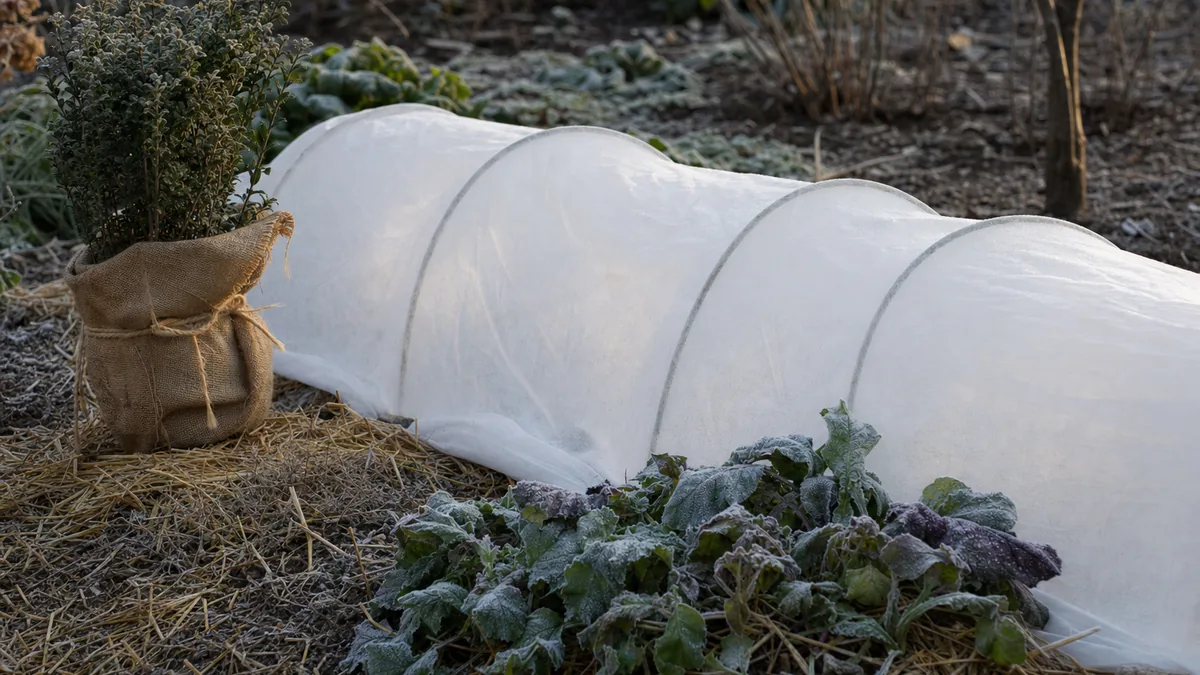
Winter Plant Protection Quick Reference
| Situation | What to do | Source |
|---|---|---|
| Forecast low at or below 32°F, plants not yet dormant | Cover with cloth or a frame; the cover should reach the ground all around | University of Georgia |
| Night as low as 28°F | Frost blanket, cloth row cover or sheet; covers add about 3 to 5 degrees | Utah State, Alabama |
| Tomatoes, peppers, squash, cucumbers | Leaf damage can start at 33°F; cover, or pick the fruit first | Alabama, Utah State, Purdue |
| Lettuce, carrots, beets | Harvest (see harvesting lettuce) or protect if the mid to upper 20s are forecast | Purdue |
| Plants in pots outdoors | Treat the pot as two zones colder than the ground; insulate, group or move | Penn State |
| Evergreen shrubs in sun and wind | Burlap screen on the south, southwest and windward sides, top open | University of Minnesota |
When to Cover Plants for Winter?
Cover plants the evening before the forecast low reaches freezing. University of Georgia Extension says freeze damage begins at 32°F or lower when plants have not gone dormant, and tells gardeners to act when the forecast predicts a freeze.
Tender crops need the earlier trigger. Alabama Extension says many warm-season vegetables can show leaf damage at 33°F, and Utah State Extension gives the same 33°F for peppers, tomatoes, cucumbers, melons and squash. Cool-season vegetables hold up better: Alabama says some withstand 26 to 31°F for a limited time, and Purdue Extension sorts them into groups. Its semi-hardy group (lettuce, carrots, beets) should be harvested or protected when the mid to upper 20s are forecast, and its hardy group (kale, spinach, cabbage, peas) when the low 20s look imminent. Purdue’s chart prints no unit; the figures read as Fahrenheit. Winter squash such as spaghetti squash can be kept after picking, as how long spaghetti squash is good for shows.
First fall frost varies by location, so look up frost dates by city, or the page for your zone such as zone 6b, and start checking the forecast as that date gets close. Colorado State Extension says radiation frosts on calm, clear nights are typically only a few degrees below the critical level, while frosts that arrive with cold fronts can go well below it, so a cover handles the first kind far better.
What to Cover Plants With in Winter?
Frost cloth or a floating row cover is the best all-round choice, and a bedsheet is the cheap stand-in. How much each material protects is where sources differ, so the numbers below are ranges by source. Our guide to what to plant in winter lists what grows under them.
Frost cloth and floating row cover
University of Wisconsin-Madison Extension says covers give between 2 and 8 degrees of frost protection depending on weight, with heavyweight covers giving up to 4 to 8°F. University of New Hampshire Extension says a lightweight cover might give 2°F and a heavy one as much as 6 to 10°F. Colorado State Extension says lightweight fabrics can give up to 10°F. Overall the range is roughly 2°F for the lightest cloth to 6 to 10°F for the heaviest. Wisconsin says to support the cloth on hoops for tall or sensitive crops, and warns that under heavy cover, tomatoes and peppers may drop blossoms above 86°F.
Blankets and bedsheets
A sheet works if it is dry. Alabama Extension suggests a lightweight fabric such as a bed sheet laid loosely over plants, which it says raises the air temperature by 3 to 5 degrees, and prefers cloth over plastic. Colorado State warns that wet fabric causes evaporative cooling, which can make the area beside it colder.
Plastic, cold frames and low tunnels
Utah State Extension says leaves that touch plastic can freeze, and Colorado State says plants can freeze where they touch the cover, so plastic must be held off the plants on a frame. In its trials, a plastic cover on a frame gave 3°F to over 6°F of protection and vents are needed on sunny days. Colorado State warns that a closed cold frame can pass 130°F after an hour of sun, so open it at least a slit by day. Colorado State calls cool-season crops somewhat tolerant of frosty nights, which makes a frame a good home for greens such as those in our guide to growing lettuce from seed. A low tunnel is the same idea: University of Vermont Extension describes flexible rods bent into a U over the row, covered with row cover fabric and optionally plastic, and Colorado State says to set hoops every three to five feet and weigh down the edges.
Burlap for shrubs, and a caution on anti-desiccants
Burlap is for wind and sun, not for cold. University of Minnesota Extension says to place burlap on the south, southwest and windward sides of evergreens that show winter injury, and to leave the top open for air and light. Dane County Extension describes a burlap tent on stakes a few inches taller than the plant, with the top left open because heavy snow can make burlap sag onto branches. Anti-desiccant sprays are where sources split. Penn State Extension says evergreens benefit from a spray or a windscreen, and University of New Hampshire Extension says to apply it at about 40 to 50°F once plants are dormant. Minnesota says these sprays are not effective for protecting evergreen foliage, and Dane County says research finds them unreliable. Treat a spray as optional. Burlap is one job on the list in our guide to winterizing your garden by frost date,.
How to Cover Plants in Winter: Step by Step for a Bed
- Check the forecast. If the low is predicted at 32°F or lower, or at 33°F for tender vegetables, cover that evening, per Georgia and Alabama Extension.
- Harvest what you can. Pick ripe tender crops first, and bring in green tomatoes to finish ripening, as in our guide to ripening green tomatoes indoors.
- Water the soil. Alabama Extension says to water plants well beforehand because wet soil holds heat longer and releases it slowly.
- Set up supports. Use hoops, stakes or a frame, especially for plastic or tall plants, so the cover does not rest on foliage. Georgia says the cover should span the space above the plant and contact the ground all around.
- Lay the cover loosely. Use frost cloth, a dry sheet or blanket. Drape it to the soil with no gaps where heat can escape, per Utah State and Alabama Extension.
- Anchor the edges. Use bricks, stones or staples so wind cannot lift it, as Utah State advises.
- Uncover in the morning. Alabama says to take covers off each morning once temperatures rise, and Utah State says to remove them by day so plants do not overheat.
Does Watering and Mulching Help Before a Freeze?
Yes, both help, and both work best before the cold arrives. Alabama Extension says wet soil holds heat longer and releases it slowly, and University of Georgia Extension says drought-stressed plants are weaker and more vulnerable, so keep the soil moist. Georgia says mulch traps ground heat and keeps soil moisture. For trees and shrubs, Minnesota says to water thoroughly in October until the ground freezes, and that if fall has been dry, heavy watering before the ground freezes reduces frost penetration. Hibiscus shows how much a shrub’s needs depend on its type, as how to overwinter hibiscus explains.
Mulch depth depends on the plant, and extension numbers are a range. University of Minnesota Extension says to cover the roots of newly planted trees and shrubs with 3 to 4 inches of shredded wood mulch, and that a 4 to 6 inch layer helps steady soil temperatures against frost heaving. University of New Hampshire Extension says at least 2 inches of wood chips or straw over the root zone. Both say to keep mulch off the trunk. Our guides to organic versus inorganic mulch and common mulch mistakes cover which material to pick and the trunk-piling error to avoid. Strawberries want a straw blanket once dormant rather than a cover, which how to winterize strawberry plants explains.
Fall-planted garlic is the garden crop most likely to need that mulch, and our guide to planting garlic covers mulching the bed after planting.
How to Protect Container Plants and Potted Plants in Winter
Penn State Extension says hardiness zones describe plants in the ground, and a container’s roots can reach the temperature of the winter air, so go two zones colder with containerized plants. By that rule, as my own arithmetic, a shrub rated for zone 6 should be treated as a zone 4 plant in a pot. Your options:
- Bring it in. University of Nebraska-Lincoln Extension says small plants can go into a cool garage or basement at upper 30s to lower 40s °F, never below freezing,.
- Sink the pot. Penn State says to bury the whole pot and cover it with soil or mulch, and Nebraska to place it once daytime temperatures drop into the 30s.
- Group and mulch. Nebraska says to put small pots in the middle and large ones around the edges, water well, then mulch 6 to 12 inches deep over the container lips.
- Wrap and cover. Mississippi State Extension says to wrap pots in plastic, burlap or blankets and cover the tops to reduce heat loss. Penn State says clay and glazed pots can crack, so wrap them in bubble wrap.
Larger pots insulate better, per Penn State, and our chart of plant pot sizes shows what each size holds.
Watering potted plants in winter
Water pots well before the soil freezes, then check them during winter. Penn State says dry soil freezes faster than moist soil, and Nebraska says to check soil through winter and water when it is dry. Penn State warns against overwatering stored plants because of root rot, and our guide to fixing root rot explains the signs in a pot that stayed wet.
Tender container plants to bring inside
Plants that are not hardy where you live belong indoors before the first frost. Aloe is a common case, and our guides to growing aloe vera and how often to water succulents cover indoor care. Peppers can be lifted too, and our guide to overwintering pepper plants shows how. For potted herbs, see how to overwinter rosemary.
Which Plants Actually Need Protection?
The USDA Plant Hardiness Zone Map is based on the average annual extreme minimum winter temperature, in 10-degree F zones with 5-degree F half zones. Use it to compare a plant tag’s hardiness rating with your own zone, as Mississippi State Extension suggests. Look yours up on our growing zones page, and our guide to USDA hardiness zones explains how to read the numbers.
Penn State Extension sorts annuals by frost tolerance. Tender annuals such as impatiens, geranium, zinnia and marigold are seriously damaged or killed by frost, while hardy annuals such as pansy, snapdragon and sweet alyssum withstand light frost. Perennials, shrubs and trees that are hardy in your zone mainly need root mulch, and University of Minnesota Extension says to wrap or screen only evergreens that show winter injury.
Marigolds are the usual example of a tender annual. Our guide to growing marigolds explains why the season ends at the first hard frost. Cutting back is its own decision: our guide to cutting back hydrangeas gives timing by type, and our lavender guide covers the care that keeps a perennial herb through the cold, with the winter-specific mulch, cover and pruning advice in do lavender plants die in winter.
If you want flowers that need no cover at all, our guide to winter flowers lists hardy bloomers. The Season Planner shows your first fall frost date and the jobs to finish before it, for your own ZIP code.
When to Uncover Plants
Daily, and then for good once the cold is over. For nightly covers, Utah State Extension says to uncover during the day so plants do not overheat, and Alabama says a cover left in direct sun can damage new growth.
For season-long covers, Mississippi State Extension says to remove coverings once cold weather has passed. Wisconsin says to remove row covers gradually and make the final removal on a cloudy day. Nebraska says to unwrap pots in stages, plastic first and then straw or leaves, and to take off burlap and cages only after the danger of a late spring freeze has passed.
Free book · 23 pages, PDF
How to Protect Plants in Winter FAQ
When should you cover plants for winter?
When the forecast low is 32 degrees F or lower, according to University of Georgia Extension. Tender vegetables such as tomatoes and peppers can show leaf damage at 33 degrees F, per Alabama and Utah State Extension, so cover them a night earlier. Remove covers each morning.
What is the best thing to cover plants with in winter?
Frost cloth or a floating row cover. University of New Hampshire Extension says lightweight cover gives about 2 degrees F and heavy cover 6 to 10 degrees F, and University of Wisconsin-Madison Extension says 2 to 8 degrees F depending on weight. A dry bedsheet adds about 3 to 5 degrees, per Alabama Extension.
Can you cover plants with plastic?
Yes, but keep it off the leaves. Utah State Extension says leaves that touch plastic can freeze, and Colorado State Extension says to hold plastic on a frame and vent it on sunny days. In its trials, a plastic cover on a frame gave 3 to over 6 degrees F of protection.
How do you protect potted plants in winter?
Move small pots to an unheated garage or shed at upper 30s to lower 40s degrees F, per University of Nebraska-Lincoln Extension, or group and mulch them, or sink them in the ground. Penn State Extension says to treat containers as two zones colder than the ground.
Should you water plants before a freeze?
Yes. Alabama Extension says wet soil holds heat longer and releases it slowly during a frost, and Penn State Extension says dry soil freezes faster than moist soil in pots. Do it before the cold arrives, not during the freeze.
Do anti-desiccant sprays protect evergreens?
Sources disagree. Penn State Extension says evergreens benefit from an anti-desiccant spray or a windscreen, while University of Minnesota Extension says these sprays are not effective for protecting evergreen foliage. Minnesota and Dane County Extension both describe a burlap screen with the top left open.
When do you take winter covers off?
Take nightly covers off each morning, according to Alabama Extension. Take season-long covers off once cold weather has passed, per Mississippi State Extension, and remove row covers gradually with the final removal on a cloudy day, per University of Wisconsin-Madison Extension.
Sources & further reading
Cover materials and degrees of protection come from Colorado State Extension’s frost protection guide, UW-Madison Extension’s floating row cover article, University of New Hampshire Extension’s row cover article, Utah State Extension’s tips for dipping temperatures, University of Vermont Extension’s season extension article and Alabama Extension’s frost advisory guide.
Freeze timing, plant tolerance and uncovering are from University of Georgia Extension’s winter freeze guide, Mississippi State Extension’s winter protection post, Purdue Extension’s cold tolerance chart, Penn State Extension’s guide to annual hardiness and the USDA Plant Hardiness Zone Map.
Pots, shrubs and mulch come from Penn State Extension’s guide to overwintering plants in containers, University of Nebraska-Lincoln Extension’s winter protection for potted trees and shrubs, University of Minnesota Extension’s guide to protecting trees and shrubs in winter, UW-Madison Extension Dane County’s evergreen winter burn article and University of New Hampshire Extension’s tree and shrub winter damage article.
Free book · 23 pages, PDF
The Spacing & Planting Cheat Sheet
Sent