Lavender plants do not die in winter if the type suits your zone and the soil drains well. Iowa State Extension calls English lavender reliably winter hardy to USDA zone 5, and Washington State University Extension says it can survive 5°F, and colder in well-drained soil. Spanish and French lavender are the tender ones. A gray, stiff plant in January is usually dormant, not dead, and the lavender planting and care guide covers the rest of the year.
Lavender in Winter at a Glance
The short version depends on three things: which lavender you have, whether it sits in the ground or a pot, and how fast your soil drains. Extension sources do not all agree on zone limits, so the table gives the range, and our explainer on USDA hardiness zones shows how to read your own.
| Type or situation | Zone limit | What to do | Source |
|---|---|---|---|
| English lavender in the ground | Zone 5 (Chicago Botanic Garden lists 6 to 9) | Plant where water drains fast; mulch lightly | Iowa State, Colorado State, Chicago Botanic Garden |
| Hardiest English cultivars (‘Munstead’, ‘Hidcote’) | Zone 4 per one Ask Extension answer | Mulch with straw; cover in hard frost | UVM Extension Master Gardener |
| Lavandin hybrids | Zone 5, in a protected spot | Pick a sheltered site | Iowa State Extension |
| Spanish and French lavender | Not hardy in Colorado or Iowa | Grow as annuals or bring pots indoors | Colorado State, Iowa State |
| Lavender in a pot, left outside | Plan as two zones colder | Move to an unheated garage or shed | Penn State Extension |
| Wet, heavy winter soil | Any zone | Raise the bed or plant on a mound | Washington State Extension |
Do Lavender Plants Die in Winter? What Actually Kills Them
Not by default. Lavender is a woody perennial that goes dormant, and the plants that fail are usually the wrong type for the zone (the growing zones directory lists yours by state), or they sit in soil that stays wet. Iowa State Extension calls winter survival the greatest challenge for growing lavender in Iowa and the Upper Midwest, and says plants are most at risk when soils stay wet or when freeze-thaw cycles repeat. The Chicago Botanic Garden’s plant evaluation program adds that the woody stems are often injured or killed in cold winters, and its guide to lavender varieties for the Midwest says many gardeners report occasional losses over winter.
Purdue Extension’s Rosie Lerner writes that after a hard winter, lavender may have considerable dieback, or may not have survived below-zero temperatures. So the answer has three parts: a hardy type in drained soil usually comes through, a hardy type in wet soil often does not, and a tender type outside its zone will not.
Your zone is the first number to know. USDA zones come from average annual minimum winter temperatures, so match the number to the zone limits in the table.
What Does a Lavender Plant Look Like in the Winter?
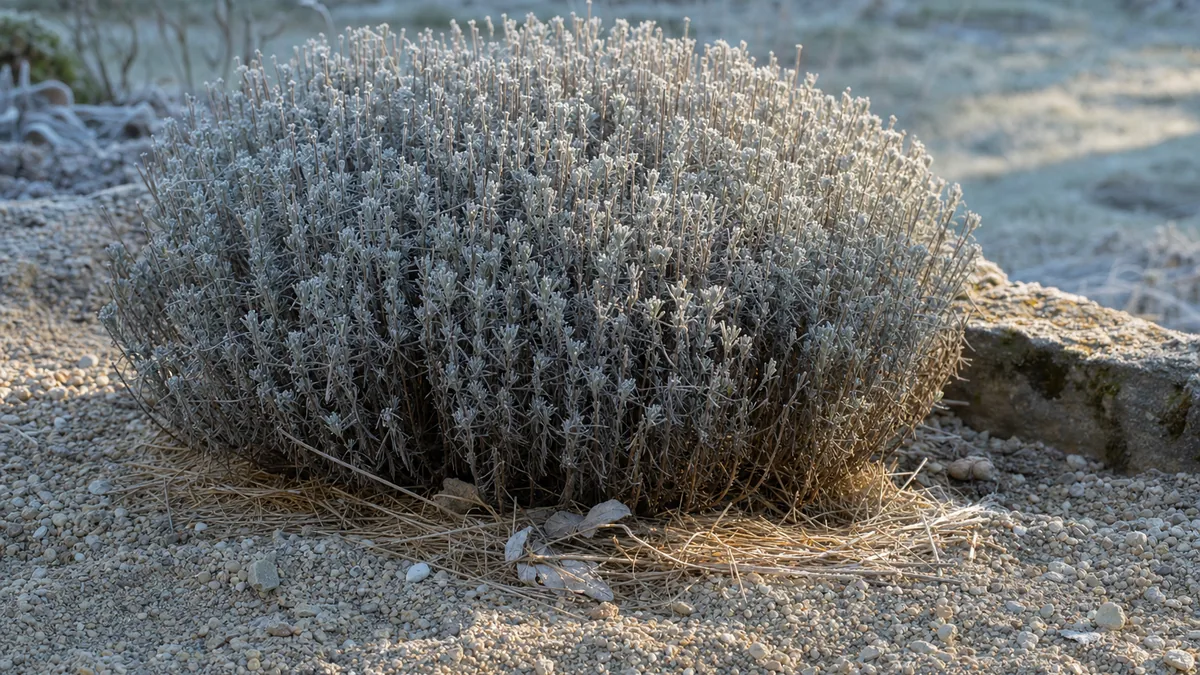
A dormant lavender often looks worse than it is. Expect a mound of woody stems with thin, gray or faded foliage. That alone is not a death sign. Purdue Extension says it is easy to mistake live branches for dead ones while they are still dormant, and advises waiting for new growth in spring before deciding how far to cut.
An Ask Extension answer from May 2025 shows how deceptive it can be. A Michigan gardener’s English lavender, buried under snow for about five months, had mostly white leaves and dead-looking branches. The expert said it was not dead, had new growth, and should survive with some damage, though recovery might take more than a season or two. If the white you see is a powdery coating instead of faded dormant leaves, check it against our powdery mildew guide.
The scratch test for dead lavender
University of Illinois Extension describes a quick test for any woody stem: lightly scratch it with a fingernail or a key. If green shows through, the stem is alive. If it is completely brown and breaks easily, it is dead. Use it in spring, not midwinter, on several stems. University of Maryland Extension says to wait until a damaged shrub puts out new growth in spring, then assess the damage.
- Alive: green under the scratch, or new leaf buds on the lower stems (Illinois Extension, Purdue Extension).
- Probably dead: brown and brittle all the way to the base, with no new growth once nearby plants have leafed out (Illinois Extension on dead stems, Maryland Extension on waiting for growth).
- Damaged but recovering: some stems dead, some green. Purdue says to cut back to healthy wood once new growth is well underway.
Resist the urge to tidy early. The same Michigan Ask Extension answer advises pruning only when nights are consistently above 50°F, so the plant can recover first.
Can a Lavender Plant Survive Winter? Zones by Type
It depends on the species, and the published zones disagree. The comparison table in our English vs Spanish vs French lavender section covers the types; here is what each source says about cold, so you can see the spread instead of one tidy number.
- English lavender (Lavandula angustifolia): Iowa State and Colorado State both give zone 5. Washington State says zones 5 and above and a 5°F survival temperature. Utah State gives zones 5 to 10 for lavender as a group. The Chicago Botanic Garden says English lavender, lavandin and L. x chaytoriae are typically listed hardy in zones 6 to 9, and UF/IFAS publication FP337 gives 5b to 8. The UF/IFAS Pasco County guide, written for Florida gardeners, lists 8 to 11.
- Cold-hardy cultivars: a UVM Extension Master Gardener names ‘Munstead’, ‘Hidcote Blue’ and ‘Phenomenal’ as hardy to zone 4. Utah State says ‘Lady’ will survive zone 4 winters if mulched or grown on a south-facing site.
- Lavandin (L. x intermedia): Iowa State says it is hardy to zone 5 only in a protected location. Washington State agrees it is slightly less hardy than English but usable in zone 5.
- Spanish and French lavender: Colorado State says they are not cold hardy in Colorado, and Iowa State says they are not winter hardy in Iowa. UF/IFAS Pasco County lists both for zones 8 to 11. Washington State describes them as somewhat hardy to tender.
Treat the edge of a range as a gamble. A plant at the limit of its zone does better with perfect drainage, a sheltered spot and a hardy cultivar. The same wet-feet logic applies to rosemary, and our guide on whether a rosemary plant can survive winter shows how another Mediterranean herb handles the zone cutoff.
Winter Wet and Drainage: The Real Killer
Cold is only half the story, and often the smaller half. Washington State Extension says lavender grown in well-drained soil can withstand considerably colder winters than lavender in poorly drained soil, and that it cannot tolerate saturated soil, particularly in late fall, winter and early spring when plants are dormant. The Chicago Botanic Garden puts it plainly: good drainage, especially in heavier clay soils, is crucial to year-round survival. UF/IFAS adds that plants are more susceptible to winter injury in wet, heavy soil.
The damage is usually root and crown rot. If a plant that went into winter healthy comes out soft and discolored at the base, read our root rot guide for the signs and what can still be saved.
Fixes are about building the site, not fussing in January. Washington State suggests mounds, berms or raised beds, and Iowa State says raised planting areas improve winter survival. For a new bed, our guide to filling a raised garden bed shows the layers, and the calculator below shows whether your soil leans toward clay.
How to Take Care of a Lavender Plant in Winter
What to do with lavender in winter is mostly less, done at the right time. The steps follow extension advice.
- Stop feeding in late summer. Utah State Extension says too much fertilizer makes plants vulnerable to disease and cold weather injury.
- Skip heavy, wet mulches. A UVM Extension Master Gardener says to avoid leaves or grass clippings, which hold moisture and promote root rot. Iowa State likewise says to avoid heavy mulch because it holds moisture and promotes rot.
- Mulch lightly after the ground freezes. Iowa State suggests a light mulch of straw or evergreen boughs once the ground has frozen, as long as it does not trap moisture at the crown.
- Cover in hard frost if you are at the edge of your zone. The UVM volunteer says to use row cover, burlap or blankets after the first hard frost, once nights stay in the 20s°F, and to remove them when frost risk ends. Covering too early can keep plants warm and disrupt dormancy. Colorado State says fabric row covers can shield new plants from wind and heavy snow.
- Water new plants if winter is dry. Colorado State says fall-planted lavender should not let its root zone dry out in winter. For established plants in drained soil, avoid extra watering, since wet soil is the bigger risk.
- Wait for spring growth. Do not prune dormant plants or judge them by January looks.
Mulch advice is where the sources split. UF/IFAS says to protect the crowns with several inches of mulch during winter, and Utah State recommends heavy mulching for fall-planted lavender. Colorado State says to keep mulch away from the crown, and Washington State says organic mulch should not be applied deeply around the base, especially in humid climates or areas with very wet winters. A reasonable reading is to mulch the surroundings and keep the crown itself clear in wet climates, and to go thicker only in dry, very cold ones. Our comparison of organic vs inorganic mulch helps you choose between straw and gravel, and the broader list of ways to protect plants in winter covers covers and timing for the rest of the garden.
If you like your winter jobs on one calendar, the Season Planner app shows the frost dates and the next job for your garden. The rest of the cleanup is in our winterize garden checklist.
How to Prune Lavender Plants for Winter
The safest winter pruning is none. A UC Master Gardener article from UC ANR says lavender should not be pruned during winter, because pruning then can cause dieback that may kill the plant. Whether to prune in fall is where the sources really disagree:
- Early fall only: Washington State says pruning is best done in fall, early, before the first hard frosts. The UC article allows early fall before any danger of frost. University of Maryland Extension says not to prune after mid-August.
- Late summer at the latest: the UVM Extension Master Gardener says to prune in late summer or early fall, since late pruning can increase winter injury.
- Spring instead: Purdue, Colorado State, Maryland and UF/IFAS all prefer spring, once new growth appears. The Chicago Botanic Garden says to cut back in early spring to a point just above where last year’s growth started.
So if you live in a cold zone, the low-risk path is spring pruning. If you prune in late summer, keep it light. Both the UC article and the UVM volunteer say to remove no more than about one third of an English plant, and to cut into new green growth, not bare wood. Iowa State explains why: lavender does not readily produce new growth from old wood.
If you cut stems for crafts, do it in summer, and our guide on how to dry flowers covers hanging and silica gel. The same timing logic, prune by type and zone, shows up in our guide to cutting back hydrangeas.
Can I Bring My Lavender Plant Inside for the Winter?
Yes, but a pot indoors is the hardest way to keep lavender, so decide by type. Iowa State Extension says container lavender will not overwinter well outdoors, and suggests using it as an annual or bringing it indoors. For Spanish, spike and French lavender, which are not winter hardy there, it recommends overwintering indoors in containers.
There are two routes, depending on whether the plant is hardy where you live.
- Hardy English lavender in a pot: keep it cold and dormant, not warm. Penn State Extension says roots of above-ground containers can reach the temperature of the winter air and advises going two zones colder with potted plants. That puts English lavender rated for zone 5 at roughly zone 3 conditions in a pot, which is simple arithmetic from the sourced figures. University of Illinois Extension suggests an unheated garage, shed or cool basement at 20 to 45°F, notes that many perennials need cold dormancy, and says to check the soil through winter. Penn State warns that dry soil freezes faster than moist soil and that overwatering can cause root rot.
- Tender Spanish or French lavender, or a pot in a very cold zone: bring it indoors to the brightest window. If you also keep drought-loving potted plants, see whether succulents can survive winter for their limits, and our checklist on when to bring plants inside for winter gives the temperature cues and steps.
Indoor results are mixed, so set expectations. An Ask Extension answer from a Minnesota volunteer says decline indoors is common for outdoor herbs, because of dry indoor air and low winter light. The advice: keep it in as high a light spot as you have, water only to keep the roots from drying out, and watch for mites, mealybugs and aphids. That volunteer found it easier to start over with a new plant in spring. University of Missouri Extension adds that you should check a plant for insects and disease before bringing it in.
If you dig a garden plant to pot it for the winter, University of Missouri Extension says an 8-inch pot or larger may be needed for the root system of a plant that looks small, so measure the roots first.
Lavender will not give you color in the cold months, so if you want blooms in January, our list of flowers that grow well in winter is the better source. For the broader series on planting and seasonal care, browse the spacing and planting hub, or see what to plant now for your ZIP code when spring comes.
Free book · 23 pages, PDF
Lavender in Winter FAQ
Do lavender plants die in winter?
Not if the type suits your zone and the soil drains. Iowa State Extension says English lavender is reliably winter hardy to USDA zone 5, and Washington State Extension says well-drained plants withstand considerably colder winters than plants in poorly drained soil. Spanish and French lavender are not hardy in Colorado or Iowa.
What does a lavender plant look like in the winter?
A dormant mound of woody stems with faded, gray or thinned foliage, which is normal. Purdue Extension says it is easy to mistake live branches for dead while they are dormant. Wait for spring growth before judging the plant.
How can I tell if my lavender is dead?
Scratch a stem in spring. University of Illinois Extension says that if green shows through, the stem is alive, and if it is completely brown and breaks easily, it is dead. University of Maryland Extension says to wait until new growth appears in spring before assessing damage.
Should I cut back lavender for winter?
Only lightly and early, or not at all. A UC ANR Master Gardener article says not to prune lavender during winter because it can cause dieback that may kill the plant. Maryland Extension says to stop by mid-August, while Purdue and Colorado State prefer spring pruning once new growth appears.
Should I mulch lavender for winter?
Lightly, with a dry material. Iowa State Extension suggests straw or evergreen boughs after the ground freezes, as long as it does not trap moisture at the crown. Colorado State Extension says to keep mulch away from the crown, while UF/IFAS says to protect crowns with several inches in winter, so match the depth to how wet your winters are.
Can I bring my lavender plant inside for the winter?
Yes, for tender types, but expect a struggle. A Minnesota Ask Extension volunteer says decline indoors is common because of dry air and low light, and advises the brightest spot and watering only to keep roots from drying. Hardy English lavender in a pot can instead overwinter in an unheated garage at 20 to 45 degrees F, per University of Illinois Extension.
Sources & further reading
Zones, winter injury, mulch and container advice come from Iowa State Extension’s Growing Lavender in Iowa, Colorado State Extension’s Growing Lavender in Colorado, Utah State Extension’s English Lavender in the Garden and Washington State University Extension’s Growing and Marketing Lavender (EB2005). The Chicago Botanic Garden’s Lavenders for Northern Gardens evaluation and Lavender Varieties for the Midwest supply the zone 6 to 9 listing, drainage and spring pruning advice. Florida figures are from UF/IFAS publication FP337 and the UF/IFAS Pasco County lavender guide. Pruning timing and winter damage come from Purdue Extension’s Prune Lavender at the Right Time, University of Maryland Extension’s lavender page, its winter damage page, the UC ANR Master Gardener article on pruning lavender and University of Illinois Extension’s Wait-n-See Spring, which gives the scratch test. Answers from extension volunteers are from Ask Extension: overwintering lavender (UVM Extension Master Gardener), English lavender looks bad and over winter potted lavender. Container and indoor guidance is from Penn State Extension’s Overwintering Plants in Containers, University of Illinois Extension’s Overwintering potted plants and University of Missouri Extension’s Moving Garden Plants Indoors. For how we source the facts on this site, see our methodology page.
Free book · 23 pages, PDF
The Spacing & Planting Cheat Sheet
Sent