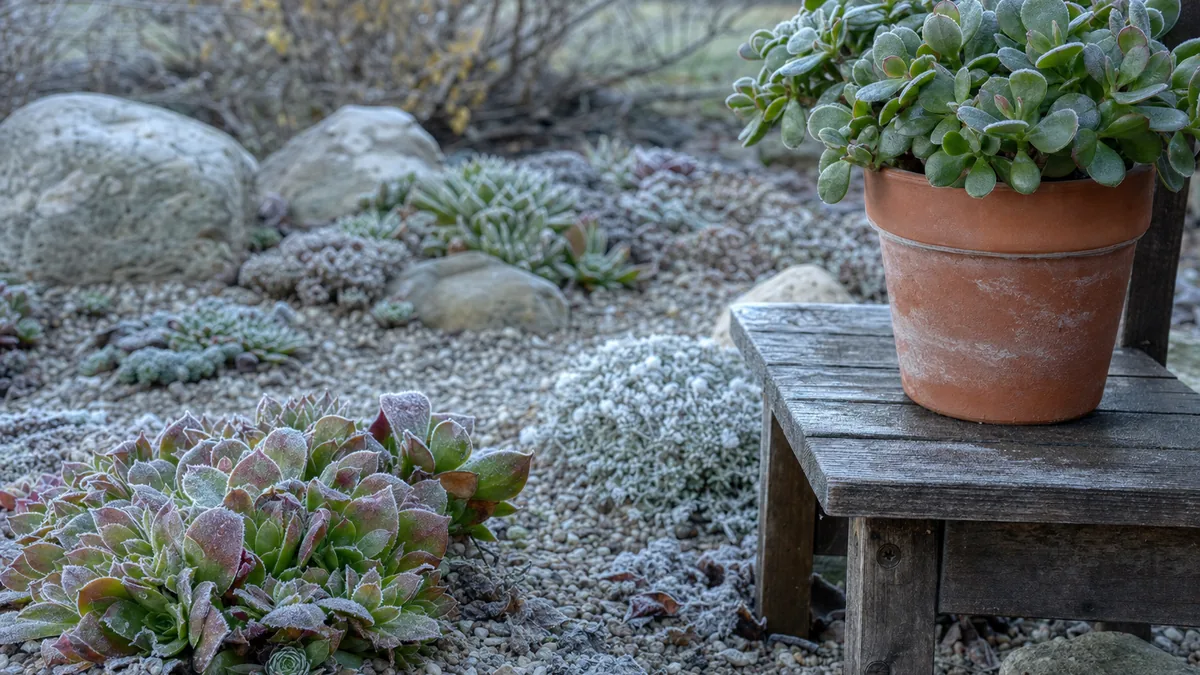
Yes, some succulent plants survive winter outdoors, but only the hardy types, and your USDA zone decides which. The Brooklyn Botanic Garden lists hens and chicks (Sempervivum tectorum) as hardy in zones 3 to 8 and hardy purple ice plant in zones 5 to 9. Tender aloe, jade and echeveria come indoors before frost: UF/IFAS says aloe can stay out year-round in zones 8 to 11.
Can Succulents Survive Winter? At a Glance
Hardiness varies enormously inside the succulent group. This table pulls together the zone and temperature limits that botanic gardens and extension services publish, with the action each one calls for. Sources sometimes disagree, and where they do the range is shown.
| Type or situation | Zone or temperature limit | What to do | Source |
|---|---|---|---|
| Hardy: hens and chicks (Sempervivum) | Zones 3 to 8 (4a in one Oregon guide) | Leave outside in fast-draining soil | Brooklyn Botanic Garden, NC State, Oregon State |
| Hardy: sedum (stonecrop) | Zone 4 to 9 for blue spruce sedum; varies by variety | Leave outside, keep crowns dry | Brooklyn Botanic Garden, Oregon State |
| Hardy: ice plant (Delosperma) | Zones 5 to 9 (purple), 4 to 8 (yellow) | Leave outside in sun and gravelly soil | Brooklyn Botanic Garden |
| Hardy: prickly pear and cholla (Opuntia) | Zones 4 to 9 (Nichol’s prickly pear), 4 to 11 (cholla) | Leave outside, avoid wet winter soil | Brooklyn Botanic Garden |
| Tender: echeveria | Zones 9 to 11 | Pot it and overwinter indoors in colder zones | NC State Extension |
| Tender: aloe vera | Zones 8 to 11 (UF/IFAS), 10 and up (NC State) | Bring in before frost, see aloe vera care | UF/IFAS, NC State, Missouri Botanical Garden |
| Tender: jade plant | Zones 11 to 12 (NC State), 11 (Oklahoma State) | Bring in before the first frost | NC State, Oklahoma State, University of Wisconsin |
| Tender: larger-leaved Mexican sedums | Do not tolerate cold or much dampness | Overwinter indoors | Washington State University Extension |
Which Succulents Are Hardy and Which Are Tender?
Hardy succulents come from cold or mountain climates and sleep through winter outdoors. The Brooklyn Botanic Garden’s hardy succulent border article gives zones for each: hens and chicks 3 to 8, blue spruce sedum (Sedum reflexum) 4 to 9, hardy purple ice plant (Delosperma cooperi) 5 to 9, ‘Lesotho’ yellow ice plant 4 to 8, Nichol’s prickly pear 4 to 9, claret cup cactus 4 to 9 and walking-stick cholla 4 to 11. A Colorado Extension answer for the Front Range town of Castle Rock calls ice plants, sedum and hens and chicks some of the hardiest options there, with hedgehog cacti and prickly pears also doing well.
The zones are not identical everywhere, so treat them as ranges. An Oregon State University Extension guide for the Willamette Valley says hens and chicks grow in zone 4a and that sedum zones start at 4 and vary by variety, while NC State Extension lists the border sedum ‘Autumn Joy’ in zones 3 to 10. Your own winter low matters most, and the USDA zone for your ZIP code is the quickest check. You can look it up below, or browse our growing zones pages by state.
Tender succulents come from frost-free places and are really houseplants in most of the country. NC State Extension lists echeveria (Echeveria elegans) in zones 9 to 11 and notes it is grown mostly as a houseplant in shallow containers in North Carolina. A Washington State University Extension presentation on succulents in the Pacific Northwest puts larger-leaved Mexican sedums in the same camp, saying they will not tolerate cold or much dampness and should be overwintered indoors.
Cold is only half the problem. The same WSU presentation says many succulents are surprisingly cold-hardy but must be protected from rain, and the Oregon State guide warns that planting sites must drain fast or winter and spring rains will cause rot. A hardy plant in soggy soil can die in a winter it would otherwise shrug off. Whether a tender plant is dying of cold or of wet is the question behind most winter losses, and it is also why our guide to how to water succulents keeps stressing drainage.
Can Aloe Vera Survive Winter Outside?
Only where freezing is rare. UF/IFAS says aloe can be grown outside year-round in zones 8 to 11. NC State Extension is stricter and says it can be an outdoor perennial in zones 10 and higher, and Missouri Botanical Garden lists it as winter hardy in zones 10 to 12. These sources do not agree on how far north the plant is safe, so the lower end of that range is a gamble. If you are at the cold edge, plan on the stricter number or be ready to cover and pot up.
The University of Arizona Cooperative Extension says aloe vera can be grown outdoors where there is no chance of freezing, and that potted plants must come back indoors before the first fall freeze. Penn State Extension calls aloes not frost tolerant and says to bring them in before the threat of frost. Missouri Botanical Garden gives container plants a minimum of 40°F in winter and says to bring them indoors in early fall before night temperatures dip below 50°F. So the practical answer for most of the country is that aloe summers outside and winters inside.
Aloe lives in a pot all winter without much fuss. Penn State says the dormant period runs from fall through winter and to water less so the soil is barely moist and the leaves do not shrivel, and NC State likewise says to water less in winter. Our guides on how often to water aloe vera and how to repot aloe vera cover the schedule and the pot, which matters if you dug a garden plant up to bring it in.
Can a Jade Plant Stay Outside in Winter?
No, not outside a frost-free climate. NC State Extension lists jade plant (Crassula ovata) for zones 11 to 12, and the Oklahoma State University plant profile gives zone 11. The University of Wisconsin Extension horticulture page says jade tolerates a wide range of temperature and humidity and may even tolerate light frost, but is killed by freezing conditions, and that jade houseplants must be brought indoors before the first frost.
Jade is a good summer-outside plant. Wisconsin says to acclimate it gradually to the higher light outdoors to prevent sunburn. In winter, when it is semi-dormant, Wisconsin says watering should be restricted and the soil kept on the dry side, and NC State says to reduce watering from fall to late winter. If you want the plant to bloom, Wisconsin notes a cool spot around 55°F, especially at night, and no added light helps trigger flowering. UF/IFAS’s jade plant publication covers propagation, and rooting a few cuttings before frost is cheap insurance; our guide to growing succulents from cuttings shows the steps.
At What Temperature Should You Bring Succulents Inside?
For tender types, bring them in before nights fall below about 50°F, and always before frost. Missouri Botanical Garden gives the 50°F night figure for aloe, University of Wisconsin Extension says jade and the University of Arizona says aloe must be in before the first frost or freeze, and Penn State says before the threat of frost. Frost can arrive on a night when the forecast low is still above freezing, as our guide to what temperature frost forms explains, so give yourself a margin.
Hardy succulents need no such rush, and some tender-leaning plants take a little cold. The University of Nebraska-Lincoln says to keep cacti and succulents in a cool room at 55 to 60°F but never below 45°F, while Iowa State University Extension prefers a range of 55 to 75°F, noting some species tolerate as low as 45°F. The WSU presentation suggests storing overwintering plants between 35 and 60°F with a fan for air circulation. That is a wider range than the others, so for a first winter stay at the warmer end. Our when to bring plants inside for winter guide has the full routine, and the frost date for your ZIP code sets the outer deadline.
How to Take Care of an Aloe Plant and Other Succulents in Winter
The routine below applies to aloe vera and to other tender succulents kept indoors, and it follows the extension sources already named.
- Move them in early. Do it before nights near 50°F, and check leaves and soil for pests first. The steps for that are in our bring-plants-inside guide.
- Check the pot. It needs drainage holes. For a plant dug from the ground, use a pot sized to the roots with a gritty succulent mix.
- Give the brightest spot you have. University of Nebraska-Lincoln says cool does not mean dim, and Missouri Botanical Garden says cacti and succulents need at least 4 hours of bright, direct light each day.
- Keep it cool, not cold. Aim for the 55 to 60°F that Nebraska recommends, away from heat vents and from cold drafts at windows and doors, which the University of Wisconsin Extension in Chippewa County lists as places to avoid.
- Water far less. The University of Minnesota Extension says to water only enough to prevent shrinking and withering in the dim winter months and let the soil dry completely between waterings. Missouri Botanical Garden says no more than once per month. The schedules in how often to water succulents put the gaps side by side.
- Skip the fertilizer. Iowa State University Extension says to avoid fertilizing in winter when succulents are not growing.
- Go back out slowly in spring. UF/IFAS warns aloe can sunburn when moved from low to bright light too quickly, so reintroduce it to strong sun over days.
Every plant in the house reaches winter on its own rhythm, and the Houseplant Care App sets water, feed and repot timing for each houseplant so the longer winter gaps are on a list instead of in your head.
How Much Light Do Succulents Need Indoors in Winter?
As much as you can give. Iowa State University Extension says to aim for ten or more hours of bright, indirect light and that most succulents need at least six to eight hours, with plants in low light turning lanky and pale. Light is the main limit indoors, because winter days are short and a window pane cuts what gets through. Penn State Extension notes that grow lights are a good option for aloe without adequate natural light.
For fixtures, University of Minnesota Extension suggests cool white fluorescent tubes positioned 6 to 12 inches above the plants for 14 to 16 hours a day, while Iowa State says high-output, full-spectrum fluorescent or LED fixtures work. Those are published for fluorescent tubes, so an LED panel needs its own hanging distance. Our LED vs. fluorescent grow lights comparison covers the choice, and the calculator below handles distance and light dose. More plants that move indoors for winter are collected in the indoor plants hub.
How Do You Protect Succulents Left Outside in Winter?
For hardy types, drainage is the protection. The Brooklyn Botanic Garden recommends a sunny, fast-draining spot, sand worked into the soil where needed, and gravel mulch to keep the crowns dry. Oregon State suggests a layer of grit, gravel or pumice under the leaves to keep rosettes off wet soil. The WSU presentation recommends amending garden soil and potting mix one-third to one-half with perlite or pumice. Since WSU stresses keeping them out of the rain, potted plants can move under an eave.
Tender succulents in the ground in a marginal zone need cover on the nights it freezes. University of Arizona Cooperative Extension suggests a cotton sheet over the plant on nights at or slightly below freezing, and a 60-watt bulb under the sheet for extra warmth, kept from touching the plant or the sheet. It says not to use plastic sheeting, because plastic conducts cold wherever it touches the plant, and to move container plants indoors until freezing weather passes, kept dry in a bright spot. Oregon State adds that tender succulents left outdoors should not be watered in winter. Our how to protect plants in winter guide covers the other covers and when to take them off.
What Does Frost Damage Look Like on a Succulent?
UF/IFAS Extension in Putnam County describes freeze damage on succulents as translucent or water-soaked patches that later turn brown, and says thick leaves can soften or collapse where the water inside froze. Damage often shows first on young or exposed leaves and can take days or weeks to show in full. The University of Arizona describes it as blackening of exposed plant parts and adds that a mild freeze may be only cosmetic, with a short hard freeze sometimes injuring just the outer skin.
Resist the urge to cut it all off. UF/IFAS Putnam County says to wait until the risk of further frosts has passed before pruning, because damaged tissue shields what is alive underneath and early cutting can push new growth that the next cold snap catches. Kansas State University Extension notes the full extent of cold injury may take several weeks to appear. Mushy tissue that starts at the base of the plant after a cold, wet spell may be rot rather than frost, in which case our root rot guide has the rescue steps.
Free book · 25 pages, PDF
Can Succulents Survive Winter FAQ
Can succulent plants survive winter outside?
Hardy ones can. The Brooklyn Botanic Garden lists hens and chicks in zones 3 to 8, hardy purple ice plant in zones 5 to 9 and Nichol's prickly pear in zones 4 to 9. Tender types such as echeveria (zones 9 to 11, NC State Extension) and jade (zones 11 to 12) need a frost-free climate or a spot indoors.
Can aloe vera plants survive winter outside?
Only in mild zones. UF/IFAS says aloe can stay outside year-round in zones 8 to 11, while NC State Extension says zones 10 and higher. The University of Arizona says outdoors only where there is no chance of freezing, and to bring potted plants in before the first fall freeze.
Can a jade plant stay outside in winter?
Not where it freezes. The University of Wisconsin Extension says jade may tolerate light frost but is killed by freezing conditions, and must be brought indoors before the first frost. NC State Extension lists it in zones 11 to 12.
How do I take care of an aloe vera plant in winter?
Keep it indoors in bright light and water much less. Penn State Extension says to reduce watering from fall through winter so the soil is barely moist and the leaves do not shrivel, and NC State Extension says to water less in the winter months. Do not fertilize, since Iowa State Extension says succulents are not growing then.
At what temperature should I bring succulents inside?
Before nights fall to about 50 degrees F for tender types, and always before frost. Missouri Botanical Garden gives 50 degrees F for aloe, and University of Nebraska-Lincoln says to keep indoor cacti and succulents at 55 to 60 degrees F and never below 45 degrees F.
Do succulents need a grow light in winter?
Often, yes. Iowa State Extension says to aim for ten or more hours of bright, indirect light, and University of Minnesota Extension says fluorescent tubes should sit 6 to 12 inches above the plants for 14 to 16 hours a day. A south or west window may be enough without a light.
Should I water succulents in winter?
Rarely. University of Minnesota Extension says to water only enough to prevent shrinking and withering in dim winter months, and Missouri Botanical Garden says no more than once per month. Outdoors, Oregon State says tender succulents should be left dry in winter.
Sources & further reading
Hardy succulent zones and drainage advice come from the Brooklyn Botanic Garden’s article on a hardy succulent garden, Oregon State University Extension’s guide to succulents in the Willamette Valley, Washington State University Extension’s Growing Succulents in the Pacific Northwest, an Ask Extension answer on succulents in Castle Rock, Colorado and NC State Extension’s Sempervivum tectorum and Autumn Joy sedum pages. Tender plant zones are from NC State’s Echeveria elegans and jade plant profiles and Oklahoma State’s jade plant profile. Aloe advice is from UF/IFAS Gardening Solutions, NC State Extension, Missouri Botanical Garden, University of Arizona Extension and Penn State Extension. Jade care is from the University of Wisconsin Extension’s jade plant page. Indoor temperature, light and watering come from University of Nebraska-Lincoln’s winter care of indoor plants, University of Minnesota Extension’s cacti and succulents page, Iowa State University Extension’s Growing Succulents Indoors, Missouri Botanical Garden’s cactus and succulents factsheet and University of Wisconsin Extension’s winter care of houseplants. Frost damage and protection are from UF/IFAS Extension Putnam County, University of Arizona bulletin AZ 1399 and Kansas State University Extension. For how we source the facts on this site, see our methodology page.
Free book · 25 pages, PDF
The Indoor Plants Repotting Cheat Sheet
Sent