To grow aloe vera, plant it in a pot with a drainage hole filled with fast-draining cactus or potting mix lightened with perlite or coarse sand. Give it as much bright light as you can, and water thoroughly only after the soil has dried out, as our guide to watering succulents explains. Start new plants from the pups that grow at the base of a mature plant, because extension sources are cautious about growing aloe from a single leaf.
Aloe Vera Quick Facts
| What | Answer | Source |
|---|---|---|
| Outdoor hardiness | Zones 8 to 11 (UF/IFAS) or zones 10 to 12 (NC State, Missouri Botanical Garden) | UF/IFAS, NC State, Missouri Botanical Garden |
| Light | Full sun, or 2 to 6 hours of sun in partial shade; south or west window indoors | NC State, University of Arizona |
| Soil | Cactus mix, or potting mix with perlite, grit or coarse sand | University of Arizona, NC State |
| Watering | When the top inch is dry (UF/IFAS) or when the soil is completely dry (NC State, WVU) | UF/IFAS, NC State, West Virginia University |
| Best way to propagate | Offsets (pups) from the base of a mature plant | University of Arizona, Missouri Botanical Garden, NC State |
| Pup rooting time | About a month after planting | University of Arizona |
| Growth rate | Medium | NC State |
| Mature size | 1 to 2 feet tall (Missouri Botanical Garden), up to 2 feet (UF/IFAS) | Missouri Botanical Garden, UF/IFAS |
How Aloe Vera Grows and Reproduces
Aloe vera is a succulent that forms a flattened rosette of thick, spiny leaves. The University of Arizona Cooperative Extension says the rosette spreads by underground rhizomes, with leaves usually 8 to 10 inches long and a flower stem 2 to 3 feet tall. Missouri Botanical Garden gives a wider range, with leaves up to 18 inches long.
That is also the answer to how aloe reproduces. NC State Extension lists division as the recommended propagation strategy and says the plant reproduces by offsets. Missouri Botanical Garden says to propagate from the offsets that form near the base of mature plants. Arizona adds that seed is possible but slow and works best under greenhouse conditions,.
How fast does aloe vera grow?
NC State Extension rates aloe vera as a medium grower with low maintenance. We found no extension figure for inches per year or years to maturity, so we do not give one. What the sources do say is that size depends partly on the pot. UF/IFAS says a smaller pot keeps the plant small and a larger pot promotes growth. Missouri Botanical Garden says only mature plants flower, and that container plants flower only under optimal conditions such as sunny windows. UF/IFAS adds that indoor plants rarely bloom.
Growing Aloe Vera Indoors or Outdoors
Most people in the United States grow aloe vera as a houseplant, because it does not tolerate freezing. The extension sources disagree a little on where it can stay outside all year. UF/IFAS says it can be grown outdoors year-round in zones 8 to 11. NC State Extension and Missouri Botanical Garden both say zones 10 to 12. Near the edge of that range, the colder numbers are the safer reading. To check which zone you are in, use our growing zones by state pages.
Missouri Botanical Garden gives practical temperature limits for container plants: summer nights of 50°F to 60°F are tolerated, the minimum winter night temperature is 40°F, and outdoor plants should come in before fall nights drop below 50°F. The University of Arizona says potted plants can go outside in summer but must come back indoors before the first fall freeze.
If you are new to the zone numbers, our USDA hardiness zones guide explains what they measure and what they leave out.
Moving between indoors and outdoors needs care. West Virginia University Extension says to move plants outdoors gradually, starting in shade for a few days, then shifting to sunnier spots, and to avoid harsh midday sun. UF/IFAS warns that a plant can sunburn if moved from low light to bright light too quickly, and that moving it from a sunny area to dimmer indoor light can also stress it.
How to Plant Aloe Vera: Pot, Soil and Steps
Drainage decides whether an aloe lives. UF/IFAS says aloe grows in any well-drained quality potting media, and NC State Extension calls coarse, well-draining soil a must. Arizona recommends a good commercial potting mix with added perlite, granite grit or coarse sand, or a packaged cacti mix, in a pot with a large drainage hole. NC State suggests a pot with several drainage holes and considers clay pots ideal. West Virginia University gives a homemade medium of one part potting soil to one part coarse sand. It notes that gravel in a pot without holes still lets moisture build up, so choose a pot with holes.
- Pick a pot with drainage holes. NC State considers clay ideal.
- Fill with a gritty mix. Use cactus mix, or potting mix blended with perlite, grit or coarse sand, as Arizona describes.
- Set the plant at its old depth. Spread the roots out, then firm the mix around them. Keep the base of the leaves above the soil.
- Water thoroughly once, then let it dry. Soak the soil until water runs out the drainage holes and empty the saucer. UF/IFAS and the UVM helpline both say never let the plant stand in water.
- Place it in your brightest spot. See the light section below.
Not sure how big a pot to buy? Our guide to plant pot sizes covers how pot width relates to plant size and soil volume.
How Much Light Does Aloe Vera Need?
Bright light is the one thing extension sources agree on, though they phrase it differently. NC State Extension lists full sun, meaning 6 or more hours of direct sunlight a day, or partial shade, meaning 2 to 6 hours. West Virginia University prefers a bright, sunny windowsill with at least six hours of direct daylight indoors, and says artificial light can supplement it. The University of Arizona suggests a south or west facing window. Missouri Botanical Garden says aloe prefers full sun and tolerates some part shade. One outlier is the University of Vermont Extension Master Gardener helpline, which answered a homeowner that aloe needs very bright indirect light.
Give it the brightest place you have. Missouri Botanical Garden says aloe needs bright light to flower, and UF/IFAS notes that a plant moved into full sun suddenly can sunburn, so make any move to brighter light gradual. If you have no bright window, a grow light can fill the gap.
Weighing up lamp types? Our comparison of LED vs fluorescent grow lights has the details.
How Often to Water Aloe Vera
Aloe stores water in its leaves, and every extension source we read says to let the soil dry between waterings. They differ on how dry. UF/IFAS says to water only when the top inch of soil is dry to the touch, then water thoroughly. NC State Extension and West Virginia University say to wait until the soil is completely dry. Missouri Botanical Garden says to water very moderately in spring, summer and fall, and reduce to a minimum in winter. For how often to water in other seasons and rooms, see how often do you water succulents. For an aloe-specific schedule, see how often to water aloe vera.
| Season | What extension says |
|---|---|
| Spring and summer | About once a week in the active growing season, only when the soil is completely dry (West Virginia University). Soak completely and let it dry between waterings (University of Arizona). |
| Winter | About once every two to three weeks, only enough to keep the leaves from wilting (West Virginia University). Water very little (UVM Extension Master Gardener helpline). Reduce to a minimum (Missouri Botanical Garden). |
| Any season | Never leave the plant standing in water (UF/IFAS, UVM). |
NC State Extension warns that overwatering can rot the roots, and Missouri Botanical Garden lists overwatering as a problem to avoid, along with mealybugs and scale. Our root rot guide covers the signs of rot and what can be saved. If you want help reading other symptoms, our guide to why a plant is wilting separates thirst from too much water.
Fertilizer
Aloe needs very little. The University of Arizona suggests a light application of indoor plant fertilizer in spring. West Virginia University says to fertilize only a couple of times a year during warm months, at half the recommended rate for household plant fertilizer.
How to Propagate Aloe Vera From Pups
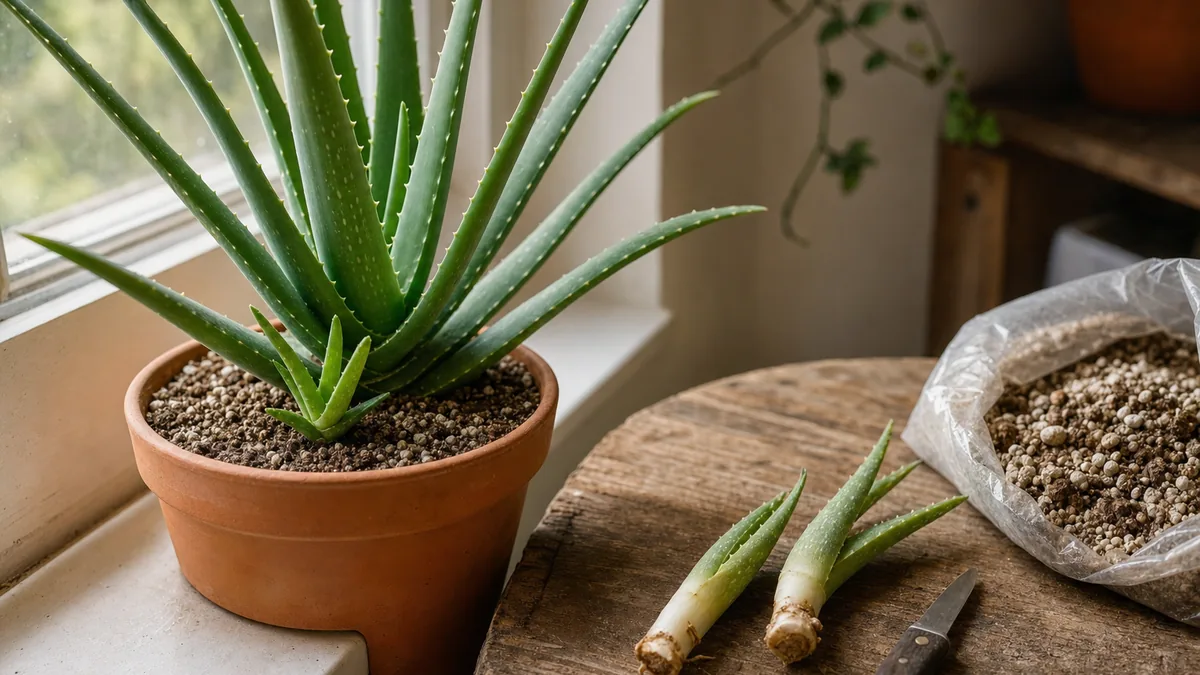
Pups, also called offsets, are small plants that grow from the base of a mature aloe. Every extension page we found that describes propagating aloe vera uses them. UF/IFAS Horticultural Sciences, in a department blog post, says mature, potted plants are the most likely to produce them and that it knows of no limit on how many a plant can make.
The University of Arizona gives the clearest steps for aloe: remove offsets once they are a couple of inches tall, cut them away with a clean, sharp knife, let the wound dry and scab over for about a week, then plant them in potting mix. It says roots should form in about a month. Iowa State University Extension, writing about offsets in general and naming aloe as one example, says to pot the offset in well-drained media such as cactus potting soil, in a container with a drainage hole, and to water lightly. The new plant establishes in a few weeks.
- Choose a pup that is a couple of inches tall. Arizona’s guideline.
- Cut it free with a clean, sharp knife. Cut between the pup and the parent. Arizona’s steps call for the callus step whether or not the pup has roots.
- Let the cut end callus. Arizona says about a week. UF/IFAS Horticultural Sciences says a leaf cut end calluses in a day or two, which is a different material, so the longer pup time is the safer one.
- Plant it in cactus or gritty potting mix. Use a small pot with a drainage hole.
- Water lightly. Iowa State’s wording.
- Check for roots after about a month. West Virginia University says roots need at least a month to develop, and that a gentle tug with resistance means roots have formed.
Propagating aloe vera without roots
A pup with no roots is fine, as long as it has a clean cut and has callused. Arizona’s steps do not require roots at planting, and says roots form in about a month. Iowa State notes that most succulents root without rooting hormone, and West Virginia University says rooting hormone is optional.
Can you root aloe in water?
We found no extension guide that recommends it. Iowa State University Extension says most succulents do not root well in water, and recommends well-drained media such as cactus potting soil or perlite. Use soil, not a glass of water.
Can You Grow Aloe Vera From a Single Leaf?
This is the most searched question about aloe, and the honest answer is: probably not, and the extension sources do not agree. Here is who says what. Leaf propagation does work for many other succulents, which our guide to growing succulents from cuttings covers.
| Source | What it says about aloe and leaves |
|---|---|
| University of Arizona Extension | Describes propagating aloe by offsets only. Its only mention of cutting a leaf is to harvest sap for minor burns and insect bites. |
| Missouri Botanical Garden, NC State Extension | List offsets or division as the way to propagate aloe vera. Neither describes a leaf method. |
| Ask Extension (Michigan question, June 2018) | An Ask Extension expert said a fully grown leaf of some succulents may root after callusing, but an aloe vera leaf will not root if broken off. The answer cited Michigan State University Extension for the callusing step. |
| UF/IFAS Horticultural Sciences blog | A department blog post says leaf cuttings can root once the cut end calluses over, which normally takes a day or two. |
| Iowa State University Extension (succulents in general) | For leaf-propagated succulents, use the entire leaf including the tissue that attaches it to the stem. Partial leaves will not root. Aloe is listed only under offsets. |
The sources that give aloe propagation as a recipe (Arizona, Missouri Botanical Garden, NC State) all use pups or division. The one Cooperative Extension answer on aloe vera leaves says a broken-off leaf will not root. The source that says leaf cuttings can root is a personal account on a university department blog, with no success rate. So treat a leaf as a low-odds experiment, not a method.
If you want to try anyway, the general succulent advice applies. Iowa State says to lay the entire leaf on slightly damp, well-drained soil such as cactus potting soil, with the stem end at the soil surface, and keep the surface damp but not wet. Illinois Extension says to callus a leaf cutting for 4 to 7 days first. These are not aloe-specific numbers, and the Ask Extension answer adds that rooting from leaves can take many months and that a cold windowsill slows it further. Plant the leaf only very shallowly, because that same answer says planting too deeply prevents growth. If you want a dependable result, take a pup from the parent plant instead.
How to Cut an Aloe Vera Plant or Leaf
Cutting a leaf for gel
The University of Arizona says aloe leaves are cut to harvest the sap for minor burns and insect bites. NC State Extension adds cautions: the leaves and sap contain anthraquinone glycoside, contact with the latex can irritate skin, and it advises testing a small skin patch before applying the gel. It lists aloe as poisonous to people, cats and dogs, with ingestion possibly causing abdominal cramping and diarrhea, and says juice is edible only after the aloin has been removed. Do not eat raw leaf or sap.
Cutting off broken or damaged leaves
An Ask Extension answer to a Michigan homeowner with broken leaves recommended cutting off the broken leaves and not taping them back together.
Cutting off a pup or a whole rosette
For pups, use the steps above. For a leggy rosette, Iowa State University Extension describes a technique called beheading for rosette-forming succulents in general: cut the rosette with 1 to 2 inches of stem attached, let the cut end callus for several days, then root it like a stem cutting in well-drained media. Iowa State does not name aloe there, so treat it as a general succulent method.
Repotting and Replanting Aloe Vera
Aloe does not need frequent repotting. UF/IFAS says to repot as needed to refresh the media or to give the roots room, and to increase the pot size by no more than two sizes, since a too-large container can hold excess moisture and lead to root rot. A UF/IFAS Charlotte County Extension blog post says the same in plainer words: move to a pot just a bit bigger than the old one. The UVM Extension Master Gardener helpline’s advice is to check whether the roots have outgrown the pot.
- Check the roots. The UVM helpline says to see whether the roots have outgrown the pot.
- Use fresh, gritty mix in a pot with drainage holes.
- Water lightly afterward. Iowa State says to water lightly after potting up an offset, and UF/IFAS warns against excess moisture.
Planting in the ground? NC State Extension lists the space needed as 12 inches to 3 feet, and recommends a very well-drained loam or sand. In zones where it survives winter, UF/IFAS Charlotte County says that outdoors, once it is established, it can rely on rainwater alone. The Charlotte County post describes one plant that spread from a small pot into a patch four feet wide.
Free book · 25 pages, PDF
How to Grow Aloe Vera Plants FAQ
How do you grow aloe vera from a leaf?
Extension sources are cautious. An Ask Extension answer said an aloe vera leaf will not root if broken off, while a UF/IFAS Horticultural Sciences blog says leaf cuttings can root after the end calluses for a day or two. Arizona, Missouri Botanical Garden and NC State describe propagating aloe by offsets only, so use pups for a reliable new plant.
How do you propagate aloe vera from pups?
The University of Arizona says to remove offsets once they are a couple of inches tall, cut them away with a clean, sharp knife, let the wound scab over for about a week, then plant them in potting mix. Roots should form in about a month.
How often should I water aloe vera?
Only when the soil has dried. UF/IFAS says water when the top inch is dry, while NC State Extension and West Virginia University say wait until it is completely dry. West Virginia University gives about once a week in the growing season and once every two to three weeks in winter.
How much light does an aloe vera plant need?
NC State Extension lists full sun (6 or more hours of direct sun) or partial shade (2 to 6 hours). West Virginia University prefers at least six hours of direct daylight indoors, and the University of Arizona suggests a south or west window.
How fast does aloe vera grow?
NC State Extension rates its growth as medium. We found no extension figure for inches per year. UF/IFAS says pot size affects growth: a smaller pot keeps it small and a larger pot promotes growth, and plants can reach about two feet tall.
Can aloe vera grow outdoors?
Yes, where freezing is not a risk. UF/IFAS says it can grow outdoors year-round in zones 8 to 11, while NC State Extension and Missouri Botanical Garden say zones 10 to 12. Missouri Botanical Garden says to bring container plants in before fall nights drop below 50°F.
Can you root aloe vera in water?
It is not recommended. Iowa State University Extension says most succulents do not root well in water and suggests well-drained media such as cactus potting soil or perlite instead.
Sources & further reading
Propagation, planting and watering details come from University of Arizona Cooperative Extension, NC State Extension Plant Toolbox (aloe vera), UF/IFAS Gardening Solutions, Missouri Botanical Garden Plant Finder, Iowa State University Extension, West Virginia University Extension and University of Illinois Extension. The leaf-propagation and repotting accounts come from the UF/IFAS Horticultural Sciences blog, the UF/IFAS Charlotte County Extension blog, and two Ask Extension answers (broken aloe leaves and a University of Vermont Extension Master Gardener helpline reply). For how we source the facts on this site, see our methodology page.
Free book · 25 pages, PDF
The Indoor Plants Repotting Cheat Sheet
Sent