To water succulents, soak the soil until water runs out of the drainage hole, then wait until the mix is nearly dry before you water again. Iowa State University Extension suggests starting at every 2 to 3 weeks and checking the soil, while the University of Minnesota Extension says to water only enough in low-light winter months to keep plants from shrinking. The rhythm matters far more than the calendar, which is why we also cover how often to water succulents by season, light and pot. A drought-tolerant garden herb such as lavender likes the same let-it-dry approach, which our lavender how to guide explains.
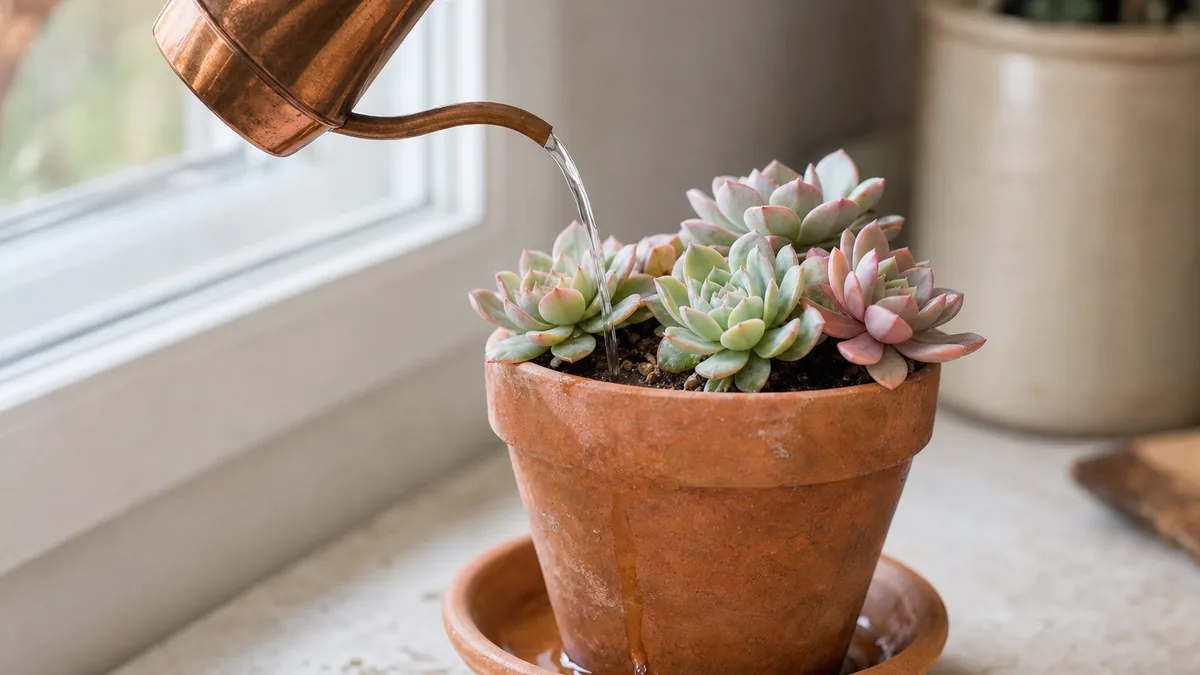
Watering Succulents Quick Facts
| What | Answer | Source |
|---|---|---|
| Method | Water thoroughly until it drains, then let the mix dry before watering again | Iowa State, UC Master Gardeners of San Luis Obispo, Minnesota |
| How much | No set volume. Water until it runs from the drainage holes | Montana State, Minnesota |
| How often | Start at every 2 to 3 weeks and adjust to the soil (guides range from weekly to no more than monthly in winter) | Iowa State, Texas A&M Plant Clinic, Missouri Botanical Garden |
| When to water | When the mix is dry or almost dry, at least two thirds of the way down | UC Master Gardeners of San Luis Obispo, Iowa State |
| Pot | Drainage hole, and no standing water in a saucer or sleeve | Iowa State, UC Master Gardeners, Texas A&M AgriLife |
| Winter | Water only enough to prevent shrinking | Minnesota, Montana State, Missouri Botanical Garden |
| Room humidity | Indoor air at 10 to 30 percent relative humidity is tolerated | Minnesota, Montana State |
How to Water a Succulent, Step by Step
Extension guides describe the same cycle in slightly different words. Iowa State University Extension calls it a wet-dry cycle: water thoroughly, wetting the entire root ball until it drains, then let the soil dry before watering again. University of Missouri Extension horticulturist David Trinklein says proper watering is probably the most important factor in succulent care, and that succulents do not tolerate a wet growing medium for long periods.
- Check that the mix is dry. The UC Master Gardener program of San Luis Obispo County says not to water again until the mix is almost dry, and suggests confirming it is dry at least two thirds of the way down with a water meter or a bamboo skewer. Iowa State suggests a chopstick: if it comes out darker with moisture, the plant does not need water yet.
- Water slowly at the soil. Pour in passes until the whole root ball is wet. Montana State University Extension says to water until it runs from the drainage holes or is completely soaked into the soil.
- Let it drain. University of Minnesota Extension says to discard excess water after a few minutes. Iowa State says never to let water sit more than a few hours in trays, sleeves or double pots.
- Wait. Check the soil again in a week or two rather than watering on a fixed day.
How Much Water Do Succulents Need?
We could not find an extension source that gives a volume of water per pot, and that is reasonable, because a 3-inch pot and a 12-inch bowl need very different amounts. What the guides do agree on is the target: the whole soil volume gets wet, and the excess drains out. Montana State University Extension warns that watering frequently with light sprinkles does not provide enough water for a succulent to survive. University of Minnesota Extension adds that repeated shallow sprinklings lead to distorted growth.
A practical way to judge it: keep pouring until water just starts to run from the bottom, then stop. Texas A&M AgriLife Extension horticulturist David Reed also says to water until some water runs out the bottom hole, which helps prevent salt buildup. If a pot is large, give it that same soak. Do not give a small splash every few days.
How Often Should You Water Succulents?
Iowa State University Extension suggests starting at watering every 2 to 3 weeks, and Missouri Botanical Garden says to check soil moisture at that same 2 to 3 week interval. Treat that as a first guess and let the soil overrule the calendar, because the right gap shifts with the plant, the pot and the room. Water less in low-light months: University of Minnesota Extension says to give only enough to prevent shrinking and withering through the low-light winter months.
How to Tell If a Succulent Needs Water (or Has Had Too Much)
The symptoms of too much and too little water look confusingly similar, because both end with unhappy leaves. Iowa State University Extension separates them this way. Aloe is a common case, and our aloe vera growing guide has its own watering notes.
| Problem | What you see | What to do |
|---|---|---|
| Too much water | Yellowing, soft, mushy leaves and stems, leaves dropping, damp soil at the surface, sometimes mold or fungus gnats | Stop watering, let the mix dry well, check the drainage hole and empty trays. Repot into fast-draining soil if the mix is too fine or organic (Iowa State) |
| Too little water | Leaves turn yellow, shrivel and brown before dropping, and stems and leaves look wrinkled and mottled | Soak thoroughly, then return to the normal cycle (Iowa State) |
Iowa State also warns that root rot is often mistaken for underwatering, which leads people to add more water and make it worse. Always feel the soil before you reach for the watering can. Washington State University Chelan County Master Gardeners give an older, simpler cue for when a plant really is thirsty: water when the plant starts to droop, the leaves have indentations, or the plant starts to look a little gray.
Which mistake is more forgiving? The UC Master Gardener program says succulents do better with underwatering than overwatering, and Texas A&M Plant Clinic notes that overwatering is one of the most common problems in the samples sent to its lab. If you are unsure, wait a few more days.
How to Water Succulents Indoors
Indoors, light and airflow decide how fast the soil dries, so watering and light are really one decision. Iowa State University Extension says succulents need ten or more hours of bright, indirect light, that some tolerate less but most need at least six to eight hours, and that plants in low light become lanky and pale. Missouri Botanical Garden is more specific about direct light, saying cacti and succulents generally need at least 4 hours of bright, direct light daily, and that plants in full sun dry out faster than those in filtered light. Montana State University Extension gives 2 to 3 hours for low-light species and up to 6 hours for high-light species. These numbers overlap but do not match, so treat them as a range, and watch your plant’s color and shape.
If your window is weak, University of Minnesota Extension says supplemental fluorescent or LED lights can sit 6 to 12 inches above the plants and run 14 to 16 hours a day. Our comparison of LED vs. fluorescent grow lights helps you choose a lamp. A plant under a grow light will dry out faster than one in a dim window, so check the soil more often.
Humidity and temperature
Dry indoor air is not a problem for these plants. Both Montana State and University of Minnesota Extension say they tolerate indoor relative humidity of 10 to 30 percent, and Iowa State says low winter humidity is generally fine because it helps the soil dry. Iowa State gives a temperature range of 55°F to 75°F, with cooler nights.
How to Water Succulents in Pots
A pot with a drainage hole is the single best protection against overwatering. The UC Master Gardener program says pots need lots of drainage holes or at least one large one, and says not to use saucers or other containers that cause the pot to sit in water. Texas A&M’s David Reed agrees: use a drainage hole and skip the saucer, since it keeps the bottom soil moist.
Terracotta, plastic and size
Iowa State University Extension calls clay or terracotta ideal because it is porous and lets soil dry faster, and says small or shallow containers work well because their soil dries more quickly. Montana State University Extension says terracotta drains well and holds less water than plastic or glass. The UC Master Gardeners say unglazed terracotta is best for beginners, and that plastic and glazed stoneware need more attention to watering. On size, they suggest a pot 1 to 2 inches wider than the plant, and Washington State University Chelan County says larger pots can make controlling moisture difficult. For what the numbers on nursery pots mean, see our guide to plant pot sizes explained.
Pots with no drainage hole
Sources split on the workaround. Montana State University Extension says that if a pot lacks a hole, you can add coarse gravel or hydro-stones to the bottom. Iowa State disagrees, saying a gravel layer does not replace a drainage hole, and recommends a double pot instead: a smaller pot with drainage set inside the decorative one, emptied after watering. University of Minnesota Extension says clay shards or gravel may help, but moisture can drain back into the soil and keep the roots wet too long. It also advises extra care with shallow dish gardens, which seldom have holes. The safest choice is the double pot, and the next best is to water in small, careful passes and tip out anything that pools.
After repotting, give roots a rest. Montana State University Extension says that if roots may have been damaged during transplanting, keep the plant out of strong sunlight and do not water it for about a week.
Soil Mix: Half the Watering Job
A fast-draining mix lets you water generously without risk. University of Missouri Extension says succulents need a porous medium that dries quickly, and that commercial all-purpose potting mixes retain too much water for long periods and can cause root rot and plant death. Its homemade option is one part potting mix to one part coarse sand, turkey grit or perlite. University of Minnesota Extension also gives one part potting soil to one part coarse sand, and offers a squeeze test: moisten the mix, squeeze it, and on release it should fall apart. Montana State uses the same squeeze test. If you also want to multiply your plants, our guide to growing succulents from cuttings covers the rooting mix and the callus step.
Other guides give different recipes. Iowa State suggests about one third organic material and two thirds mineral material, or a commercial cactus and succulent mix for beginners. The UC Master Gardeners use half porous material such as pumice, perlite or decomposed granite and half organic material. Missouri Botanical Garden suggests two parts sand to one part soil mix for most cacti. The common thread is plenty of grit, and a mix that crumbles after a squeeze.
Watering Succulents in Winter
Most succulents slow down in winter, and their water needs drop sharply. University of Minnesota Extension says that in low-light winter months you should water only enough to keep plants from shrinking and withering, and that water needs rise again in spring as light increases. Missouri Botanical Garden says to water no more than once per month in winter. Montana State University Extension is the bluntest: watering during dormancy can be deadly, and dormant succulents need only enough water to keep from shriveling.
Temperature matters too. Nebraska Extension says to keep cacti and succulents cool in winter, ideally 55°F to 60°F, never below 45°F, and still in high light, such as a cool room with a south-facing window. Washington State’s Chelan County guide notes that it is the combination of wet and cold that is fatal to cacti. A cool, damp pot is the worst case, so be especially careful with winter watering. In spring, as days lengthen, move back toward the regular soak-and-dry rhythm.
Not every succulent goes dormant. Missouri Botanical Garden says jungle cacti such as Christmas, Thanksgiving and Easter cactus want evenly moist soil all year, especially during flowering. Check the tag before treating one like a desert plant. Orchids want a different routine again, covered in how to water orchids. More on indoor care is in our Indoor Plants hub.
Common Succulent Watering Mistakes
- Misting or sprinkling lightly. Montana State and Minnesota Extension both warn that frequent light sprinkles do not give the plant enough water and can distort growth. Soak instead.
- Watering on a schedule, not by the soil. Even the guides that suggest 2 to 3 weeks, such as Iowa State, tell you to check dryness first.
- Leaving water in the saucer. Iowa State says not to leave water in trays or sleeves for more than a few hours, and University of Maryland Extension advises pouring off water that collects in saucers to prevent fungus gnats.
- Using all-purpose potting mix. University of Missouri Extension says it holds too much water and can cause root rot.
- Fertilizing at the wrong time. University of Missouri Extension says to fertilize only during active growth, usually spring and summer, at one quarter to one half of the label rate every three or four waterings. Iowa State adds: avoid fertilizing in winter.
- Mistaking rot for thirst. Iowa State says root rot symptoms are often mistaken for underwatering. Check the roots and soil before adding more water. For a wider look at wilting, see our guide to why a plant is wilting.
Free book · 25 pages, PDF
How to Water Succulents FAQ
How do you water succulents?
Soak the soil until water runs out the drainage hole, then wait until the mix is dry before watering again. Iowa State Extension calls this a wet-dry cycle, and the UC Master Gardeners of San Luis Obispo say not to water again until the mix is almost dry. Empty any water that collects in a tray after a few minutes.
How much water do succulents need?
No extension guide gives a fixed volume, because it depends on pot size. Montana State Extension says to water until it runs from the drainage holes or is completely soaked into the soil, and warns that light sprinkles do not provide enough water for a succulent to survive.
How often should I water a succulent plant?
Start with every 2 to 3 weeks, as Iowa State Extension suggests, and let the soil decide. Texas A&M Plant Clinic says once a week, maybe more in a dry place, and Missouri Botanical Garden says no more than once a month in winter. Water when the mix is dry or almost dry.
How do you water succulents indoors?
Use a pot with a drainage hole, water thoroughly, and let the soil dry between waterings. Indoors, light controls drying. Iowa State says succulents need ten or more hours of bright, indirect light, and Minnesota Extension says indoor humidity of 10 to 30 percent is tolerated, so no misting or humidifier is needed.
How do you water succulents in pots with no drainage holes?
Carefully. Iowa State Extension says gravel does not replace a drainage hole and suggests a double pot, with a draining pot set inside the decorative one. Montana State Extension says coarse gravel at the bottom can help. Either way, pour slowly and empty any excess within a few hours.
Do succulents need water in winter?
Much less. Minnesota Extension says to water only enough to keep plants from shrinking in low-light winter months, and Missouri Botanical Garden says no more than once per month. Montana State Extension warns that watering during dormancy can be deadly. Jungle cacti are an exception and prefer even moisture.
Sources & further reading
Watering method, timing, pots and soil come from Iowa State University Extension: Growing Succulents Indoors and Common Problems and Issues of Succulents, UC Master Gardener Program of San Luis Obispo County: Succulents, Cultural Practices, Montana State University Extension: Growing Succulents (MT202208AG), University of Minnesota Extension: Cacti and succulents, University of Missouri Extension: Succulent mania takes root, Missouri Botanical Garden: Cacti and Succulents, Texas A&M AgriLife Extension (David Reed), Texas A&M Plant Clinic: Soft Spot for Succulents and Washington State University Chelan County: Growing and Caring for Succulents. Winter temperatures come from Nebraska Extension: Winter Care of Indoor Plants, and general overwatering signs from University of Maryland Extension: Overwatered Indoor Plants. For how we source the facts on this site, see our methodology page.
Free book · 25 pages, PDF
The Indoor Plants Repotting Cheat Sheet
Sent