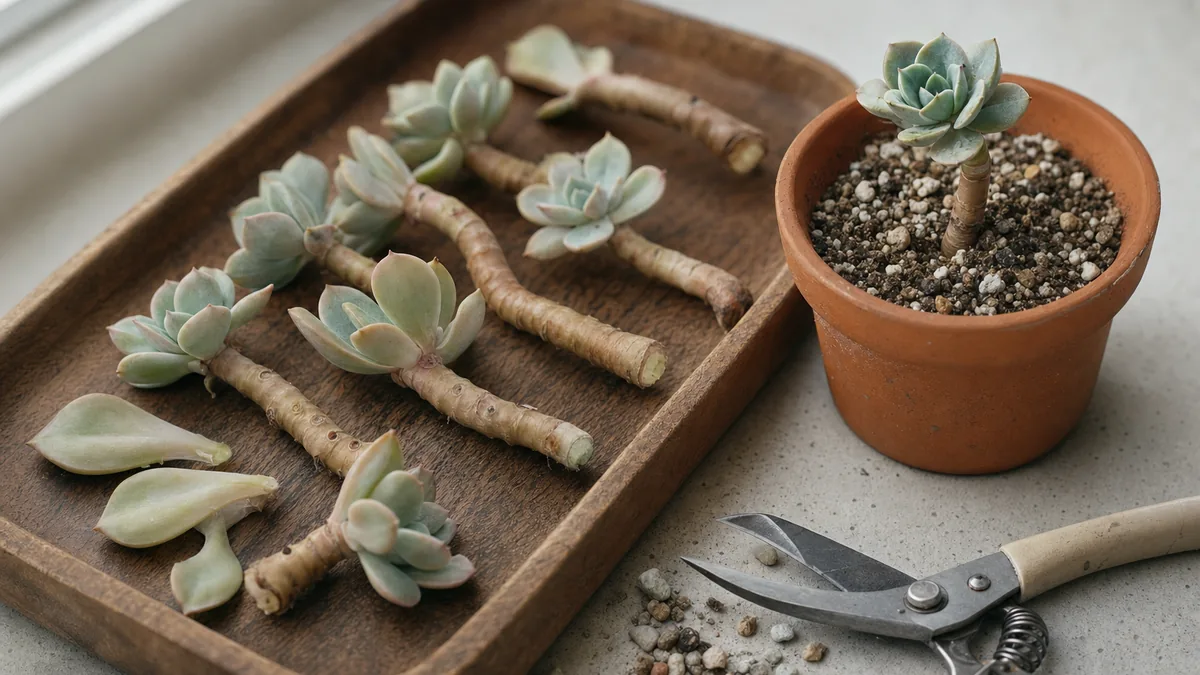
To grow succulents from cuttings, cut a healthy stem about 3 to 6 inches long, strip the lower leaves, and let the cut end dry and callus for several days. Then set it in a fast-draining, gritty mix and water lightly, as our guide to how to water succulents describes. Illinois Extension says rooting typically shows within a few weeks to a month, and West Virginia University Extension says to allow at least a month.
Succulent Propagation Quick Facts
| What | Answer | Source |
|---|---|---|
| Stem cutting length | 3 to 6 inches (guides range from 3 to 4 up to 3 to 6) | Iowa State, Illinois, West Virginia |
| Callus time | Several days; 4 to 7 days where a number is given | Iowa State, Illinois, West Virginia |
| Rooting mix | Equal parts potting mix and perlite or coarse sand | Illinois, West Virginia, Minnesota |
| Leaf cuttings | Whole leaf, base intact, laid on slightly damp mix | Iowa State, RHS |
| Offsets and pups | Pull or cut off with roots; callus first if rootless | Iowa State, West Virginia, Thrive |
| Temperature | About 20°C (68°F) for leaf cuttings | RHS |
| Time to root | A few weeks to a month or more | Illinois, West Virginia, Iowa State |
| Water | Slightly moist, never soggy | RHS, Minnesota, Illinois |
How Do Succulents Reproduce, and Which Method Should You Use?
Succulents reproduce by seed and by vegetative routes, and the vegetative routes are what home gardeners use. Iowa State University Extension describes three main routes for home propagation: stem cuttings, leaf cuttings, and offsets or division. University of Minnesota Extension adds that many succulents can grow new plants from broken-off leaves, which is why a knocked-off leaf on the windowsill sometimes turns into a baby plant. Once your cuttings are established, see our succulent watering schedule by season, light and pot for how long to leave between waterings.
Which route you choose depends on the plant. Iowa State lists the genera that suit each method, and the table below turns that list into a quick chooser.
| Method | Works well for | What to know |
|---|---|---|
| Stem cuttings | Aeonium, Echeveria, Sedum, Crassula, Kalanchoe, Graptopetalum | Gives a full plant sooner than a leaf does (Illinois) |
| Leaf cuttings | Graptopetalum, Pachyphytum, Sedum, Crassula, Kalanchoe | Slower; a leaf takes longer to make a full-size plant (Illinois) |
| Offsets and pups | Sempervivum, Aloe, Haworthia, Gasteria, Agave | Pull or cut off so the pup keeps its roots (Iowa State) |
| Beheading | Leggy Aeonium and Echeveria | Root the top rosette; the stump sprouts new rosettes (Iowa State) |
If you are not sure, match the plant to its look: a branching stem suggests stem cuttings, a rosette with small plants at its base suggests pups, and plump leaves that detach easily suggest leaf cuttings.
When to Take Succulent Cuttings
Spring into early summer is the usual advice. The Royal Horticultural Society says to take succulent leaf cuttings in spring to early summer for the best results, though some plants can be propagated at other times of year. Penn State Extension, writing about houseplant cuttings in general, calls early spring the ideal time while noting that most houseplants can be propagated year-round.
Warmth matters more than the calendar. The University of Arizona Cooperative Extension says cactus cuttings taken when nighttime temperatures are 60°F and above root successfully, and that cuttings taken in cooler months may root slowly or not at all. For cacti, its guide names August to October as the usual propagation window. Indoors you can control temperature, but the principle holds: a cool room slows everything down.
How to Take a Cutting From a Succulent
These steps cover how to cut succulent plants for propagation, whether you call the pieces cuttings, clippings or trimmings.
- Pick a healthy growing tip. Illinois Extension says to take the cutting from an active growing point on the mother plant. Skip stems that are soft, shriveled or spotted.
- Cut with a clean, sharp blade. Iowa State recommends clean, sharp pruners or scissors. Gloves or needle-nose pliers help with spiny cacti, as Illinois notes.
- Cut a piece 3 to 6 inches long. Iowa State says 3 to 6 inches, while Illinois and West Virginia University Extension both say 3 to 4 inches. Shorter pieces are fine for small plants.
- Strip the lower leaves. Iowa State says to remove the leaves from the lower half of the stem, and Illinois says to keep a few at the top. Illinois adds that at least one or two sets of nodes, where leaves were removed, should end up in the growing medium, since new roots emerge there.
Rooting hormone is optional. Iowa State says most succulents root readily without it, and Illinois calls it optional for most cacti and succulents. If you do use it, Penn State Extension warns that only a little is needed and that too much slows root development.
Beheading a leggy plant
A stretched, leggy Echeveria or Aeonium can be reset. Too little light is a common cause of stretching, as it is with leggy seedlings. Iowa State describes removing the whole rosette with an inch or two of stem attached, then callusing and rooting it like any stem cutting. The remaining stalk will form side rosettes, which Iowa State says can be cut and rooted after several months.
How Long to Let Succulent Cuttings Callus
Callusing means letting the fresh cut dry and seal over before it touches soil. It is the step most often skipped, and it is what stops cuttings from rotting. The University of Arizona says all cuttings should be air dried until the soft inner tissue calluses, and that if this step is skipped the cutting may rot.
The guides do not give one number, because the right time depends on the size of the cut and the plant.
| Source | Callus time | For what |
|---|---|---|
| Iowa State Extension | Several days | Stem cuttings |
| Illinois Extension | 4 to 7 days | Stem and leaf cuttings |
| West Virginia University Extension | At least 4 to 7 days | Stem and leaf cuttings |
| Royal Horticultural Society | A day or two | Leaf cuttings |
| Thrive (the gardening charity) | 1 to 7 days | Offsets |
| University of Arizona Extension | Up to several months | Very large cactus cuttings |
A practical reading of that spread: thin leaves and small offsets heal in a day or two, ordinary stem cuttings want about 4 to 7 days, and thick, heavy cuttings take longer. Lay the cuttings on a dry tray out of direct sun, or, as Iowa State suggests, stand them in an empty cup or pot. The cut end should look dry and slightly shrunken, not wet, before you plant.
Best Soil for Succulent Cuttings
Every source asks for the same thing: a mix that drains fast. Illinois Extension says these plants do not tolerate constantly wet media. The exact recipe varies a little.
- Illinois Extension: 1 part potting mix to 1 part perlite, or 1 part coarse sand to 1 part potting mix, or a ready-made cactus and succulent mix.
- West Virginia University Extension: 1 part potting mix to 1 part perlite, or 3 parts potting mix, 2 parts coarse sand and 1 part perlite.
- University of Minnesota Extension: a 1:1 mix of potting soil and coarse sand, tested by squeezing a moist handful, which should fall apart on release.
- Royal Horticultural Society: 2 parts cactus compost to 1 part fine grit, with a fine grit topping.
- Iowa State Extension: cactus potting soil or plain perlite for stem cuttings.
Penn State Extension says compost and garden soil are not recommended for rooting cuttings, and Minnesota says both the pot and the medium should be sterile. Use a pot with drainage holes. West Virginia notes that without them, excess moisture can soak back into the soil even over a gravel layer.
Here is a quick batch for a tray of cuttings. Using the RHS ratio of 2 parts cactus compost to 1 part grit, a 6-quart batch is 4 quarts of compost plus 2 quarts of grit. Using the 1:1 recipes, it is 3 quarts of each.
How to Plant Succulent Cuttings
Once the cut end is dry, planting is quick. The goal is to bury the bare stem and node without burying leaves.
- Fill a small pot with your gritty mix. Illinois suggests small plastic inserts or individual containers so cuttings do not sit too wet. The RHS fills pots three-quarters full and tops them with grit.
- Moisten the mix lightly. West Virginia says to insert the callused end into slightly moist succulent medium, not too deep. Minnesota uses slightly moist, sterile sand for stem cuttings.
- Insert the callused end. Bury at least one or two leaf nodes (Illinois). Penn State says stem cuttings can stand vertically with at least one node buried, or lie horizontally with half the stem in the media.
- Firm the mix gently. The cutting should stand without leaning on its leaves. A little grit around the base helps.
- Place in bright light, out of harsh sun. The RHS advises a well-lit spot that is protected from direct sunshine.
- Wait before heavy watering. Keep the mix just slightly moist and let roots form (details below).
Several cuttings can share a pot or tray if the leaves do not touch. The RHS says to air cuttings about twice a week and remove decaying leaves promptly.
Can you root succulent cuttings in water?
Mostly no. Iowa State says most succulents do not root well in a glass of water. Stick with dry callusing and a gritty mix.
How to Propagate Succulents From Leaves
Leaf propagation costs nothing and gives you many tries from one plant. Illinois Extension says each leaf can yield many cuttings, but each leaf takes longer to make a full-size plant than a stem cutting does.
- Remove a whole leaf. Iowa State says to take the entire leaf, including the base tissue where it joins the stem, and that partial leaves will not root. Twist gently side to side until it comes off clean.
- Let it callus. The RHS says a day or two for succulent leaves. Illinois and West Virginia say 4 to 7 days for leaf and stem cuttings alike.
- Lay it on slightly damp mix. Iowa State says to lay the leaf flat on well-drained medium such as cactus potting soil, with the stem end settled at the surface and not covered. The RHS likewise says to insert the leaf without covering it.
- Keep the surface damp but not wet. Iowa State says a spray bottle works well.
- Wait. Iowa State says roots and tiny rosettes form in several weeks. Illinois reports a small plant forming at the leaf base over one to two months, while the original leaf eventually dies off.
Illinois says the original leaf eventually dies off, so there is no need to pull it away early. Once the new rosette has roots, Illinois says to repot it when the root system holds together, into a container 1 to 2 inches larger.
Snake plant leaf sections
Snake plant (Sansevieria, now Dracaena) is a special case. Iowa State says to cut a 3 to 5 inch section of leaf, let it callus for a day, and set it in well-drained potting mix. Roots and shoots form only on the end that was lower on the plant, so Iowa State suggests cutting the bottom straight across and the top at an angle to keep track. New roots and shoots appear after several weeks.
Propagating Succulents From Offsets and Pups
Offsets, often called pups, are the easiest way to multiply succulents because they are small plants already. Iowa State Extension lists Sempervivum, Agave, Aloe, Lithops, Gasteria, Haworthia and all Cactaceae among the plants that produce them. Pull or cut the pup away so that each piece keeps both leaves and roots, and use clean pruners or scissors where needed. Aloe is a good example, and our aloe vera guide covers its pups in detail.
- Check for roots. West Virginia says to gently tug the offset. If you feel resistance, roots have formed and it can be potted right away. Offsets without roots need to callus first.
- Let a rootless pup dry. Thrive says a callus generally takes 1 to 7 days. It adds that you can leave the offset longer, until it starts rooting, and that it may yellow and wither while new leaves appear at its base.
- Pot it in well-drained mix. Iowa State says cactus potting soil in a pot with a drainage hole, then water lightly. Thrive suggests filling the pot to about 2 to 3 cm (about 1 inch) below the rim and setting the offset in the middle.
- Be patient. Iowa State says offsets establish after a few weeks.
Agave pups need extra care. The University of Arizona says to leave a small portion of the stem that connected the offset to its parent, since cutting too close means roots will not form. Arizona also shows a rooted agave offset after 4 weeks.
Hens and chicks (Sempervivum) are the textbook example. Penn State Extension says to gently pull or cut apart the plantlets and replant them immediately.
Light, Warmth and Water for Rooting Succulents
Light
Cuttings and established succulents want different light. For fresh cuttings, the RHS advises a warm, well-lit position protected from direct sunshine. Iowa State Extension, writing about general houseplant cuttings, gives 4 to 6 hours of bright indirect light for root and shoot growth, and warns that too much light can scorch leaves. Once the plant is rooted and growing, West Virginia says succulents want a bright windowsill with at least six hours of direct daylight. More indoor plant guides are in our Indoor Plants hub.
If your windows are dim, add a lamp. University of Minnesota Extension says to position fixtures 6 to 12 inches above succulents and run them 14 to 16 hours a day. Our comparison of LED vs fluorescent grow lights helps you choose a lamp.
Warmth
The RHS suggests about 20°C (68°F) for succulent leaf cuttings and says growth slows at low temperatures. Penn State Extension gives 75°F to 80°F for general houseplant stem cuttings in a warm location, so a warm room is better than a cold one, but this range is for a wide range of houseplants, not specifically succulents.
Water
The sources agree on one idea, which is that less is safer. The RHS says to keep the compost just slightly moist and warns that cuttings may rot if too wet. Iowa State says to keep the surface of leaf cuttings damp but not wet, and to water offsets lightly. Thrive says to water young offset plants about every couple of weeks. Minnesota says to water sparingly for sand-rooted cuttings and then to let soil dry out completely between waterings once plants are established.
Once a plant is growing well, West Virginia gives a watering rhythm: about once a week in spring and summer, and about once every two to three weeks in winter, soaking until water runs out of the drainage holes and waiting until the soil is completely dry. Minnesota warns that repeated shallow sprinklings often cause distorted growth.
How Long Does It Take to Propagate Succulents?
Expect weeks, not days, and longer for leaves. The sources give these figures.
| Method | Time | Source |
|---|---|---|
| Stem cuttings, general | A few weeks to a month for roots | Illinois Extension |
| Stem and leaf cuttings | At least a month | West Virginia University Extension |
| Leaf cuttings | Several weeks to first roots and rosettes; a small plant over one to two months | Iowa State, Illinois |
| Offsets | A few weeks to establish | Iowa State Extension |
| Cactus cuttings in summer | 4 to 6 weeks for most species; several months for slow ones | University of Arizona Extension |
| Houseplant stem cuttings, general | 3 to 6 weeks | Iowa State Extension |
To check for roots without digging, use the tug test. Illinois says to gently tug the cutting, and that resistance means it has rooted. Repot once the roots hold the mix together, into a container 1 to 2 inches larger (Illinois).
Why Succulent Cuttings Rot, Shrivel or Fail to Root
- Mushy, black base. Almost always rot. The cause named by Arizona is skipping the callus, and by the RHS, too-wet compost. Cut above the soft part, let it callus again and restart in drier mix. For rot that spreads to rooted plants, see our root rot guide.
- Decaying leaves on a leaf cutting. The RHS says to remove decaying leaves promptly so rot does not spread.
- Cutting sits and never roots. Check the temperature. The RHS notes growth slows at low temperatures, and Arizona says cactus cuttings taken in cool months may root slowly or not at all.
- Leaf stays green but nothing grows. Be patient. Illinois reports leaf cuttings left on a shelf for about a month before they showed growth.
- Partial leaf. Iowa State says partial leaves will not root. Try again with a clean, whole leaf.
- Wilting after planting. Our guide on why a plant is wilting covers water stress in general.
Once you have rooted plants, pot them up into a mix that drains well, and move them to the brighter light that established succulents need. For choosing a container, see our guide to plant pot sizes.
Free book · 25 pages, PDF
Propagating Succulents FAQ
How do you propagate succulents from cuttings?
Cut a healthy stem 3 to 6 inches long (Iowa State says 3 to 6, Illinois and West Virginia say 3 to 4), strip the lower leaves, let the end callus for several days, then plant it in a gritty mix with one or two nodes buried. Water lightly and wait a few weeks to a month for roots.
How long should succulent cuttings dry before planting?
Several days. Illinois Extension and West Virginia University Extension both give 4 to 7 days for stem and leaf cuttings. The Royal Horticultural Society says a day or two for leaves, and Thrive says 1 to 7 days for offsets. The cut end should be dry and sealed before it touches soil.
Can you propagate succulents from a single leaf?
Yes, for many types such as Sedum, Crassula, Kalanchoe, Graptopetalum and Pachyphytum, according to Iowa State Extension. Use a whole leaf with its base intact, because partial leaves will not root. Expect several weeks for roots and a small rosette over one to two months (Illinois).
What is the best soil for rooting succulent cuttings?
A fast-draining mix. Illinois and West Virginia give 1 part potting mix to 1 part perlite, Minnesota gives 1 part potting soil to 1 part coarse sand, and the RHS gives 2 parts cactus compost to 1 part fine grit. Penn State says to avoid garden soil and compost.
Do succulent cuttings need sunlight to root?
They need bright light but not harsh sun. The Royal Horticultural Society says to use a well-lit spot protected from direct sunshine, and Iowa State gives 4 to 6 hours of bright indirect light for general houseplant cuttings. Established succulents want at least six hours of direct daylight (West Virginia).
How often should I water succulent cuttings?
Lightly, and only to keep the mix slightly moist. The RHS warns that cuttings rot if too wet, Iowa State says to keep leaf cuttings damp but not wet, and Thrive says to water young offsets about every couple of weeks. Do not soak until the plant has roots.
Can I root a succulent cutting in water?
It is not recommended. Iowa State Extension says most succulents do not root well in a glass of water. Callus the cutting and root it in a dry, gritty mix instead.
Sources & further reading
Methods, callus times, media and rooting times come from Iowa State University Extension on propagating succulents, University of Illinois Extension, West Virginia University Extension and University of Minnesota Extension. Leaf cuttings, temperature and timing come from the Royal Horticultural Society, and offsets from Thrive. Cactus and agave details come from the University of Arizona Cooperative Extension. General houseplant cutting guidance (media, hormones, temperature, hens and chicks) comes from Penn State Extension and the Iowa State houseplant stem cutting guide. For how we source the facts on this site, see our methodology page.
Free book · 25 pages, PDF
The Indoor Plants Repotting Cheat Sheet
Sent