If you’re comparing led vs fluorescent grow lights for seedlings, herbs, or houseplants, the short version is that LED has replaced fluorescent as the default choice for most home growers: it uses less electricity per hour of light and lasts far longer. That doesn’t make fluorescent obsolete, though. It’s still a reasonable, budget-friendly option in a few specific situations, and knowing which one actually fits your setup matters more than defaulting to whichever is trendier.
LED vs. Fluorescent: At a Glance
Here’s how the two compare across the factors that actually affect a home growing setup.
| Factor | LED | Fluorescent |
|---|---|---|
| Upfront cost | Higher per fixture | Lower per fixture |
| Running cost / efficiency | More light per watt; lower electricity cost over time | Less efficient; higher electricity cost for comparable light output |
| Lifespan | Tens of thousands of hours | Several thousand to around 10,000 hours; tubes need periodic replacement |
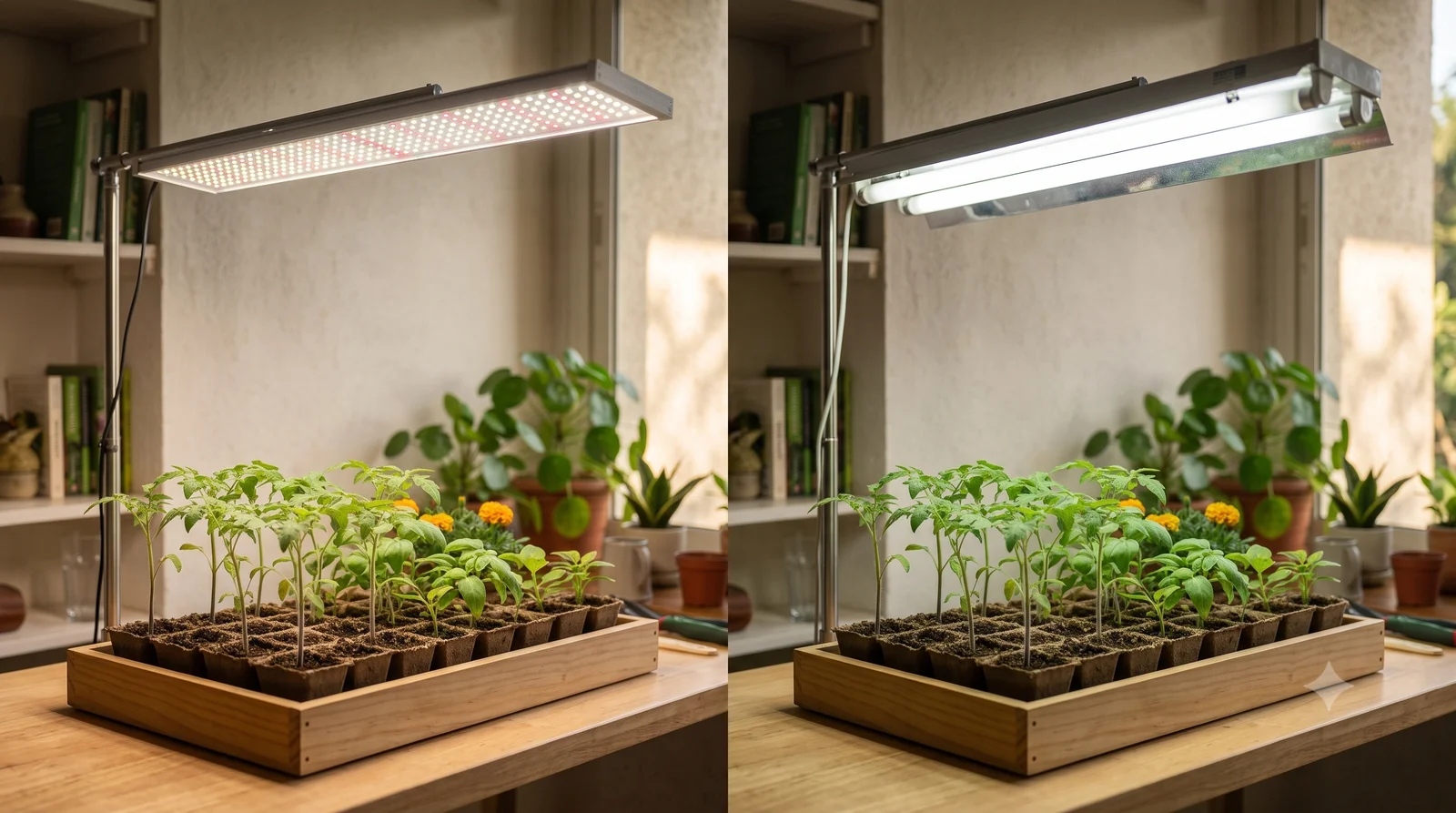
| Heat output | Runs cooler; can be hung closer without leaf stress in most cases | Runs cooler than old incandescent bulbs, but generally warmer than LED |
| Full-spectrum availability | Widely available, easy to find | Available but less common; usually requires pairing tube types |
| Mercury content / disposal | None | Contains a small amount of mercury; requires proper disposal |
Full-Spectrum LED Grow Lights
Most LED grow lights sold today are full-spectrum, meaning they emit light across the range plants use for photosynthesis rather than concentrating in a narrow band. That matters less than the raw spec-sheet claim of “full spectrum” itself, though: what actually determines whether a light does its job is the PPFD (photosynthetic photon flux density) it delivers at your plant’s canopy, and the DLI (daily light integral) that works out to over a full photoperiod. A full-spectrum LED with weak output at the correct distance will underperform a narrower-spectrum fixture placed and run correctly, which is why full spectrum led grow lights are worth choosing on PPFD and DLI specs, not the spectrum claim alone.
If you already have a PPFD reading from a light meter, our Grow Light & DLI Calculator converts it to DLI instantly, and also handles wattage sizing for your growing area and recommended hanging distance by light type and growth stage, all three questions this article touches on, worked out for your specific setup.
LED Grow Light vs. a Regular Shop Light
A dedicated LED grow light and a standard LED shop light aren’t the same thing, even though both are LED. The difference is spectrum, not just brand markup. Shop lights are built and tuned to look bright and neutral to the human eye: a high lumen rating, weighted toward the green-yellow wavelengths our eyes are most sensitive to. Grow lights are tuned toward the red and blue wavelengths plants actually use for photosynthesis, which a shop light typically under-delivers even at a comparable lumen rating.
In practice: a shop light can keep a low-light houseplant alive in a pinch, especially placed close and run long hours, but it’s a compromise, not an equivalent substitute. For anything you’re relying on for real growth (seedlings, herbs, fruiting vegetables), a dedicated full-spectrum grow light rated in PPFD or DLI, not just lumens, is the more dependable choice. That spectrum gap is really the whole led grow light vs shop light question in miniature.
Power Consumption and Running Cost
LED grow lights convert a larger share of the electricity they draw into usable light, rather than losing it as heat, which is why an LED fixture typically delivers comparable plant-usable light to a fluorescent setup while pulling meaningfully less power. Over months of daily use (most seedlings and houseplants run their lights 12–16 hours a day), that efficiency gap adds up on the electricity bill, even though the LED fixture usually costs more upfront.
Framed simply, led vs fluorescent power consumption comes down to how much of that draw converts to usable light versus heat. Wattage needs also vary by what you’re growing, not just light type: roughly 15–20 actual watts per square foot for seedlings and low-light houseplants, 25–35 for leafy greens and herbs, and 40–50 for fruiting vegetables. Enter your growing area and light need into the Grow Light Calculator’s Coverage & Wattage mode for a specific wattage range and an estimated electricity cost, so you’re comparing real numbers instead of guessing.
What About Mercury and Disposal?
Fluorescent tubes contain a small amount of mercury, which means they can’t just go in the regular trash when they burn out or break: most areas require dropping them off at a hazardous waste or electronics recycling site, and many hardware stores accept old tubes for free recycling. It’s a minor extra step, but it’s a real one, and worth factoring in if you’re weighing fluorescent against LED for a long-term setup. LED fixtures contain no mercury and don’t carry that disposal requirement.
Lifespan and Daily Cycling
LED grow lights are typically rated for tens of thousands of hours of use, often outlasting the rest of the fixture itself. Fluorescent tubes have a shorter practical life: usually a few thousand hours up to around 10,000 depending on the tube type, and output gradually dims well before the tube fully fails, so a tube that still lights up may already be under-delivering usable light for growing. Fluorescent tubes are also less tolerant of frequent on/off cycling than LED; each start-up shortens tube life somewhat, so a setup on a timer that cycles many times a day will wear tubes faster than one left running for a single long daily stretch.
Best Use Case: Starting Seeds Indoors
Fluorescent still holds up well for one specific job: starting seeds. Seedlings need bright, close, even light for a relatively short window (a few weeks before transplant or hardening off), and fluorescent tubes run cool enough to sit close to freshly germinated seedlings without the scorch risk a hot light source would carry, while costing less upfront than an equivalent LED setup, a reasonable tradeoff for a short-term, low-stakes use case. LED works just as well for seed starting and is the better long-term investment if you’ll keep growing beyond the seedling stage.
For photoperiod, wattage, and timing guidance specific to seed starting, see our Seed Starting Calculator. It works out a planting and hardening-off schedule based on your last frost date, independent of which light type you choose. If you’re starting tomatoes specifically, our How to Grow Tomatoes from Seed guide covers the full process, including exactly when to move seedlings off a heat mat and under a light like this one.
Free book · 25 pages, PDF
LED vs. Fluorescent Grow Lights FAQ
Is it worth replacing fluorescent tubes with LED grow lights?
Usually, yes, for a setup you'll keep using long-term: LED's lower running cost and much longer lifespan tend to offset the higher upfront price within a couple of years of regular use. If you're only starting seeds for a few weeks a year and already own working fluorescent tubes, replacing them isn't urgent.
Can I use regular LED lights, or do I need actual grow lights?
A dedicated grow light is the more reliable choice. Regular LED lights (like shop lights) are tuned for lumens and human visibility rather than the red and blue wavelengths plants use for photosynthesis, so they typically under-deliver usable light even at a comparable brightness rating.
How much energy does an LED grow light use compared to fluorescent?
LED fixtures generally use less electricity than fluorescent for a comparable amount of plant-usable light, since more of the power draw converts to usable light rather than heat. The exact gap depends on the specific fixtures being compared, but it's consistent enough to matter on an electricity bill over months of daily use.
Does a normal ceiling light give enough light for houseplants?
Rarely. Ceiling lights are typically too far from the plant and too dim in plant-usable wavelengths (PPFD) to substitute for a dedicated grow light, even in a bright-feeling room. A low-light houseplant near a window may get by on ambient light, but most houseplants and all seedlings do better under a light positioned close and rated for growing.
Sources & further reading
For seed-starting lighting specifics, see Kansas State University Extension’s guide to lighting options for starting seeds (LEDs vs. fluorescent). For more on how we source and review the facts behind every calculator and guide on this site, see our methodology page. And for the complete picture on lighting alongside pot sizing and other houseplant basics, see our complete guide to indoor plants.