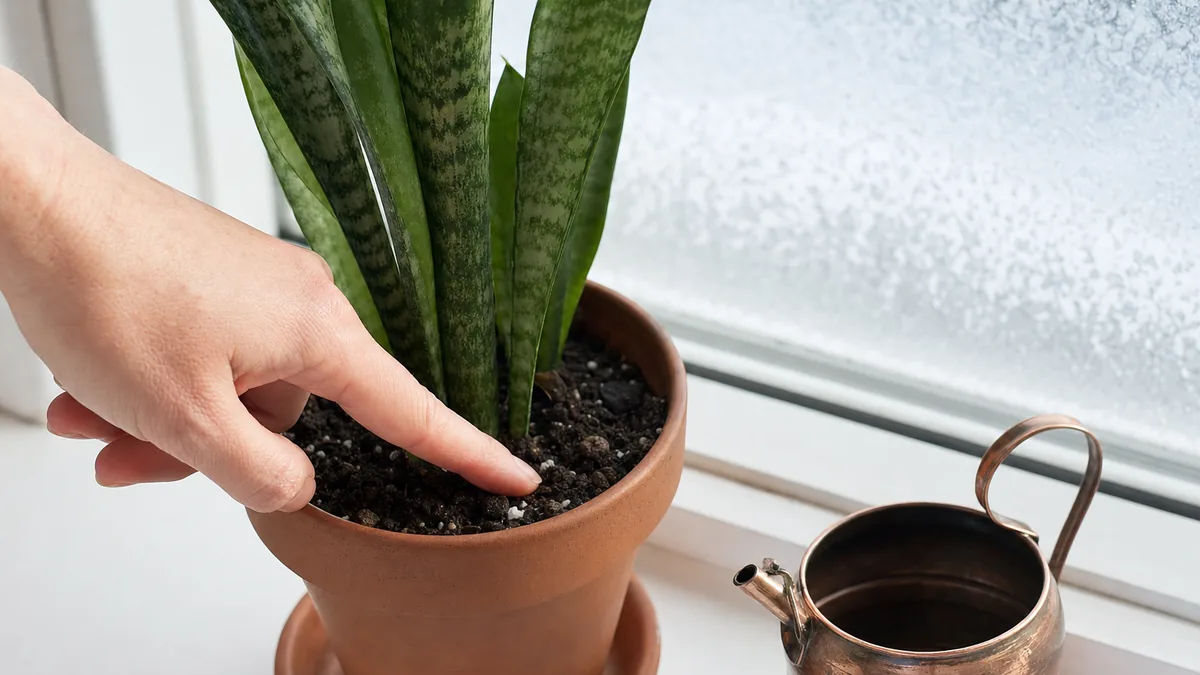
How often to water plants in winter depends on the soil, not the calendar, because growth slows and pots dry out more slowly. Iowa State Extension says to water houseplants when the soil is dry to the touch about one inch down, and no extension source gives one schedule for every plant. Our indoor plants hub has the rest of the houseplant guides.
Winter Watering Quick Reference
The rows are ranges from the sources named, and where no source gives a number the rule is to let the soil dry first. Orchids follow a rhythm of their own, as our guide to watering orchids shows.
| Plant or situation | How often | What to do | Source |
|---|---|---|---|
| Most houseplants | No fixed days; water when dry 1 to 2 inches down | Water until it drains, then empty the saucer | Iowa State, NC State, WSU |
| Desert cacti and succulents | No more than once a month; Nebraska says none from mid to late November to March | Water lightly only if the plant shrivels | Missouri Botanical Garden, UC, Nebraska |
| Snake plant | About once a month, sparingly | Let the soil dry completely first | UConn, Illinois |
| ZZ plant | No number given; let the soil dry between waterings | Follow the soil-dry rule and lean dry | UF/IFAS, UConn |
| Tropical foliage plants | No number given; soil should nearly dry out between waterings | Check 2 inches down, raise humidity | NC State, UConn |
| Herbs indoors | When dry to the touch and before wilting | Give light, or add a grow light | Iowa State |
| Poinsettia | Thoroughly when the soil feels dry to the touch | Remove foil, empty the saucer | Colorado State, Delaware |
| Potted plants outdoors | Check 2 inches down before a freeze; pots sunk in the garden monthly | Water only when the mix is not frozen | Ask Extension, Colorado State PlantTalk |
| Evergreens, shrubs and trees in a dry winter | About every 4 weeks (Kansas State); once or twice a month (Colorado State) | Water above 40°F, never on frozen ground | Kansas State, Colorado State, Illinois |
Do You Water Plants in the Winter? Why They Need Less
Yes, but less often, and only when the soil says so. University of Vermont Extension explains that shorter days trigger a resting period called quiescence, when growth slows, and that overwatering is a common winter mistake. North Dakota State University Extension adds that reduced light and cooler temperatures slow growth in winter. A plant that is barely growing uses little water, so the mix stays wet for longer. Plants that spent summer outdoors face the biggest swing, and our guide on when to bring plants inside for winter covers the move.
Light, temperature and growth all shift at once. NC State Extension says most houseplants prefer daytime temperatures of 65 to 75°F with about a 10° drop at night, and that winter watering can be significantly reduced, with soil nearly drying out between waterings. Iowa State Extension says the right interval depends on the species, the potting mix, the temperature, the light and the humidity, so no one number fits every home. A plant by a bright window that keeps growing needs water sooner than the same plant in a dim corner.
How Often Should You Water Indoor Plants in Winter?
Use a soil test, not a day count. The extension pages agree on the method and differ a little on the depth. Iowa State Extension says to water when the soil is dry to the touch about one inch down. UW Extension in Chippewa County says to water when the top inch or so is dry and not on a fixed schedule. NC State Extension says to feel the top 2 inches, and Washington State University Extension says 1 to 2 inches. So the working range is the top 1 to 2 inches, and the same answer holds for house plants of every kind. What changes is how long the soil takes to get there, which is longer than in summer and longer again in a cool room.
When you do water, Iowa State says to keep adding water until it flows out of the bottom of the pot, then discard the excess. UW Extension in Chippewa County says to give the pot 15 to 30 minutes to drain, then empty the saucer.
Pots and drainage matter more in winter
An oversized pot holds a large block of damp mix around a plant that is not growing. Colorado State Extension notes, in its poinsettia advice, that clay pots need watering more often and plastic pots are more prone to overwatering. A plant that has sat wet for weeks may be in trouble, and our guide to root rot shows healthy and rotten roots, while plant pot sizes explained helps you match pot to plant.
How to check soil moisture without guessing
- Finger test. Push a finger 1 to 2 inches in. University of Maryland Extension and University of Illinois Extension both give about 2 inches.
- Skewer or chopstick. NC State says to push a wooden skewer into the pot, and if little soil sticks to it when pulled out, the plant is dry enough to water. University of Vermont Extension uses a chopstick the same way.
- Pot weight. University of Maryland Extension says a pot with dry mix weighs much less than one holding plenty of water, so lift it to compare.
- Moisture meter. Optional. University of Vermont Extension suggests a meter or a chopstick, while University of Illinois Extension says a probe can help but may not always be reliable.
How Often to Water Snake Plant and ZZ Plant in Winter?
Both tolerate drought and fail from too much water, so winter is when they most need a light hand.
How often to water snake plant in winter
About once a month, and sparingly. A University of Connecticut handout on Sansevieria says to water roughly once a month in winter, and calls overwatering the quickest way to kill any houseplant. University of Illinois Extension says to let the soil dry completely between waterings and, in winter, to water just enough to keep the foliage from shriveling. A UF/IFAS Extension sheet says to significantly reduce watering from fall to late winter. Use the monthly figure as a first guess and check the soil before each drink.
How often to water ZZ plant in winter
No extension page we found gives a number of days for a ZZ plant, so follow the soil-dry rule. UF/IFAS Extension says to let the soil become dry between waterings, not to let the plant sit in water, and that it is very drought tolerant. UConn Extension says to err on the dry side when in doubt because fleshy rhizomes store water, and lists yellow leaves and rotting rhizomes as the signs of overwatering.
UF/IFAS also says growth is reduced and injury can occur below 50°F, so a ZZ plant on a chilly sill is the case to wait longest. For leaves turning yellow on either plant, see why plant leaves turn yellow.
Succulents, Tropical Foliage, Herbs and Poinsettia in Winter
Succulents and cacti
This group needs the least, and the sources span a range. Missouri Botanical Garden says to water cacti and succulents no more than once per month in winter, because excess water can cause fungal root rot. A University of California Master Gardener article says about once a month for indoor cacti. Nebraska Extension goes furthest: stop watering from mid to late November until March, with a light drink only if the plants begin to shrivel, and keep nights cool at 40 to 50°F. Use the longer gap in a cool room. Our succulent watering schedule compares the published intervals. Missouri Botanical Garden notes one exception: jungle cacti such as Christmas cactus want evenly moist soil all year, especially during flowering.
Tropical foliage plants
For philodendron, pothos, dracaena and similar leafy plants, no extension page gives a day count, so use the soil-dry rule. NC State says soil should nearly dry out between waterings. UConn Extension adds that tropical plants need extra humidity in winter and that peace lily prefers moist soil except in winter, a reminder to read the label. Crisp tips are covered in why leaf tips turn brown.
Herbs indoors
Iowa State Extension says to water herbs when the potting soil is dry to the touch and before the plant begins to wilt, and that herbs ideally get four to six hours of direct sun a day, with grow lights on a timer for 12 to 16 hours when sun is short. Rosemary fails most often indoors, and our guide to overwintering rosemary shows where sources disagree on how dry to go.
Poinsettia
Colorado State Extension says to water thoroughly whenever the soil feels dry to the touch, until water runs from the drainage holes, and to remove or punch through any foil. University of Delaware Extension says to empty the saucer if water is still there after 3 to 4 hours, and warns that cool temperatures with moist soil encourage root rot. See how often to water poinsettia for the full routine.
Signs of Overwatering vs Underwatering in Winter
The two look alike at first, since both can cause drooping, so check the pot. WSU Extension lists the signs of too little water as a light pot, brown leaf tips or a collapsed plant, and the signs of too much as a heavy pot, a drooping plant and lower leaves turning yellow or brown. University of Maryland Extension says a plant that is too wet drops leaves or turns yellow, and University of Illinois Extension says wilting often means a plant needs water but can also be a symptom of overwatering. Winter errs toward too wet, so test the soil before you assume thirst. Our guide to why a plant is wilting walks through the check. WSU also warns that soil dried out completely can become hydrophobic and repel water, so water thoroughly and break up compacted soil.
Humidity, Heating Vents and Water Temperature
Heating dries the air faster than it dries the pot. NC State Extension says most houseplants prefer 40 to 50 percent humidity and that indoor air can fall below 20 percent in winter, and NDSU Extension puts winter homes at about 10 to 20 percent. Both suggest a humidifier, grouping plants or pebble trays with the pot held above the water. NC State and UW Extension in Chippewa County say misting gives little benefit.
UW Extension in Chippewa County says to keep plants away from heat vents, fireplaces and radiators, and from windows or doors where cold drafts reach them, with daytime temperatures of 65 to 70°F and nights of 60 to 65°F for foliage plants. A plant in a vent stream dries faster than its neighbors, so check it more often.
University of Illinois Extension says to use room-temperature water, not cold, and UConn Extension says cold water can shock some plants’ roots. Illinois adds that tap water should sit at least 24 hours so chlorine and fluoride can dissipate. No extension page we found gives an exact degree figure, so lukewarm to room temperature is the safe description.
If you keep many pots, the Houseplant Care App gives each plant its own watering, feeding and repotting rhythm.
How Often to Water Outdoor Plants in Winter?
Rarely, and only when the ground is not frozen. Colorado State Extension says to water only when air and soil temperatures are above 40°F with no snow cover, at midday, and about once or twice a month during extended dry periods without snow. Kansas State Extension says that in dry spells with little rain or snow, plan to water roughly every four weeks, deep enough to reach about 12 inches, when temperatures are above freezing. The thresholds differ (40°F against freezing), so the cautious reading is the warmer one.
Evergreens, trees and shrubs in a dry winter
University of Illinois Extension says evergreens do not go dormant, so they keep losing water through their needles, and to check soil about once a week by digging a hole 4 to 6 inches deep under the drip line. Colorado State gives amounts for dry winters from October through March: 5 gallons monthly for an established shrub under 3 feet, 5 gallons twice a month for a newly planted shrub, and 18 gallons monthly for an established shrub over 6 feet.
Fall-planted trees and shrubs need more. Illinois says to water newly planted ones weekly during dry periods because their roots are limited, and Kansas State says new plantings are especially vulnerable to winter drought. Our guide on planting trees in winter covers watering a tree planted after leaf fall, and the winterize your garden checklist fits watering in with the other fall jobs.
Do not water frozen ground
Illinois Extension says to stop supplemental watering after the ground freezes, because trees cannot absorb water through frozen soil. An Ask Extension answer written for Maryland agrees: frozen soil will not absorb water readily, if at all. Kansas State adds that hoses should be disconnected after watering when freezing is expected.
How often to water outdoor potted plants in winter
Potted plants dry faster than plants in the ground. An Ask Extension expert says to check the soil about 2 inches deep and water only once it is somewhat dry, to check before a predicted freeze because a frozen pot makes moisture unavailable, and to set pots on feet 1 to 2 inches off the ground so drainage water does not freeze in the holes. Penn State Extension says to water well before the soil freezes, since dry soil freezes faster than moist soil. Colorado State’s PlantTalk says to check pots sunk in the garden monthly and pots clustered under the eaves every two weeks. Protection for the pot itself is in how to protect plants in winter, and your zone decides which pots can stay out.
A Five-Step Winter Watering Check
- Look at the plant, not the date. Start with its row in the table above, since succulents and snake plants wait weeks.
- Test the soil. Push a finger or skewer 1 to 2 inches in (Iowa State, NC State, WSU) and lift the pot to judge its weight.
- Water only if it is dry. Use room-temperature water (Illinois) and add it until it runs from the drainage holes (Iowa State).
- Drain and empty the saucer. UW Extension in Chippewa County says to allow 15 to 30 minutes.
- Check again in a few days. Note how long the soil took to dry and use that gap until the light changes.
Outdoors, confirm the soil is not frozen and the temperature is above 40°F, then water at midday.
Free book · 25 pages, PDF
Watering Plants in Winter FAQ
Do you water plants in the winter?
Yes, but less often. University of Vermont Extension says shorter days trigger a resting period when growth slows, so plants use less water. Iowa State Extension says to water houseplants only when the soil is dry to the touch about one inch down.
How often should you water indoor plants in winter?
When the top 1 to 2 inches of soil are dry, not on a fixed day. Iowa State Extension says one inch, NC State says the top 2 inches, and WSU says 1 to 2 inches. Most plants will need water less often than in summer.
How often to water snake plant in winter?
About once a month, sparingly. A University of Connecticut handout on Sansevieria gives a roughly monthly winter figure, and University of Illinois Extension says to let the soil dry completely and water just enough to keep the leaves from shriveling.
How often to water ZZ plant in winter?
No extension page gives a number of days, so water only after the soil has dried. UF/IFAS Extension says to let the soil become dry between waterings, and UConn Extension says to err on the dry side when in doubt because the rhizomes store water.
How often to water outdoor plants in winter?
Roughly once or twice a month in a dry spell, and only when the ground is not frozen. Colorado State Extension says to water when air and soil are above 40°F with no snow cover, and Kansas State Extension says roughly every four weeks in a dry winter.
How often to water outdoor potted plants in winter?
Check the soil 2 inches down and water only when it is somewhat dry, per an Ask Extension expert. Colorado State PlantTalk says to check pots sunk in the garden monthly and pots under the eaves every two weeks, and Penn State says to water well before the soil freezes.
Sources & further reading
Indoor plants: Iowa State Extension on winter watering, NC State Extension, UW Extension, Chippewa County, University of Vermont Extension, NDSU Extension, University of Maryland Extension, Illinois Extension on watering, WSU Extension and UConn on growing houseplants.
By plant: UConn on Sansevieria, Illinois Extension on snake plant, UF/IFAS Santa Rosa County, UF/IFAS on ZZ plant, UConn on ZZ plant, Missouri Botanical Garden, Nebraska Extension on cacti, UC Master Gardeners, Iowa State on herbs, Colorado State on poinsettias and University of Delaware.
Outdoors: Colorado State Extension on fall and winter watering, Illinois Extension on trees and shrubs, Kansas State, Douglas County, Ask Extension on winter shrub watering, Ask Extension on potted plants, Colorado State PlantTalk and Penn State Extension.
Free book · 25 pages, PDF
The Indoor Plants Repotting Cheat Sheet
Sent