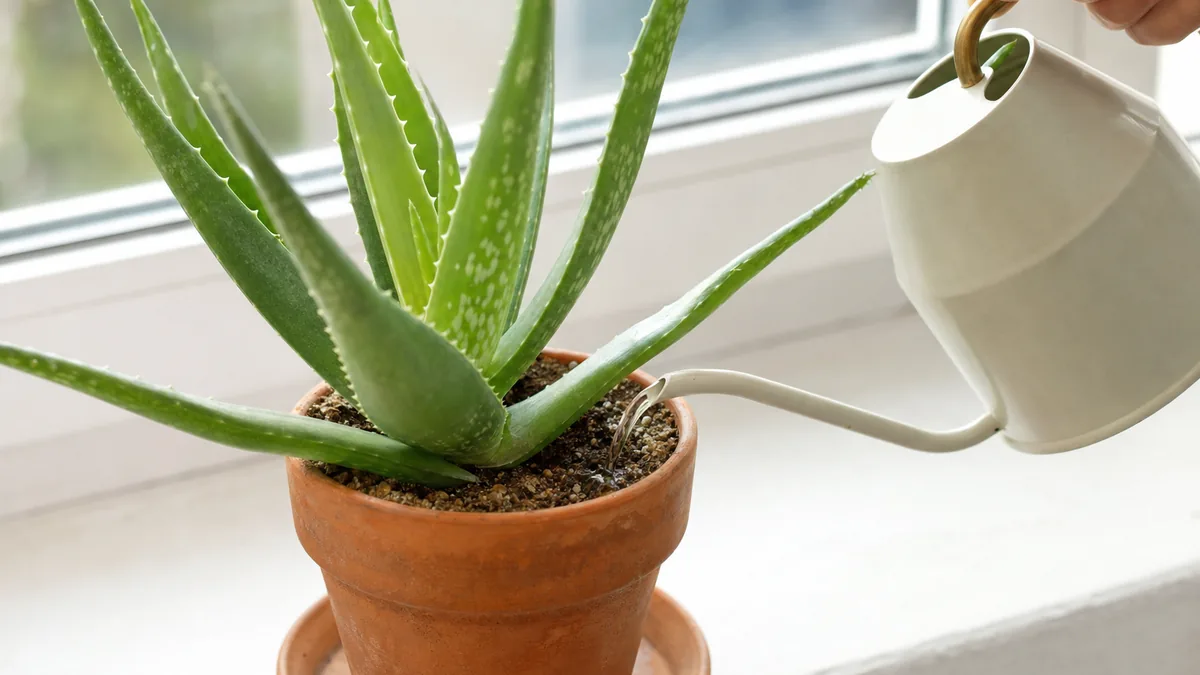
The answer to how often to water aloe vera is: only after the soil has dried. NC State Extension says to let it dry completely between waterings, while UF/IFAS says water when the top inch is dry. For succulents in general, West Virginia University Extension puts that at roughly once a week in spring and summer and every two to three weeks in winter. Soak the pot until water drains out, then wait. Our guide to how to water succulents covers the method in more depth.
How Often to Water Aloe Vera: Quick Facts
| Question | Short answer | Source |
|---|---|---|
| When to water | When the top inch is dry (UF/IFAS) or when the soil is completely dry (NC State, South Dakota State) | UF/IFAS, NC State, SDSU |
| Spring and summer | Typically about once a week for succulents in containers | West Virginia University |
| Winter | Every two to three weeks, just enough to stop leaves wilting. Or “barely moist” | West Virginia University, Penn State |
| How much | No set volume. Soak until water runs out of the drainage holes | West Virginia University, Montana State |
| Pot | Drainage holes, clay is best, and never leave it standing in water | NC State, UF/IFAS, UNH |
| Biggest risk | Overwatering and root rot | UNH, NC State, SDSU |
How Often to Water an Aloe Plant: What Extension Sources Say
There is no single number, and the sources that give one are describing different seasons, rooms and pots. What they share is the rule: let the soil dry, then water thoroughly. NC State Extension says to allow the soil to completely dry between waterings. South Dakota State University Extension says regular, thorough watering is best, making sure the soil dries out completely before watering again. UF/IFAS Gardening Solutions says to water only when the top inch of soil is dry to the touch, and then to water well. Missouri Botanical Garden says to water very moderately in spring, summer and fall.
They differ on how dry is dry. Penn State Extension says to water thoroughly when the soil surface is dry during the growing season, and adds that it is best to err on the side of underwatering. University of Maryland Extension suggests feeling the soil about an inch deep (or more, depending on pot size) and watering only when it is pretty dry to the touch at that depth. A finger pushed into the mix is the simplest test.
| Source | Growing season | Winter |
|---|---|---|
| West Virginia University (succulents in containers) | Typically once a week, only once the soil is completely dry | Typically every two to three weeks, just to prevent wilting |
| UF/IFAS (aloe vera) | When the top inch is dry | Not stated |
| NC State (aloe vera) | When the soil is completely dry | Water less frequently |
| Penn State (aloe) | Early spring to early fall: when the soil surface is dry | Fall through winter: soil barely moist, leaves not shriveling |
| Missouri Botanical Garden (aloe vera) | Very moderately in spring, summer and fall | Reduce to the minimum |
| South Dakota State (aloe vera) | When the soil has dried out completely | Reduce watering, since the plant goes dormant |
Note that the weekly and every-two-to-three-weeks figures come from West Virginia University’s page on succulents as a group, which says recommendations vary by variety. The aloe-specific pages give the rule but no interval in days, so we do not invent one. Treat about a week as the day you check in the growing season, and the soil as the final word. Our aloe vera growing guide covers planting, light and pups.
How to Water an Aloe Vera Plant: The Soak and Dry Method
The method that every source above describes is soak, drain, then wait. West Virginia University Extension says proper watering in containers is achieved by soaking the soil until water is running out of the drainage holes. Montana State University Extension gives the same target and warns that light sprinkles do not supply enough water. West Virginia adds that watering small amounts frequently can cause distorted, poor growth.
- Test the soil. Push a finger in an inch or more. UF/IFAS waits for the top inch to be dry, while NC State and South Dakota State wait for the whole pot to be dry. If it is still damp, skip the day.
- Water slowly at the soil. Pour around the edge of the pot until the mix is wet all the way through. University of Maryland Extension says each watering needs to be thorough so all of the potting mix is well moistened.
- Let it drain. Extra water should drip freely out of the bottom holes, according to Maryland Extension.
- Empty the saucer. Maryland says to empty drained water from the saucer promptly, because a pot sitting in water can kill roots. UF/IFAS says never to let the plant sit in water, and the UNH Extension says never to allow it to sit in a saucer of standing water.
- Wait for the soil to dry again. Then repeat.
How much water does an aloe plant need?
No extension source we found gives a volume, such as cups per pot size, and that makes sense: a 4-inch pot and a 12-inch pot need different amounts. The standard is the same for both: the whole root zone gets wet and the excess runs out. If you are using a pot with no drainage hole, see the pot section below, because the sources do not agree on workarounds.
How Often to Water Aloe Vera Indoors
Indoors, how fast the pot dries depends on light, warmth and airflow, so the same plant can need water on different days in different rooms. NC State Extension lists full sun (6 or more hours of direct sunlight a day) or partial shade (2 to 6 hours). The University of New Hampshire Extension calls a south-facing windowsill perfect, with an unobstructed east or west window also workable. South Dakota State says aloe wants bright, indirect light and warns that direct sun can burn its tender skin, so the sources do not fully agree. Whichever you choose, change light gradually: UF/IFAS warns that a plant can sunburn when moved from low light to bright light too quickly.
A brighter, warmer spot dries the soil faster, and a dim, cool corner slows everything down. Penn State Extension says grow lights are a good option without enough natural light, and to rotate the container periodically so all sides get light. Under a lamp, expect to check the soil sooner. Our comparison of LED vs fluorescent grow lights helps with the choice.
Temperature matters for indoor watering too. South Dakota State says temperatures between 55 and 85°F closely resemble the plant’s natural environment, and UNH Extension says aloe should not be grown in a room that dips below 50°F. Missouri Botanical Garden is more tolerant, giving 50 to 60°F summer nights and a minimum of 40°F in winter. Keep the pot away from cold drafts, which UNH says can discolor foliage or damage the leaf tips. A cold, wet pot is the worst case for roots. For more on caring for plants inside, browse our Indoor Plants hub.
How Often to Water Aloe in Winter vs Summer
Summer and the growing season
Aloe is actively growing from spring into early fall, and that is when it drinks the most. The University of Arizona Cooperative Extension says that during the summer months the soil should be completely soaked but allowed to dry between waterings. Penn State defines the growing season as early spring to early fall, and West Virginia gives the typical rhythm as once a week. If the pot spends the summer outside in more light and wind, check the soil more often, since the interval is set by how fast the mix dries.
Winter
Every source that addresses the cold months says to cut back. NC State says to water less frequently in the winter months, Missouri Botanical Garden says to reduce watering to the minimum, and South Dakota State says it is best to reduce watering because the plant goes dormant. Penn State is specific about the goal for fall through winter: reduce watering so the soil is barely moist and the leaves do not shrivel. West Virginia’s winter figure is typically once every two to three weeks, just to prevent leaves from wilting. Montana State University Extension, writing about succulents in general, warns that watering during dormancy can be deadly.
If your winter room is cool and dim, lean toward the longer end of the gap. For how this compares to other succulents, our schedule guide for succulents lays out the published intervals side by side.
Soil, Pot and Drainage: Half the Watering Job
Soil mix
A fast-draining mix lets you water thoroughly without risk. UF/IFAS says aloe can be grown in any well-drained quality potting media, and NC State asks for very well-drained soils suitable for succulents. The University of Arizona recommends a good commercial potting mix with extra perlite, granite grit or coarse sand added, or a packaged cacti mix. Penn State gives a homemade recipe of one part potting soil, one part sand and one part perlite or lava rocks. West Virginia’s succulent mix is simpler: one part potting soil to one part coarse sand. The mixes differ, but the point is the same, and Montana State’s squeeze test shows it: moisten the soil, squeeze it, and a properly draining soil will fall apart when released.
Pot material and drainage holes
NC State recommends a pot with several drainage holes and says clay is best. Montana State University Extension agrees that terracotta promotes drainage and holds less water than plastic or glass. Penn State asks for large drainage holes, and the University of Arizona wants a large one. UNH Extension adds that a sandy, fast-draining mix only works if the container has at least one drainage hole. A plastic or glazed pot is not forbidden, but the soil will stay wet longer in it, so stretch the gap between waterings.
For a pot with no hole, the sources do not give a safe fix. West Virginia suggests coarse gravel at the bottom but says this gives only some drainage and that moisture can still soak back into the soil. A better habit is to keep the aloe in a plain nursery pot with holes and set it inside the decorative one, emptying it after watering. That double pot method comes from our own reading of the drainage advice rather than from an aloe-specific source.
Pot size
Too big a pot holds too much damp soil. UF/IFAS says not to increase the pot size by more than two sizes, because too large a container can hold too much moisture and lead to root rot. UF/IFAS Charlotte County Extension says to move to a pot just a bit bigger than the old one. Penn State suggests repotting about every two years into a container slightly larger than the previous one, leaving 1 to 1.5 inches between the root ball and the pot edge. By our arithmetic, a root ball 4 inches across needs a pot about 6 to 7 inches wide inside (4 plus 1 to 1.5 on each side). For more on how pot size numbers work, see our guide to plant pot sizes explained.
Signs of Overwatering and Underwatering
Both problems can turn leaves yellow, so check the soil before you change your routine. University of Maryland Extension lists overwatering, underwatering, under-fertilization, too little light and too much light as causes of yellowing, and says root rot can cause it because too few healthy roots are left to support the foliage.
| Problem | What you see | Source |
|---|---|---|
| Too much water | Yellowing, soft and mushy leaves and stems, leaves dropping, soil that stays damp | Iowa State University Extension (succulents) |
| Too little water | Yellow, shriveled, puckered leaves that recover once watered | South Dakota State Extension (aloe) |
| Root rot | Caused by overwatering. No treatment, and it can be fatal if not caught early | South Dakota State Extension |
The trap is that root rot often looks like thirst. Iowa State warns that these symptoms are often confused for underwatering, and more water is added, making the problem worse. UNH Extension is blunt that overwatering is one of the few things that will consistently kill aloe. If the leaves are limp but the soil is wet, stop watering and read our guide to root rot. For wider diagnosis, see why your plant is wilting.
Which mistake is safer? Penn State’s advice is to err on the side of underwatering, and the SDSU note that an underwatered plant should recover once watered fits with that. A thirsty plant recovers once it is watered, according to South Dakota State, while rotted roots cannot be put back.
Watering Aloe Vera Outdoors and in the Ground
Outdoors, rain does most of the work. UF/IFAS Charlotte County Extension says to water a new plant to establish it, then leave an established outdoor plant to survive on rainwater alone. That only suits places where it can stay out year-round. UF/IFAS says outdoors all year in zones 8 to 11, while Missouri Botanical Garden says winter hardy in zones 10 to 12. Near the edge of that range, the colder zone numbers are the safer reading. Check your zone on our growing zones by state pages, and see the USDA hardiness zones guide for what the numbers mean.
Everywhere else, aloe is a summer-outside, winter-inside plant. South Dakota State says aloe cannot tolerate frost, the University of Arizona says to bring potted plants back indoors before the first fall freeze, and Missouri Botanical Garden says to bring them in before night temperatures begin to dip below 50°F. When the plant moves, reset your watering and count the days again, because a new spot changes how fast the mix dries.
Free book · 25 pages, PDF
How Often to Water Aloe Vera FAQ
How often should I water my aloe vera plant?
Only when the soil has dried. UF/IFAS says water when the top inch is dry, and NC State Extension and South Dakota State say wait until it is completely dry. For succulents in general, West Virginia University Extension gives roughly once a week in spring and summer and every two to three weeks in winter.
How often should I water an aloe plant indoors?
Use the soil as your guide, not a calendar. Indoors, a bright warm window dries a pot faster than a dim cool one. West Virginia University Extension gives typically once a week in the growing season, and Maryland Extension suggests watering only when the soil is dry to the touch an inch down or deeper.
How much water does an aloe plant need?
No extension source gives a volume. West Virginia University Extension says to soak the soil until water runs out of the drainage holes, and Montana State Extension warns that light sprinkles do not supply enough water. Then empty the saucer.
How often should I water aloe in winter?
Much less. West Virginia University Extension gives typically every two to three weeks, just to prevent wilting, and Penn State Extension says to keep the soil barely moist so the leaves do not shrivel. Missouri Botanical Garden says to reduce watering to the minimum.
How do you tell if an aloe is overwatered or underwatered?
Iowa State University Extension says an overwatered succulent has yellowing, soft, mushy leaves and stems with damp soil. South Dakota State Extension says too little water gives yellow, shriveled, puckered leaves that recover after watering. Feel the soil first, because root rot can look like thirst.
What kind of pot and soil should aloe vera have?
NC State Extension recommends a pot with several drainage holes and says clay is best. The University of Arizona recommends a commercial potting mix with extra perlite, granite grit or coarse sand, or a packaged cacti mix, in a pot with a large drainage hole.
Can aloe vera sit in a saucer of water?
No. UF/IFAS says never to let the plant sit in water, and UNH Extension says never to allow it to sit in a saucer of standing water. University of Maryland Extension adds that a pot sitting in drained water can kill roots, so empty the saucer promptly.
Sources & further reading
Watering rules and intervals come from UF/IFAS Gardening Solutions, the NC State Extension Plant Toolbox, West Virginia University Extension: Succulents 101, South Dakota State University Extension: Aloe Vera Houseplant How-To, Penn State Extension: Aloe, a Hardy Houseplant and Missouri Botanical Garden Plant Finder. Soil, light and temperature details come from the University of Arizona Cooperative Extension aloe vera guide and the University of New Hampshire Extension. Symptoms and testing the soil come from University of Maryland Extension: What Causes Aloe Leaves to Turn Yellow and Iowa State University Extension: Common Problems and Issues of Succulents. Pots and outdoor care come from Montana State University Extension: Growing Succulents and the UF/IFAS Charlotte County Extension blog. For how we source the facts on this site, see our methodology page.
Free book · 25 pages, PDF
The Indoor Plants Repotting Cheat Sheet
Sent