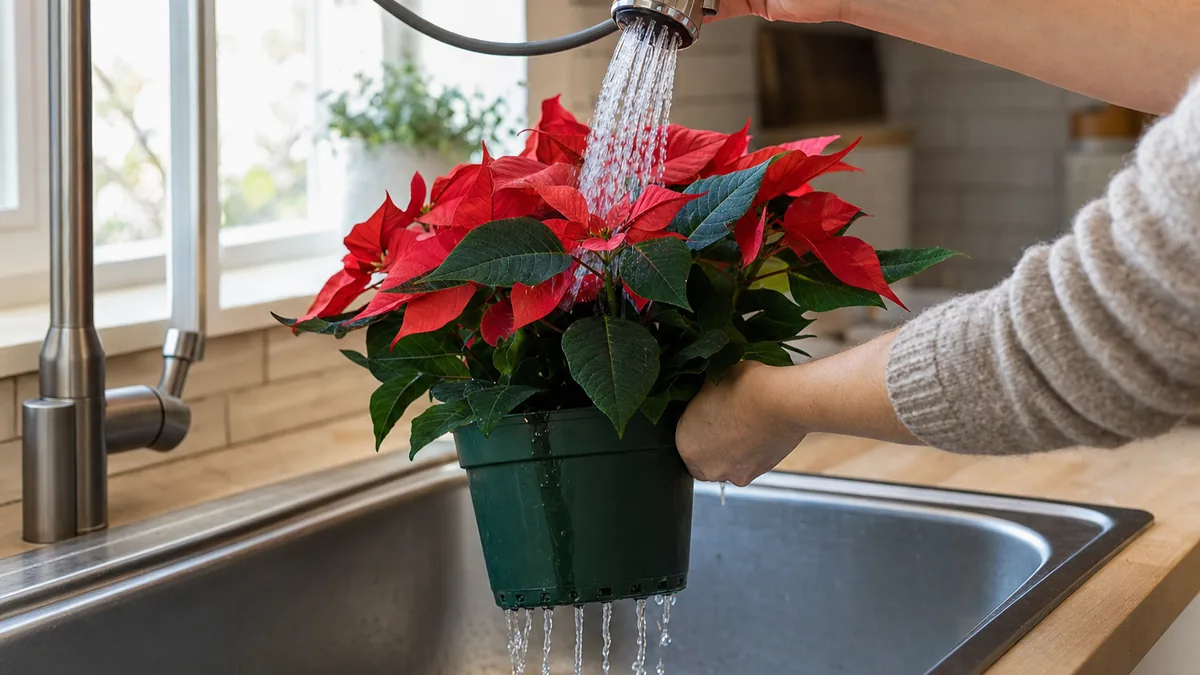
How often to water poinsettia has no fixed answer, and that surprises people. Colorado State University Extension says plainly that there is no set rule. Instead, water thoroughly whenever the soil surface feels dry to the touch, let every drop drain out, and never leave the pot sitting in water. In a warm house that can mean checking daily. The routine is the same sink and drain habit used in our guide to how to water orchids.
Poinsettia Watering Quick Facts
Every figure below comes from a university extension page, named in the right-hand column. Where the pages disagree, the table shows the range.
| Question | Short answer | Source |
|---|---|---|
| When to water | When the soil surface feels dry to a light touch, or the pot feels lightweight | UMN Extension |
| Fixed schedule | None. Check the soil, in a warm room as often as daily | Colorado State, Illinois Extension |
| Method | Set it in a sink, water thoroughly, drain completely | UMN Extension |
| Foil or decorative sleeve | Remove it to water, or punch drainage holes in it | UMN, Illinois, Colorado State, Delaware, NC State |
| Saucer | Discard what collects there | Illinois, Colorado State, NC State |
| Indoor temperature | 65 to 70°F is ideal, and keep it above 50 to 55°F | UMN, Illinois, Delaware, Mississippi State |
| Light | Bright, indirect light, at least six hours a day | Colorado State, Illinois Extension |
| Biggest risk | Constant wetness, which rots the roots and drops leaves | UMN, Mississippi State, NC State |
How Often Do You Water Poinsettias?
Extension sources agree on the trigger and refuse to give a number of days. Colorado State University Extension says to water the plant thoroughly whenever the soil feels dry to the touch, and adds that there is no set rule on how often to water a poinsettia. University of Minnesota (UMN) Extension gives two checks: water when the soil surface feels dry to a light touch, or when the pot feels lightweight when lifted. Illinois Extension is the most hands-on, saying to check the soil daily and water when it is dry. NC State Extension, writing from Clay County, says to check regularly and water when the surface feels dry. Mississippi State University Extension puts the other half of the rule in one line: water only when needed, and wait until the soil is dry.
So the real answer to how often is “whenever the top of the soil is dry.” In a bright, warm room that may be every few days, and in a cool room it may be much less often. A calendar reminder is only a prompt to check, not a reason to pour.
The sources do not agree on one detail. University of Delaware Cooperative Extension says to water thoroughly when the soil feels dry to the touch or when the leaves begin to droop a little. UMN takes a stricter line, saying never to let poinsettias get so dry that they wilt. A drooping leaf is a late signal, so check the soil before it gets there.
How to Water Poinsettias Indoors, Step by Step
- Check the soil. Touch the surface. If it feels dry, or the pot feels light when you lift it, it is time (UMN Extension). If it is still damp, wait a day and check again.
- Take off the wrapper. UMN says to remove the plant from its decorative foil or outer pot before watering.
- Carry it to the sink. UMN says to set the plant in a sink and water thoroughly.
- Water until it runs out of the bottom. NC State says to water thoroughly until excess water drains from the bottom of the pot. Delaware says to add enough to saturate the soil.
- Let it drain completely. UMN says to allow the plant to drain completely. Leave it in the sink until it stops dripping.
- Empty any saucer. Illinois and NC State both say to discard excess water in the saucer. Delaware gives a timer: if the saucer still holds water after 3 or 4 hours, remove the plant and dump it.
- Put it back. Return the pot to its bright spot, in its wrapper only if the wrapper has drainage holes.
Doing this at the sink means you never have to guess how much water is enough. The pot tells you: water out of the bottom holes, then drip stops.
How Much Water Do Poinsettias Need?
No extension page we read gives a cup or ounce amount, and we will not invent one. The right amount depends on the pot size, the mix and the room. The sources describe the amount by result instead.
- Saturate the mix. Delaware says that when you water, add enough to saturate the soil.
- Water until it drains. NC State says to water thoroughly until excess water drains from the bottom of the pot, and UMN says to let it drain completely.
- Keep it moist, not soggy. Mississippi State says to keep the plant moist but not soggy. UMN says to keep the soil moist.
- Lift the pot. UMN says a lightweight pot means it is time to water. After a few waterings you will know the feel of a freshly watered pot and a dry one.
Our tip: a small sip of water at the top can wet the surface while the lower soil stays dry. Running water through the whole pot at the sink, as UMN describes, avoids that.
How to Water a Poinsettia in a Foil Sleeve or Decorative Pot
Most store poinsettias arrive wrapped in foil or sitting in a decorative pot cover with no drainage. That wrapper can leave a healthy plant waterlogged, because water runs down and collects at the bottom with nowhere to go. Extension sources all give the same fix, with two variations.
- Remove it to water: UMN says to remove the plant from the decorative foil or outer pot before watering. Colorado State and NC State both say to remove the foil before watering.
- Or punch holes in it: Illinois says to punch holes in the foil so water can drain into a saucer. Delaware says to remove the foil or punch holes in the bottom of it. Mississippi State says the same about the plastic decorator wrap.
If you punch holes, put a saucer under the whole thing and empty it after each watering, as Illinois and NC State advise. Removing the sleeve is simpler. Water the plant in the sink, let it drain, and drop it back into the sleeve only once it has stopped dripping. A gift plant that came wrapped and has been sitting for a week may already be sitting in water, so lift it out and look.
Poinsettia in Pots: Size, Material and Drainage
The pot changes how fast the soil dries. Mississippi State says pots that are 4 inches wide dry out faster than 6 or 8 inch pots, so small plants need more frequent checks. Colorado State adds that plants in clay pots need more frequent watering, while those in plastic pots are prone to overwatering. In other words, plastic holds moisture longer than clay, and most nursery poinsettias come in plastic.
UMN says to make sure the plant is in a pot that drains freely. If you repot, choose a container with drainage holes. Our guide to plant pot sizes explains how pot diameter, depth and volume line up, which is useful when you are swapping a nursery pot for something more decorative.
Light, Temperature and Drafts Change How Fast It Dries
The watering schedule is really a drying schedule, and light and heat drive it. A poinsettia in a bright, warm room uses water faster than one in a cool corner.
Light. Colorado State says poinsettias are happiest in indirect natural light, with at least six hours of daily exposure, and Illinois also calls six hours of light daily ideal. UMN says a south, east or west window works. NC State says to keep it near a sunny window but out of direct afternoon sun. Mississippi State warns that direct sun increases watering needs and shortens bloom life. If your window is dim, a lamp can help, and our comparison of LED versus fluorescent grow lights helps you choose one.
Temperature. The sources give overlapping ranges, so here they are side by side.
| Source | What it says |
|---|---|
| UMN Extension | 65 to 70°F is ideal indoors. Damage below 50°F. |
| Illinois Extension | No lower than 55°F and no higher than 70°F. High temperatures shorten the plant’s life. |
| Colorado State Extension | 67 to 70°F by day and 60 to 62°F at night. |
| Mississippi State Extension | 68 to 72°F by day and 60 to 65°F at night. Do not let it drop below 50°F. |
| NC State Extension | Daytime 65 to 75°F with slightly cooler nights. |
| University of Delaware | Temperatures below 50°F cause damage. Cold or cool temperatures with moist soil encourage root rots. |
Read that as a comfortable middle of about 65 to 70°F. The last row matters for watering: Delaware warns that cool temperatures combined with moist soil encourage root rots, so a cold room is a reason to water less often, not more.
Drafts and heat. UMN says to avoid spots near cold drafts, heat ducts, fireplaces, fans and space heaters. Mississippi State says to keep the plant away from drafts, HVAC vents and heaters. NC State says to keep it away from exterior doors, since sudden temperature changes can cause leaf drop, and Illinois says that even a few minutes of low temperature can damage the bracts and leaves. Delaware and Illinois both say not to let the bracts touch a cold window. Warm air from a vent will only make the soil dry faster, so in our experience a plant near one needs checking more often.
Signs of Overwatering and Underwatering
The two problems look similar from across the room, because both end in a droopy plant that drops leaves. Check the soil and the pot weight before you decide which one you have.
Too much water
- Leaf and bract drop. Mississippi State says overwatering is a major cause of early leaf and bract drop, and that leaf drop is one symptom of it.
- Yellow lower leaves. Colorado State says yellowing leaves can indicate over or under watering and potential root rot, and it singles out lower leaves that begin to yellow and drop.
- Soggy soil that never dries. UMN says constant wetness will rot plant roots, and NC State says poinsettias do not tolerate soggy soil and that overwatering is a common reason they decline after the holidays.
If the lower leaves are yellowing and the soil stays wet for days, tip the plant out of the pot and look at the roots. Soft, brown roots point to rot, and our guide to root rot covers what to do. For the general yellow leaf problem across houseplants, see why plant leaves turn yellow.
Too little water
- Wilting. UMN says never to let poinsettias get so dry that they wilt.
- Dropped leaves. Delaware says that if the plant is allowed to wilt, it will drop its leaves prematurely. Illinois says wilted plants tend to drop bracts sooner.
- A light pot and dry surface. These are the UMN cues that it is time to water.
A wilted plant that is simply dry usually perks up after a thorough soak at the sink. If it is wilting while the soil is wet, the roots are the problem, and our guide to why a plant wilts walks through telling the two apart.
How Often to Water Poinsettia in Winter
For most people, winter is the whole season you own a poinsettia, since the plants are bought around the holidays. None of the extension pages we read give a separate winter number of days. What they give is the same rule, applied to a heated house.
- Check the soil often. Illinois says daily, and a dry heated room is where that matters most.
- Water only when the surface is dry, as UMN and Mississippi State say, rather than topping up a little each day.
- Keep the plant out of the path of vents and heaters, which UMN lists as spots to avoid.
- If the room is cool, water less often. Delaware says cool temperatures with moist soil encourage root rots.
After the holidays, the sources split. If you want to keep the plant, University of New Hampshire Extension says to begin cutting back the amount of water in April, then repot and water the soil thoroughly in May. Illinois describes letting the soil go completely dry during dormancy while watering only enough to prevent the stems from shriveling. UNH warns that if the plant goes so dry that the stem shrivels, that will kill it. Both are about reflowering, which is a separate project because NC State says the plant needs about 14 hours of complete darkness each night for 8 to 10 weeks. Our indoor plants hub gathers the other houseplant guides. If you also keep a desert plant, its needs differ, so see how to water succulents before you reuse this routine.
Free book · 25 pages, PDF
How Often to Water Poinsettia FAQ
How often should you water a poinsettia?
Whenever the soil surface feels dry to a light touch, according to UMN Extension. Colorado State University Extension says there is no set rule on how often, and Illinois Extension says to check the soil daily. Water thoroughly, drain completely, and do not water again until the surface is dry.
How much water does a poinsettia need?
Enough to saturate the soil and run out of the drainage holes. Delaware Cooperative Extension says to add enough to saturate the soil, and UMN says to set the plant in a sink and let it drain completely. If the saucer still has water after 3 or 4 hours, Delaware says to dump it.
Should I take the foil off my poinsettia to water it?
Yes, or punch holes in it. UMN, Colorado State and NC State Extension say to remove the foil before watering. Illinois and Delaware say you can instead punch holes in the foil so water drains into a saucer. Either way, do not leave water standing at the bottom of the wrapper.
Why is my poinsettia dropping leaves?
Often too much water. Mississippi State Extension says overwatering is a major cause of early leaf and bract drop. NC State says sudden temperature changes from cold drafts, vents and doors can also cause it, and Delaware says a plant that is allowed to wilt will drop its leaves prematurely.
What temperature do poinsettias like?
About 65 to 70°F. UMN Extension calls that range ideal and says temperatures below 50°F cause damage. Illinois says no lower than 55°F and no higher than 70°F, and Colorado State says 67 to 70°F by day and 60 to 62°F at night.
Are poinsettias poisonous to pets?
Sources vary in wording. UMN Extension says poinsettias are not poisonous but the sap may cause dermatitis, and Mississippi State says research has shown they are not toxic, though they are not recommended for people or animals to eat. Colorado State calls them mildly toxic to cats and dogs. Keep the plant out of reach of pets.
Sources & further reading
Watering triggers, the sink method and foil advice come from University of Minnesota Extension’s guide to growing and caring for poinsettia, Illinois Extension’s Caring for Poinsettias, Colorado State University Extension’s poinsettia care tips, University of Delaware Cooperative Extension’s Caring for Poinsettias and NC State Extension’s Poinsettia Care from Clay County. Overwatering symptoms, pot size, drafts and toxicity notes are from Mississippi State University Extension’s Selecting and Maintaining Poinsettias (P2573). The after-holiday watering schedule comes from University of New Hampshire Extension’s Poinsettias: Care and Reflowering. For how we source the facts on this site, see our methodology page.
Free book · 25 pages, PDF
The Indoor Plants Repotting Cheat Sheet
Sent