How often do you water succulents? Colorado State University Extension says once a week or less, depending on plant type and container size, and West Virginia University Extension puts it at roughly weekly in spring and summer and every two to three weeks in winter. Season, light, pot material, soil and humidity move that number, so use the tables below as a starting point and let the soil have the final say. For the soak and drain method itself, see our guide to how to water succulents.
How Often to Water Succulents: Quick Facts
| Question | Short answer | Source |
|---|---|---|
| Typical interval | Once a week or less, depending on plant and pot size | Colorado State Extension |
| Spring and summer | About once a week for indoor succulents | West Virginia University Extension |
| Winter | Every two to three weeks, only to stop leaves wilting | West Virginia University Extension, Colorado State Extension |
| Volume per watering | No standard amount. Wet the whole pot and let the excess drain | Colorado State Extension, Nebraska Extension |
How Often Should You Water Succulents? A Schedule by Conditions
There is no single answer because the sources that give numbers describe different settings: indoor pots, outdoor pots in a desert, and cacti planted in the ground. The University of Illinois Extension is blunt that these plants cannot be watered on a set schedule, and lists four reasons: the time of year, the size of the plant, the type of potting soil and the size of the pot. This page is about the interval, not the soak, drain and wait method itself.
Read the published intervals below as ranges for different settings, not as rival answers.
| Source and setting | Growing season or general guidance | Winter |
|---|---|---|
| West Virginia University Extension, succulents in containers | Typically once a week | Typically once every two to three weeks, just enough to prevent wilting |
| Missouri Botanical Garden, cacti and succulents | Check every 2 to 3 weeks. Water more at peak growth (March to October in the Midwest) | No more than once a month |
| Texas A&M Plant Clinic, succulents | About once a week, maybe more if the plant is in a dry place | Not stated |
| University of Minnesota Extension, cacti and succulents | No fixed interval. Let the soil dry out completely. Need rises as spring light increases | Only enough to prevent shrinking and withering in the low-light months |
| UC Master Gardeners of San Luis Obispo County | No fixed interval. Wait until the mix is almost dry | Not stated |
| Montana State University Extension | No fixed interval. Water only when the soil or substrate is dry | Only enough to prevent shriveling |
| Colorado State Extension, succulents | Once each week or less | Not stated |
| Colorado State Extension, cactus | When the top inch of soil is dry | May be only every two to three weeks, even less often if the weather is rainy or cool |
| Clemson Extension, desert cacti indoors | Regularly March to September, letting the soil dry partly between waterings | A light watering every few weeks, letting the plant get very dry between |
| Nebraska Extension, potted cacti | When the top inch is dry. Many go several weeks between waterings | No water from mid to late November until March, unless plants begin to shrivel |
| University of Arizona Extension, potted cacti and succulents in southern Arizona | Every 5 to 7 days in summer (May to September), every 7 to 10 days in spring and fall (March, April, October, November) | Every 10 to 14 days (December to February) |
The Arizona row looks aggressive next to the others for a reason. That schedule is the University of Arizona Cooperative Extension watering guide for established landscape plants in southern Arizona, where summer heat dries a pot quickly. The same guide lists cacti, agave and yucca planted in the ground at every 10 to 14 days in summer, every 21 to 28 days in spring and fall, and no irrigation in winter. A pot on a mild, shaded porch or a living room shelf will not dry on that clock.
For scale, here is our own arithmetic on the 2 to 3 week starting interval, not a sourced figure: 52 weeks divided by 3 is about 17 waterings a year at the slow end, and 52 divided by 2 is 26 at the fast end.
The decision table
Here is how the conditions push the interval one way or the other. Each line is something an extension source states directly.
| Condition | Water sooner when | Wait longer when | Source |
|---|---|---|---|
| Season | Spring and summer growth | Fall and winter, when growth slows | Colorado State, West Virginia |
| Light | Days lengthen and light increases in spring | Low-light winter months | University of Minnesota Extension |
| Location | Pots moved outdoors for the summer | Pots kept indoors | University of Minnesota Extension |
| Heat | Central Valley highs in the 90s and above (check containers daily) | Cool or rainy weather | University of California Cooperative Extension, Colorado State |
| Pot material | Plastic or glazed pots need closer watching | Terracotta dries faster, so it tolerates a looser eye | UC Master Gardeners of San Luis Obispo, Montana State, UF/IFAS |
| Pot size | Small containers dry out easily | A pot too big for the plant stays wet too long | UC Cooperative Extension, Cornell, Clemson, Iowa State |
| Soil | Sandy, low water-holding mix | Heavy mix that holds water | University of Illinois Extension |
| Plant type | Rain forest cacti, which should not dry out completely in spring and summer | Desert cacti and most other succulents | Clemson Extension |
How Often to Water Succulents Indoors
Indoors, the guides cluster around a weekly check in the growing season and a slower rhythm in winter. West Virginia University Extension says watering is typically about once a week in spring and summer, and Colorado State Extension says once a week or less. Colorado State ties it to container size and plant type, and West Virginia adds that recommendations vary by variety. If your plant sits in a bright south or west window, expect it to land near the weekly end. The University of Illinois Extension calls a south or west window the most ideal bright light for these containers.
Treat the weekly figure as the day you check, not the day you pour. Iowa State University Extension suggests starting at every two to three weeks and then checking that the soil is dry several inches down, waiting a few more days if it is still damp. Missouri Botanical Garden likewise says to check moisture every 2 to 3 weeks and let the pot dry thoroughly between waterings. Either is a useful place to begin for a cooler room or a larger pot.
Dry indoor air does not change the picture much. Iowa State says it is rare for indoor conditions to be too dry for succulents, and that low winter humidity is usually fine. Dim rooms matter more: a plant under a weak window uses water slowly, while one under a grow light dries faster. If you are adding supplemental lighting, our LED vs. fluorescent grow light comparison covers the options.
How Often to Water Succulents Outdoors
Outdoors splits into two cases: pots and plantings in the ground.
Succulents in outdoor pots
University of Minnesota Extension says that once plants are outdoors for the summer, they will require more water and should be checked regularly. It also suggests a semi-shaded, protected spot and avoiding hot, intense sun from 11 a.m. to 3 p.m. The University of California Cooperative Extension horticulture associate Anne Schellman writes that in spring you may water pots every few days while checking the soil, and that when Central Valley temperatures reach the 90s and higher, containers should be checked daily. She also notes that plants can dry out easily in small containers. That is the fast end of the range, and it is a hot-climate figure.
Succulents in the ground
Established plantings need far less. Bodie Pennisi, a University of Georgia Cooperative Extension floriculturist, says succulents store water in their leaves and stems, so irrigation is seldom necessary once they are established, and that they are especially averse to wet places in winter. The University of Arizona guide above backs the pattern with numbers: for cacti, agave and yucca in the ground, intervals stretch from 10 to 14 days at the summer peak to none in winter.
Hardiness decides whether a succulent can stay outside at all. Check your zone on the growing zones page before you plant sedum or hens and chicks in the ground, and bring tender types indoors before frost.
How Often to Water Succulents in Winter and Summer
Watering succulents in winter
Most guides agree that cool-season watering drops to a trickle. Colorado State Extension says to give cacti just enough to keep the roots from drying out and the plants from shrinking, and that this may mean only every two to three weeks, or less in rainy or cool weather. Clemson Extension says a light watering every few weeks is usually enough for dormant desert cacti. Missouri Botanical Garden says no more than once a month in winter, while University of Minnesota Extension says to give only enough to prevent shrinking and withering through the low-light months. Nebraska Extension goes furthest, advising no water at all from mid to late November until March for cacti kept cool, with a light drink only if they begin to shrivel.
Cold plus wet is the dangerous pairing, so a cool room means even longer gaps.
Watering succulents in summer
Summer is when the weekly rhythm applies. Nebraska Extension says to water when the top inch of soil is dry and to soak the whole root ball, and that cacti watered this way often go several weeks between waterings. Clemson says desert cacti grow quickly from March to September, which is when regular watering pays off.
Summer-growing and winter-growing succulents
A few popular succulents run on the opposite calendar. University of Wisconsin Extension says Aeonium, in its native habitat, grows in spring and fall and goes dormant in hot, dry summer, though it keeps growing through summer in Wisconsin. In winter it wants cool conditions, around 50°F, and only enough water to keep the foliage from shriveling. A University of California Master Gardener workshop presentation also lists Aeonium ‘Zwartkop’ as a summer-dormant, winter grower and recommends rain shelter during dormancy. If a plant looks tired in July, check its type before you pour on water.
Holiday cacti are the other exception. Clemson Extension says rain forest cacti need substantially more water than desert types and should never dry out completely in spring and summer, with watering reduced around the end of September. Clemson also says they prefer at least 50 percent humidity but will tolerate less.
Pot, Soil, Light and Humidity: What Moves the Interval
Pot material and size
Montana State University Extension says terracotta and similar porous pots hold less water than plastic or glass. UF/IFAS Extension agrees that terracotta lets soil dry faster, which helps fight root rot. The UC Master Gardeners of San Luis Obispo say plastic and glazed stoneware need a little more attention to watering. In practice, the same plant in a plastic pot may need water days later than the one in clay.
Size works the other way. Iowa State recommends a container just big enough to fit the root system and says overly large pots take longer to dry. Clemson says to repot cacti into a container only slightly larger, and Cornell says a container too large for the plant often stays wet too long. If you are not sure which size to step up to, our pot sizes explained post helps.
Soil mix
The University of Illinois Extension recommends soil that is well drained and low in water-holding capacity, usually a sandy mix. Colorado State Extension asks for well-drained potting soil. A mix that drains quickly is forgiving, while a dense one holds water and stretches the safe interval.
Light, temperature and air
Colorado State Extension lists light, temperature, humidity and air movement among the conditions that change how fast a houseplant uses water. University of Minnesota Extension adds that the need for water rises as light increases in spring. A bright, warm, breezy spot dries a pot quickly, and a cool, dim, still corner dries it slowly. Moving a plant from one to the other should reset your interval.
How to Know When to Water Succulents
The calendar is only a reminder to look. These checks tell you when to actually water.
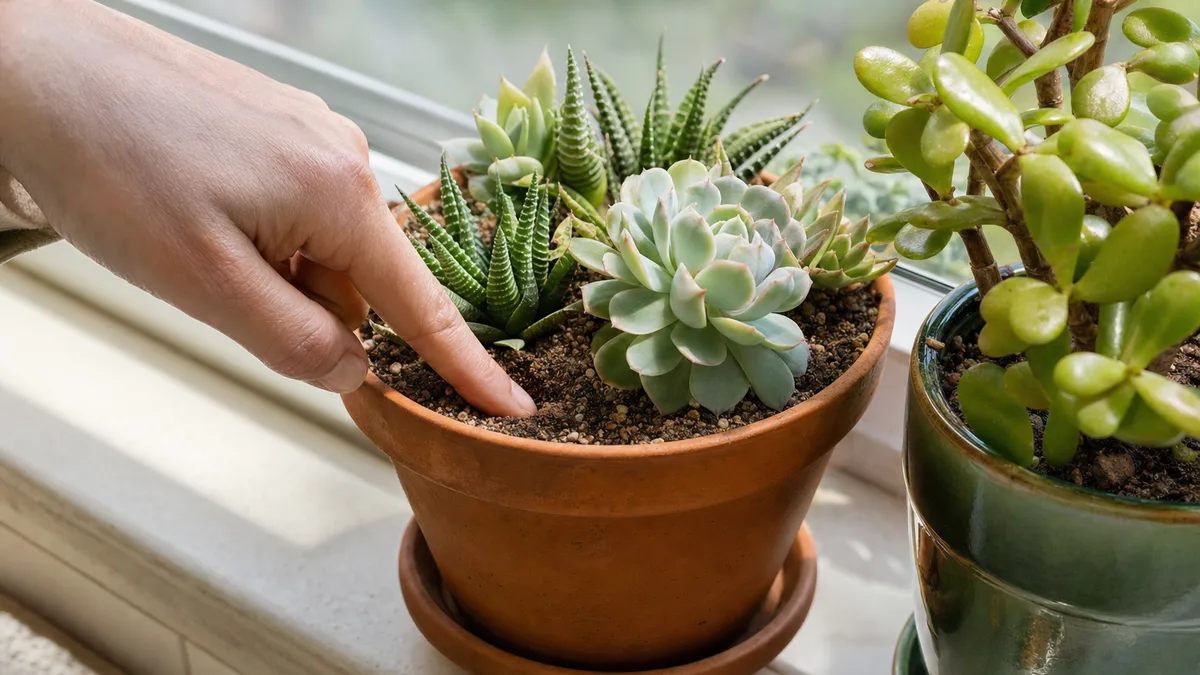
- The finger or skewer test. The University of Illinois Extension says to check the soil with your finger and, if it still feels moist, to wait. Nebraska Extension uses the top inch as the cue. The UC Master Gardeners of San Luis Obispo suggest a bamboo skewer or water meter and waiting until the mix is dry at least two thirds of the way down.
- The weight test. Lift the pot right after a thorough watering, then again later. A light pot is a dry pot. Missouri Botanical Garden says to become familiar with the weight of the pot when the soil is dry and use that as a gauge. The lifting routine itself is our own habit, and no number is attached to it.
- Leaf signs. Iowa State says underwatered plants have yellow, shriveled leaves that turn brown before falling, with wrinkled, mottled stems and leaves. Overwatered plants have yellowing, soft, mushy leaves and stems, dropping leaves and damp soil at the surface.
The two problems can look alike, and Iowa State notes that root rot is often mistaken for underwatering, which leads people to add water to a plant that is already drowning. Feel the soil before you water a wrinkled plant.
For a wider look at the causes, see our guides on why a plant is wilting and why leaves turn yellow.
How dry is dry enough?
The sources disagree on this one. University of Minnesota Extension says to always let the soil dry out completely between waterings, Montana State says to water only when the soil or substrate is dry, and the UC Master Gardeners of San Luis Obispo say to wait until the mix is almost dry. Texas A&M AgriLife horticulturist David Reed warns that letting the soil dry out completely can damage the root system. His test is memorable: the soil should be not dry like toast, but dry like a piece of fresh bread, with moisture but no wetness. For most home growers, bone dry for a short time is fine, and bone dry for weeks is not.
How Much Water Does a Succulent Need?
We looked for an extension figure for volume per pot size, a cups-per-inch rule, and did not find one in the guides above. That makes sense, since the right amount depends on pot, soil and plant. The sources agree on the target instead. Colorado State Extension says to water thoroughly, let water flow through the drain holes and discard the excess. The University of Illinois Extension says to soak the container thoroughly and let the excess drain. The University of Arizona guide sets the depth as watering to the bottom of the pot.
The opposite habit is the one to avoid. Cornell Cooperative Extension says a little water frequently produces weak, shallow roots and sickly plants, and West Virginia University Extension says small amounts watered often cause distorted, poor growth. So the answer to how much is: enough to wet everything, not a splash. The soak-and-drain steps are in our how to water succulents guide.
How Long Can Succulents Go Without Water?
No extension guide we found gives a fixed number of days, because it depends on the plant, pot, temperature and season. What the guides do say is reassuring. The UC Master Gardeners of San Luis Obispo say succulents can sometimes survive months of drought. University of Georgia Extension describes them as adaptable to extended periods of drought. Nebraska Extension says many cacti will go several weeks between waterings in summer, and none at all for the winter dormant period in a cool room. University of Arizona Extension schedules potted cacti and succulents as far apart as 10 to 14 days even in the dry southern Arizona winter.
Surviving is not thriving. Colorado State Extension says the soil should be allowed to dry out completely between waterings, but a plant left dry for a long stretch will shrivel and stall. For a trip, water thoroughly before you leave and move small pots out of hot, direct afternoon sun. Our aloe vera guide covers a plant that tolerates this kind of neglect well, and succulent cuttings have their own light-watering rules while they root. For the aloe-specific version of this advice, see how often to water aloe vera.
Build Your Own Succulent Watering Schedule
Turn the tables into a rhythm for your plants in five steps.
- Pick a check day. Choose a weekly day to look at your plants, which matches the weekly interval West Virginia and Colorado State Extension describe for the growing season.
- Test before you pour. Use a finger, a skewer or the weight of the pot. If the soil is still damp, skip the week.
- Soak, then drain. When it is dry, water thoroughly and tip out any excess after a few minutes.
- Note the gap. Write down how many days it took to dry. That is your real interval for that plant and pot.
- Reset by season. In fall and winter, stretch the gap toward two to three weeks or longer for dormant plants. In spring, move back as light rises. Pots moved outdoors need a fresh check, and anything in a different pot, window or soil deserves a new count.
More on caring for plants indoors is in our Indoor Plants hub.
Free book · 25 pages, PDF
How Often to Water Succulents FAQ
How often should you water succulents indoors?
About once a week in spring and summer and every two to three weeks in winter, according to West Virginia University Extension. Colorado State Extension says once a week or less, depending on plant type and container size. Check that the soil is dry before you water.
How often should you water succulents in winter?
Much less. Colorado State Extension says it may be only every two to three weeks, and even less in cool or rainy weather. Nebraska Extension advises no water for cool, dormant cacti from mid to late November until March, with a light drink only if they shrivel.
How often should you water succulents in summer?
Roughly weekly for indoor pots, per West Virginia University Extension. Nebraska Extension says to water when the top inch is dry and that many go several weeks between soakings. Outdoor pots dry faster, and University of California Cooperative Extension says to check them daily when Central Valley temperatures reach the 90s.
How much water does a succulent need?
No extension source we found gives a standard volume. Colorado State Extension and the University of Illinois Extension say to water thoroughly until water drains from the holes, then discard the excess. Cornell Cooperative Extension warns that frequent small amounts lead to weak, shallow roots.
How long can a succulent go without water?
No guide gives a fixed number of days. The UC Master Gardeners of San Luis Obispo say succulents can sometimes survive months of drought, and Nebraska Extension says many cacti go several weeks between waterings in summer. Longer gaps are tolerated better in cool rooms than in hot windows.
How do you know when a succulent needs water?
Check the soil. The University of Illinois Extension says to test it with your finger and wait if it feels moist, and the UC Master Gardeners suggest a skewer and waiting until the mix is dry at least two thirds of the way down. Iowa State says shriveled, wrinkled leaves can mean thirst, though mushy yellow leaves point to too much water.
Do pot material and size change how often to water succulents?
Yes. Montana State University Extension says terracotta holds less water than plastic or glass, so it dries faster. Iowa State says overly large pots take longer to dry. Match the pot to the root system and expect plastic pots to need water later than clay ones.
Sources & further reading
Intervals and seasonal guidance come from West Virginia University Extension: Succulents 101, Colorado State University Extension PlantTalk: Succulents and Cactus, Houseplants: Watering, Clemson Extension HGIC: Indoor Cacti, Nebraska Extension: Cacti Care, and University of Arizona Cooperative Extension: Recommended Watering Schedule for Southern Arizona Established Garden and Landscape Plants. Factors, pots and soil come from University of Illinois Extension: Succulent Container Gardens, Cornell Cooperative Extension: Care of Non-Hardy Cacti and Succulents, Montana State University Extension: Growing Succulents, Iowa State University Extension: Growing Succulents Indoors, Common Problems and Issues of Succulents, University of Minnesota Extension: Cacti and succulents, UF/IFAS Extension Lake County: Succulents and UC Master Gardener Program of San Luis Obispo County: Succulents. The 2 to 3 week starting interval, the once-a-week figure and the dry-soil tests also draw on Missouri Botanical Garden: Cacti and Succulents, Texas A&M Plant Clinic: Soft Spot for Succulents and Texas A&M AgriLife Extension (David Reed). Outdoor and dormancy notes come from University of California Cooperative Extension: Gardening with Succulents, University of Georgia Extension: Succulents overcome summer and winter water stresses, University of Wisconsin Extension Horticulture: Aeonium and a University of California Master Gardener workshop presentation, Succulent Celebration. For how we source the facts on this site, see our methodology page.
Free book · 25 pages, PDF
The Indoor Plants Repotting Cheat Sheet
Sent