Part of our Plant Problem Diagnosis series
Root rot looks like a thirsty plant: leaves wilt and yellow, but the soil is still wet and the roots, when you check, are brown and soft instead of firm and light. University extension sources agree on the core response. Cut back watering, take the plant out, remove the rotted roots, and repot into fresh, well-draining mix in a clean pot with drainage holes. Rotted roots do not grow back, so how much healthy root is left decides whether the plant makes it. Garden plants that hate wet feet, such as lavender, need fast-draining soil from the start, as our lavender how to guide shows.
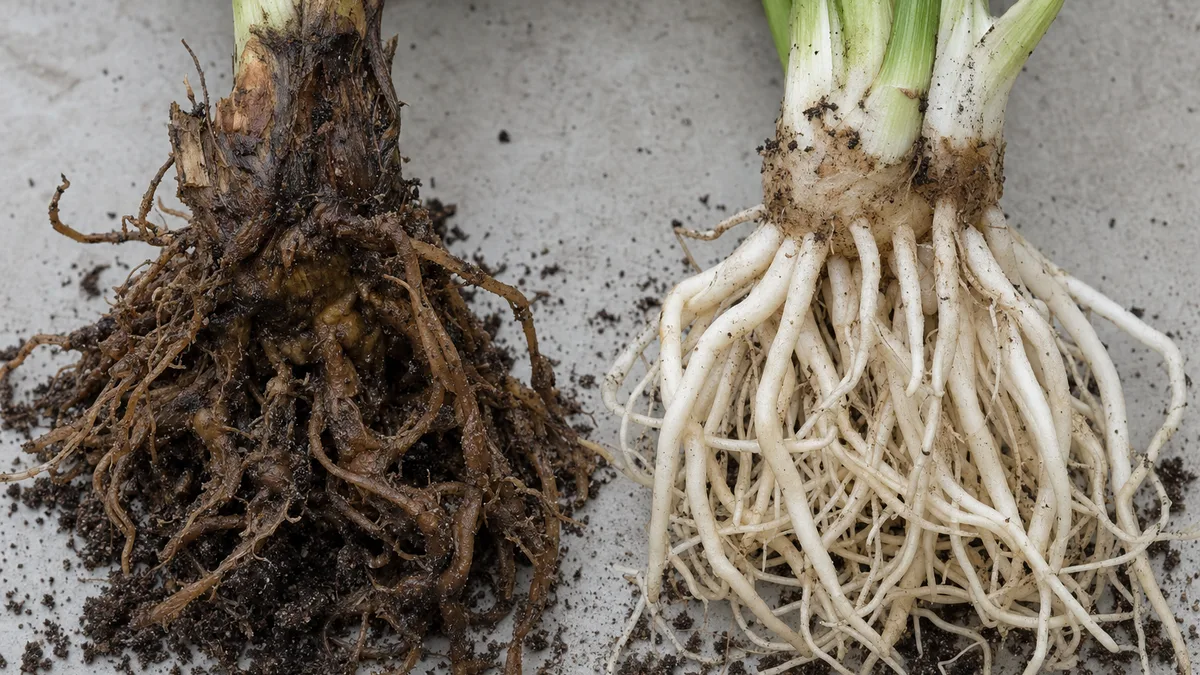
Quick Answer: How to Tell If a Plant Has Root Rot
Three checks sort root rot from its look-alikes in a couple of minutes. The roots give the only definite answer. If you are not sure why the plant is drooping, our guide to why a plant is wilting covers the other causes.
Root Rot vs. Underwatering: Same Wilt, Different Roots
A plant with rotted roots wilts for the same reason a dry plant does: the roots cannot deliver water as fast as the leaves lose it. That is why the two get confused, and why the instinct to add water makes root rot worse. UConn Extension warns that a plant with damaged roots will still look wilted and may get more water, which keeps the cycle going. Iowa State Extension notes that root rot symptoms are commonly mistaken for lack of water, and that the wilting often starts with the lowest leaves and moves upward.
So the soil tells you the first half of the story and the roots tell you the second. Push a finger in an inch or two. Dry and crumbly, and a deep watering perks the plant up within hours, means thirst. Wet or heavy soil with a plant that keeps drooping means look at the roots. Lifting the pot helps too: University of Minnesota Extension says a light pot is dry and a heavy one is still moist.
Once the plant is out of the pot, the comparison is straightforward.
- Healthy roots: firm, pliable, light in color (white or pale), with many fine feeder roots. South Dakota State University Extension describes them as sturdy and pliable.
- Rotted roots: soft, brown or black, sometimes reddish, and fragile. Penn State Extension says they are often limp rather than brittle, and the outer layer strips away, leaving only a thin central strand. They may smell bad.
- Roots of a dry plant: usually still firm, though they may look sparse or tightly wound. Drying out can also kill roots, so brown roots alone do not prove a fungus; the wet soil and mushy texture do the convincing.
Above ground, root rot can also show as stunting and yellow or red leaves that mimic a nutrient problem. If wilting and yellowing is what you are chasing, our guide to why leaves turn yellow walks through the other causes, because plenty of them have nothing to do with roots. Tiny seedlings that collapse at the soil line are a separate problem, damping off.
What Causes Root Rot
Root rot is a wet-soil problem first and an organism problem second. Iowa State Extension says root rots are caused by several fungal and fungus-like organisms, naming Pythium, Phytophthora, Rhizoctonia and Fusarium. The University of Wisconsin-Madison Plant Disease Diagnostics Clinic lists the same four as the most common and adds that most of them prefer wet soil. Purdue Extension calls Pythium and Phytophthora water molds, which is a useful clue: they are organisms built for saturated conditions. North Carolina State Extension says diseases caused by Phytophthora and Pythium are favored by high soil moisture.
The organisms are widespread, so the conditions are what decide whether they win. Iowa State Extension says they usually strike plants that are already stressed, and names an excessively wet growing medium as the most common stress. Purdue Extension describes how excess moisture can make roots leak, which attracts opportunistic fungi and water molds.
- Watering too often. Virginia Cooperative Extension puts it this way: overwatering is not about how much water you apply, it is about how often you water. Iowa State Extension advises watering by each plant’s needs rather than by a calendar.
- No drainage hole. University of Minnesota Extension says a plant in a pot with poor or no drainage is doomed, and that a good pot has at least one large hole in the bottom.
- A pot that is too big. Virginia Cooperative Extension warns against moving a houseplant into a container that is too large, because the roots then sit in a root zone that stays too wet. Pot size sets how fast soil dries, which is why our plant pot sizes guide matters more than it sounds.
- Old or compacted mix. Iowa State Extension says old, broken-down, compacted soil holds more water and can cause overwatering even with careful watering.
- Water left standing. Virginia Cooperative Extension says not to leave a container in a drainage tray of water for more than 60 minutes. The University of Illinois Extension warns that permanently attached saucers can leave roots waterlogged.
- Contaminated pots, tools or mix. The Wisconsin clinic says potting mix, drainage water, tools and pots can spread the fungi, and that garden soil can carry them.
Season matters too. Iowa State Extension says winter conditions such as unfavorable temperature, humidity, lighting and watering can stress houseplants, and calls root rot the most common indoor plant disease its clinic sees in winter, so a routine that worked in summer may need to change. The New York Botanical Garden says overwatering is the most common cause of orchid death, and our guide to watering orchids shows a soak and drain routine that avoids it. Holiday plants such as poinsettias, which often sit in foil sleeves, are a common winter case, so see how often to water poinsettia.
How to Treat Root Rot: Rescue Steps for Potted Plants
Extension sources are blunt about this one. The University of Illinois Extension says plants rarely recover from root rot, and the Wisconsin clinic says discarding the plant is often the best and most cost-effective response. But if firm roots remain, the steps below follow what several extension publications describe. Penn State Extension adds the key principle: rotted roots do not recover, and the plant has to grow new ones, so root rots need to be managed early.
- Stop watering and take the plant out. Tip or lift it from the pot and look at the whole root ball. South Dakota State University Extension suggests this check as soon as a plant wilts in moist soil.
- Rinse and inspect. SDSU Extension says that if enough healthy roots remain, rinse them off. Rinsing the old mix away shows you what is firm and what is mush.
- Trim the dead roots. UConn Extension says to cut away the brown or black roots, and Virginia Cooperative Extension lists pruning dead roots among its fixes for an overwatered plant. UGA Extension’s repotting guidance says to remove damaged or diseased roots while saving as much living root mass as possible. Use clean scissors or pruners. The Wisconsin clinic recommends disinfesting tools, work surfaces and clay pots after handling affected plants, using a 10% bleach or detergent solution, or alcohol.
- Choose a clean pot with drainage holes, sized to the smaller root system. UConn Extension says to use a container just large enough for what is left. The Wisconsin clinic says plastic pots that held an affected plant should be thrown out because they are hard to disinfest.
- Repot in fresh, well-draining mix. SDSU Extension calls for new, sterile soil. The Wisconsin clinic advises pasteurized commercial potting mix rather than garden soil and says not to reuse mix from the sick plant. UConn Extension suggests adding perlite, composted bark or sand to make a mix more porous. Skip the gravel layer: the Wisconsin clinic, the University of Minnesota and the University of Illinois all say it does not improve drainage and can hurt it.
- Water less, and water by the soil. After repotting, UConn Extension says to keep the soil moist enough to prevent wilting and to support new roots. That does not mean wet. Check the soil an inch or two down and wait if it is still damp.
- Be patient and keep watching the soil. The extension sources I reviewed do not give a recovery timeline, light level or fertilizer advice for a recovering plant, so this guide does not either. New growth is the sign that new roots are working. If the plant keeps declining, check the roots again.
Virginia Cooperative Extension also mentions pruning dead or dying stems and foliage along with dead roots to stimulate new growth, so leaves that have already collapsed can go.
What about fungicides?
The Wisconsin clinic does not recommend chemical fungicides for houseplant root rots, citing the limited products available to home gardeners and their cost. Penn State Extension says fungicides do not cure root rot: roots that have rotted do not recover, chemicals usually do not fully eradicate the fungus, and repeated applications are needed. Penn State also says no single fungicide controls all of these fungi, and that you should follow the label if you use one. This guide does not recommend a product.
What Can and Cannot Be Saved
None of the sources give a percentage for how much root is enough. The logic is simple: new roots must grow to replace rotted ones, so a plant with a good share of firm, light roots has something to rebuild from, and one with a mostly mushy root system has very little. SDSU Extension says plainly that some plants may not be salvageable and will have to be discarded, and Purdue Extension says that sometimes it is too late to save the plant.
If you decide to start over, treat the leftovers as contaminated. The Wisconsin clinic says not to reuse the potting mix or drainage water from a sick plant, to throw out plastic pots, and to disinfest clay pots and tools.
Succulents and cacti are a common casualty of overwatering. Virginia Cooperative Extension says succulents and cacti typically need thorough watering only once or twice a month, versus once or twice a week for many tropical houseplants. Our guide to watering succulents goes through the soak-and-dry rhythm that keeps them out of trouble, and how often to water succulents covers the schedule.
Root Rot in Garden Beds, Trees, and Lawns
Outdoors you cannot unpot the problem, so extension advice shifts from rescue to drainage. Purdue Extension says prevention is the best approach: avoid planting known susceptible hosts in unsuitable sites, and for Phytophthora-prone plants avoid heavy clay, poorly draining soil, downspouts and low spots that collect water. It adds that some root rots, Phytophthora among them, are treatable if caught and diagnosed early, but that the damage often built up over several seasons and recovery can take just as long. When saving the plant is not practical, Purdue says to remove it, correct the underlying cultural problems, and consider a more resistant plant. If you are not sure how heavy your soil is, the Soil Type Calculator can help you work it out.
For flower and bedding plantings, Utah State University Extension describes Phytophthora root and crown rot as a soil-borne fungus that can persist in soil indefinitely and is especially associated with heavy clay and poor drainage. Its homeowner steps are cultural: use disease-free plants, remove diseased plants and the soil around them with a spade as soon as they are spotted, improve drainage, raise flat planting areas so water drains off rapidly, plant at the same depth as in the pot or flat, and irrigate deeply and infrequently, letting the top half inch to 1 inch of soil dry out before watering again. Utah State says fungicides should not be tried unless those cultural methods are also used. Rhizome and bulb flowers such as calla lilies are a common case, and our calla lily care guide explains how to water them and when to let the rhizome rest.
For lawns, Missouri Extension describes Pythium root rot as a consistent issue in poorly drained turf, with overwatering and prolonged rainfall contributing, and advises improving surface and subsurface drainage and not watering excessively while the disease is active. Note that Missouri says the disease is mainly a problem on putting greens there, so a healthy home lawn with a few brown patches in summer is not automatically root rot.
How to Prevent Root Rot
Every extension source above points the same way: keep the root zone from staying wet. In practice that comes down to five habits.
- Always use a pot with drainage. The University of Illinois Extension says a hole at the bottom of the container is critical. For a decorative pot with no hole, keep the plant in a plastic liner pot and drain the outer pot after watering, as Illinois and Minnesota both suggest.
- Pick the right size. A container just big enough for the roots, not a roomy one. Both Virginia Cooperative Extension and UConn Extension say this.
- Water by soil moisture, not the calendar. Iowa State Extension says to check moisture before every watering and water only when the soil is dry down an inch or two, waiting another day if unsure. Virginia Cooperative Extension suggests the finger test as a check. Amounts change with season, light and pot size.
- Use fresh, well-draining mix. Pasteurized commercial potting mix, with something like peat moss added to heavy mixes, according to the Wisconsin clinic. Refresh old, compacted soil, as Iowa State Extension advises.
- Empty the saucer. Do not let the pot sit in water. Virginia Cooperative Extension gives 60 minutes as the limit.
The Wisconsin clinic also advises buying from a reputable source and checking for root rot before you purchase.
Root Rot Quick Reference Table
Match what you see to the likely cause and the next step.
| What you see | Likely cause | Next step |
|---|---|---|
| Wilting, soil dry, roots firm | Underwatering | Water deeply and check the soil more often |
| Wilting, soil wet, roots firm and light | Overwatering, no rot yet | Let the soil dry, fix drainage, water less often |
| Wilting, soil wet, some roots brown and mushy | Partial root rot | Trim dead roots, repot in fresh mix, clean pot with holes |
| Wilting, soil wet, most roots mushy or gone | Advanced root rot | Try the rescue steps if any firm roots remain; otherwise start over with a clean pot and mix |
| Yellow lower leaves, smell from the pot, soggy mix | Chronic overwatering, possible rot | Check the roots, clear the drainage hole, empty the saucer |
| Declining shrub or tree on wet, heavy soil | Root rot in the landscape | Improve drainage, confirm the diagnosis, replace with a tolerant plant if needed |
Free book · 23 pages, PDF
Root Rot FAQ
How to cure root rot in a houseplant?
University extension sources are cautious about the word cure. Penn State Extension says rotted roots do not recover and the plant has to grow new ones, and the University of Illinois Extension says plants rarely recover from root rot. What extension sources do describe is rescue: stop overwatering, cut away rotted roots, and repot in fresh, sterile, well-draining mix in a clean container with drainage holes. If enough healthy roots remain, the plant can regrow from them. Fungicides are not a cure either, per Penn State.
How to get rid of root rot in soil?
The sources I reviewed do not describe a way to clean the fungi out of potting mix you are keeping. The Wisconsin plant disease clinic says not to reuse potting mix or drainage water from a sick plant, to throw out plastic pots, and to disinfest tools, work surfaces and clay pots with a 10% bleach or detergent solution, or alcohol. In the ground, Utah State University Extension says to remove diseased plants and the soil around them with a spade, improve drainage and raise planting areas. Utah State also says the fungus can persist in soil indefinitely.
How to fix root rot without repotting?
Honestly, extension sources do not describe a reliable way to. The standard advice is to look at the roots, trim the dead ones and repot into fresh mix, which means taking the plant out of the pot anyway. The one step every source agrees on is to reduce soil moisture: the Wisconsin clinic says to water enough to prevent drought stress but not to overwater, and Iowa State Extension lists reduced watering first, with repotting that may help. Letting the mix dry out can stop things from getting worse, but Penn State Extension says rotted roots do not recover. If the plant is still declining, check the roots rather than waiting.
How to treat root rot with hydrogen peroxide?
I could not find a university extension source that recommends hydrogen peroxide for root rot, so there is no extension-backed method or dose to give you, and any recipe you see online is unproven here. What the extension pages I found do say is narrower. Cornell Cooperative Extension mentions a diluted peroxide soil drench for fungus gnat larvae, which is a pest problem, not rot, and Colorado State Extension lists hydrogen peroxide among disinfectants for cleaning hydroponic equipment and says to follow label instructions. Neither covers treating a rotted root system. The proven basics are less exciting: less water, trimmed roots, fresh mix and drainage.
Should I use a fungicide on root rot?
Extension sources say fungicides are not a stand-alone fix. Penn State Extension says no single product controls every root rot fungus, that chemicals usually do not fully eradicate the fungus, and that rotted roots will not recover. The Wisconsin plant clinic does not recommend them for houseplants because of limited home-gardener products and cost, and Utah State says not to use fungicide on bedding plants without also using cultural methods such as better drainage. If you do use a product, follow its label exactly.
Can I reuse the pot and the soil?
Not the soil. The Wisconsin plant disease clinic says not to reuse potting mix or drainage water from sick plants. Plastic pots that held an affected plant should be thrown out because they are hard to disinfest, and clay pots, tools and work surfaces should be disinfested with a 10% bleach or detergent solution, or alcohol, according to the same clinic. Start the rescued plant in a clean pot with drainage holes and new, well-draining mix.
Sources & further reading
The root symptoms, the named fungi and the wet-soil conditions come from Iowa State Extension’s Root Rots of Houseplants and its older Root Rot on Houseplants article, and from the University of Wisconsin-Madison Extension’s Root Rots on Houseplants. Penn State Extension’s Fungal Root Rots and Chemical Fungicide Use covers root appearance and fungicides. Rescue steps draw on UConn Extension’s Ailing Houseplants, South Dakota State University Extension’s Troubleshooting Common Problems: Houseplant How-To, and the University of Georgia’s Repotting Basics. Watering, pot size and drainage advice comes from Virginia Cooperative Extension’s Properly Watering Container Houseplants, the University of Minnesota Extension’s Watering houseplants, the University of Illinois Extension’s Container Drainage Options, and Iowa State Extension’s Diagnosing Houseplant Problems Related to Poor Culture. Outdoor root rot comes from Purdue Extension’s Root Rot in Landscape Plants, Utah State University Extension’s Phytophthora Root & Crown Rot and Missouri Extension’s Pythium Root Rot turf profile. The hydrogen peroxide statements come from Cornell Cooperative Extension’s fungus gnat article and Colorado State Extension’s root disease management in hydroponic systems, and the link between Pythium, Phytophthora and high soil moisture comes from North Carolina State Extension’s Prevention and Management of Soilborne Diseases. For our sourcing approach, see our methodology page, and browse the Plant Diagnosis hub for the rest of the series.
Free book · 23 pages, PDF
The Plant Problem Diagnosis Quick Reference
Sent