How to Use This Calculator
- Enter your emitter count and flow rate (GPH).
- Choose Per Plant or Area Coverage mode and enter your target water amount.
- Read your run time and total water delivered.
Free book · 23 pages, PDF
How Do You Calculate Drip Irrigation Run Time?
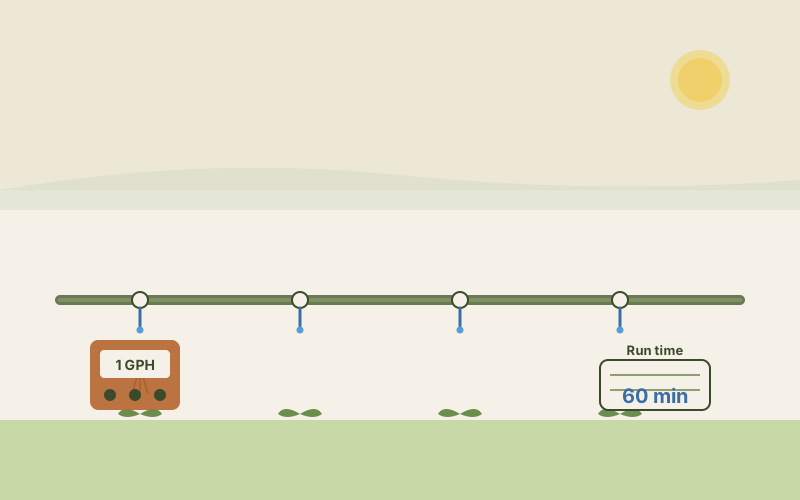
Drip irrigation run time comes down to one relationship: how much water you want delivered, divided by how fast your emitters deliver it. If a single emitter puts out 1 gallon per hour (GPH) and you want 1 gallon at that plant, you run the system for 1 hour. The emitter count on the rest of the line doesn’t change that math, since every emitter on the same line runs in parallel at the same rate.
Watering by area instead of by plant works a little differently: you’re converting a target depth of water (like “1 inch”) into gallons using the area you’re covering, then dividing that total by the combined flow rate of every emitter running on that zone. Home garden watering needs typically fall in the range of 1–1.5 inches per week during the growing season, though exact needs vary by plant, soil, and climate. This calculator gets you the run time for whatever target you set, it doesn’t prescribe the target itself.
Either way, this tool is scoped to home garden drip systems: figuring out run time and water delivered for a zone you already have. It doesn’t size main-line pipe, calculate pressure loss over distance, or plan laterals per acre. That’s professional irrigation design work, outside what a homeowner-level calculator like this one should attempt.
One important limitation to keep in mind: run time calculated from flow rate alone doesn’t account for how fast your soil can actually absorb water. Soil has a maximum infiltration rate: the speed at which it can take in water before the surface saturates and runoff begins. Clay soil absorbs water slowly, roughly 0.1–0.5 inches per hour; sandy or loamy soil absorbs much faster, often 1–3+ inches per hour. If your emitters are delivering water faster than your soil can absorb it, you’re not watering more effectively; you’re generating surface runoff that never reaches the root zone. In that case, the calculated run time is still correct as a total-volume target; the question is how to deliver it without exceeding the soil’s absorption rate.
Common Emitter Flow Rates Reference
Standard point-source drip emitters are manufactured in a handful of common flow rates. Which one to use depends mostly on plant size and soil drainage:
| Flow rate | Typical use case |
|---|---|
| 0.5 GPH | Small perennials, groundcovers, and closely spaced plants, especially in clay or loam soil that holds moisture, often paired two-per-plant for redundancy. |
| 1 GPH | The standard default for most vegetables, annuals, and small shrubs in average garden soil. |
| 2 GPH | Larger shrubs, young trees, and larger containers that need more volume per session. |
| 4 GPH | Mature shrubs and small trees with an established root zone, or any planting in fast-draining sandy soil that needs water delivered quickly before it drains past the root zone. |
As a tree or shrub matures, it’s common to add emitters or step up to a higher flow rate rather than just running the original emitter longer. A bigger root zone needs water spread over a wider area, not just more time in one spot.
Worked Example
Say you have 10 emitters rated at 1 GPH, one per tomato plant, and you want to deliver 1 gallon per plant this session.
- Run time: 1 gallon ÷ 1 GPH = 1 hour.
- Total system flow: 10 emitters × 1 GPH = 10 GPH.
- Water delivered this session: 10 plants × 1 gallon = 10 gallons.
Switch to Area Coverage mode with the same 10 emitters covering a 50 sq ft bed, targeting 1 inch of water: the calculator converts that to roughly 31 gallons (50 sq ft × 1 in × 0.623), divides by the 10 GPH total system flow, and returns a run time of about 3 hours 7 minutes instead. Same emitters, same flow rate, but a very different run time because the target is defined differently.
How to Find a Drip Zone’s Precipitation Rate
Run time is the drip irrigation calculation most people need day to day. Precipitation rate is the one that tells you whether your soil can keep up: it’s how fast a zone applies water, in inches per hour, the same unit as the soil infiltration rates above. Because one gallon is 231 cubic inches and one square foot is 144 square inches, the formula is:
The 1.604 is just 231 ÷ 144, and it’s the reverse of the 0.623 gallons per square foot per inch the calculator uses (1 ÷ 0.623 ≈ 1.605). For dripline laid in an even grid, Toro’s published version plugs the spacings in directly, in inches: 231 × emitter GPH ÷ (row spacing × emitter spacing).
- Emitter zone: the 10 emitters at 1 GPH over a 50 sq ft bed from the worked example above give 1.604 × 10 ÷ 50 = about 0.32 inches per hour. Delivering 1 inch takes 1 ÷ 0.32 ≈ 3.1 hours, which matches the calculator’s 3 hours 7 minutes.
- Dripline grid: 0.9 GPH emitters every 12 inches, with lines 18 inches apart, give 231 × 0.9 ÷ (12 × 18) = about 0.96 inches per hour. That’s faster than clay’s roughly 0.1–0.5 inches per hour, so a clay bed on that layout is a candidate for the cycle-and-soak approach in Common Mistakes below.
Common Mistakes
- Mixing emitter flow rates on one line. A 0.5 GPH and a 4 GPH emitter on the same zone, run for the same amount of time, deliver wildly different amounts of water. Match flow rates within a zone, or run mismatched plants on separate zones.
- Not accounting for soil infiltration rate. The same calculated run time delivers water very differently in clay versus sand. Clay soil has a low infiltration rate (roughly 0.1–0.5 inches per hour), so running emitters longer than the soil can absorb causes surface runoff rather than deeper root-zone delivery. For clay or other slow-draining soils, consider splitting the calculated run time into 2–3 shorter cycles with a 30–60 minute pause in between (a “cycle and soak” approach). The pauses let water from the first cycle move deeper into the profile before you add more, so the full volume actually reaches the root zone instead of running off the surface. Sandy soil works in the opposite direction: it drains fast, so delivering water quickly with higher-flow emitters or more frequent short cycles prevents it from draining below the root zone before plants can use it.
- Running too short or too long. A short run time can leave water sitting in the top inch of soil, encouraging shallow roots; an overly long one can waterlog the root zone or waste water past what the plant can use. Match run time to an actual target amount, not a habit.
- Ignoring seasonal adjustment. A run time that’s right in July heat is very likely too much in cooler spring or fall weather. Recalculate for the season instead of leaving the timer on one setting year-round.
Drip Irrigation Calculator FAQ
How do I calculate drip irrigation run time?
Divide the water you want delivered by your total flow rate. For a single plant on one emitter, run time = target gallons ÷ emitter GPH. For a zone covering an area, run time = total gallons needed ÷ (number of emitters × flow rate per emitter). The calculator above does this automatically for either case.
What emitter flow rate should I use?
1 GPH is the standard default for most vegetables, perennials, and small shrubs. Use 0.5 GPH for closely spaced small plants in heavier, slower-draining soil, and 2–4 GPH for larger shrubs, young trees, or fast-draining sandy soil that needs more volume, faster.
How many gallons does 1 inch of water over an area equal?
About 0.623 gallons per square foot per inch of depth, so 1 inch of water over a 50 sq ft bed is roughly 31 gallons. The calculator’s Area Coverage mode uses this exact conversion to translate a target watering depth into gallons and, from there, into run time.
Can I use this as an irrigation precipitation rate calculator?
Yes, with one extra step. In Area Coverage mode, enter your area, emitter count, and flow rate, and set the target to 1 inch. The run time you get back, in hours, is the time your zone takes to apply 1 inch, so 1 divided by that run time is the precipitation rate in inches per hour. The formula behind it is 1.604 × total emitter GPH ÷ area in sq ft (231 × GPH ÷ area in square inches).
How do you calculate fertilizer application rates for drip irrigation?
Work from the amount per area, not per gallon of water. Take the rate on the fertilizer label (or your soil test) for your bed’s square footage, then divide it by the number of feedings you plan. Mississippi State University Extension does the same for tomatoes: the season’s nitrogen is split across the growing weeks, with less early and more once fruit sets. If you use a ratio injector, the stock tank has to be stronger than the final feed by that ratio. University of Georgia Extension’s example: for 16 oz per 100 gallons through a 1:30 injector with a 25-gallon stock tank, mix 16 ÷ 100 × 25 × 30 = 120 oz into the tank. Inject over at least 45 to 60 minutes rather than all at once so it spreads evenly, and fit check valves and an anti-siphon (backflow) device so fertilizer can’t be drawn back into your water supply. This calculator doesn’t work out fertilizer amounts; it gives the run time the feeding rides on.
How long should I run my drip irrigation system?
It depends entirely on your emitter flow rate and target water amount; there’s no universal number of minutes that works for every setup. Enter your emitter count, flow rate, and target amount into the calculator above for a run time matched to your actual system, not a generic rule of thumb.
Does this calculator handle system design for larger properties?
No. This tool is scoped to homeowner-level drip systems: figuring out run time and water delivered for a zone you already have. It does not size main lines, calculate pressure loss over distance, or plan laterals for acreage. That’s professional irrigation design territory, outside what this calculator covers.
Sources & further reading
The area-based water conversion used in this calculator (gallons = area in square feet × depth in inches × 0.623) comes from Utah State University Extension’s Center for Water-Efficient Landscaping, which also offers a full landscape irrigation calculator with location-specific evapotranspiration data for Utah. Standard emitter flow rates and their typical plant-size use cases follow widely used drip irrigation design guidance from cooperative extension sources. The drip precipitation rate formula and its 231 constant follow Toro’s published irrigation formulas and conversions and Hunter Industries’ “Drip: Calculating Application Rates”, with the derivation of the constant from Rain Bird’s “Calculating Precipitation Rates” design tip. Fertigation guidance comes from Mississippi State University Extension’s “Fertigation: The Basics of Injecting Fertilizer for Field-Grown Tomatoes” and University of Georgia Extension’s “Fertilizer Injectors: Selection, Maintenance and Calibration” and “Drip Chemigation: Injecting Fertilizer, Acid and Chlorine”. For more on how we build and verify the formulas behind every calculator on this site, see our methodology page.