How to Use This Calculator
- Enter your sand, silt, and clay percentages, or your jar test measurements.
- Read your USDA texture class and what it means for your soil.
How Does Soil Texture Classification Work?
Soil is made of three mineral particle sizes: sand (0.05–2.0 mm, gritty), silt (0.002–0.05 mm, smooth and floury), and clay (under 0.002 mm, sticky when wet). Every soil is some mixture of the three, and the relative proportion of each determines its texture class: a permanent, mineral-based property that doesn’t change with tilling or amendment the way soil structure or organic matter content can.
Texture directly affects drainage (sandy soils drain fast, clay soils drain slowly), nutrient and water retention (clay and silt hold far more than sand), and workability (loam and sandy loam are easiest to dig and till; heavy clay is difficult when wet or dry). The USDA soil texture triangle plots any sand/silt/clay combination into one of 12 official texture classes based on where it falls against the triangle’s defined boundaries.
The 12 Classes on the Soil Texture Triangle
Every result the calculator returns is one of the 12 USDA texture classes below. The ranges come from the USDA NRCS Soil Survey Manual; the gardening notes summarize what university extension soil scientists say each texture does in a garden bed. In each range, the lower number is included and the upper one is not, so “7 to 27% clay” means at least 7% and less than 27%.
| Texture class | USDA definition | What it means in the garden |
|---|---|---|
| Sand | Over 85% sand; silt + 1.5 × clay under 15 | Drains and dries out fast, holds few nutrients, and warms early in spring. Water and fertilize more often. |
| Loamy sand | 70 to 90% sand; silt + 1.5 × clay 15 or more; silt + 2 × clay under 30 | Still sand-dominated: quick drainage and low water and nutrient holding, so it needs frequent watering. |
| Sandy loam | 7 to 20% clay with over 52% sand, or under 7% clay with under 50% silt; silt + 2 × clay 30 or more | Gritty, drains quickly, and warms early in spring. Easy to dig, but dries out sooner than a loam. |
| Loam | 7 to 27% clay, 28 to 50% silt, 52% or less sand | The balanced middle: holds water well, drains easily, and is easy to work. It still benefits from added organic matter. |
| Silt loam | 50% or more silt with 12 to 27% clay, or 50 to 80% silt with under 12% clay | Holds more water than sandy soils, but compacts easily if worked while moist and can form a crust after rain. |
| Silt | 80% or more silt, under 12% clay | Smooth and floury. Holds plenty of water but is prone to compaction and surface crusting; organic matter helps its structure. |
| Sandy clay loam | 20 to 35% clay, under 28% silt, over 45% sand | Enough clay to behave clayey despite the sand: holds nutrients better than a sandy loam but drains more slowly and turns sticky when wet. |
| Clay loam | 27 to 40% clay, over 20% and up to 45% sand | Holds water and nutrients well, but drains and warms slowly in spring and compacts if dug while wet. |
| Silty clay loam | 27 to 40% clay, 20% or less sand | Holds water well but compacts easily and can crust. Wait until it is moist enough to crumble, not wet, before digging. |
| Sandy clay | 35% or more clay, over 45% sand | Acts like clay even with all that sand: sticky when wet, hard when dry, and slow to drain. Organic matter is the best fix. |
| Silty clay | 40% or more clay, 40% or more silt | Holds water and nutrients tightly and drains slowly. Sticky when wet, hard when dry, and easily compacted. |
| Clay | 40% or more clay, 45% or less sand, under 40% silt | Drains slowly, holds nutrients well, warms late in spring, compacts if worked wet, and hardens as it dries. Organic matter is the best amendment. |
The class tells you where you are starting, not where you have to stay. Adding organic matter every year improves drainage, structure, and workability in any of these textures, even though it won’t move your soil into a different class.
How to Do a Jar Test
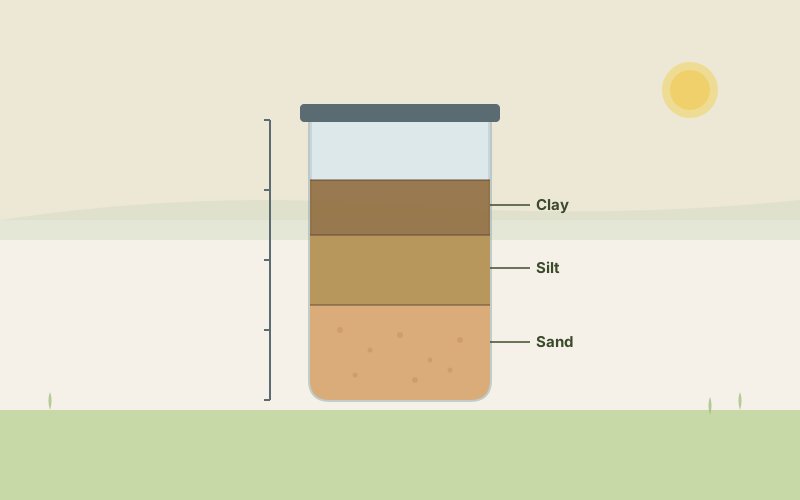
Fill a straight-sided clear jar about one-third full of soil (break up any clods first), then fill nearly to the top with water and a drop of dish soap to help particles disperse. Shake vigorously for a full minute, then set the jar down undisturbed and don’t touch it until each layer has settled.
Timing matters: sand settles in about 1 minute, so mark that line right away. Silt settles within a few hours, forming the next visible line. Clay is the slow one: it can take 24–72 hours or longer for fine clay soils to fully settle. Don’t rush the final reading; checking too early is the most common source of error in a jar test.
Faster Alternative: The Ribbon Test
If you want a quick field estimate rather than a precise lab-style reading, the ribbon test works in under a minute. Wet a small handful of soil until it’s moldable but not sticky-wet, then squeeze it between your thumb and forefinger to form a ribbon. A ribbon under 1 inch before it breaks suggests a sandy soil; 1–2 inches puts you in the loam range; over 2 inches indicates a clay-heavy soil. It’s far less precise than a jar test or lab analysis, but useful for a fast first read.
Worked Example
A jar test settles into layers measuring 2.5″ of sand, 1.5″ of silt, and 1″ of clay, a total of 5 inches.
- Sand: 2.5 ÷ 5 × 100 = 50%.
- Silt: 1.5 ÷ 5 × 100 = 30%.
- Clay: 1 ÷ 5 × 100 = 20%.
- Classification: sand 50% / silt 30% / clay 20% falls inside the loam class on the USDA triangle.
This is the balanced texture most gardeners consider ideal: good drainage, solid water and nutrient retention, and easy to work across a wide moisture range.
Common Mistakes
- Reading the jar too early. Sand and silt settle fast, but clay can take 24–72+ hours. Reading the final line before clay has fully settled overstates silt and understates clay, which can misclassify the soil entirely.
- Underestimating how much a little clay changes things. As little as 20% clay can make a sand-dominant soil behave as distinctly “clayey” (holding water, swelling, and compacting) because clay particles have vastly more surface area per unit volume than sand or silt.
- Confusing texture with structure or organic matter. Texture (the sand/silt/clay ratio) is a fixed, mineral property of your soil that amendment doesn’t change. Soil structure (how particles aggregate) and organic matter content can both be improved with compost and management practices, but they won’t change your soil’s underlying texture class.
Soil Type Calculator FAQ
How do I do a soil jar test?
Fill a clear jar 1/3 with soil, add water to near the top, shake vigorously for a minute, then let it settle undisturbed. Sand settles first, then silt, then clay, forming visible layers you can measure to calculate percentages.
How long does the jar test take?
Sand settles in about 1 minute, silt within a few hours, but clay can take 24–72 hours or longer to fully settle in fine-clay soils. Read the sand line quickly, then leave the jar alone for at least a full day before reading the final clay boundary.
What does my soil texture mean for gardening?
Texture sets your baseline drainage, water retention, and workability: sandy soils drain fast and need more frequent watering, clay soils hold water and nutrients but drain slowly and compact easily, and loam sits in the balanced middle most gardeners want.
Can I estimate soil texture without a jar test?
Yes, with the ribbon test: wet a small handful of soil and squeeze it between your thumb and finger into a ribbon. Under 1 inch means sandy, 1–2 inches means loam-range, and over 2 inches means clay-heavy. It is faster but less precise than a jar test.
Why does a small amount of clay make such a big difference?
Clay particles are microscopic and have enormous surface area relative to their size, so even 20% clay by volume can dominate a soil’s behavior (holding water, swelling when wet, and binding other particles together) in a way that sand and silt at the same percentage do not.
What is loam soil made of?
Under the USDA definition, loam has 7 to less than 27% clay, 28 to less than 50% silt, and 52% or less sand, so no single particle size dominates. A typical loam is roughly 40% sand, 40% silt, and 20% clay. The name describes only the mineral mix: a loam can still be low in organic matter, which you build up separately with compost.
How accurate is this soil texture calculator?
The classification step is exact: it applies the class definitions in the USDA NRCS Soil Survey Manual, the same boundaries drawn on the USDA textural triangle, so a given set of percentages always returns the same class. For example, 91% sand, 3.5% silt, and 5.5% clay is sand, because silt plus 1.5 times clay comes to 11.75, under the cutoff of 15. The weak point is the input. A jar test measures the thickness of settled layers, while the USDA classes are defined by particle weight from a lab analysis, so treat a jar-test result that lands near a class boundary as an estimate and use a lab particle-size test if you need a firm answer.
Sources & further reading
Texture classification in this calculator follows the USDA soil texture triangle boundary definitions, cross-referenced against USDA NRCS’s Soil Texture Calculator reference tool. Jar test process guidance draws on Clemson Cooperative Extension’s “Soil Texture Analysis: The Jar Test” fact sheet. The 12 texture class ranges and the loam definition come from Chapter 3 of the USDA NRCS Soil Survey Manual (Agriculture Handbook No. 18). The gardening notes for each class draw on Virginia Cooperative Extension’s “Understanding the Texture of Your Soil for Agricultural Productivity” (CSES-162P), Utah State University Extension’s “Gardening in Sandy Soils” and “Gardening in Clay Soils”, Colorado State University Extension’s CMG GardenNotes #214, “Estimating Soil Texture”, USDA NRCS’s “Soil Quality Indicators: Soil Crusts”, and Oregon State University Extension’s “Understanding soil texture is key to better gardening”. For more on how we source and review the formulas behind every calculator, see our methodology page.