Soil bulk density is the dry weight of soil divided by its volume, usually written in grams per cubic centimeter, according to the USDA Natural Resources Conservation Service. For a loam, NRCS puts the ideal for plant growth below 1.40 g/cm³ and the level that restricts root growth above 1.80. You can measure it in a garden by pressing a pipe of known size into the bed, weighing the soil dry, and dividing. Which layer you sample matters, and our guide to soil profile horizons explains the layers.
Soil Bulk Density Quick Facts
| What | Answer | Source |
|---|---|---|
| Formula | Dry weight of soil divided by its volume | USDA NRCS |
| Units | Grams per cubic centimeter (g/cm³) | USDA NRCS |
| Ideal for plant growth | Below 1.60 sandy, below 1.40 silty, below 1.10 clayey | USDA NRCS Soil Quality Indicators |
| Restricts root growth | Above 1.80 sandy, above 1.65 silty, above 1.47 clayey | USDA NRCS Soil Quality Indicators |
| Core size | A 3-inch diameter ring driven 3 inches into the soil | USDA NRCS Soil Health Guide |
| Particle density often assumed | 2.65 g/cm³ | Oklahoma State Extension |
| Dry weight of a silt loam | About 83 pounds per cubic foot at 1.33 g/cm³ | Penn State Extension |
What Soil Bulk Density Tells You
Bulk density is a measure of how tightly packed a soil is. NRCS calls it an indicator of soil compaction, and Oklahoma State University Extension defines it as the mass of solid particles in a given volume of soil, where that volume is the whole core, pore space included. A fluffy, crumbly soil full of air holds fewer solids in each cubic centimeter, so its bulk density is lower. A compacted soil holds more.
That matters to roots. NRCS says compaction can result in shallow plant rooting and poor plant growth, and that by reducing water infiltration into the soil it can lead to increased runoff and erosion. High bulk density also signals low porosity, which can impair the movement of air through the soil. You can feel compaction with a spade, but a number lets you compare one bed with another, or one year with the next. A lab soil test reports different things from density, which our guide to how to read soil test results walks through.
Soil Density Formula: Dry Mass Over Total Volume
In its simplest form, bulk density equals the oven-dry mass of the soil divided by the total volume it occupied. Oklahoma State Extension writes it as Pb = Ms / Vt, where Pb is bulk density, Ms is the mass of soil solids and Vt is the total volume of the soil core. NRCS gives the same relationship in words: dry weight of soil divided by its volume. The “dry” part matters, because water adds weight without changing the volume of soil.
Three related formulas turn up in the same extension guides, so the table collects them with the unit each one uses.
| Quantity | Formula | Source |
|---|---|---|
| Core volume | V = π × r² × height, with π = 3.14 and r the inside radius of the ring | USDA NRCS Soil Health Guide |
| Soil water content | (moist weight − oven-dry weight) ÷ oven-dry weight, in g/g | USDA NRCS Soil Health Guide |
| Dry weight of the core | moist soil weight ÷ (1 + soil water content) | USDA NRCS Soil Health Guide |
| Bulk density | dry weight of the core ÷ core volume, in g/cm³ | USDA NRCS Soil Health Guide |
| Porosity | 1 − (bulk density ÷ particle density), where 2.65 g/cm³ is often assumed | Oklahoma State Extension |
To turn grams per cubic centimeter into pounds per cubic foot, Penn State Extension multiplies by 62.4. At a bulk density of 1.33 g/cm³, which Penn State says approximates a silt loam, that gives 82.99 pounds of dry soil in one cubic foot.
How to Calculate Soil Density From a Core Sample
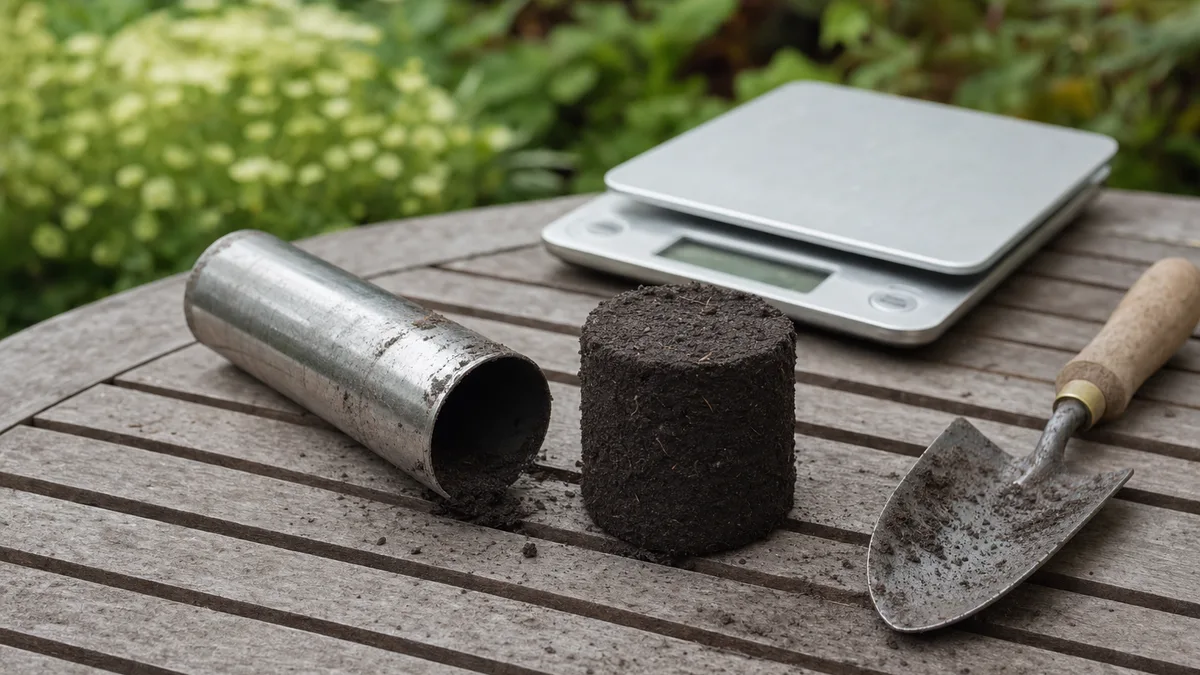
NRCS measures bulk density with a 3-inch diameter aluminum ring driven 3 inches into the soil. A length of pipe of about that size does the same job in a garden. The pipe is our adaptation: NRCS describes a ring, and we found no extension guide written for a can or pipe. The steps below follow the NRCS Soil Health Guide, and Oklahoma State Extension advises that a core diameter of 5 cm (2 inches) or larger is ideal.
You will need the pipe, a mallet and a block of wood, a trowel and a flat knife, resealable bags, a kitchen scale, a paper plate or ceramic cup, a 1/8 cup measuring scoop, and a microwave. NRCS lists a scale with 1 gram precision.
- Clear the surface. Remove any residue from the spot you are sampling.
- Drive the pipe in 3 inches. Use the mallet and block of wood so the pipe goes straight down. NRCS leaves the top 2 inches of its ring above the surface.
- Lift out the core. Cut around the outside of the pipe, slide the trowel underneath so no soil falls out, and lift. Trim the soil flush with the bottom with the knife. Oklahoma State says to discard the sample if there is evidence of compaction during collection.
- Weigh the moist soil. Put the whole core in a labeled bag and weigh it, then weigh an identical empty bag and subtract.
- Take a subsample. Knead the bag to mix the soil, scoop a level 1/8 cup of loose soil onto the weighed plate, and weigh it.
- Dry the subsample. NRCS microwaves it in 4-minute cycles at medium power until dry, then weighs it again.
- Do the arithmetic. Work out the core volume, the soil water content, the dry weight of the core and the bulk density, using the table above.
Worked Example: Bulk Density of Soil Calculation
The numbers below are made up to show the arithmetic. They are not measurements from a real bed. Suppose you press a 3-inch diameter pipe 3 inches into a loam, so the core has a radius of 1.5 inches and a height of 3 inches.
| Step | Working | Result |
|---|---|---|
| Core volume | 3.14 × 1.5 × 1.5 × 3 = 21.2 cubic inches; one cubic inch is 16.387 cm³ | 347.3 cm³ |
| Moist core weighed | Weighed with the bag, minus the empty bag | 520 g |
| Subsample weights | Moist 40 g, after microwaving 33 g | 40 g and 33 g |
| Soil water content | (40 − 33) ÷ 33 | 0.212 g/g |
| Dry weight of the core | 520 ÷ (1 + 0.212) | 429.0 g |
| Bulk density | 429.0 ÷ 347.3 = 1.235, rounded | 1.24 g/cm³ |
| Porosity | 1 − (1.24 ÷ 2.65) | 0.53, or 53 percent pore space |
| Weight per cubic foot, dry | 1.24 × 62.4 | About 77 lb |
Compare the 1.24 result with the loam row in the next section. NRCS says a loam below 1.40 g/cm³ is ideal for plant growth, so this made-up bed is in good shape. The same 1.24 would be well above the clayey ideal of 1.10, which is why texture matters when you read the result.
Bulk Density Ranges by Soil Texture
Roots tolerate a different amount of packing in different soils, so NRCS gives separate limits by texture in its Soil Quality Indicators sheet.
| Soil texture | Ideal for plant growth (g/cm³) | Restricts root growth (g/cm³) |
|---|---|---|
| Sandy | Below 1.60 | Above 1.80 |
| Silty | Below 1.40 | Above 1.65 |
| Clayey | Below 1.10 | Above 1.47 |
The NRCS Soil Health Guide is more specific for two common garden textures. For sand and loamy sand it gives the same below 1.60 ideal and above 1.80 limit. For sandy loam and loam it gives below 1.40 as ideal and above 1.80 as restricting. For clay soil with under 45 percent clay it gives below 1.10 and above 1.47. NRCS says these values do not apply to red clayey soils or volcanic ash.
Note the pattern: the finer the soil, the lower the bulk density at which roots start to struggle. A clay bed packed to 1.5 g/cm³ is past the limit, while a sandy bed at the same density is under the ideal ceiling. Not sure which row you are in? The jar test in the Soil Type Calculator above sorts it out.
Bulk Density and the Weight of Soil
Bulk density also tells you how heavy soil is, which matters when you order it by the yard. For how much soil a new bed takes, see our guide to soil for a 4x8 raised bed. Penn State’s silt loam figure of 82.99 pounds of dry soil per cubic foot becomes 82.99 × 27 = about 2,241 pounds per cubic yard, or roughly 1.1 tons. Moist soil weighs more than that, because the figure counts dry soil only. Our Topsoil Calculator uses 1.2 tons per cubic yard as a middle estimate, and its FAQ explains that a loam at the NRCS ideal of under 1.40 weighs under about 1.18 tons per cubic yard dry.
If you are choosing between topsoil, garden soil and compost, our guide to topsoil vs garden soil compares them, and our complete guide to soil and amendments covers the rest.
Common Soil Bulk Density Mistakes
- Using moist weight instead of dry weight. The formula is dry weight over volume. NRCS corrects the moist core with the soil water content from a subsample, as in the worked example.
- Compacting the sample while taking it. Oklahoma State says to discard a sample if there is evidence of compaction during collection, because it would read denser than the soil really is.
- Judging the number against the wrong texture. A value that is ideal for sand can restrict roots in clay. Check the row for your texture first.
- Mixing units. NRCS reports g/cm³. Penn State converts to pounds per cubic foot with 62.4. Do not compare a figure in one with a limit in the other.
- Using the table where it does not apply. NRCS says its root-growth values do not apply to red clayey soils or volcanic ash.
Free book · 23 pages, PDF
Soil Bulk Density FAQ
What is soil bulk density?
NRCS defines it as the dry weight of soil divided by its volume, and calls it an indicator of soil compaction. It is usually written in grams per cubic centimeter. The volume includes the pore spaces, so a loose, crumbly soil has a lower bulk density than a packed one.
What is a good bulk density for garden soil?
It depends on texture. NRCS gives below 1.60 g/cm3 as ideal for sandy soil, below 1.40 for silty soil and below 1.10 for clayey soil. Roots are restricted above 1.80 in sandy soil, above 1.65 in silty soil and above 1.47 in clayey soil. For a loam, the NRCS Soil Health Guide gives below 1.40 as ideal.
Is there a dry density formula for soil that differs from bulk density?
We found no extension source that treats them as different measurements. NRCS and Oklahoma State Extension both define bulk density on a dry basis: the mass of dry soil solids divided by the total volume of the soil. If you see a formula for dry density, it is the same ratio. Moist density, which includes the water, is a different number.
Does a soil density measurement need lab equipment?
NRCS's field method uses a 3-inch ring, a scale with 1 gram precision, a measuring scoop and a microwave oven. Oklahoma State describes drying a core at 105 degrees Celsius for at least 24 hours, which is a laboratory oven. We found no extension guide written for a garden pipe or can, so the pipe method here is our adaptation of the NRCS ring. It still needs a scale.
What does high bulk density do to plant roots?
NRCS says compaction can result in shallow plant rooting and poor plant growth. It also reduces water infiltration, which can increase runoff and erosion, and high bulk density signals low porosity, which can impair the movement of air through the soil.
How much does a cubic foot of soil weigh?
Penn State Extension uses a bulk density of 1.33 g/cm3, which approximates a silt loam, and a conversion factor of 62.4 to get 82.99 pounds of dry soil per cubic foot. That is about 2,241 pounds per cubic yard. Moist soil weighs more, so treat the dry figure as a floor when you plan a delivery.
Sources & further reading
The definition, the units, the texture limits and the effects of compaction come from the USDA NRCS Soil Quality Indicators: Bulk Density sheet. The core method, the formulas for volume, soil water content and bulk density, and the finer texture table come from the NRCS Bulk Density Soil Health Guide.
The formula notation, the core diameter advice, the oven drying conditions, the particle density assumption and the porosity formula come from Oklahoma State University Extension’s Basics of Soil Bulk Density. The pounds-per-cubic-foot conversion comes from Penn State Extension’s What is an acre furrow slice of soil?. All pages were read in October 2026. For how we source the facts behind every guide, see our methodology page.
Free book · 23 pages, PDF
The Soil & Amendments Cheat Sheet
Sent