The short answer to how to fill a raised garden bed: a blend of roughly 60% topsoil, 30% compost, and 10% perlite or coarse sand, not straight soil dug from the yard and not, despite what a lot of DIY advice suggests, a base layer of logs or gravel to cut costs. The real way to save money is depth and sourcing, not what’s mixed into the soil itself, and that’s the part most guides skip.
This covers how to fill a garden bed of any size: what the mix should actually be, how much of it you need, and the legitimate ways to cut the cost of filling a deep bed without hurting drainage or starving your plants of nitrogen.
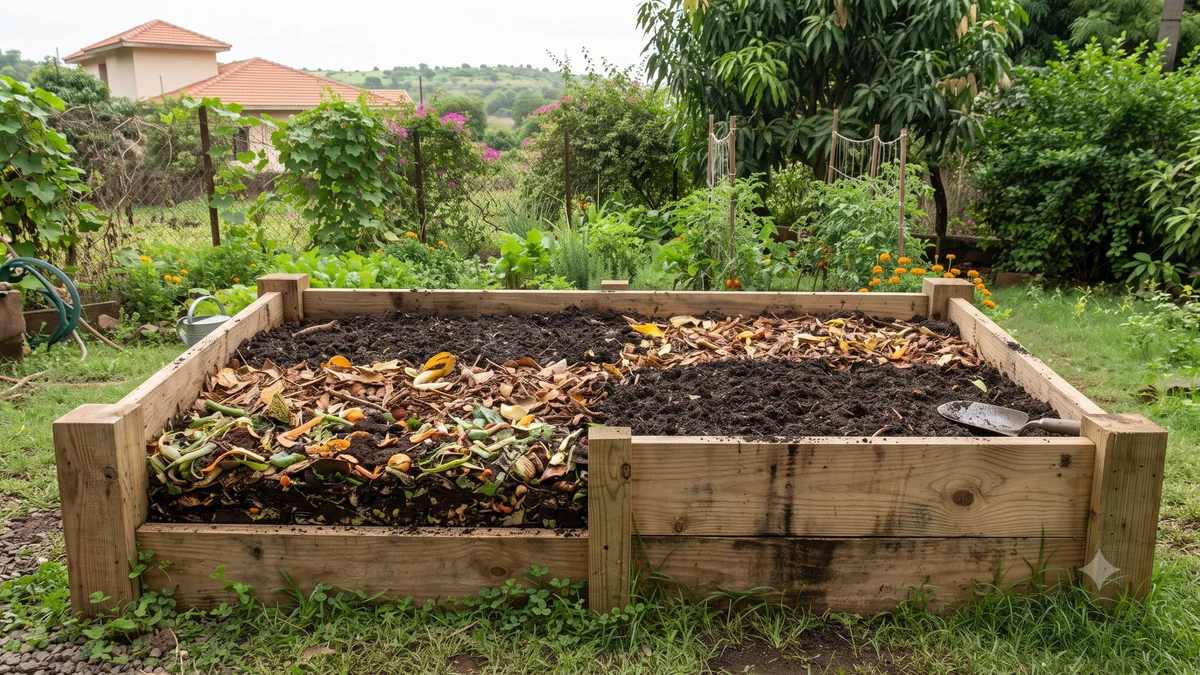
What to Fill a Raised Garden Bed With
Skip straight garden soil or topsoil dug from your own yard. On its own, it compacts hard inside a boxed-in bed, drains poorly, and doesn’t hold the nutrients a densely planted bed needs. The problem is structural, not just nutritional: native soil forms fine particles packed together by years of settling and foot traffic, and scooping it into a raised frame doesn’t undo that. There’s nothing left holding pore space open once it’s watered in, so roots hit a dense, low-oxygen block a few inches down instead of the loose root run a raised bed is supposed to offer. So what to fill raised garden bed with instead? A real blended mix. The standard one, the same ratio our own Raised Bed Soil Calculator is built around, is 60% topsoil, 30% compost, and 10% perlite or coarse sand for drainage. Topsoil provides the bulk, compost supplies nutrients and moisture retention, and the perlite or sand keeps the whole mix from compacting under its own weight. Our Compost Calculator works out how much compost you’ll need for that 30% share, for any bed size.
That’s not the only legitimate formula. A 50/30/20 blend (more perlite or sand, less topsoil) works better for heavier native soils that need extra drainage help. Square Foot Gardening’s well-known “Mel’s Mix” skips topsoil entirely for equal thirds compost, peat moss or coco coir, and vermiculite. Any of the three is a genuine raised bed filler; what actually hurts a bed is skipping the blend altogether and using one material straight.
Buying a pre-mixed bagged “raised bed soil” is the convenient version of the same thing: most brands approximate one of these same ratios, so check the label rather than assuming. It costs more per cubic foot than blending your own topsoil, compost, and perlite or sand separately, but for a single small bed the convenience is often worth the markup. For multiple beds, or anything over a cubic yard, blending your own from separately sourced ingredients gets meaningfully cheaper.
How Much Will You Actually Need?
Filling a raised garden bed always comes down to the same equation: footprint times depth, and it adds up fast: a standard 4×8 bed at 12 inches deep takes 32 cubic feet, more than a cubic yard. Rather than do that math by hand, run your bed’s exact dimensions through the Raised Bed Soil Calculator for cubic feet, cubic yards, bag counts, and estimated weight. If your bed happens to be a 4×8, we’ve also published the full depth-by-depth breakdown for a 4x8 bed, covering every common depth from 6 to 18 inches.
One practical note before you order anything: measure your bed’s interior dimensions, not the outer frame. Wall thickness eats an inch or two off both length and width, which is a bigger swing than it sounds on a smaller bed, and it’s an easy way to end up a bag or two short.
Filling Deep Beds Without Buying All That Soil
Depth is where the real cost lives. A 12-inch bed needs 50% more soil than an 8-inch one over the same footprint, and past about 18–24 inches, buying the entire volume as bagged or even bulk soil gets expensive fast. Search how to fill a raised garden bed cheap and most advice jumps straight to one shortcut: stuff something free into the bottom, without checking whether that actually works at the depth involved.
Sourcing matters as much as the mix once you’re filling more than a bed or two. Bagged soil is convenient, but it runs roughly 3–5x more per cubic foot than the same material bought in bulk from a landscape supplier, even after factoring in delivery. The crossover point is around 2 cubic yards (about 54 bags at 1.5 cu ft each), past which a bulk quote almost always beats a cart full of bags at the garden center.
Logs, branches, and other bulky organic matter at the bottom of a bed (hugelkultur, or lasagna-style bottom-filling) is a real, legitimate technique, but it’s built for mounds two to three feet tall or more that mature over several years. In a standard 10–12 inch bed, buried wood ties up nitrogen while it decomposes, and the bed sinks as the wood breaks down and compresses, so you lose the depth you paid to avoid buying. We’ve made the full case for this, including the university extension research on nitrogen tie-up and how often a properly built hugelkultur mound needs rebuilding, in our guide to filling methods and cost-saving options in a 4x8 raised bed; the short version is that it’s a genuinely useful technique, just not at this depth.
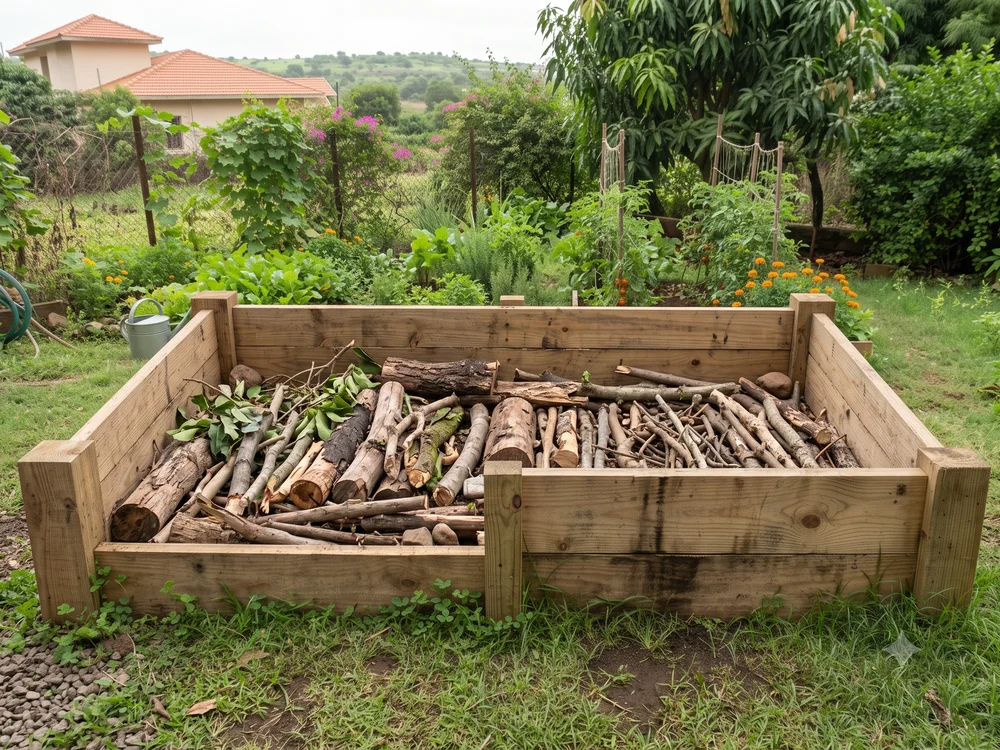
What you shouldn’t use as filler at any depth: treated lumber (the preservatives can leach into soil growing food), plastic, rubber, or anything else that won’t break down or that might leach into what you’re eating. If it wouldn’t compost, it doesn’t belong under a vegetable bed.
The actual cheapest way to fill raised beds is one most guides skip entirely: check whether the bed needs to be filled to the brim at all. If it sits directly on native soil or grass (not a patio, deck, or other hard surface), roots aren’t stopped by the bottom of the frame. They grow on past it into the ground below. Match fill depth to what you’re actually growing: shallow crops like lettuce, radishes, and most herbs don’t need a 12-inch bed filled to the top, even if the frame itself is that tall. That’s the one adjustment that actually cuts your soil bill, rather than swapping in a free material that creates a different problem.
Layering: Does Order Matter?
There’s a lot of advice out there on how to fill raised garden beds, and one piece of it gets repeated more than any other: cardboard at the bottom, then a layer of gravel, then soil on top. The cardboard part holds up. If your bed sits on grass or weeds, cardboard or a few sheets of newspaper at the very bottom is a reasonable raised bed filler for suppressing what’s underneath: it blocks light long enough for the grass to die back, then breaks down on its own.
The gravel part doesn’t hold up nearly as well. It’s sold as improving drainage, and Washington State University Extension’s research on drainage material in plantings found close to the opposite: water won’t move from a finer material into a coarser one underneath it until the finer layer is fully saturated first, so a gravel layer doesn’t drain water out faster: it holds more water above itself before any drains through at all. That research is specifically about containers and pots, where the effect is most pronounced because the vessel is sealed; an open-bottom raised bed sitting on the ground can still shed excess water sideways and down into the native soil in a way a sealed pot can’t. But the core mechanism (a coarse layer under a fine one doesn’t pull water down faster) doesn’t change just because the bed is open underneath. Skip the gravel. It isn’t doing what it’s sold as doing, and it eats into the soil depth you’re paying for.
From there, order is simple: coarse organic matter, if you’re using any at real hugelkultur depth, goes at the very bottom, then your growing mix on top, deepest where you need the most root room. There’s no benefit to further layering once you’re above the weed barrier.
Settling and Topping Up
Filling raised garden beds is never really a one-time job. Whatever mix you use, expect it to drop: loose soil typically settles 10–20% of its volume in the first season alone, as organic matter breaks down, watering compacts loose material, and air pockets close up. Fill a couple of inches proud of the frame when you first build the bed, and plan to top it off with a bag or two each spring. That’s normal maintenance, not a sign you did something wrong or bought the wrong mix.
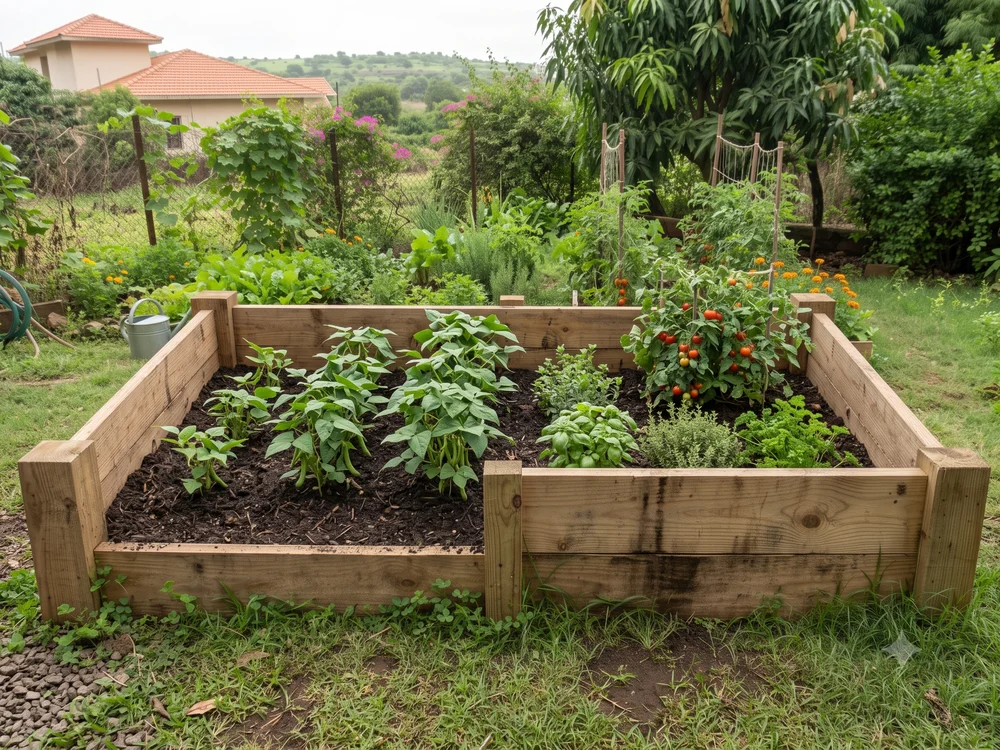
That’s really the whole picture of how to fill raised beds well: the right mix, filled to the depth your crops actually need, expecting it to settle and topping off in spring rather than treating settling as a problem to solve.
Ready to fill yours? Our Raised Bed Soil Calculator runs the exact cubic feet, cubic yards, bags, and weight for your bed’s real dimensions and depth.
Free book · 23 pages, PDF
How to Fill a Raised Garden Bed FAQ
What is the best way to fill a raised garden bed?
The best way to fill raised garden beds is a real blended mix (60% topsoil, 30% compost, 10% perlite or coarse sand), filled to 8-12 inches deep for most vegetables. Skip straight garden soil, since it compacts, and skip a gravel layer at the bottom, since it doesn't improve drainage the way it's often sold. Use the Raised Bed Soil Calculator above for the exact amount your bed needs.
What is the cheapest way to fill a raised bed?
Match your fill depth to what you're growing rather than filling the whole frame. If the bed sits on native soil or grass, roots grow past the bottom of the frame anyway, so shallow crops like lettuce and herbs don't need a 12-inch bed filled to the brim. That cuts your soil volume without hurting the mix. Bulk soil from a landscape supplier also costs far less per cubic foot than bagged once you're filling more than about 2 cubic yards.
What should I put on the bottom of a raised garden bed?
If the bed sits on grass or weeds, cardboard or a few sheets of newspaper is a reasonable base layer to suppress what's underneath: it blocks light and breaks down on its own. Skip a gravel or rock layer above that; research on drainage material in plantings has found it doesn't improve drainage the way it's commonly advertised, since water won't move into a coarser layer until the finer material above it is fully saturated.
Can I fill a raised bed with just compost?
No, straight compost is too rich and too fine on its own, and it breaks down and compacts faster than a proper blend. It's one ingredient in the mix, about 30% of the total, not the whole thing. Pair it with topsoil for bulk and perlite or coarse sand for drainage.
How do I fill a raised garden bed cheap without hurting drainage?
Buy bulk soil instead of bagged once your bed is larger than roughly 2 cubic yards. Bulk runs 3-5x cheaper per cubic foot. Don't cut the compost or aeration component to save money; a mix that's mostly cheap topsoil compacts and drains poorly, which costs more in plant losses than the soil it saved.
Is bagged or bulk soil cheaper for filling a raised bed?
Bulk is cheaper per cubic foot once you're past roughly 2 cubic yards of soil (about 54 bags at 1.5 cu ft each), even after paying for delivery. Below that threshold, bagged soil's convenience usually outweighs the markup, especially for a single small bed where a bulk delivery minimum wouldn't be worth it anyway.
Sources & further reading
The 60/30/10 mix ratio, bag sizing, and settling estimate above come from our own Raised Bed Soil Calculator. For the hugelkultur bottom-filling research and depth-by-depth soil volumes, see our guide to soil and filling methods for a 4x8 raised bed. For the drainage-layer research cited above, see Washington State University Extension’s “The Myth of Drainage Material in Container Plantings”. For more on how we source and verify the facts behind every calculator and guide on this site, see our methodology page. And for the bigger picture on topsoil, garden soil, compost, and mulch, see our complete guide to soil and amendments.