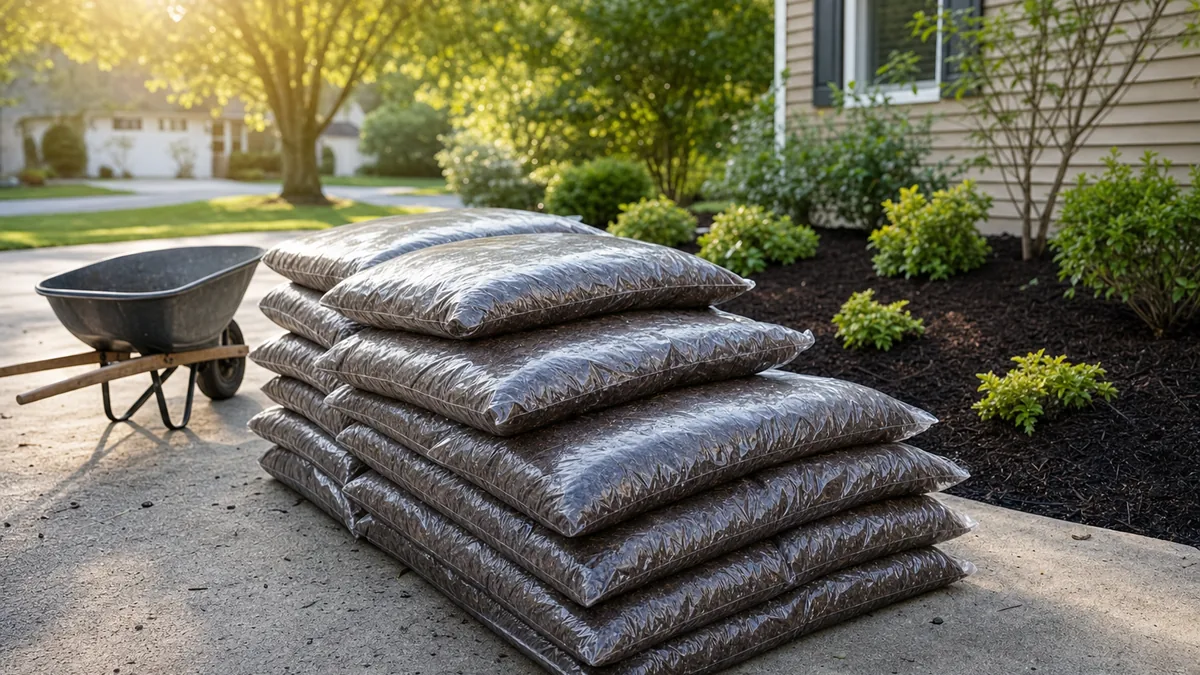
A cubic yard is 27 cubic feet, according to Mississippi State University Extension, so it takes 13.5 bags of 2 cubic foot mulch (buy 14), 9 bags of 3 cubic foot mulch, or about 22 bags of 1.25 cubic foot mulch. Divide 27 by the cubic feet printed on the bag, then round up. If you have not picked a material yet, read organic vs. inorganic mulch first.
| Bag size | Bags in 1 cubic yard | Buy |
|---|---|---|
| 1.25 cu ft | 21.6 | 22 bags |
| 2 cu ft | 13.5 | 14 bags |
| 3 cu ft | 9 | 9 bags |
How Many Bags of Mulch Are in a Cubic Yard?
The arithmetic never changes: bulk mulch is sold by the cubic yard, bags are sold by the cubic foot, and 27 cubic feet make one yard. Mississippi State University Extension states the conversion plainly, “One cubic yard equals 27 cubic feet,” and the University of Georgia describes the same figure as 3 feet by 3 feet by 3 feet. To find your bag count, divide 27 by the bag size on the label. A 2 cubic foot bag gives 27 ÷ 2 = 13.5, a 3 cubic foot bag gives 27 ÷ 3 = 9, and a 1.25 cubic foot bag gives 27 ÷ 1.25 = 21.6.
Which bag sizes exist? Mississippi State says bagged mulch is available “in amounts such as 1.25 cubic feet or 2.0 cubic feet,” and its Southern Gardening column buys 3 cubic foot bags. The University of Georgia adds that some products are labeled in dry quarts instead, most commonly a 20-quart bag, which it puts at roughly three-fourths of a cubic foot. That would be 27 ÷ 0.75 = 36 bags to the yard, which is why a cheap-looking small bag is easy to misjudge. Georgia also counts a 10-cubic-yard delivery as about 270 one-cubic-foot bags, so a plain 1 cubic foot bag works out to 27 per yard. Bag sizes vary between brands and stores, so read the number printed on the bag rather than assuming. The same division works for bagged soil, and our 4x8 raised bed soil chart turns bed depth into bag counts for the soil that goes under the mulch.
Round up, and round once
You cannot buy half a bag, so round up. Thirteen and a half bags of 2 cubic foot mulch is 14 in practice, and 21.6 bags of 1.25 cubic foot mulch is 22. Mississippi State’s own worked example does the same thing: 33 cubic feet divided by 1.25 gives 26.4, and the publication says you will need 27 bags. The one trap is rounding too early. If you need three cubic yards, multiply first and round at the end.
| Order size | Cubic feet | 2 cu ft bags | 3 cu ft bags |
|---|---|---|---|
| 1 cubic yard | 27 | 14 (13.5) | 9 |
| 2 cubic yards | 54 | 27 | 18 |
| 3 cubic yards | 81 | 41 (40.5) | 27 |
| 5 cubic yards | 135 | 68 (67.5) | 45 |
Three separate single-yard purchases would be 42 bags of 2 cubic feet, one more than the 41 you need for three yards bought together.
How Many Bags of Mulch Are on a Pallet?
There is no single answer, because the count depends on the bag size and on who is selling. No university extension publishes a standard pallet count, so the most reliable numbers come from the sellers’ own listings, and they differ. Master Landscape Supply lists a pallet of 70 bags at 2 cubic feet each, “140 cu. ft. total (5.19 Cubic Yards).” Lukas Nursery lists a pallet of 70 bags of 2 cubic feet and describes it as approximately 5 yards. The Mill sells a 70-bag pallet of 2 cubic foot pine bark mulch. A Home Depot listing for a cypress blend, though, is a pallet of 75 bags of 2 cubic feet, and it says the pallet covers 150 cubic feet.
So for 2 cubic foot bags, 70 is the count in most of the listings we checked and 75 is a real exception. For 3 cubic foot bags and every other size, we could not verify a count from a source, so we are not giving one. Ask the seller, or read the pallet listing, before you plan a job around it.
You can turn any pallet into yards yourself: bags per pallet times cubic feet per bag, divided by 27. A pallet of 70 bags at 2 cubic feet is 140 ÷ 27 = 5.19 cubic yards, which matches the seller’s figure. A pallet of 75 is 150 ÷ 27 = 5.56 cubic yards. Either way, a pallet is roughly five cubic yards, not one, so it only makes sense for a big job. If new raised beds are part of that job, how to fill a raised garden bed shows how much soil each one takes before you mulch it. For how far a yard spreads at each depth, see how many cubic feet are in a yard of mulch, and for the general conversion see how many cubic feet are in a cubic yard.
How Many Bags of Mulch Do I Need for a Bed?
Work out the square footage, pick a depth, and convert to cubic feet. The University of Georgia puts it this way: divide the area by 12 to get the cubic feet needed for 1 inch of mulch, then multiply by the number of inches you want. Mississippi State’s older Southern Gardening column gives a yard-based shortcut: one cubic yard covers 324 square feet at 1 inch deep, so square feet times depth in inches, divided by 324, gives cubic yards. UF/IFAS Extension agrees, saying a cubic yard covers 324 square feet at 1 inch deep, or 108 square feet at 3 inches.
Worked example: a 9 by 14 foot bed at 3 inches
- Area: 9 × 14 = 126 square feet. For a round bed, use 3.14 × radius × radius, the circle method in the same Mississippi State column.
- Volume: 126 × 3 ÷ 12 = 31.5 cubic feet.
- Cubic yards: 31.5 ÷ 27 = 1.17, which matches 126 ÷ 108 from the UF/IFAS coverage figure.
- 2 cubic foot bags: 31.5 ÷ 2 = 15.75, so buy 16.
- 3 cubic foot bags: 31.5 ÷ 3 = 10.5, so buy 11.
- 1.25 cubic foot bags: 31.5 ÷ 1.25 = 25.2, so buy 26.
At 1.17 cubic yards, this bed sits just past one yard. Buying 16 bags is fine for a single weekend, but it is the point where a bulk quote is worth a phone call.
How deep should the layer be?
Depth drives the whole count, so decide it before you shop. UF/IFAS Extension says Florida-Friendly Landscaping recommends 3 inches, with no more than 3 inches applied. The Alabama Cooperative Extension System lists 2 to 3 inches for wood chips and pine bark. Rutgers Cooperative Extension says total mulch depth, counting last year’s layer, should not exceed 3 inches, or 2 inches on compacted or poorly drained soil. The table shows what 100 square feet needs at the three depths most people choose.
| Depth (100 sq ft) | Cubic feet | Cubic yards | 2 cu ft bags | 3 cu ft bags |
|---|---|---|---|---|
| 2 in | 16.7 | 0.62 | 9 | 6 |
| 3 in | 25 | 0.93 | 13 | 9 |
| 4 in | 33.3 | 1.23 | 17 | 12 |
The 4 inch row agrees with Mississippi State’s worked example for a 100 square foot bed: 33 cubic feet, which is one cubic yard plus 5 cubic feet, or 17 bags of 2 cubic feet. The 3 inch row agrees with its Southern Gardening column, which says a 100 square foot bed at 3 inches takes nine of the 3 cubic foot bags. Going deeper than the sources suggest does not help the plants. Piling it on is one of the errors in our guide to the 8 mulch mistakes that hurt plants, and so is guessing the amount at the store.
Bagged or Bulk Mulch: Where Does It Switch?
Bags win on convenience and bulk wins on price per cubic foot, and the sources agree on both halves. The Alabama Cooperative Extension System says, “If large quantities are required, buying bulk loads of mulch is less expensive than buying mulch by the bag.” The University of Georgia says bags are the cleanest and most convenient way to move mulch, “But it’s not the cheapest,” while loose bulk is messy and needs a truck with an open bed. Mississippi State tells readers to compare bulk prices with bagged prices before buying. None of them names a dollar break-even, because prices differ too much by region.
You can find your own break-even with three numbers from local sellers: the price of one bag, the price of one bulk cubic yard, and the delivery fee. For 2 cubic foot bags, a yard costs 13.5 times the bag price. Bulk is cheaper once the saving per yard, 13.5 times the bag price minus the bulk price, adds up to more than the delivery fee. Put differently, the break-even order in cubic yards is the delivery fee divided by that per-yard saving. If the saving per yard is small, you need a large order to cover delivery. If it is large, bulk wins on a single yard.
Three more checks decide it in practice:
- Minimum order. The University of Georgia notes that delivered bulk usually carries a minimum, which its column puts at 10 cubic yards, about 270 one-cubic-foot bags. That column dates from 2003, and minimums vary by supplier, so ask.
- Pallet price. Divide the pallet price by its cubic yards (5.19 for 70 bags of 2 cubic feet) to get a price per yard you can set against a bulk quote.
- Hauling and dumping. The University of Georgia notes that bulk is messy and needs a truck with an open bed, so factor in where the load will be dropped and how you will move it.
The same bag-versus-yard comparison applies to bagged soil, bagged compost and any other bulk material you might order alongside the mulch.
Settling, Rounding Up and Topping Up
Organic mulch does not stay at the depth you spread it. UF/IFAS Extension says organic mulches “settle, reducing the depth of your mulch layer” as they decompose, and that it is time to replenish when the depth falls below 2 inches. Its example is pine bark, which a UF/IFAS study found keeping two-thirds of its original depth after two years. The sources we used give no single settling percentage for fresh mulch, so do not rely on one. Plan on a thinner layer next spring than the one you spread today.
That has two practical effects on what you buy. First, you do not re-buy a full layer. Rutgers says total depth should not exceed 3 inches counting old mulch, and UF/IFAS recommends adding another thin layer on top rather than replacing the old one, which it says can damage surface roots. If the old layer has dropped to 1 inch and you want 3, you add 2 inches. On 100 square feet that is 16.7 cubic feet, or 9 bags of 2 cubic feet. If it has dropped to 2 inches, you add 1 inch, or 5 bags. The Alabama Cooperative Extension System also advises raking old mulch to break apart matted layers before adding more.
Second, round up generously on a first application. A bed edged by uneven ground, a tree ring, or a layer spread by eye will use more than the formula says. Round to whole bags, and add a bag or two if the bed is irregular. A spare unopened bag is easy to use later, while a half-finished bed means another trip. If you are mulching ahead of winter, the timing and depth are covered in our guide to winterizing your garden.
Free book · 23 pages, PDF
Bags of Mulch in a Yard FAQ
How many bags of mulch are in a cubic yard?
It depends on the bag size: divide 27 by the cubic feet on the bag. Mississippi State University Extension says one cubic yard equals 27 cubic feet, so 2 cubic foot bags give 13.5 (buy 14), 3 cubic foot bags give 9, and 1.25 cubic foot bags give 21.6 (buy 22). Always check the volume printed on the bag, since sizes vary by brand.
How many bags of mulch are on a pallet?
It varies by bag size and seller. Master Landscape Supply and Lukas Nursery list 70 bags of 2 cubic feet per pallet, about 5 cubic yards, while a Home Depot cypress blend listing has 75 bags of 2 cubic feet, covering 150 cubic feet. We could not verify a count for other bag sizes, so check the listing or ask the seller.
How many 2 cubic foot bags of mulch are in a yard?
13.5, so buy 14. A cubic yard is 27 cubic feet (Mississippi State University Extension), and 27 divided by 2 is 13.5. Because you cannot buy half a bag, round up. For larger orders, multiply before rounding: 3 cubic yards is 81 cubic feet, or 41 bags, not 42.
How many 3 cubic foot bags of mulch are in a yard?
Exactly 9. A cubic yard is 27 cubic feet (University of Georgia Extension: 3 feet by 3 feet by 3 feet), and 27 divided by 3 is 9. Mississippi State's Southern Gardening column uses the same bag: 100 square feet at 3 inches deep comes to a bit under a cubic yard, and it says to buy nine of the 3 cubic foot bags.
How many bags of mulch do I need for 100 square feet?
At 3 inches deep, 100 square feet needs 25 cubic feet: 13 bags of 2 cubic feet or 9 bags of 3 cubic feet. At 2 inches it is 9 bags of 2 cubic feet, and at 4 inches 17. UF/IFAS Extension recommends mulching to 3 inches and says a cubic yard covers 108 square feet at that depth.
Is bagged or bulk mulch cheaper?
Bulk is cheaper for large quantities, according to the Alabama Cooperative Extension System, while the University of Georgia says bags are the most convenient but not the cheapest option. The switch point depends on your local bag price, bulk price per yard and delivery fee, and the University of Georgia notes that delivered bulk often has a minimum order. Compare local quotes before deciding.
Sources & further reading
The 27 cubic feet per yard conversion, the 1.25 and 2.0 cubic foot bag sizes, the 100 square foot worked example and the advice to compare bulk with bagged prices come from Mississippi State University Extension’s Mulches for the Landscape. The 324 square feet per yard shortcut and the 3 cubic foot bag example are from its Southern Gardening column Calculate Mulch, Soil Needs for Plant Beds (1997, flagged by the site as possibly outdated; the arithmetic is unchanged). Dry quart bags, the area-divided-by-12 method, the bulk minimum and the bagged versus bulk trade-offs are from University of Georgia horticulturist Wayne McLaurin’s 2003 column Rough calculations easy with garden-variety math. Depth, coverage and settling figures are from UF/IFAS Gardening Solutions, Choosing and Installing Mulches. Depth ranges by material and the bulk price statement are from the Alabama Cooperative Extension System’s Mulches for the Home Landscape, and the 3 inch total depth limit is from Rutgers NJAES Problems With Over-Mulching Trees and Shrubs (FS099). Pallet counts come from seller listings, which are not extension data and change: Master Landscape Supply, Lukas Nursery, The Mill and a Home Depot listing. For more on how we source and review the facts behind every calculator and guide on this site, see our methodology page. And for the full picture on mulch alongside topsoil, garden soil and compost, see our complete guide to soil and amendments.
Free book · 23 pages, PDF
The Soil & Amendments Cheat Sheet
Sent