The best time to plant winter rye is about 30 days before your first expected fall frost, according to UMass Extension, and no later than three weeks before the first killing frost, according to University of Minnesota Extension. Rye is forgiving, though: Penn State Extension says it can go in as late as early November, because it still germinates at 35°F. This guide covers rye as a cover crop for home beds, not the grain crop, and its cousin winter wheat has its own dates.
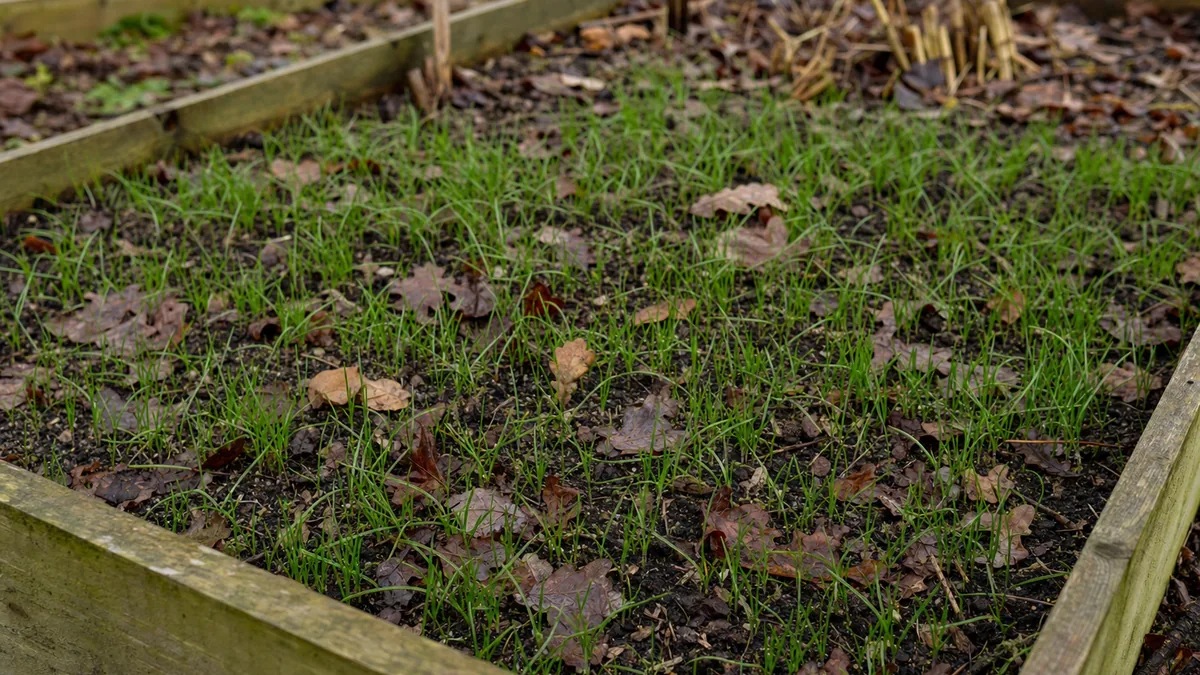
When to Plant Winter Rye at a Glance
Extension services give different windows because they write for different climates. Count back from your own first frost date rather than copying a calendar date from another state.
| Situation | Window or limit | What to do | Source |
|---|---|---|---|
| Home garden beds, general rule | About 30 days before the first expected frost; rye can go a little closer | Count back from your first frost date | UMass Extension |
| Minnesota | By mid-October, and not later than 3 weeks before the first killing frost | Sow earlier (September to early October) for more spring growth | University of Minnesota Extension |
| Vermont and the Northeast (farm trials) | A four-week window centered on the first frost date | Sow inside the window; later sowing gave less cover | UVM Extension |
| Illinois | Early October | Broadcast 4 to 5 lb per 1,000 sq ft | University of Illinois Extension |
| Pennsylvania home gardens | Up to early November | Broadcast, rake in lightly, mist with water | Penn State Extension |
| Kentucky | August in the north and east to mid-November in the west | Match the date to your part of the state | University of Kentucky Extension |
| Colorado vegetable garden | After a killing frost has ended the crop | Clear the bed, broadcast 2 lb per 1,000 sq ft, rake lightly | Colorado State University PlantTalk |
| Spring kill | 2 to 3 weeks before planting vegetables | Mow, then turn under before it flowers | UMN and Penn State Extension |
When Do You Plant Winter Rye? Count Back From First Frost
UMass Extension says cover crops should be planted about 30 days before the first expected frost, and that winter rye and winter wheat may be planted a little closer to that date because most of their growth happens in early spring. University of Minnesota Extension is more specific about the late edge: plant winter rye by mid-October, not later than three weeks before the first killing frost. It adds that planting from September to early October lets rye build more biomass and compete better with weeds the next spring.
So the sources agree on roughly three to four weeks ahead of frost as the target, and they disagree about how much slack you get after that. University of Vermont Extension tested sowing dates in field trials at research farms in seven Northeastern states and found the best results from a four-week window centered on each site’s historic first frost date, two weeks before and two weeks after. Sowing after that window cut ground cover by 57 percent and biomass by 44 percent across the trials. Those were farm plots, but the pattern applies to a garden bed: every week of delay means less rye going into winter.
Your first frost date is the number everything hangs on. Our guide to what temperature frost forms explains why the date on the calendar is an average, not a promise, and the calculator below gives you the average first fall frost for your ZIP code.
The growing zones pages show how cold your winters run, and the planting calendar by ZIP code shows what else belongs on the calendar that month. The whole job sits on the fall chore list in our winterize your garden guide, where sowing a cover crop is one of seven steps.
When Can You Plant Winter Rye? How Late Is Too Late
Later than most cover crops, but not without a cost. Penn State Extension’s home garden advice is that winter rye can be planted until November and will germinate in soil as cool as 35°F. The University of Kentucky Extension gives a mid-November end date for the western part of that state, and Colorado State’s PlantTalk simply says to sow after you have cleared the garden following a killing frost. USDA NRCS says cereal rye has excellent winterhardiness and one of the latest seeding windows of the cover crops it covers.
The catch is growth. Rye sown in late fall makes a thin stand that does less before winter, and UVM Extension says that when it is sown around the time of the first light frost the plants will be small, so use a higher seeding rate. Its field trials also found that higher rates could not fully make up for the growing days lost to late sowing. So a date near the end of a published window is a trade: you gain a covered bed and lose some growth. A thermometer check helps, and our soil temperature guide shows how to take the reading.
If the window has closed completely, a bed left bare is not the only alternative. Penn State’s guidance for gardens includes oats and wheat at the same 4 pounds per 1,000 square feet as rye, and our list of what to plant in winter covers crops that can still go in for a cold-season harvest.
How to Plant Winter Rye, Step by Step
The steps below combine the home garden guidance from Illinois, Penn State, Colorado State and UMass Extension. They are written for a garden bed, not an acre of field.
- Clear the bed. Pull spent crops and weeds once the last harvest is in. Colorado State says to sow after you have cleared the garden following a killing frost, and Illinois Extension says to weed and rake the surface so the seed has grooves to settle into. If the bed is part of a rotation, succession planting sets which crop finishes last.
- Measure the area. Length times width in feet gives square feet, and seed is bought by weight.
- Pick a seeding rate. This is where the extension pages differ, as the next list shows. The home garden sources below run from about 2 to 5 pounds per 1,000 square feet, and UVM Extension says to use a higher rate for late sowing or a rough seedbed.
- Broadcast the seed evenly. Hand scattering works on a small bed. Spread it evenly across the bed.
- Cover the seed. Penn State says to lightly rake it in, and Colorado State says to rake lightly and water. UVM Extension says rye should not be sown more than 2 inches deep, and the University of Kentucky table lists 1 to 2 inches. Because rye is more depth-sensitive than some grains, shallower is safer than deeper.
- Water to start it. Colorado State says two or at most three fall waterings are enough to germinate and establish rye. Illinois Extension is stricter, saying to water every other day, skipping days with rain in the forecast, until the rye is 4 to 6 inches tall.
Seeding rates for home beds, as the sources give them:
- Colorado State PlantTalk: 2 pounds per 1,000 square feet.
- UMass Extension: 2 to 4 ounces per 100 square feet of garden (our arithmetic: about 1.25 to 2.5 pounds per 1,000 square feet).
- University of Wisconsin Extension: 2 to 3 pounds per 1,000 square feet for winter cover crops in general, with the amount varying by species.
- University of Kentucky Extension: 3 to 4 pounds per 1,000 square feet for rye.
- Penn State Extension: 4 pounds per 1,000 square feet.
- University of Illinois Extension: 4 to 5 pounds per 1,000 square feet.
The range is wide, so treat the low end as the minimum for a cover that arrives early and the high end as insurance for a rough seedbed or a late sowing. The calculator below turns your bed size into pounds and ounces of seed.
Is Winter Rye the Same as Ryegrass?
No, and the confusion explains why people search for winter rye grass. USDA NRCS says cereal rye (Secale cereale) is vastly different from both annual and perennial ryegrasses, which are Lolium species. Cereal rye is a grain and cover crop with large seed that weighs 56 pounds per bushel, while annual ryegrass has much smaller seed at 26 pounds per bushel. NRCS also says annual ryegrass has a shorter seeding window and is more susceptible to winterkill, which is part of why it is a poor stand-in for rye as a cold-weather cover.
Ryegrass has a different job in lawns. In warm climates, bermudagrass lawns are overseeded with ryegrass for winter color, a temporary use covered with extension rates in can you plant grass seed in the winter. If a seed bag says winter rye, check the Latin name or the label: cereal rye or Secale is the cover crop for beds, and rye grass or Lolium is the lawn seed.
Is Winter Rye Worth Planting? Benefits and Downsides
Winter rye does several jobs in a home garden, and the extension pages agree on most of them. UVM Extension lists erosion control, deep roots that reduce compaction and improve tilth, a tolerance for drought, low fertility and a soil pH range from 4.5 to 8.0, and scavenging of leftover nitrogen so it does not leach away. Illinois Extension adds winter weed suppression, because rye planted before winter annuals germinate outcompetes them, and a mulch of residue that can hold moisture if spring turns dry. Colorado State says it adds two seasons of plant growth for soil improvement in one year.
The compaction benefit matters most on tight soils, and a core test shows whether you have the problem: our guide to soil bulk density explains how to measure compaction and what the ranges mean. If you plan to leave the cut rye on top as a mulch, organic vs. inorganic mulch explains how organic mulches behave on the soil.
The downsides are real, and they all show up in spring:
- Seed germination. UVM Extension says rye can inhibit the germination of small-seeded vegetables planted soon after it is incorporated, while large-seeded crops and transplants are rarely affected. UConn Extension adds that smaller seeds are more affected than larger ones, and that the effect is plant-specific.
- Nitrogen tie-up. UVM Extension says mature rye residue decomposes slowly and can immobilize nitrogen, and UMass Extension warns of a temporary nitrogen deficiency for crops planted while it decomposes. A soil test shows where you stand, as how to read soil test results explains.
- Too much growth. The University of Kentucky says rye resumes growth early in spring and may produce too much top growth if not killed soon enough. After a wet spring that delays tillage, it suggests avoiding rye in a garden altogether.
- Hard to turn under. UMass Extension says tilling should be done as early as possible, because the longer rye grows the harder it is to turn under.
When to Kill Winter Rye in Spring, and How Long Before Planting
Rye greens up early. Illinois Extension says it resumes growth in early March and can reach chest height by April, so spring management starts sooner than most gardeners expect. The sources describe the same sequence with slightly different numbers.
- Cut it before it flowers. Penn State Extension says to cut plants down before they flower so they do not go to seed, and UConn Extension says the proper timing for mowing is during flowering, before the rye sets seed. Mowing earlier lets it regrow, according to UVM Extension.
- Pick the right height to turn it under. Penn State says to turn it under when it is 10 to 12 inches tall, and UVM says between 12 and 18 inches while it is still succulent. Colorado State says it reaches 6 to 12 inches by spring.
- Mow low, let it dry, then dig. Illinois Extension says to mow as close to the soil as possible, or use a string trimmer, let the cut rye dry for a day or two of warm weather, then till 3 to 4 inches deep to kill the roots. UConn Extension says the residue from mowing can be left as mulch or tilled in, and if you would rather compost the cut tops, what can you compost lists what belongs in the pile.
- Wait before planting. The wait is the part sources disagree on, and the table below gives it.
| Source | Wait before planting |
|---|---|
| UMass Extension | About 2 weeks for rye to decompose |
| University of Illinois Extension | Terminate about 2 weeks before the transplant date |
| University of Minnesota Extension | At least 2 to 3 weeks before vegetable planting |
| Penn State Extension | At least 2 to 3 weeks after turning it under |
| UConn Extension | 2 to 4 weeks after tillage, and about 2 weeks to ease allelopathy |
| University of Kentucky Extension | 4 to 6 weeks if killed with a herbicide, for allelopathy in gardens |
So the range is about 2 to 6 weeks, with 2 to 3 weeks the most common answer. Penn State’s cereal rye guide, written for field crops, says recent research suggests the allelopathic effect fades within about a week of termination and plays only a minor role in weed suppression, which fits the shorter waits. The University of Minnesota notes that terminating closer to planting extends weed suppression but can compete with the vegetable crop for nutrients and water. For large-seeded crops and transplants the shorter wait is the safer bet, and the Illinois article transplants tomatoes and peppers into the residue in late May. If you are growing your own plants, how to grow tomatoes from seed has the indoor schedule to line up with the rye kill date.
Putting the dates on one calendar is the fiddly part: sowing date in fall, mowing before flowering, a 2 to 3 week gap, then transplant day. The Season Planner app works out your frost dates, the next job and the seeds to buy for your own garden in one plan, and you can see how the Season Planner works before you decide. On paper, the rule is simple: count back 30 days from your first frost for sowing, and count back 2 to 3 weeks from planting day for the spring kill. For more on timing and spacing across the garden, browse the spacing and planting hub.
Free book · 23 pages, PDF
When to Plant Winter Rye FAQ
When do you plant winter rye?
About 30 days before your first expected fall frost, according to UMass Extension. University of Minnesota Extension says to plant by mid-October and not later than three weeks before the first killing frost, and that earlier sowing in September gives more spring growth. Penn State Extension says winter rye can go in as late as early November.
When can you plant winter rye if you are late?
Into November in many areas, with a smaller stand. Penn State Extension says winter rye germinates in soil as cool as 35 degrees F, and University of Kentucky Extension gives mid-November for western Kentucky. UVM Extension found late sowing reduced ground cover and biomass, so use a higher seeding rate.
How do you plant winter rye in a garden bed?
Clear the bed, broadcast the seed evenly, rake it in lightly and water. Colorado State PlantTalk gives 2 pounds per 1,000 square feet and Illinois Extension 4 to 5 pounds. UVM Extension says not to sow rye more than 2 inches deep. Keep the soil moist until the seedlings are 4 to 6 inches tall, per Illinois Extension.
How long before planting vegetables should I kill winter rye?
At least 2 to 3 weeks, according to University of Minnesota Extension and Penn State Extension. UConn Extension says to wait 2 to 4 weeks after tillage, and the University of Kentucky suggests 4 to 6 weeks when a herbicide is used. Transplants and large seeds tolerate residue better than small seeds, says UVM Extension.
Is winter rye the same as winter rye grass?
No. USDA NRCS says cereal rye (Secale cereale) is vastly different from annual and perennial ryegrasses (Lolium). Annual ryegrass has smaller seed and a shorter seeding window, and NRCS says it is more susceptible to winterkill than cereal rye. Buy cereal rye for a garden cover crop.
Does winter rye take nitrogen from the soil?
It can, temporarily. UVM Extension says mature rye residue decomposes slowly and can tie up nitrogen, and UMass Extension warns of a temporary deficiency for crops planted while the residue breaks down. Cutting rye while it is young and waiting the full 2 to 3 weeks reduces the problem.
Sources & further reading
Planting windows and the spring kill come from UMass Extension’s cover crop growing tips, University of Minnesota Extension’s fall cover crops post, Penn State Extension’s tips for planting cover crops in home gardens, University of Illinois Extension’s cereal rye garden reset article, Colorado State University PlantTalk on winter rye and University of Kentucky Extension’s Winter Cover Crops for Kentucky Gardens and Fields. Sowing date trials, the winter rye fact sheet and management details are from UVM Extension’s sowing dates and seeding rates report, UVM’s Winter Rye: A Reliable Cover Crop, UConn Extension’s Managing Cover Crops in Spring, Penn State Extension’s Cereal Rye as a Cover Crop and University of Wisconsin Extension’s cover crops and green manures article. The rye and ryegrass comparison is from USDA NRCS’s Rye: Which is Which. For how we source the facts on this site, see our methodology page.
Free book · 23 pages, PDF
The Spacing & Planting Cheat Sheet
Sent