How to Use This Calculator
- Enter your bed length and width, or switch to Total area.
- Choose how you will sow: broadcast (scattered, then raked in) or drilled in rows.
- Pick one cover crop, or switch to a mix of two or three and set each species’ percentage of its full rate.
- Read the low, typical and high pounds and ounces (or grams and kilograms). Type your seed price to add a cost.
Cover Crop Seeding Rates by Species
Every figure below comes from a published extension or SARE table, and the numbers follow the Imperial or Metric setting in the calculator. The “per 1,000 sq ft” column is the pounds-per-acre rate divided by 43.56, which is the unit gardeners see on seed packets.
How Much Cover Crop Seed Do I Need?
Seed packets and extension tables give a rate per acre or per 1,000 square feet, so the work is scaling that rate to your bed. Divide your area in square feet by 43,560 to get acres, then multiply by the rate in pounds per acre. A bed of 600 sq ft is 0.0138 acre, so at 26 lb per acre it takes about 0.36 lb of seed. That is why the amounts for small beds are best read in ounces.
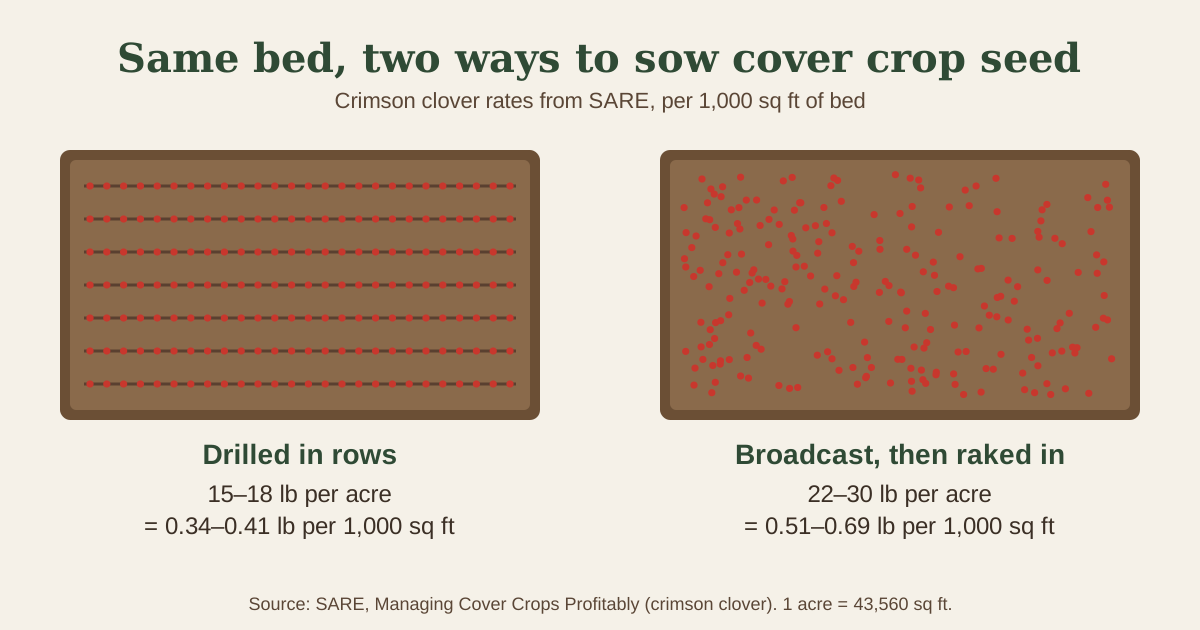
The calculator shows three amounts. Low and high are the two ends of the published range for the crop and method you picked. Typical is the midpoint of that range, which we use because the sources do not name a single best number. SARE advises higher rates for hairy vetch when seeding in spring, late in the fall, or into a weedy or sloped field, so if your site looks like that, lean toward the high end.
Broadcast vs Drilled Rates
Most home gardeners broadcast: scatter the seed by hand or with a small spreader, rake it in lightly, and water. Drilling puts seed at an even depth in rows, usually with a seed drill or a hand seeder, and needs less seed. The Midwest Cover Crops Council puts the difference at 20 to 50 percent more seed for broadcasting without incorporation and 10 to 20 percent more when the seed is shallowly incorporated. The Southern Cover Crops Council gives the same 20 to 50 percent figure.
The calculator does not apply a multiplier. It uses the broadcast and drilled ranges each source publishes for that crop, and the “Broadcast vs Drilled” toggle switches between them. Mississippi State Extension’s table is written the other way around, listing broadcast rates and noting that they can be cut 20 to 30 percent with a seed drill, which fits the same pattern.
Worked Example
Say you have a 20 × 30 foot vegetable plot you want to sow with crimson clover by broadcasting in late summer.
- Area: 20 ft × 30 ft = 600 sq ft.
- Acres: 600 ÷ 43,560 = 0.01377 acre.
- Rate: SARE gives 22 to 30 lb per acre broadcast, so the typical (midpoint) rate is 26 lb per acre.
- Typical seed: 0.01377 × 26 = 0.358 lb, which is about 5.7 oz, or 6 oz.
- Range: 22 lb per acre gives 0.303 lb (5 oz) and 30 lb per acre gives 0.413 lb (7 oz).
Now make it a mix of crimson clover and winter rye using SARE’s guidance of clover at about two-thirds of its rate and the other crop at one third to one half. Clover at 67 percent is 26 × 0.67 = 17.4 lb per acre, or 0.240 lb (4 oz) for the plot. Winter rye at 40 percent of its 125 lb per acre broadcast midpoint is 50 lb per acre, or 0.689 lb (11 oz). The total to buy is about 0.93 lb, or 15 oz. To price it, multiply each species’ pounds by your own price per pound.
In metric, the same plot is about 56 m² and the typical crimson clover amount is about 162 g.
Common Cover Crop Seeding Mistakes
- Using a farm rate without converting it. A rate in pounds per acre is not pounds per bed. Divide your square feet by 43,560 first, or let the calculator do it.
- Skipping the broadcast increase. The Midwest Cover Crops Council says broadcast rates need to run 10 to 50 percent above drilled rates to get an adequate stand, so use the broadcast figures when you do not have a drill.
- Sowing too late. SARE notes that delaying oats by even two weeks in late summer can reduce their effectiveness as a spring weed fighter. Count back from your first frost date.
- Burying small seed. Crimson clover, annual ryegrass and radish are sown only about 1/4 to 1/2 inch deep (SARE and Mississippi State Extension), and SARE says winter rye should go no deeper than 2 inches.
- Sowing buckwheat too early. SARE says to plant buckwheat after all danger of frost.
- Ignoring seed quality. Mississippi State Extension’s legume rates are for pure live seed, and pretreated legume seed is about half treatment by weight, so check the tag for the PLS percentage.
- Letting the crop set seed or leaving it too close to planting. Penn State Extension advises cutting cover crops when or just before they flower, and turning them under at least two to three weeks before planting the garden.
Cover Crop Seed Calculator FAQ
How much cover crop seed do I need per 1,000 square feet?
It depends on the crop and how you sow. Converting SARE’s broadcast rates, 1,000 sq ft takes about 0.5 to 0.7 lb of crimson clover, 0.6 to 0.7 lb of hairy vetch, 0.5 to 0.7 lb of annual ryegrass, 2.1 to 3.7 lb of winter rye, 2.2 to 2.9 lb of oats and 0.3 to 0.5 lb of daikon radish. Penn State Extension’s home-garden guide is higher for some crops: 4 lb per 1,000 sq ft for winter rye and oats, 1 to 2 lb for annual ryegrass and clovers, and 1 lb for tillage radishes. Both are published figures, which is why the calculator shows low, typical and high amounts instead of a single number.
Can I use this as a cover crop mix calculator?
Yes. Switch What are you sowing to Mix of 2 to 3, pick up to three species, and set each one’s percentage of its own full rate. The calculator gives pounds and ounces for each species and a total to buy. The preset buttons start from published guidance, for example SARE’s advice to sow crimson clover at about two-thirds of its normal rate and the other crop at one third to one half of its monoculture rate. Percentages are yours to change; there is no single published split that fits every garden.
Is this a cover crop seeding rate calculator for acres as well as garden beds?
It works from 100 sq ft up to an acre and beyond, because every rate is stored in pounds per acre and scaled to your area. Choose Total area and type 43,560 sq ft for one acre (about 4,047 m² in metric). The rates come from extension and SARE tables written for field seeding, so on a large plot, check them against your local extension office and seed supplier.
Why do broadcast rates run higher than drilled rates?
Scattered seed has less contact with soil and more of it is lost, so more is needed to get the same stand. The Midwest Cover Crops Council says to increase the rate 20 to 50 percent over drilled rates when broadcasting without incorporation, and 10 to 20 percent with shallow incorporation. SARE’s published ranges show the same pattern: crimson clover is 15 to 18 lb per acre drilled and 22 to 30 lb broadcast, and winter rye is 60 to 120 lb drilled and 90 to 160 lb broadcast. Raking the seed in lightly after scattering helps.
Why do different sources give different seeding rates for the same cover crop?
They describe different regions, seed sizes and seedbeds. Winter rye is 90 to 160 lb per acre broadcast in SARE’s guide but 60 to 90 lb in Mississippi State Extension’s publication, and SARE allows as much as 300 to 350 lb for late fall broadcasting. Rather than average them, the calculator uses one published range per crop and lists the other published figures in the table above, so you can pick the end of the range that fits your site and sowing date.
When should I sow a cover crop in my garden?
Each crop has its own window, listed in the table above. In short: crimson clover about 6 to 8 weeks before the average first frost, hairy vetch 30 to 45 days before the first killing frost, oats at least 40 to 60 days before a killing frost, winter rye from late summer to midfall in Zones 3 to 7, and buckwheat only after all danger of frost has passed. Our Frost Date Calculator gives your average first frost so you can count back from it.
Does coated or inoculated seed change how much I buy?
It can. Mississippi State Extension notes that its legume rates are for pure live seed (PLS), and that legume seed pretreated with fungicide or inoculant is approximately 50 percent seed and 50 percent treatment by weight. If the tag shows a PLS percentage, divide the pounds the calculator gives by that percentage (as a decimal) to get the weight to buy. For coated seed with no PLS on the tag, ask the supplier how much of the weight is actual seed.
How do I estimate what my cover crop seed will cost?
Type your supplier’s price into the Seed price box, per lb in Imperial or per kg in Metric. The calculator multiplies it by the pounds for each rate, so you see a typical cost and the low and high ends. In a mix, each species has its own price box and the total adds them up. It does not guess prices, so with nothing typed it shows pounds only.
Sources & further reading
Seeding rates, sowing windows and depths come from these published sources. SARE’s Managing Cover Crops Profitably (3rd edition) supplies the rates for crimson clover, cereal rye, hairy vetch, oats, annual ryegrass and radish, and the mix guidance. The SARE oat rates are in bushels; we convert them at 32 lb per bushel, the standard oat bushel weight stated by Iowa State University Extension.
Buckwheat rates are from University of Missouri Extension’s “Growing Buckwheat for Grain or Cover Crop Use” (G4163). Field pea rates and the PLS and coated-seed notes are from Mississippi State University Extension’s “Cover Crops: Seeding Rates and Planting Depths for Cool-Season Species” (P3425), with SARE’s field peas chapter as a cross-check. The home-garden comparison rates and the advice on cutting and turning under are from Penn State Extension’s “Tips for Planting Cover Crops in Home Gardens”.
The broadcast increase comes from the Midwest Cover Crops Council and the Southern Cover Crops Council. The radish cross-check is from Iowa State University Extension. For how we source and review the formulas behind every calculator, see our methodology page. For rates and timing that fit your region, check with your local extension office.
For how cover crops fit with compost, topsoil and mulch in a full bed plan, see our complete guide to soil and amendments.