The best time to plant winter wheat is in early to mid fall, just after your area’s Hessian fly-free date. Ohio State Extension puts the Ohio average at September 28, Penn State Extension lists Pennsylvania counties from September 20 to October 1, and K-State Research and Extension gives Kansas planting windows from September 10 to October 25, depending on the zone. It is one of the crops you can plant for winter: the seed sprouts in fall, rests through the cold and grows again in spring.
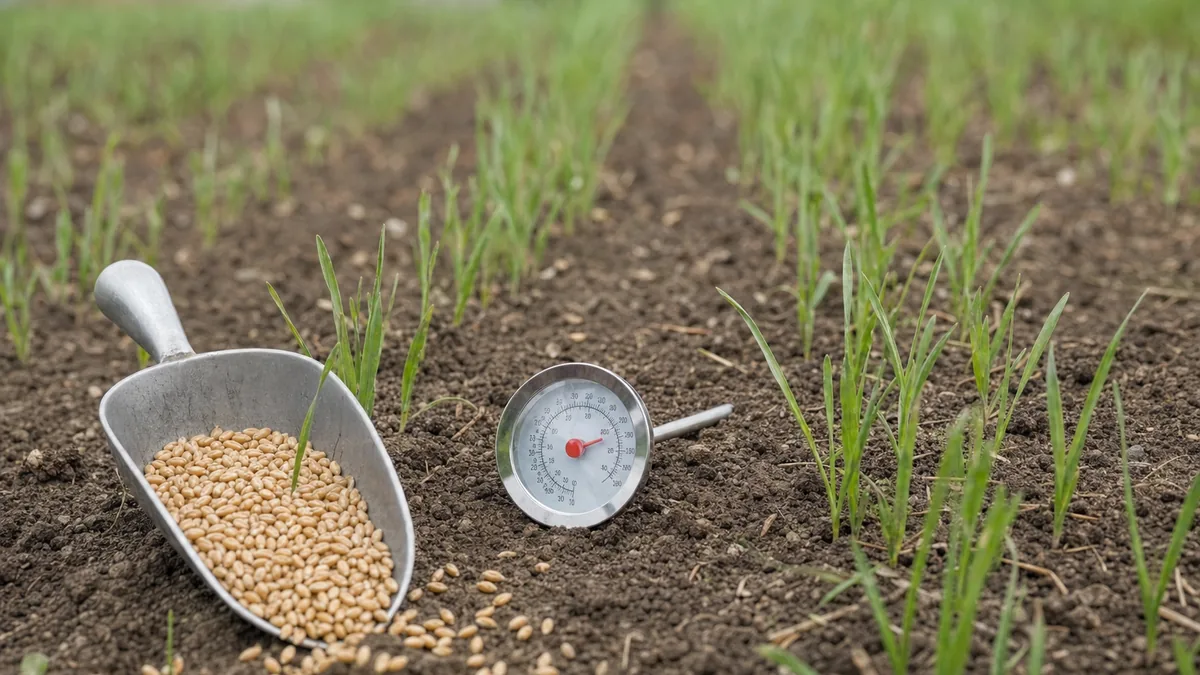
When to Plant Winter Wheat at a Glance
There is no single national date. Wheat is sown when the Hessian fly has finished its fall flight, and that date moves with latitude and elevation, as the growing zones by state pages suggest. This table gathers what each extension service below says, so you can find the row closest to you, then check your own county.
| Region | Planting window | What to do | Source |
|---|---|---|---|
| Kansas (zones 1 to 4) | September 10 to October 25, by zone | Plant within a week of the local fly-free date | K-State Research and Extension |
| Ohio | After September 28 on average (September 22 north to October 5 south) | Plant within 10 days after your fly-free date | Ohio State Extension |
| Pennsylvania | Fly-free dates September 20 to October 1, by county | Plant on or after your county date, a week later to be safe | Penn State Extension |
| Missouri | October 1 to 31 | Wait for the fly-free date, which runs late September to mid October | University of Missouri Extension |
| Alabama (north, central, south) | Trial standard dates October 30, November 6, November 13 | Trial yields dropped when sown 30 days later | Alabama Extension |
| Pacific Northwest dryland | Late August to the third week of September for top yield; mid to late October is late | Plant early where moisture allows | Oregon State Extension |
| Home garden, west of the Cascades | Mid September to mid October | Sow 1 cup of seed per 100 square feet | Washington State University Extension |
These are windows, not rules, so check your county before you buy seed. Wheat is one of several fall jobs, and the planting calendar by ZIP code lists what else to sow at the same time.
When Is Winter Wheat Planted? Start With the Hessian Fly-Free Date
The Hessian fly is a small midge whose larvae feed on wheat stems. University of Missouri Extension says the fly-free planting date and resistant varieties are the most effective management tools, and that wheat sown on or after the date for your region should avoid fall damage, because most adult flies die before the crop emerges. For Missouri it gives October 1 in the north and October 18 in the southeast. A University of Missouri IPM article gives a slightly different span, September 28 along the Iowa border to October 17 in the bootheel, and calls the fly-free date the optimum date for planting wheat. The two sources are a day or so apart at each end, so treat the dates as a guide and ask your county office for the current date. Fly-free dates come from insect biology, not frost, but your first frost date shows how much fall growing time you have left.
Other states publish their own ranges. Ohio State Extension says the average Ohio fly-free date is September 28, and a fall management newsletter from the same university says it varies from September 22 in the northernmost counties to October 5 in the southernmost, with the best planting time within 10 days after it. Penn State Extension lists county dates, among them September 20 for Potter County, September 27 for Centre, September 30 for Lancaster and October 1 for Franklin. Penn State notes that page was last updated in 2012 and that the dates may be somewhat soft after warmer autumns, so it suggests considering planting a week or so later. K-State’s wheat handbook gives no single Kansas fly-free date and says to ask your county agent. It does say that planting within a week of the local date usually allows enough time for good fall growth.
Planting far ahead of that date has costs beyond the fly. K-State Agronomy lists wheat streak mosaic, barley yellow dwarf, armyworms, root and crown diseases and excessive fall growth that drains soil moisture. It also says some varieties will not germinate when soil is above 85°F, which is why our guide to soil temperature for planting is worth a read before you sow in a warm September. Frost dates vary by source too, as we explain in Farmer’s Almanac frost dates vs. NOAA.
How Late Can You Plant Winter Wheat?
Later than the fly-free date by a few weeks is usually possible, but yield falls. Oregon State Extension, writing about Pacific Northwest dryland wheat, says late planting in mid to late October can cost 5 to 15 bushels per acre or more in some years and places. In Alabama Extension’s trial plots, the latest planting date lost 16 to 55 percent of yield against the standard date at the southern site in all three years, and 21 percent at the northern site in two of the three years (1 percent in the third). The Missouri IPM article says the loss depends on fall weather, with warm autumns letting late wheat grow and tiller more, and that the data are too limited to give a firm rule.
Tillers are the key. K-State says a winter wheat plant under usual conditions will have three to six tillers, that tillers form in fall and make most of their growth in spring, and that growers aim for three to five tillers before winter dormancy. Late planting reduces tillering. K-State and University of Minnesota Extension both advise raising the seeding rate as planting is delayed. Minnesota puts the target stand at 21 to 23 plants per square foot, and 23 to 25 when planting is late or the seedbed is poor.
In short, each week past the window costs yield, and the sources agree the fix is a thicker seeding rate rather than a later calendar. Garlic is the other classic fall job with a closing window, and our guide on how to plant garlic shows how that timing works for a home bed. The same goes for the harvest side, and when to harvest garlic covers lifting the bulbs the next summer.
How Does Winter Wheat Overwinter? Vernalization Explained
Winter wheat has to be chilled before it will make grain. South Dakota State University Extension says winter wheat needs an extended period of temperatures below 40°F to trigger its reproductive phase the next spring, and that without a cold period it will not produce seed. The required time varies by variety. For the southeastern United States, Alabama Extension says most winter varieties need three to seven weeks of vernalization, with the effect strongest near 40°F, and warns that a prolonged warm spell in winter can undo accumulated chilling and reduce head formation or yield. K-State describes the same biology from the plant’s side: exposure to low winter temperatures is what induces jointing, and without it the plant keeps making leaves.
Hardiness builds as fall shortens. K-State says shorter days and falling temperatures prompt the plant to develop a high level of cold hardiness, with most varieties shifting from upright to a low, spreading growth form. Hardiness is usually greatest in early winter and fades gradually. South Dakota State puts the crown survival limit of the hardiest varieties at about minus 15°F, so check the variety against your own winter lows. Our explainer on USDA hardiness zones shows how winter lows are mapped, and the finder below gives your zone from a ZIP code. For a garden bed, a few inches of straw or similar cover is a normal part of protecting plants in winter.
How Do You Plant Winter Wheat? Seeding Rate and Depth
Start with the home garden scale, then see the field numbers. Washington State University Extension’s home garden cover crop guides list winter wheat at 1 cup of seed per 100 square feet. That rate is the one to use for a bed, a raised bed or a garden plot. WSU’s table for the west side of the Cascades lists mid to late September and early to mid October as planting dates. The same guide cautions that planting before late September makes wheat more susceptible to disease and premature death, so the later part of that range looks safer.
- Find your date. Look up your county’s Hessian fly-free date with your extension office, then plan to sow on it or within a week or two after. Ohio State says the best time is within 10 days after.
- Measure the seed. Use 1 cup per 100 square feet (WSU). A 10 by 10 foot bed takes one cup, and a 4 by 8 foot raised bed (32 square feet) takes about one third of a cup.
- Prepare a clean bed. Remove weeds and rake the surface level, so seed lands at an even depth.
- Sow at the right depth. Depth advice differs a little. University of Minnesota Extension says 1 to 1.5 inches, and warns that shallower than an inch raises winterkill risk. K-State calls 1 to 2 inches optimal, and the University of Missouri gives three quarters of an inch to 1.5 inches. Ohio State says shallow planting is a main cause of low tiller numbers and poor winter survival. An inch to an inch and a half sits inside all four ranges.
- Firm the soil and water if dry. Good contact between seed and moist soil gets the crop up so it can tiller before cold.
- Check fall growth. Look for the three to five tillers K-State describes by the time growth stops, then leave the bed alone through winter.
What about field-scale seeding rates per acre?
The extension recommendations per acre, for those buying seed in bulk: K-State gives 60 to 75 pounds per acre for eastern Kansas, 50 to 60 for central Kansas and 40 to 60 for the west. Ohio State gives 1.2 to 1.6 million seeds per acre, and warns that more than 30 seeds per foot of row increases lodging and the risk of severe powdery mildew the next spring. The University of Missouri puts it at 1.3 to 1.5 million pure live seed per acre. These are field drill rates, not a guide for a garden bed.
When Is Winter Wheat Harvested? Spring Growth to Harvest
Winter wheat is planted in fall and harvested the following summer. Cornell Cooperative Extension’s small grains guide describes the spring sequence for New York: tillers form after green-up, tillering ends by late April or early May, and jointing begins stem extension that runs through May. Heads appear in late May or early June, with flowering a few days later. Spring weather can shift heading by two to three weeks. Grain filling lasts about a month, and the crop is physiologically mature by early to mid July. That frees the bed for a later sowing, and succession planting explains how to fill the gap.
K-State puts numbers on ripeness. Physiological maturity comes at 30 to 35 percent kernel moisture, and combine-ripe grain is 12 to 13 percent moisture. K-State adds that grain must be harvested promptly after it ripens to save the yield. Cornell’s sequence is for New York, so expect your own dates to shift with your climate.
For a home plot, the practical cues are the ones in the sources: the heads turn from green to straw color and the kernels harden. Home-scale threshing is a different skill from field combining, and that is a topic for a grain-specific guide. If you enjoy following a grain through its growth stages, how rice grows shows the same sequence of tillering, heading and grain fill in a warm-season crop.
Can You Plant Winter Wheat as a Cover Crop?
Yes, and the planting dates are similar. Penn State Extension says to plant a winter wheat cover crop by mid to late September in northern Pennsylvania and up to mid-October in the south. Ohio State Extension gives a reliable establishment window of September 28 to November 1 and says to plant after the fly-free date. Penn State reports dry matter of more than 3,000 pounds per acre from early September plantings and up to 6,000 on fertile soils, while Ohio State lists 2,000 to 5,000 pounds per acre per year and calls wheat less effective at weed suppression than other cool-season cereals because it makes less biomass.
Seeding rates differ between the two states, which is worth knowing. Penn State recommends 1.5 to 1.7 million seeds per acre, about 100 to 120 pounds, in pure stands drilled, with an increase of about 20 percent for a poor seedbed or late planting. Ohio State lists 50 to 90 pounds per acre drilled. For a garden bed, WSU’s rate of 1 cup per 100 square feet applies. WSU also says wheat covers the ground quickly in fall but grows less vigorously than rye in early spring, and that its leafier growth breaks down faster once tilled in.
Timing in spring matters more than the sowing date. Penn State says to terminate about two to three weeks before planting the cash crop, Ohio State says at least 14 days before corn, and Purdue Extension’s home garden guide says to terminate cover crops two to four weeks before your anticipated planting date. If wheat is cut or tilled too close to planting, Ohio State warns of nitrogen tie-up. For the other cereal grain used as a winter cover, our guide on when to plant winter rye covers its timing, and the winterize garden checklist shows where a cover crop fits in the fall cleanup.
Fitting Winter Wheat Into Your Planting Plan
Planting winter wheat is a dated job, so write the dates down: your fly-free date, the sowing window, the spring termination date if it is a cover crop, and the July harvest. Our planting calendar by ZIP code and the frost dates pages give the frost side of that timeline. The Season Planner app puts the frost dates for your ZIP code, the next job and the seeds to buy into one plan, so a fall sowing like this one sits alongside everything else you grow.
For more on timing, spacing and what to sow next, the spacing and planting hub has the full set of guides.

Free book · 23 pages, PDF
When to Plant Winter Wheat FAQ
When is winter wheat planted?
In fall, after the Hessian fly-free date for your area. Ohio State Extension gives an Ohio average of September 28, Penn State Extension lists Pennsylvania counties from September 20 to October 1, and K-State Research and Extension gives Kansas windows between September 10 and October 25 depending on the zone.
When is winter wheat planted and harvested?
It is planted in fall and harvested the next summer. Cornell Cooperative Extension says winter wheat in New York is physiologically mature by early to mid July, and K-State says combine-ripe grain is 12 to 13 percent moisture, with prompt harvest after ripening needed to save the yield.
How late can you plant winter wheat?
A few weeks past the fly-free date is possible, but yield falls. Oregon State Extension says late planting in mid to late October can cost 5 to 15 bushels per acre or more in Pacific Northwest dryland wheat, and Minnesota Extension advises raising the target stand from 21 to 23 plants per square foot to 23 to 25 when planting is delayed.
When to plant winter wheat in Missouri?
Around the fly-free date, then through October. University of Missouri Extension gives fly-free dates of October 1 in the north and October 18 in the southeast, and a county quick reference gives a planting date range of October 1 to 31 at 1.3 to 1.5 million pure live seed per acre.
How do you plant winter wheat in a garden?
Sow it at 1 cup of seed per 100 square feet, about 1 to 1.5 inches deep, in fall. Washington State University Extension lists that cup rate for home gardens, and University of Minnesota Extension says seeding shallower than an inch increases the risk of winter kill.
How much winter wheat to plant per acre?
Extension rates run from about 40 to 75 pounds per acre in Kansas, depending on region, according to K-State. Ohio State Extension gives 1.2 to 1.6 million seeds per acre and the University of Missouri 1.3 to 1.5 million pure live seed per acre. Rates rise with late planting.
Does winter wheat need cold to make grain?
Yes. South Dakota State University Extension says winter wheat needs an extended period below 40 degrees F to trigger its reproductive phase and will not produce seed without it. Alabama Extension says most varieties need three to seven weeks of that chilling in the Southeast.
Sources & further reading
Planting windows, seeding rates, depth, tillers, hardiness and harvest moisture come from K-State Research and Extension’s Wheat Production Handbook and K-State Agronomy eUpdate on planting wheat too early. Ohio figures are from Ohio State Extension’s Wheat Management for Fall 2021 and Wheat as a Cover Crop in Ohio. Pennsylvania fly-free dates are from Penn State Extension’s Hessian Fly on Wheat, and cover crop dates and rates from Penn State Extension’s Winter Wheat as a Cover Crop. Missouri dates are from University of Missouri Extension’s Hessian Fly Management on Wheat, University of Missouri IPM’s article on delayed wheat plantings and its wheat management quick reference. Vernalization and late planting losses are from South Dakota State University Extension, Alabama Extension’s Planting Date and Variety Selection Effects on Wheat Yield and Oregon State Extension’s PNW 635. Stand targets and depth are from University of Minnesota Extension. Spring growth is from Cornell CALS’s small grains growth stages. Home garden rates are from WSU Extension’s Cover Crops for Home Gardens West of the Cascades and its East of the Cascades companion, with termination timing from Purdue Extension’s home garden cover crops guide. For how we source the facts on this site, see our methodology page.
Free book · 23 pages, PDF
The Spacing & Planting Cheat Sheet
Sent