How does rice grow? It is a warm-season grass that sprouts from seed, tillers into a clump, flowers as a panicle and fills its grain over a long, hot season, usually with water held over the field for most of that time. The University of Arkansas System Division of Agriculture lists planting at about 60°F soil, and its trial varieties reach 50 percent heading roughly 83 to 87 days after emergence. This guide covers the stages, how farmers plant it and how to try a pot at home. If you have read how asparagus grows, rice is a very different plant, and our spacing and planting guides cover the basics it builds on.
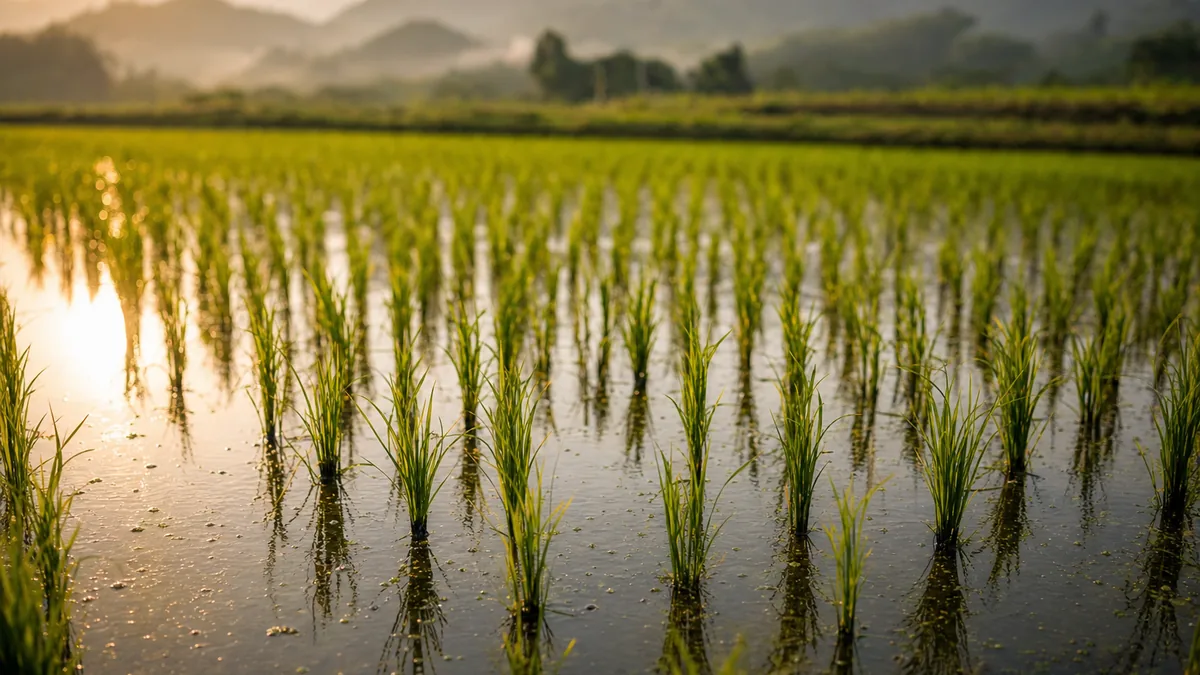
How Rice Grows at a Glance
| Topic | What the sources say | Source |
|---|---|---|
| Planting soil temperature | About 60°F at 4 inches deep; germination needs above 50°F | University of Arkansas |
| Seed depth (drilled) | 1/4 to 1 1/2 inch | University of Arkansas |
| Emergence to 50% heading | About 83 to 87 days for three trial varieties | University of Arkansas |
| Grain fill to maturity | 30 to 45 days | University of Arkansas |
| Field flood depth | 2 to 4 inches (Mississippi, Arkansas); 4 to 6 inches (California) | Mississippi State, UC Davis |
| Home pot | About 120 days from planting to seed in a 1 gallon pot | USDA Agricultural Research Service |
Rice Growth Stages from Seed to Grain
The University of Arkansas rice quick facts sheet splits the crop into two big phases. The vegetative phase runs from germination to panicle initiation, and the reproductive phase runs from panicle initiation to maturity. Its timeline shows the pace of each step.
- Germination and emergence. The seed swells and a shoot pushes up. Arkansas lists emergence at 5 to 28 days, depending mostly on how cold the soil is.
- Seedling and early leaves. From the first to the fourth leaf takes 15 to 25 days, which the sheet describes as roughly one leaf per week.
- Tillering. The plant sends up side shoots (tillers) from its base, forming a clump. Arkansas lists first to fourth tiller at 24 to 42 days.
- Panicle initiation and internode elongation. The reproductive phase begins when the plant starts forming the seed head inside the stem. The Arkansas quick facts sheet marks panicle differentiation at about 1/2 to 3/4 inch of internode elongation.
- Heading and flowering. Fifty percent heading is when half of the panicles start to push out of the leaf sheath, called the boot.
- Grain fill and ripening. The kernels fill and harden, taking 30 to 45 days to maturity according to the Arkansas quick facts sheet. The same sheet puts maturity at about 20 percent grain moisture.
Those day counts shift with weather, and cold soil is the biggest brake on emergence. Our post on soil temperature for planting explains why a seed sown into cold soil simply sits there.
How Long Does Rice Take to Grow?
There is no single answer, because it depends on the variety and the weather. The University of Arkansas Rice Management Guide lists days from emergence to 50 percent heading in its field trials as 83 for Antonio, 86 for Jupiter and 87 for Taggart. Add the 30 to 45 days of grain fill from the quick facts sheet and, by our arithmetic, a crop needs roughly 115 to 130 days after emergence, plus the days the seed takes to come up.
California numbers fit that picture. The UC Davis agronomy fact sheet on public California varieties groups them as Very Early, Early or Late, and says, for example, that M-206 matures four days later than M-104 and four days earlier than M-202. In other words, the spread between early and late varieties in one state is a matter of days, not weeks.
At home the numbers are similar. The USDA Agricultural Research Service backyard guide says a potted rice plant takes about 120 days from planting to produce seed. Arkansas also ties its heading and harvest predictions to the DD50 program, a heat-unit method. Heat units are the same idea as growing degree days, which you can work out for your own location.
How Farmers Plant Rice: Drill, Water Seeding and Transplanting
If you are wondering how to farm rice or how rice is planted at scale, there are three main methods. The USDA Economic Research Service says all U.S. rice is grown in irrigated fields, and that the method varies by region.
- Drill or broadcast into dry soil. The ERS says most Mississippi Delta producers drill or broadcast seed into dry seedbeds. Arkansas lists drilled rates of about 30 seeds per square foot for varieties and about 10 for hybrids, planted 1/4 to 1 1/2 inch deep. The goal is a final stand of 12 to 18 plants per square foot for varieties and 6 to 10 for hybrids.
- Water seeding. The ERS says California seeds primarily by air directly into flooded fields. Southwest Louisiana and the Texas Gulf Coast use both aerial seeding and dry drilling. Arkansas says water seeding is typically about 5 percent of its acres, uses a higher rate of 40 seeds per square foot for varieties, and recommends presoaking seed 24 to 36 hours and draining it 24 to 48 hours. The older reasons for water seeding were red rice (weedy rice) suppression and reduced labor.
- Transplanting seedlings. Rice in Asia is commonly grown by transplanting seedlings into puddled soil, according to CIMMYT. The same page puts transplanting labor at about 25 to 50 person-days per hectare, against about 5 for direct seeding. It notes that direct seeding was the dominant method before the 1950s and is now favored where wages are high or water is short.
So how do farmers plant rice in lowland areas? In the U.S. they overwhelmingly seed it directly, either dry or onto water. CIMMYT reports that 100 percent of U.S. rice area is direct seeded, while transplanting remains common across Asia. The ERS adds that four regions produce almost all the U.S. crop: the Arkansas Grand Prairie, the Mississippi Delta, the Gulf Coast of Texas and Louisiana, and California’s Sacramento Valley.
Timing is regional. The 2026 Arkansas quick facts sheet gives optimum seeding windows of March 25 to May 15 in the south, April 1 to May 10 in the center and April 5 to May 5 in the north of the rice area. LSU AgCenter’s recommendations, dated 2011, give March 15 to April 20 for southwest Louisiana and April 5 to May 10 for north Louisiana. LSU also says that planting by April 15 in southwest Louisiana gives a ratoon (second) crop the best chance, because the first crop should be harvested before mid-August.
Flooded Paddy vs Upland Rice
Rice does not need to stand in water to live, but most commercial rice is flooded on purpose. The FAO describes several growing systems.
- Irrigated lowland: bunded fields that hold water from rivers, reservoirs or wells.
- Rain-fed lowland: puddled, dyked fields that depend on rain or runoff, with shallow ponded water of 0 to 25 cm.
- Upland: unbunded fields that are prepared and seeded dry and depend on rainfall and soil moisture instead of standing water.
- Deep-water: fields with at least 1 m of water for part of the season, where tall varieties can elongate as water rises.
The FAO says water is kept in the field to suppress weeds, which is the main agronomic reason flooding became standard. Mississippi State University Extension says most rice acres in Mississippi and the U.S. use a system where rice is drill seeded and grown without flooding for about six weeks, then flooded for the next 10 to 14 weeks. It says that traditional flooding uses 30 to 36 inches of water per year.
Water saving is an active research area. Mississippi State reports that alternate wetting and drying cut water use by 23 to 39 percent in its plots, with yields staying at typical levels when the water was not allowed to drop more than 4 inches below the soil surface. Flood timing matters too. The Arkansas quick facts sheet says to apply the permanent flood at about the fifth leaf or first tiller stage.
Rice Water and Temperature Needs
Rice wants warmth first and water second. LSU AgCenter says germination is negligible at or below an average daily temperature of 50°F, climbs modestly from 50 to 55°F, and does not speed up much until temperatures pass 60°F. It adds that seedling survival is unsatisfactory until the average daily temperature is above 65°F. Arkansas aims for 60°F soil at 4 inches deep, and says germination requires temperatures above 50°F.
Seed too early and you pay for it. LSU lists slow emergence, more seedling disease in cool weather and more bird damage. Seed too late and yields fall, and bacterial panicle blight is linked to high day and night temperatures during pollination and grain fill. A Cornell CALS article on growing rice in New York puts the northern version bluntly, saying that if you plant too early frost kills the seedlings and if you plant too late the grains will not be ready for harvest. Winter wheat is the cool-season counterpart, planted in fall instead, and when to plant winter wheat covers its planting windows and harvest.
Flood depth varies by source. UC Davis says to hold a continuous 4 to 6 inches for growth and weed control in California. The Arkansas guide says to maintain a 2 to 4 inch flood for three weeks after flooding for nitrogen uptake, and a consistent flood deeper than 4 inches for blast disease management. Mississippi State describes standing water of 2 to 4 inches in its traditional system. Those ranges overlap, so treat 2 to 6 inches as the working band and follow your local extension guide for variety and disease conditions.
If you are working out whether your climate has enough warm days, the frost formation guide and your growing zone are a good first filter, and the hardiness zone explainer shows what the zone numbers do and do not tell you.
How to Grow Rice at Home
Can you grow rice in a backyard? Yes, on a small scale. Many people ask how to grow rice at home, and the best extension source we found is the USDA Agricultural Research Service handout Watching Rice Grow in Your Own Backyard. It is a container method, not a paddy. Because the container method keeps the soil wet, a rain barrel set up as in our rainwater collection system guide is a cheap way to keep the pots topped up.
- Choose the pot. Fill a 1 gallon pot with soil, potting mix or garden soil, leaving a 2 inch space at the top, per USDA ARS.
- Sow the seed. Plant rice seed 1/2 inch deep, about 6 seeds per container.
- Give light and moisture. Put the pot in full sun and keep the soil moist. USDA ARS says to water until water fills the shallow pan or saucer below.
- Wait for seedlings. Within about 10 days seedlings emerge, according to USDA ARS.
- Thin. Keep no more than 3 plants per pot, evenly spaced.
- Harvest. USDA ARS says it takes about 120 days from planting to produce seed. Harvest when the grain turns yellow and the seeds have hardened.
For a head start in a cooler climate, the Cornell CALS article describes starting seedlings in a nursery and transplanting them after the last frost, and says younger single seedlings grew faster and caught up with older ones. Growing rice in the ground follows the same warm-season logic as peanuts, another crop that needs a long, frost-free stretch. If you start seed indoors, our guide to leggy seedlings explains how to keep young plants from stretching toward the window.
A heavier planting needs a plan. Using the Arkansas target stand of 12 to 18 plants per square foot for varieties as a field reference shows how dense commercial rice is compared with a pot of three plants. Before you commit a bed, our vegetable garden guide and the plant spacing pages help you map out where each container or hill will go.
How to Plant Wild Rice
Wild rice is a separate plant from the crop in the grocery store, and it is grown in open water instead of a leveled paddy. The Minnesota Board of Water and Soil Resources seeding guide lists it as Zizania aquatica, describes it as an annual and says it tends to grow in water from six inches to three feet deep. Seeding rates range from 6 to 30 pounds per acre. Seed is collected from the end of August through the first week of September and sown soon after, since the guide says not to store seed more than two to three weeks and that it must be kept wet or it loses germination. The seed germinates under water and sends up floating leaves before the main stem. The guide is written for seeding lakes and wetlands, so check local rules before seeding any natural water body.
How Rice Is Harvested
So how do you pick rice? On a farm you do not pick it by hand. Farmers drain the field a few weeks after heading and then combine the crop. The University of Arkansas gives a general guide of 25 days after 50 percent heading for long-grain, 30 for medium-grain and 35 for short-grain before draining. The quick facts sheet adds that 2/3 of kernels should be straw colored on silt loam soils, or 1/3 on clay soils.
Grain moisture sets the harvest date. UC Davis says to harvest short- and medium-grain varieties at 20 to 24 percent grain moisture and long-grain varieties at 17 to 19 percent, and to drain as late as possible before harvest. Arkansas defines dry rice as 12 percent moisture, so harvested grain is then dried before it is stored. For a pot at home, USDA ARS gives a simpler cue, which is to harvest when the grain turns yellow and the seeds have hardened.
Free book · 23 pages, PDF
How Does Rice Grow FAQ
How does rice grow from seed to harvest?
It moves from germination and emergence to leaf growth, tillering, panicle initiation, heading and grain fill. The University of Arkansas lists emergence at 5 to 28 days, tillering at 24 to 42 days and grain fill to maturity at 30 to 45 days.
How long does rice take to grow?
The University of Arkansas Rice Management Guide lists 83 to 87 days from emergence to 50 percent heading for three trial varieties, followed by 30 to 45 days of grain fill. USDA Agricultural Research Service says a potted plant takes about 120 days to produce seed.
Does rice have to grow in water?
Not always. The FAO says upland rice is seeded dry and depends on rainfall and soil moisture. Most commercial rice is flooded to suppress weeds, with Mississippi State describing a flood held 10 to 14 weeks after about six weeks of dry growth.
How do farmers plant rice?
In the U.S. mostly by direct seeding. The USDA Economic Research Service says California seeds by air into flooded fields while most Delta producers drill or broadcast into dry seedbeds. CIMMYT says transplanting is common across Asia.
How do you grow rice at home?
USDA Agricultural Research Service suggests a 1 gallon pot of soil, about 6 seeds planted 1/2 inch deep, thinned to no more than 3 plants, kept in full sun with moist soil. Seedlings emerge in about 10 days and seed forms in about 120 days.
What temperature does rice need to germinate?
LSU AgCenter says germination is negligible at or below 50°F and picks up above 60°F, with seedling survival unsatisfactory until the average daily temperature is above 65°F. Arkansas targets 60°F soil at 4 inches deep.
How do you plant wild rice?
The Minnesota Board of Water and Soil Resources says to sow seed soon after the late August to early September harvest, in water six inches to three feet deep, at 6 to 30 pounds per acre. Seed should not be stored more than two to three weeks.
Sources & further reading
Growth stages, seeding dates and harvest cues come from the University of Arkansas System Division of Agriculture 2026 Arkansas Rice Quick Facts, its Rice Management Guide (MP533) and its Managing Water-Seeded Rice in Arkansas. Regional methods and U.S. production come from the USDA Economic Research Service rice sector at a glance. Temperature thresholds and Louisiana planting windows come from LSU AgCenter’s Rice Seeding Dates. Flood depth and harvest moisture come from the UC Davis Agronomy Fact Sheet on public California rice varieties, and water use from Mississippi State University Extension. Growing systems come from the FAO’s Methods of rice production and CIMMYT’s direct seeding overview. Home growing comes from USDA Agricultural Research Service’s Watching Rice Grow in Your Own Backyard and Cornell’s Can rice be grown in New York’s climate?. Wild rice details come from the Minnesota Board of Water and Soil Resources wild rice seeding guide.
Free book · 23 pages, PDF
The Spacing & Planting Cheat Sheet
Sent