How to grow marigolds is mostly a matter of sun, drainage and restraint: Clemson Extension asks for full sun (6 or more hours a day), well-drained soil and about 1 inch of water a week, then removal of faded flowers so plants bloom from early summer to hard frost. For seed depth and sowing dates, see our guide to planting marigold seeds. This page covers everything after that.
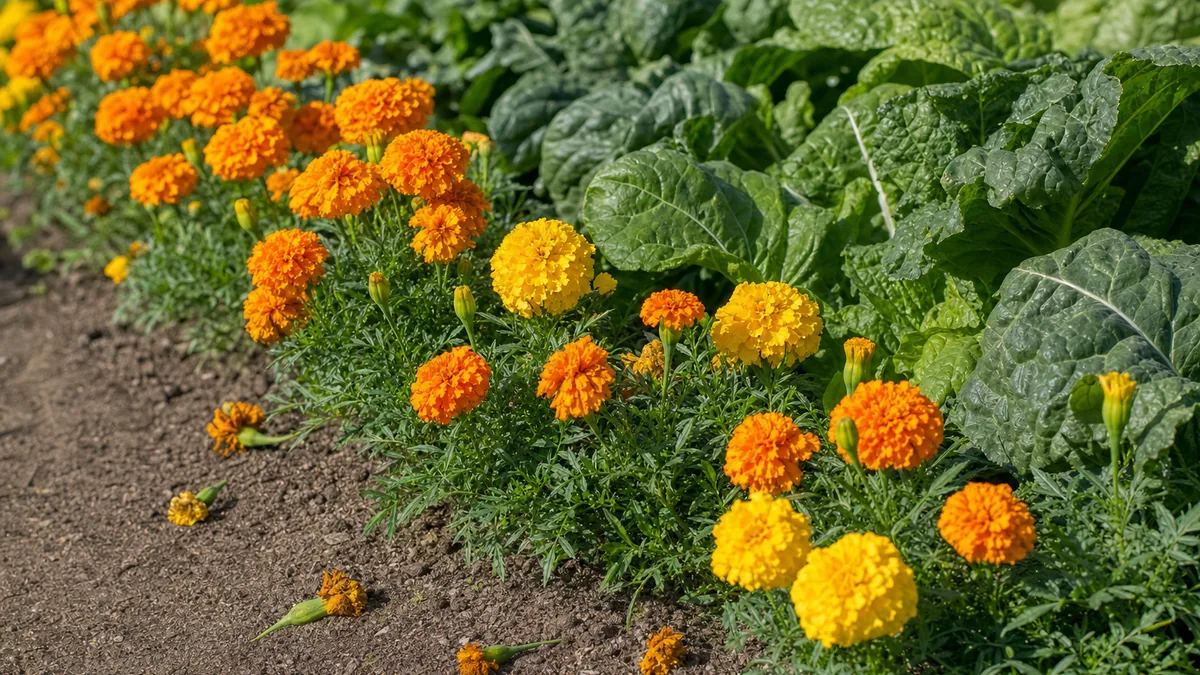
Marigold Care Quick Facts
| What | Answer | Source |
|---|---|---|
| Sun | Full sun, 6 or more hours a day | Clemson, NC State |
| Soil | Well-drained, pH 5.5 to 7.0 | Clemson, UMN, UW-Madison |
| Water | About 1 inch a week; let the soil dry slightly between waterings | Clemson, Nebraska, Penn State |
| Fertilizer | Low feeders; too much reduces blooms | UMN, UW-Madison |
| Height | French 6 to 18 inches; African up to 36 inches | Clemson |
| Spacing | French 8 to 10 inches; African 12 to 16 inches | Clemson |
| Bloom | Early summer until hard frost (African from midsummer) | Clemson |
| Pot size | One plant per 12 inch container | Nebraska Extension |
| Frost | Tender annual, damaged or killed by frost | Penn State |
French, African and Signet Marigolds: How Big They Grow
The three common groups decide most of the care. French marigolds (Tagetes patula) are bushy and compact, African marigolds (Tagetes erecta) are tall with big pom-pom flowers, and signet marigolds (Tagetes tenuifolia) are small, lacy-leaved edging plants with edible flowers, according to University of Minnesota Extension.
Sources give slightly different heights, so treat these as ranges. Clemson Extension lists French at 6 to 18 inches and African at up to 36 inches. University of Minnesota Extension says French are 6 to 12 inches, African 3 to 4 feet with flowers up to 5 inches, and signet 6 inches or less. Penn State gives French as 6 to 24 inches and notes that African types are slower to mature and flower. Clemson says tall African plants may need stakes to survive storms. Which types suit your garden also depends on your climate, and our guide to USDA hardiness zones explains how to read your zone.
How to Plant Marigolds, and When
The seed guide covers sowing step by step, so here is the short version. Marigolds are tender, so wait until the last spring frost has passed. University of Minnesota Extension and UW-Madison both say to direct sow once the soil reaches 65°F and to set out transplants only after frost danger is over. Look up your average last frost on our frost dates by city page and count from there. Penn State says plants typically flower about two months after sowing, so transplants give you color sooner. If transplants have stretched, Missouri Extension suggests cutting spindly annuals back to about half their height before planting, and our guide to leggy seedlings explains how to prevent it.
Spacing follows type. Clemson recommends 8 to 10 inches for French marigolds and 12 to 16 inches for African. Penn State says 8 to 10 inches for French and signet and 12 inches for African, and Nebraska Extension asks for at least 8 to 12 inches. Wider spacing gives better airflow, which matters because Penn State ties powdery mildew to wet, humid conditions. As my own arithmetic from those figures, a square-grid layout fits about one and a half French plants per square foot at 10 inch spacing and about two at 8 inches.
Spacing for a whole bed is collected in our spacing and planting guides.
How Much Sun Do Marigolds Need?
Full sun. Clemson Extension defines it as 6 or more hours a day, UW-Madison gives 6 to 8 hours of direct sun, and University of Minnesota Extension says marigolds need full sun all day to bloom all season. NC State adds that plants can grow in partial sun, but full sun encourages blooms. Penn State says marigolds planted in shade, or in cool, moist spots, will not bloom well.
Heat is rarely the problem. Penn State says marigolds usually tolerate very hot summers. The exception is Mississippi State Extension’s note that the peak heat of July and August can temporarily slow growth and bloom on African types.
Best Soil for Marigolds
Drainage matters more than richness. Clemson recommends well-drained loam with a pH of 5.5 to 7.0, worked about 6 inches deep with organic matter. University of Minnesota Extension and UW-Madison name pH 6 to 7 as ideal, and Minnesota suggests compost or sand for heavy soil. Clemson says soil below pH 5.5 can cause bronze speckling on leaves, and our guide to reading soil test results explains the pH line on a test.
Wet feet are the other risk. Iowa State says root rot in moist soils can kill African marigolds, and that French types handle moist soil better. If your bed holds water, fix drainage first, and see our guide to root rot for the signs.
How Often to Water Marigolds
Established marigolds in the ground need about 1 inch of water a week, according to both Clemson and Nebraska Extension. Clemson says to keep the soil evenly moist for the first couple of weeks after planting, then water deeply once a week if rain is short and let the soil dry somewhat in between. Nebraska Extension says to moisten the soil 6 to 8 inches deep each time and not to overwater. Penn State says to water more often in hot weather and to mulch between plants to hold moisture and suppress weeds.
Overwatering does more harm than underwatering. University of Minnesota Extension says marigolds tolerate drought better than overly wet soil. Missouri Extension recommends about 1 1/2 inches a week for annuals in general, so the exact amount varies by source, but deep and infrequent beats a daily sprinkle. Water at the base, since Penn State says this keeps foliage dry and helps prevent powdery mildew.
How often to water marigolds in pots
Containers dry out faster than beds, so check rather than follow a fixed schedule. Iowa State Extension says frequency varies with pot size, mix, plant and weather, and advises checking annuals in containers daily in summer. Missouri Extension says daily watering may be needed on hot days. Iowa State says to keep watering until water runs from the drainage holes.
Best Fertilizer for Marigolds
As little as possible. University of Minnesota Extension and UW-Madison both call marigolds low feeders. Minnesota says to work a general-purpose fertilizer with equal nitrogen, phosphorus and potassium into the bed at planting and then stop, because excess fertilizer produces fewer blooms. Clemson suggests a slow-release annual fertilizer at planting if you have no soil test.
Sources differ on feeding later. Nebraska Extension says to wait until plants are blooming, then use a balanced liquid fertilizer. Iowa State says an occasional complete fertilizer often prevents nutrition problems, linking overall yellowing to nitrogen deficiency and purpling of lower leaves to phosphorus deficiency. Penn State says to avoid high-nitrogen fertilizers, which grow leaves at the expense of flowers, and suggests a soilless mix with slow-release fertilizer for pots.
How to Prune, Pinch and Deadhead Marigolds
Pinching marigolds for bushier plants
University of Minnesota Extension says to pinch the top of the plant while it is small to encourage branching. UW-Madison and Penn State also say to pinch the tips for bushier, more compact growth. Take the growing tip off just above a pair of leaves and stop once flower buds form. The sources give no number of pinches, so that timing is general practice.
Deadheading marigolds
Clemson says to remove old flowers as they fade for continued bloom, and Penn State says deadheading promotes more blooms instead of seed. Minnesota calls it not required but beneficial, because spent blooms rot easily in humid weather. Iowa State separates the types: African marigolds benefit from deadheading, French marigolds rebloom without it though many gardeners do it for tidiness, and signet marigolds rarely need it because spent flowers drop quickly. To deadhead, snip the faded flower off with a short piece of stem, which is general practice rather than a sourced rule. Keepers can be dried, as in our guide to drying flowers.
Cutting back marigolds in midsummer
Clemson advises shearing signet marigolds back by one-third if blooming slows in midsummer, to encourage flowers in cooler weather. It gives that tip for signets only; for other types, removing faded flowers and straggly stems is enough.
How Long Do Marigolds Bloom?
From early summer until frost. Clemson says most varieties flower from early summer until a hard frost, with African types starting from midsummer, and Illinois Extension lists May through October. UF/IFAS adds that occasional deadheading extends the bloom period. How soon they start depends on type and on seed versus transplants: Penn State says about two months from sowing, and University of Minnesota Extension says seed sprouts in 5 to 8 days at 70 to 75°F. For color that never gaps, sow again a few weeks later using our succession planting guide. When frost ends the marigolds, our guide to what flowers grow well in winter lists what can bloom next.
How to Care for Marigolds in Pots
Marigolds do well in containers, though sources differ on type. University of Minnesota Extension recommends only signet marigolds for containers, while Illinois Extension lists marigolds in general as suitable and Iowa State calls them strong performers. A compact French or signet type is the safe choice, since a 3 foot African marigold in a small pot will tip over.
- Pot size and count. Nebraska Extension says to aim for one plant per 12 inch container.
- Mix and drainage. Use potting mix, not garden soil, in a pot with drainage holes, per Nebraska. Penn State suggests a soilless mix.
- Water and feed. Check daily in summer, as above, and feed lightly with slow-release or diluted liquid fertilizer, per Penn State.
- Deadhead. Remove spent flowers so the pot keeps blooming.
How Cold Can Marigolds Tolerate?
Not much. Penn State Extension lists marigolds as tender annuals and defines a tender annual as one that will be seriously damaged or killed by frost. Illinois and Missouri Extension also list marigold as a tender annual or frost-free planting. Purdue Extension places it in a “moderate tolerance” group, separate from its tender group, but gives no temperature. None of the pages I found gives a number, so plant after the last frost and expect plants to end with the first hard fall frost.
The exception is Mexican marigold, which Clemson and Iowa State describe as a perennial shrub hardy in USDA zones 8 to 11, a different plant from French and African types.
Marigold Pests and Problems
Marigolds are tough. Iowa State says Japanese beetles, spider mites, aphids and thrips rarely destroy plants and that insecticides are generally not warranted at home. Clemson adds that spider mites are common in hot, dry weather and slugs feed on foliage and flowers in damp spots, and Penn State says insecticidal soap, used as the label directs, usually solves spider mite and aphid problems.
Disease is mostly about moisture. Penn State says powdery mildew can develop when conditions are too wet or humid, and recommends watering at the base and planting in well-drained soil. Our guide to powdery mildew covers treatment. Iowa State describes aster yellows, spread by leafhoppers, which deforms flowers; it has no control, so remove infected plants. For yellow leaves, work through our yellow leaves diagnosis, and for drooping plants check roots and moisture with our guide to why plants wilt.
Marigolds in the Vegetable Garden: What the Evidence Says
Marigolds are the classic companion plant, and the extension record is more specific than the folklore. One benefit is well supported and several are not.
Best marigolds for pest control: the nematode evidence
The supported claim is about root-knot nematodes, microscopic soil worms. Penn State and UMass Extension say the roots of some French and African marigolds suppress them, and UMass says the benefit comes after growing marigolds as a cover crop and tilling them in. UF/IFAS says to grow them at least two months before the vegetable crop, at the same site, densely planted, and states that marigolds cannot eradicate nematodes. Penn State, UF/IFAS and Clemson all say that interplanting marigolds among vegetables does not work.
The variety matters. UF/IFAS says French cultivars appear most effective against the widest range of nematodes. The North Carolina Department of Agriculture lists effective cultivars including the African Crackerjack and the French Single Gold, Tangerine, Bonita Mixed and Gypsy Sunshine, and warns that signet types such as Tangerine Gem will not control root-knot nematode. Its plan is half the garden in marigolds and half in resistant vegetables, spaced 7 inches, tilled in each fall and swapped the next spring, with the benefit arriving the following year. UF/IFAS adds that marigolds may not sufficiently reduce severe infestations and can raise numbers of some other nematode types. If you are planning the beds these marigolds will sit beside, see our guide to starting a vegetable garden.
What is not supported
University of Minnesota Extension says gardeners often list marigolds as a Colorado potato beetle deterrent but that multiple studies have shown this to be untrue, and that for flea beetle there is little research to support the claim and some contradicts it. For deer and rabbits the sources disagree: Clemson and Minnesota say the scent deters deer, while Iowa State says marigolds do not repel rabbits, deer or other animals and that rabbits sometimes browse them heavily. UMass Extension says very little other evidence supports marigolds’ reputation, though it adds that if you like them you should grow them for the diversity.
There is narrower evidence. Minnesota cites a few studies suggesting basil and marigolds together can reduce thrips on tomatoes, a study in which marigold, onion and nasturtium reduced two cabbage worm species, and a Florida study in which African marigolds with squash increased natural enemies of aphids. Treat these as promising, not proven. For pairings tomatoes benefit from, see what to plant with tomatoes, for other flowers with evidence behind them see companion planting flowers with vegetables, and our companion planting chart compares marigolds with other pairings.
How many marigolds to plant in a vegetable garden
The extension pages give no number for a general pest-protection border. For the nematode method, the NCDA note calls for about 300 plants, or six seed packets, per 100 square feet. For a decorative edge, use the type spacings above and run a row of French marigolds along the sunny side of the bed. Think of them as a blooming border, with any pest benefit as a bonus.
Free book · 23 pages, PDF
How to Grow Marigolds FAQ
How often should you water marigolds?
In the ground, about 1 inch of water a week once established, according to Clemson and Nebraska Extension, with the soil allowed to dry slightly between waterings. In pots, Iowa State Extension says to check daily in summer, and Missouri Extension says daily watering may be needed on hot days. Water until it drains from the holes.
How much sun do marigolds need?
Full sun. Clemson Extension defines it as 6 or more hours a day, UW-Madison says 6 to 8 hours, and University of Minnesota Extension says all day for the most blooms. NC State notes marigolds can grow in partial sun, but full sun encourages flowers.
How long do marigolds bloom?
Clemson Extension says most varieties bloom from early summer until a hard frost, with African types starting from midsummer. Illinois Extension lists May through October. Penn State says plants flower about two months after sowing, and deadheading helps extend the season.
Should you pinch and deadhead marigolds?
Yes, both help. University of Minnesota Extension and UW-Madison say to pinch tips on young plants for branching, and Clemson says to remove faded flowers for continued bloom. Iowa State says African types benefit most, while French types rebloom without it and signets rarely need it.
How big do marigolds grow?
It depends on type. Clemson Extension lists French marigolds at 6 to 18 inches and African at up to 36 inches. University of Minnesota Extension gives 3 to 4 feet for African types and 6 inches or less for signets. Spacing runs 8 to 10 inches for French and 12 to 16 inches for African.
How cold can marigolds tolerate?
Not much. Penn State Extension lists marigolds as tender annuals, which are seriously damaged or killed by frost, so plant after the last spring frost. Purdue Extension places them in a moderate tolerance group, but none of the extension pages reviewed gives a temperature.
Do marigolds repel pests in a vegetable garden?
Only one benefit is well supported: some French and African types suppress root-knot nematodes when grown as a dense cover crop and tilled in, according to UF/IFAS, Penn State and UMass Extension. University of Minnesota Extension says studies show marigolds do not deter Colorado potato beetle, and little research supports the flea beetle claim.
Sources & further reading
Sun, soil, watering, bloom time, size and spacing figures come from Clemson Extension’s guide to growing and caring for marigolds, University of Minnesota Extension’s marigold page, UW-Madison Division of Extension’s marigold article, Penn State Extension’s marigolds article, Iowa State Extension’s guide to growing marigolds, Illinois Extension’s marigold page, NC State Extension Plant Toolbox entry for Tagetes and UF/IFAS Extension Pasco County’s marigold post.
Container and fertilizer guidance is from the Nebraska Extension 2026 Special Garden Project newsletter, Iowa State Extension’s FAQ on watering annuals in containers, Missouri Extension’s flowering annuals guide and Mississippi State Extension’s African marigold publication. Frost tolerance is from Penn State Extension’s guide to annual hardiness and Purdue Extension’s cold tolerance chart.
The pest-control evidence comes from University of Minnesota Extension’s companion planting article, UF/IFAS Extension’s publication on marigolds and nematodes, the North Carolina Department of Agriculture’s nematode note on marigolds, UMass Extension’s companion planting fact sheet, Mississippi State Extension’s companion planting article and Iowa State Extension’s annuals FAQ.
Free book · 23 pages, PDF
The Spacing & Planting Cheat Sheet
Sent