How to plant marigold seeds comes down to three things: warmth, a shallow cover of soil and the right date. Clemson Extension says to sow about 1/4 inch deep, either outdoors once frost danger has passed and the soil has warmed, or indoors 4 to 6 weeks before planting out. Look up your average last frost date first, because every other date in this guide counts back from it.
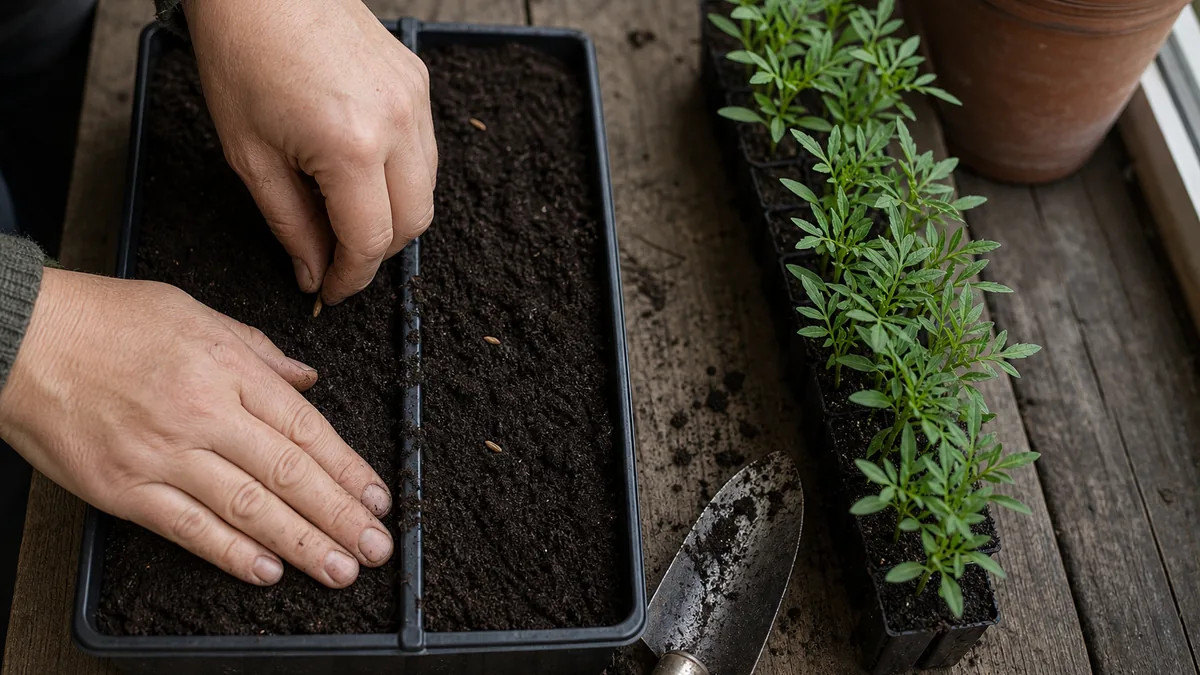
Marigold Seed Planting at a Glance
Marigold seed is large, quick and forgiving, which is why it is a classic first flower for new gardeners. Extension sources agree on most of the details and differ a little on timing. This table gathers the figures, each with its source.
| Question | What extension says |
|---|---|
| Seed depth | About 1/4 inch (Clemson, Iowa State, Nebraska) |
| Germination time | 5 to 7 days (Clemson, Iowa State); 4 to 7 days outdoors at 75 to 80°F (Mississippi State); 3 to 5 days in a heated greenhouse (NC State) |
| Start indoors | 4 to 6 weeks before planting out (Clemson, Nebraska); 8 weeks for African types (Clemson); 6 to 8 weeks (Iowa State) |
| Direct sow | After the last frost, once the soil is warm (Clemson, Nebraska) |
| French spacing | 8 to 10 inches apart, 6 to 18 inches tall (Clemson) |
| African spacing | 12 to 16 inches apart (Clemson); 12 to 18 inches (Mississippi State, UF/IFAS) |
| Sun | Full sun, 6 or more hours a day (Clemson, UF/IFAS) |
When to Plant Marigold Seeds
Marigolds are tender annuals. Nebraska Extension calls them a warm-season crop to plant after the last frost, when soils are warm, usually in mid to late May in that state. Clemson Extension gives the same rule in plainer terms: the ideal time is after the last frost in spring. A light frost kills young plants, so if you are unsure what counts, the frost temperature guide linked in the opening paragraph explains what temperature frost actually forms at.
Your frost date depends on where you live. Nebraska Extension lists average last spring frost dates of April 24 in eastern Nebraska, May 1 in central Nebraska and May 10 in the west, which shows how much a few hundred miles can shift the calendar. Enter your ZIP code below to get yours from NOAA station data.
Warm climates run on a different calendar. UF/IFAS Extension lists planting months for African marigold by zone: June in zone 7, May and June in zone 8, and March, April and September through November in zone 9. In mild-winter regions the fall window can be as good as spring. Our planting calendar by city shows the local dates, and if you do not know your zone, our hardiness zones explainer will sort it out.
French vs African Marigolds
The type you pick sets your spacing and your start date, so decide before you open the seed packet. Clemson Extension separates the two common groups this way:
- French marigolds (Tagetes patula). Plants run 6 to 18 inches tall with blooms up to 2 inches across, spaced 8 to 10 inches apart.
- African marigolds (Tagetes erecta). Plants reach up to 36 inches with blooms up to 4 inches across, spaced 12 to 16 inches apart. Clemson notes they may need staking to survive storms and bloom from midsummer to frost.
- Signet marigolds (Tagetes tenuifolia). Fine-leaved, edged-looking plants that Clemson says can be sheared by one-third if midsummer bloom slows.
The practical difference at planting time is speed. An NC State greenhouse schedule puts French types at 7 to 9 weeks from seed to a salable plant in a market pack and African types at 10 to 11 weeks, and says African cultivars can take up to two weeks longer to flower than French ones. That is a commercial greenhouse schedule, not a backyard promise, but the order holds: French first, African later. Clemson accordingly asks for an 8 week head start on African seed indoors. For where each fits in a bed, see the spacing and planting guides.
The pot marigold, Calendula officinalis, is not a true marigold. Clemson calls it a cool-season annual, so it follows different timing.
How to Start Marigold Seeds Indoors
Starting indoors gets you flowers earlier and protects seedlings from cold snaps. The lead time varies by source. Mississippi State Extension suggests sowing about 4 weeks before the last frost, Nebraska Extension says 4 to 6 weeks, Clemson says 4 to 6 weeks before planting out, and Iowa State says 6 to 8 weeks before the outdoor planting date. Treat it as a range: closer to 4 weeks for French types, closer to 6 to 8 for tall African ones, since Clemson specifically calls for 8 weeks for those.
- Count back from your date. Take your last frost date, subtract the weeks for your type and mark the sowing day.
- Fill clean cells or small pots. Use a soilless seed starting or potting mix and moisten it first so it is damp, not soggy.
- Sow shallow. Iowa State says to cover the seeds lightly with about 1/4 inch of soilless mix. Nebraska Extension also gives 1/4 inch. Marigold seed does not need light to sprout, according to a Michigan State Extension bulletin on greenhouse marigolds.
- Keep it warm. Clemson recommends 70 to 75°F. UF/IFAS says seed sprouts in about a week in that range. NC State’s greenhouse schedule uses 75 to 80°F for germination, so a seedling heat mat can help in a cool room.
- Keep the mix evenly moist. Nebraska Extension advises keeping the soil moist until seedlings emerge, then watering only when the mix is dry.
- Give light as soon as they sprout. A bright window rarely suffices in late winter. See our guide to preventing leggy seedlings for lamp height and day length.
- Pot up and harden off. Mississippi State says to move seedlings to cell packs at the true-leaf stage, and to set plants outside only after frost danger has passed.
How many marigold seeds per cell or pot?
The extension sources reviewed do not give a seeds-per-cell number. Nebraska Extension’s approach is to sow seeds close together in cell trays and transplant them into individual pots later. The common-sense home version is to put in a couple of seeds per cell for insurance, then keep the strongest. Snip the weaker seedling at the soil line rather than pulling, so you do not disturb the roots of the one you keep. This is a general practice, not a sourced figure.
Damp, crowded seedlings are the classic setup for collapse at the soil line, so give them air and do not overwater. Our damping off guide explains the signs, and our tomato seed starting guide covers the same indoor routine in more detail.
How to Sow Marigold Seeds in the Ground
Direct sowing is the easiest way to plant marigolds outside, and the seed is big enough to handle one at a time. Clemson Extension says to wait until frost danger has passed and the soil has warmed. Mississippi State reports that direct-sown seed germinates in 4 to 7 days at 75 to 80°F, so cold, wet ground in early spring will slow it down.
- Pick a sunny spot. Clemson and UF/IFAS both ask for full sun, at least 6 hours a day.
- Loosen the soil. Clemson recommends well-drained loam with a pH of 5.5 to 7.0, worked to about 6 inches deep. A low pH, below 5.5, can cause bronze-speckled leaves, according to Clemson. If you have never tested, our guide to reading soil test results helps.
- Make shallow holes or a furrow. About 1/4 inch deep is the standard. For other seed with no packet instructions, Nebraska Extension offers a rule of two to three times the seed’s size.
- Drop in the seeds and cover lightly. Nebraska Extension recommends direct seeding 1/4 inch deep and 8 to 12 inches apart. Sowing two or three per spot and thinning later is the usual backyard habit.
- Water gently and keep the surface damp. A hard stream can wash shallow seed out. Clemson says to keep soil evenly moist for the first couple of weeks.
- Thin to final spacing. Nebraska Extension says to space plants at their mature width so they just touch or overlap slightly, and to thin crowded seedlings once they are a few inches tall.
How far apart to plant marigolds
Use the figures from the types section. For French types, Clemson says 8 to 10 inches. For African types, Clemson says 12 to 16 inches while Mississippi State and UF/IFAS give 12 to 18 inches. Nebraska Extension gives a general 8 to 12 inches. Closer spacing fills in faster, wider spacing gives better airflow. As simple arithmetic from Clemson’s 8 to 10 inch French spacing, a 4 foot wide strip fits roughly five or six plants across, and the calculator will do the whole bed.
Marigolds also earn a spot at the edge of vegetable beds, though the benefits are smaller than the folklore suggests. Clemson says the scented foliage deters deer, and that intercropping marigolds does not protect neighboring plants from nematodes. Our companion planting chart covers what is actually supported.
How Long Do Marigold Seeds Take to Germinate and Bloom?
Germination and sprouting
Marigolds are among the fastest flowers from seed. Clemson and Iowa State both say seeds begin to germinate in 5 to 7 days. UF/IFAS says about one week at 70 to 75°F. NC State puts French and African seed at 3 to 5 days, but that is at the 75 to 80°F medium temperature of a heated greenhouse. In a cool garden bed, expect the slower end or longer. If nothing has come up in two or three weeks, the seed is probably old, too deep or sitting in cold, wet soil.
To get seed up quickly, give it warmth rather than any soaking trick. Extension sources reviewed describe heat and even moisture and do not recommend pre-soaking marigold seed, so there is no sourced shortcut beyond that.
How long until marigolds bloom?
Extension sources give no single sowing-to-flower number for home gardens, because it depends on type, temperature and day length. The clearest timing is the commercial schedule from NC State: 7 to 9 weeks from seed to a salable French marigold in a market pack, 10 to 11 weeks for African, and 11 to 12 weeks for one African plug in a 4 inch pot. Michigan State’s bulletin records 44 to 71 days to flower for different cultivars under short days, and reports that in its short-day treatment, temperatures above 85°F inhibited flower bud initiation. Use those as a rough guide, and allow a week or two more in a cooler garden (that allowance is my own estimate, not a sourced figure).
Once they start, they keep going. Clemson says most varieties bloom from early summer until a hard frost, and to remove old flowers as they fade for continued bloom. Mississippi State notes that peak heat in July and August can temporarily slow growth and bloom. If you want color across the whole season, a second sowing a few weeks after the first helps, as described in our succession planting guide. If you want to keep a few blooms for indoors, our guide on how to dry flowers covers the extension methods.
How to Grow Marigolds in Pots and Containers
Marigolds do well in containers, with a couple of rules. Nebraska Extension says to use potting mix rather than garden soil, to choose a container with drainage holes in the bottom and to plan on one plant per 12 inch container. Clemson lists containers as a use for marigolds but gives no container-specific numbers.
- Sow in place or transplant. You can sow seeds 1/4 inch deep in the final pot after the last frost, or move indoor-started seedlings in.
- Choose size by type. A French marigold stays compact and suits a smaller pot, while a tall African type needs a large, stable pot. The sources do not give a firm pot volume for each, so use the 12 inch figure as a starting point. Our pot size chart converts diameters to gallons.
- Watch the water. Containers dry faster than beds. Clemson says in-ground plants need about 1 inch of water a week, and potted ones will need checking more often.
- Deadhead. Clemson says old flowers should come off as they fade.
How to Save Marigold Seeds From Flowers
Penn State Extension and Iowa State Extension both list marigolds among the flowers that suit seed saving. The catch is the parent plant. Clemson says to save seed only from open-pollinated cultivars, since hybrids may be sterile or may not resemble the parent. Penn State and Iowa State say the same about hybrids in general. If your packet says F1, buy new seed next year. Saved seed is also a cheap way to fill the flower edges of a first bed, as in our guide to starting a vegetable garden.
- Let the flowers fade on the plant. Penn State suggests checking for seed about two to three weeks after blooming, and monitoring until the flowers are fully mature.
- Harvest on a dry day. Penn State recommends a clear day after the dew has dried. The University of California cooperative extension seed-saving guide says to collect whole stalks when partly dry and shake out the seed.
- Dry them out of direct sun. UC says to lay seed out for about 5 to 7 days. Iowa State says to dry thoroughly, avoid temperatures above 95°F and avoid direct sun.
- Check dryness. Penn State says seed is dry enough when it snaps by hand and does not dent under a fingernail.
- Store cool, dry and dark. Use a labeled paper envelope inside a sealed jar. UC says most annual flower seed stays viable two to three years in dry, cool, dark storage in airtight containers, and Iowa State suggests testing germination about a month before you plant.
Common Marigold Seedling Problems
- Leggy, stretched seedlings. UF/IFAS warns that if the growing area is too hot, plants become leggy. Pair moderate warmth after germination with strong light.
- Seedlings collapsing at the soil line. This is usually damping off from wet, cold or crowded conditions. Water less and improve airflow.
- Seeds that never come up. Check depth, soil warmth and seed age. Cold ground slows germination, according to the temperatures above, and Nebraska Extension’s depth rule is 1/4 inch.
- Bronze or speckled leaves. Clemson links this to soil pH below 5.5, so test before adding more fertilizer.
Free book · 23 pages, PDF
How to Plant Marigold Seeds FAQ
How deep do you plant marigold seeds?
About 1/4 inch deep. Clemson Extension, Iowa State Extension and Nebraska Extension all give 1/4 inch, whether you sow in trays or outdoors. Cover the seed lightly so the sprouts can push through.
How long do marigold seeds take to germinate?
Usually 5 to 7 days. Clemson and Iowa State give 5 to 7 days, UF/IFAS says about one week at 70 to 75 degrees F, and Mississippi State reports 4 to 7 days outdoors at 75 to 80 degrees F. Cool soil slows them down.
How many marigold seeds per hole, pot or cell?
The extension sources reviewed do not give a count. Nebraska Extension sows seeds close together in cell trays and transplants later, and says to thin crowded outdoor seedlings to their mature spacing. Putting a couple of seeds in each hole or cell and keeping the strongest seedling is a common home practice, not a sourced figure.
Can you plant marigold seeds directly in the ground?
Yes. Clemson Extension says to direct sow once the danger of frost has passed and the soil has warmed. Nebraska Extension recommends sowing 1/4 inch deep and 8 to 12 inches apart. Starting indoors gets flowers sooner, but it is not required.
When should you start marigold seeds indoors?
Clemson Extension says 4 to 6 weeks before planting out, and 8 weeks for African types. Nebraska Extension says 4 to 6 weeks before the last frost, and Iowa State says 6 to 8 weeks before the outdoor planting date. Count back from your last frost date.
How long does it take marigolds to bloom from seed?
It depends on the type and temperature. An NC State greenhouse schedule gives 7 to 9 weeks from seed to a salable French marigold and 10 to 11 weeks for African, and African types can take up to two weeks longer to flower. Garden plants in cooler conditions can take longer.
Can you save marigold seeds from your flowers?
Yes, if the plant is open-pollinated. Clemson Extension says hybrids may be sterile or may not look like the parent. Dry the seed for about 5 to 7 days out of direct sun, per University of California extension, and store it cool and dry. UC says annual flower seed usually stays viable two to three years.
Sources & further reading
Sowing depth, spacing by type, germination time and seed saving for open-pollinated cultivars come from Clemson Extension’s guide to growing and caring for marigolds in South Carolina. The indoor sowing window and germination time are also in Iowa State Extension’s FAQ on sowing marigold seeds indoors. Transplant timing, direct-sown germination and African marigold spacing are from Mississippi State Extension’s publication on African marigolds for the farmer florist. Container, frost date and direct-sowing guidance come from the Nebraska Extension 2026 Special Garden Project newsletter, and general seed depth and thinning rules from Nebraska Extension’s seed starting guide G1953. Germination temperature and seed-to-sale production schedules are from an NC State Extension greenhouse production guide, and flowering times and temperature limits from Michigan State Extension bulletin E-1443. Zone-based planting months are from UF/IFAS Extension’s fact sheet on African marigold. Seed saving steps are from Penn State Extension’s Seed Saving Basics, Iowa State Extension’s guide to harvesting and storing seeds and the University of California Cooperative Extension seed-saving guide. For how we source the facts on this site, see our methodology page.
Free book · 23 pages, PDF
The Spacing & Planting Cheat Sheet
Sent